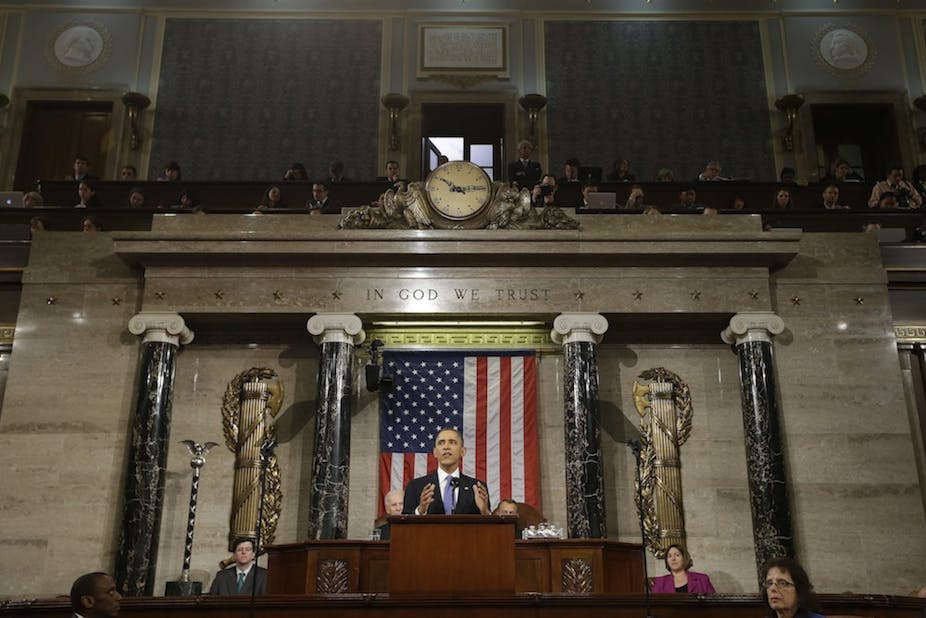
US President Barack Obama’s State of the Union plan to boost American exports and grow American jobs centres around two key regional trade agreements: the Trans-Pacific Partnership (TPP) and the Trans-Atlantic Free Trade Agreement (TAFTA).
The TPP has been under way for some time, with the next round scheduled for next month in Singapore and expected to conclude in October.
Obama also announced the US will launch talks on a comprehensive Transatlantic Trade and Investment Partnership with the European Union. Supporters of TAFTA, like Professor Dan Hamilton, have argued that such an agreement should cover not just matters of trade, but also issues of de-regulation and investment.
Both treaties will be mutually reinforcing. The United States Trade Representative will use the twin treaties to play participants and regions off against one another, and push for higher standards and obligations.
But the twin trade agreements are controversial – particularly because the discussions have lacked transparency, openness and due process. Moreover, there has been a concern that the TPP and TAFTA will be in conflict with Obama’s policy agenda on labour rights, public health, and the protection of the environment.
Made in America: labour rights, manufacturing, and trade
In his address, Obama emphasised that his first priority would be to make America “a magnet” for new jobs and manufacturing, emphasising how after 10 years of shedding jobs, manufacturers such as Caterpillar, Ford, Intel, and Apple were bringing production jobs back in the US.
Showing enthusiasm for 3D printing, Obama also spoke of creating a first manufacturing innovation institute: “A once-shuttered warehouse (in Youngstown, Ohio) is now a state-of-the art lab where new workers are mastering the 3D printing that has the potential to revolutionise the way we make almost everything.” He envisaged that establishment of a network of fifteen of such hubs to “guarantee that the next revolution in manufacturing is Made in America”.
However, the twin trade agreements may serve to undermine labour rights, working conditions, and employment.
The umbrella federation representing US unions, AFL-CIO observed of the TPP: “Negotiations must include provisions that will benefit US workers, not simply the largest global corporations.”
AFL-CIO argued the Obama administration must “improve the US trade positions so they work for the 99%, not just the 1%.” The union body lamented: “Unfortunately, for years the global corporate agenda has infused trade policy with its demands for deregulation, privatisation, tax breaks and other financial advantages for Big Business, while shrinking the social safety net in the name of ‘labour flexibility’”.
Public advocacy group, Public Citizen have argued that Obama’s trade policies create incentives to send jobs offshore. Lori Wallach observed:
“Since the implementation of our existing FTAs, more than 60,000 US manufacturing facilities have been shuttered and we have lost five million manufacturing jobs – fully one quarter of America’s manufacturing jobs prior to the agreements' implementation.”
Intellectual property, innovation, and access to essential medicines
Evoking past technological marvels and wonders, Obama spoke glowingly of the need to continue to invest in research and development.
Obama also talked about an agenda promoting development goals that included eradicating poverty in the next 20 years, connecting more people to the global economy, empowering women, reducing the number of preventable deaths of children and realising the promise of an AIDS free generation.
However, the trade agreements have not been driven by the objective of promoting such development goals. In fact, there has been much concern about the intellectual property chapter of the Trans-Pacific Partnership and its effects on public health objectives and access to essential medicines for poorer nations. In particular, commentators point to the unpopular Anti-Counterfeiting Trade Agreement and say a trade agreement between EU and US could foster a similarly flawed approach.
Judit Rius of Médecins Sans Frontières argues Obama needs to find a trade policy that adheres to his and previous administrations' commitments to global health. She observed: “The TPP is a huge conflict with those stated goals.”
The Environment, Biodiversity and Climate Change
Obama has vowed to do more to combat climate change, urging Congress to pursue a “bipartisan, market-based solution to climate change” and saying he would use his executive powers if necessary to pursue sustainability goals.
This line follows on from his inauguration speech, where Obama alluded to the prospect of trade wars and patent fights over clean technology: “We cannot cede to other nations the technology that will power new jobs and new industries – we must claim its promise.” At this week’s State Union of Address, Obama expanded upon this: “As long as countries like China keep going all-in on clean energy, so must we.”
But Obama appears to lack clarity as to his ambitions for any international agreement on climate change and there is concern that regional trade agreements may undercut environmental protection and climate policy.
United States Congressional leaders such as Ron Wyden have been concerned the TPP will hinder, rather than help, environmental protection. Elizabeth May, the leader of the Green Party in Canada, has warned that the TPP could “fundamentally erode a government’s ability to enact laws, regulations and policies that protect its environment.” And the New Zealand Greens have interrogated New Zealand Prime Minister John Key about the impact of the agreement. Likewise, the Australian Greens have been sceptical of the agreement.
Trade, Wall Street and Main Street
As a presidential candidate in 2007, Obama maintained that trade agreements should “not be just good for Wall Street – they should be good for Main Street”.
Such a critical attitude is absent from the President’s discussion of the TPP and TAFTA in 2013. In this aspect, Obama’s State of the Union address is a study in contradictions. His ambitious regional trade agenda does not necessarily sit well his public policy objectives in respect of work, public health, and the environment. As Lori Wallach of Public Citizen has noted: “Indeed, TPP and TAFTA would gut many of the most worthy goals included in Obama’s SOTU address if the American public and Congress let them come to fruition.”
There is also a need for the Obama administration to realise its promises of transparent and open government – particularly in matters of trade.
Thus far, such agreements have been negotiated in stealth and secrecy. The Obama administration should harmonise its trade objectives with its public policy agenda. The Obama administration should appoint a new United States Trade Representative who can truly realise “free and fair trade” across the Pacific and the Atlantic. Moreover, there is a need for the United States to embrace multilateral trade, and the Doha Agenda.
Dr Graham Lovell
logged in via Twitter
The move towards unfettered international free trade has given the whole world a higher standard of living. However, it has also increased the divide between the rich and the poor in both developed and developing countries.
It is a difficult balance: we want to gain the benefits of competition, which arises through exposing business to its fierce blow-torch of international competition, yet we do not want to squander the gains of 100 years of egalitarianism and set up our economies to only work…
Read moreRon Chinchen
Retired (ex Probation and Parole Officer)
I agree with you Dr Lovell. It is a serious dilemma. But in the end is it worth seeking ever better standards of living if, percentage wise, the numbers enjoying such advantages continues to diminish. I respect Obama because at heart he is trying to create greater egalitarianism for i the US capitalist structure. I fear that he is up against it. And if he does achieve some success what does that mean for other countries who through tariffs may be shut out from enjoying a better standard of living. I fear that somewhere along the line we may face a collapse and a revolt world wide against the present course we are heading.
Matthew Rimmer
ARC Future Fellow and Associate Professor in Intellectual Property at Australian National University
Thanks for the thoughtful contributions, Graham and Ron, on free trade and standards of living.
wilma western
logged in via email @bigpond.com
Perhaps a carbon tax on ceratin imports would be the go.
Most of the Free Trade Agreements seem to have small gains for the other parties and considerable advantage for the US. I would have thought that the relocation of manufacturing to Asia had little to do with Free Trade Treaties and lots to do with cost cutting and lack of workers rights.
Good to see informaed criticism of obama's rhetoric though it's great that he was re-elected.
Matthew Rimmer
ARC Future Fellow and Associate Professor in Intellectual Property at Australian National University
You raise a pertinent point, Wilma. Lots of discussions at the moment as to whether the Obama administration should or should not adopt a carbon tax: http://www.environmentalleader.com/2013/01/28/obama-rejects-carbon-tax-prefers-focus-on-jobs/
Matthew Rimmer
ARC Future Fellow and Associate Professor in Intellectual Property at Australian National University
One of the best pieces I read on the State of the Union address was 'Fix Copyright for a Creative World' - Virginia Postrel - http://www.bloomberg.com/news/2013-02-12/fix-copyright-for-a-creative-world.html She imagines, in a parallel universe, President Barack Obama, a progressive Democrat, supporting copyright law reform: "But, as artists from Walt Disney to Jay-Z have demonstrated, new works also build on the past. Locking up creative works for generations hampers the progress copyrights are supposed to encourage. And the retroactive extensions of the past few decades have convinced too many Americans that Washington cares more about corporate interests than about the public good. I will therefore send a bill to Congress restoring the copyright terms in effect before 1976: 28 years of protection renewable for another 28 years. The bill will also include a requirement that copyrights be registered with the Library of Congress so that we don’t lose track."
Matthew Rimmer
ARC Future Fellow and Associate Professor in Intellectual Property at Australian National University
Here is the Joint Statement on the Trans-Atlantic Free Trade Agreement negotiations:
http://europa.eu/rapid/press-release_MEMO-13-94_en.htm
Statement from United States President Barack Obama, European Council President Herman Van Rompuy and European Commission President José Manuel Barroso
“We, the Leaders of the United States and the European Union, are pleased to announce that, based on recommendations from the U.S.-EU High Level Working Group on Jobs and Growth co-chaired by United States…
Read moreMatthew Rimmer
ARC Future Fellow and Associate Professor in Intellectual Property at Australian National University
The European Commission put out this press release:
http://trade.ec.europa.eu/doclib/press/index.cfm?id=869
Overall economic gains
The transatlantic trade relation is the backbone of the world economy. Together, the European Union and the Unites States account for about half of the world GDP (47%) and one third of global trade flows. Each day goods and services of almost € 2 billion are traded bilaterally, contributing to creating jobs and growth in our economies. Economic ties between our…
Read moreMatthew Rimmer
ARC Future Fellow and Associate Professor in Intellectual Property at Australian National University
Civil society groups would seem to be already organising opposition to the agreement - http://www.s2bnetwork.org/fileadmin/dateien/downloads/Alert__EU-US_Transatlantic_FTA_-_Call_for_mobilisation_in_Europe_and_the_United_States.pdf
"Presidents Obama, EU Council President Van Rompuy and EU Commission President Barroso
committed on Feb 13 to start EU-US trade and investment negotiations, which may strongly affect
social, labor and environmental rights in both sides of the Atlantic and deepen global trade and
investment liberalization. Indeed, elites from both sides explicitly aim at greater transatlantic
regulatory convergence and harmonization of future regulations between the EU and the US, in the
only interests of transnational corporations and financial industry"
Matthew Rimmer
ARC Future Fellow and Associate Professor in Intellectual Property at Australian National University
Glyn Moody predicted that 2013 would see a focus upon a Trans-Atlantic Free Trade Agreement - http://blogs.computerworlduk.com/open-enterprise/2013/01/after-acta-tap-the-trans-atlantic-partnership-agreement/index.htm He commented: "So the argument here is that there will soon be all this cat's cradle of trade agreements between the EU or US and other countries, so we need to match them with an equivalent one between the EU and US, or there will be dangerous asymmetries in world trade. The invocation of TPP here is significant, because it's a hint of the kind of "equivalence" negotiators will doubtless be seeking. Indeed, the new "Trans-Atlantic Partnership" or TAP as it might be termed, will doubtless be framed as balancing what TPP will bring about in the Pacific region - and thus "indispensable" for Europe if it is not to be "left behind" etc. etc."
Matthew Rimmer
ARC Future Fellow and Associate Professor in Intellectual Property at Australian National University
Obama also made some interesting remarks about patent law reform in the wake of the State of the Union address - http://www.ip-watch.org/2013/02/15/obama-takes-swipe-at-patent-trolls-in-call-for-further-reform/ Obama said that there was a need to address the problem of patent trolls: ”They are essentially trying to leverage and hijack somebody else’s idea and see if they can extort some money out of them.” Obama admitted: “Our efforts at patent reform only went halfway to the point where they need…
Read more