The untold story of the role of government in the rise and fall of Gunns

The spotlight is shining on the collapsed Gunns, its former chairman John Gay, and the Tasmanian Government’s machinations to secure a pulpmill at all costs. But the pivotal role of successive Commonwealth Governments remains in darkness. Unravelling the part the Commonwealth Government has played in…

93qqdzw6-1349319156
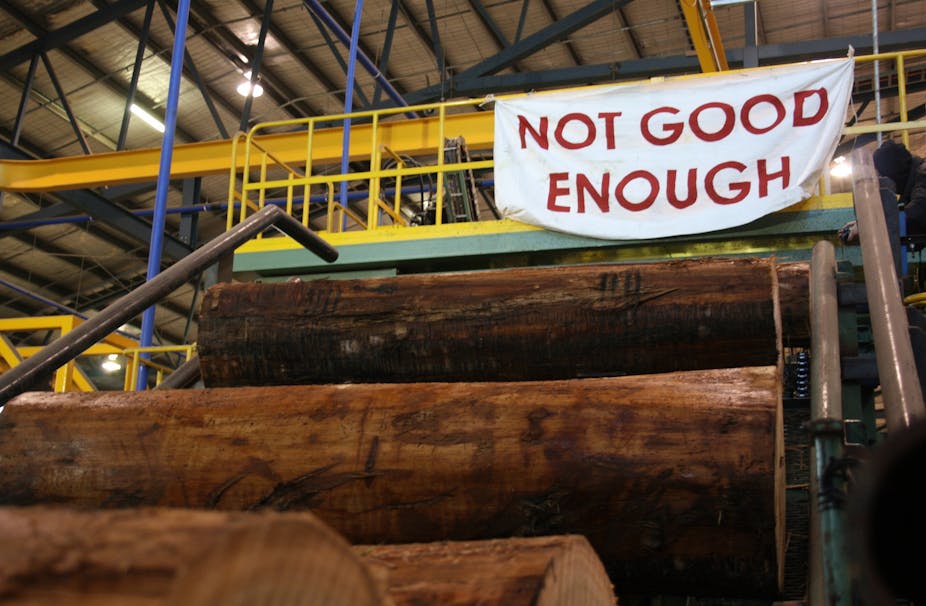
Gunns enjoyed fabulous profits, but the seeds of its collapse were planted from the outset. AAP

The spotlight is shining on the collapsed Gunns, its former chairman John Gay, and the Tasmanian Government’s machinations to secure a pulpmill at all costs.

But the pivotal role of successive Commonwealth Governments remains in darkness. Unravelling the part the Commonwealth Government has played in the saga is essential for resolving Tasmania’s forest conflict and – because there is nothing unique about Gunns or Tasmania – Australia’s forest conflict.

Aiming that spotlight on the Commonwealth Government’s role will illuminate why the entire Australian forestry industry remains in crisis and the policy framework needed to resolve the mess.

John Gay likes collecting. From the mid 1980s, as managing director of the newly ASX listed Gunns, Gay took the company through near-exhaustive Tasmanian sawmill acquisitions.

Gay bought into native forest (hardwood) sawmilling just as large areas of Commonwealth Government-subsidised softwood sawlog plantations came on stream Australia-wide.

Out-competed by an economically superior product, Australian native forest sawmilling went into terminal decline; today producing around one-third the amount when Gay started buying up big. In every state, rather than hearing a normal good news industry structural change story, environmentalists were blamed for the native forest job losses.

Neither the Commonwealth Government nor the foresters and industry players (who had so adroitly lobbied Prime Minister Robert Menzies for the plantation subsidies in the late 1950s) have claimed the glory of Australia’s softwood plantation program.

Today, softwood plantations account for 85% of Australia’s sawn timber production, 95% of its wood panels production and 80% of the wood used to make Australian paper. (For more information, read here and here).

While jobs-laden sawmilling dominated the public debate in Australia’s forest wars, from a business perspective the profits lay elsewhere, in native forest woodchip exporting.

The exporters rarely reported their profits but we can gauge them from the financial reports of the Nippon-owned operation at Eden NSW. Leaving aside the losses the company made in the first few years after start-up in 1970, its after-tax profit on equity (the money it invested in the business) averaged 34% per annumfor the next 30 years.

Engineering such fabulously high and durable profits requires the facilitating hand of government. They depended on the Japanese paper industry’s preference for resource security over cheap wood; the willingness of Australian state governments to let their forestry agencies sell cheap wood from public native forests (thus creating a huge chasm between the wood chip selling price and the cost of production); and an indifferent Commonwealth Government.

Gay found a way into the native forest woodchip honey pot in the mid 1990s. Under controversial circumstances, Gunns received its first Commonwealth woodchip export licence from the Keating Government in 1994 and proceeded to acquire every Tasmanian native forest woodchip export operation.

From then on, Gunns was cemented in conflict, joining the rest of Australia’s native forest woodchipping sector.

The push-pull factors of softwood plantation sawmill competition and high woodchip export profits drove Australian forestry into ever more intensive woodchip-driven logging.

By the early 2000s, Tasmania, East Gippsland and NSW’s Eden region were export-woodchipping between 80 to 90% of the public native forest log cut under the imprimatur of the Commonwealth Government via Regional Forest Agreements that outsourced environmental standards to financially pressured and fundamentally conflicted State Governments.

State governments barely cover their native forest wood production costs and regularly make losses on these “businesses”. This is the context for understanding Australia’s forest conflict.

Gunns enjoyed slightly over a decade of fabulous profits exporting native forest woodchips, but the seeds for its collapse were planted from the start. By the early 1990s, government funding to expand Australia’s softwood plantation estate effectively ended. There was, however, nothing stopping industry from planting more if they believed their own lobbyists’ upbeat market rhetoric. The industry and its lobbyists keep advancing all sorts of arguments to keep the plantation investment risk glued to the public purse.

The Commonwealth facilitated tax-minimising plantation managed investment schemes (MIS) to fill the planting vacuum. The schemes were backed by a coalition of interests: opportunistic accountants, financial service providers and ratings agencies; forestry industry lobbyists, wood buyers and forestry consultancies; and local governments and individual state and federal members of Parliament.

Driven by the demand for tax minimisation (not wood market realities) and reassured by the Commonwealth Government’s policy of tripling Australia’s plantation estate by 2020, investment in forestry plantations soared.

Planting was concentrated on short-rotation hardwoods for woodchips, the quickest to generate income. Crucially for Gunns, the planting started not in Tasmania, but in Western Australia, Victoria, and South Australia. Every warning – there were many – fell on government ears made deaf by the dedicated plantation MIS lobbyist (Treefarm Investment Management Association) and the coalition of beneficiaries.

The first plantings, from Western Australia, came on stream in the late 1990s with a deluge of hardwood plantation chiplogs hitting the market since the mid-2000s. Japan’s printing and writing paper consumption and therefore production had stopped growing since the late 1990s.

Gunns was caught, heavily exposed to the no-growth Japanese market with low quality native forest chips, not the superior hardwood plantation chips which the Japanese paper industry and the environmentalists were demanding. Repeating its johnny-come-lately behaviour, Gunns started offering plantation MIS opportunities to the public in 2000.

With hardwood chip markets in serious oversupply, it seemed sensible for Gunns to switch their proposed native forest pulpmill to plantations. But thorny commercial realities were drowned out in the continuing pulpmill conflict.

Australia has never built an export oriented pulpmill, for good economic reasons. The global pulp market is a dumping ground in bad economic times and survival requires extraordinary cost-competitiveness.

Furthermore, electronic technology appears to be dampening printing and writing paper consumption which is trending below GDP in major economies. Once the flush of the mill construction phase passed, Tasmania, and ultimately the Commonwealth Government, would have faced decades of lobbying from a company needing to find new ways to cut pulpmill costs. Is this what Tasmanians really want to hitch their small island state economy onto?

Gunns collapsed well before its final announcement. Government and opposition parties are struggling to come to grips with the giant’s fall. For too long, they have succumbed to the coalition of beneficiaries who lobby for government-created market distortions to create super profits, first woodchipping then plantation MIS.

It’s unsustainable and creates intense public opposition, be it from environmentalists, food farmers or those wanting to see less waste of public money and governments leading with sensible policies.

So what should the Commonwealth Government do about forestry?

First, they should understand that forestry, in Australia and globally, is not a high growth industry with unrealised potential if those pesky environmentalists would just go away. It’s time to put a ring around Australia’s plantation sector and build a strategy of consolidation and processing industry competitiveness based on market reality.

Fundamentally, this requires the Commonwealth Government resisting industry lobbying for yet another round of plantation subsidies, this time requiring $600 million for a “pilot phase” for up-front carbon sequestration payments. Without market discipline, the plantation industry will never settle into providing sustainable wealth and jobs in rural manufacturing centres.

The ongoing contraction in native forest logging, borne from the plantation competition, is much more than a good news industry structural change story. It presents Australia with a major opportunity to offer our native forests to the global climate change challenge. Old and unlogged forests are significant carbon stores and letting previously logged native forests regrow without logging them again is a highly efficient strategy with a multitude of interrelated benefits for biodiversity, water and carbon sequestration.

Opposing this are proposals, waiting in the wings, to again intensify native forest logging for bioenergy, wood pellets for domestic electricity production or export to feed overseas power stations.

So far, the Commonwealth Government has successfully steered Australia away from this woodchip “round 2” future for native forests. While this gives some hope that a native forest conflict-free Australia can soon become a reality, such a reachable outcome is unimaginable without Commonwealth Government intent.

Articles also by This Author

Sign in to Favourite

Want to follow The Conversation?

Sign up to our free newsletter to get the day's top stories in your inbox each morning, with a special wrap on Saturday.

Spinner
Become a friend of The Conversation and donate

Join the conversation

38 Comments sorted by

Comments on this article are now closed.

  1. Phil Dolan

    Viticulturist

    And still the state government says that the pulp mill should be built.

    report
  2. Dianna Arthur

    Dianna Arthur is a Friend of The Conversation.

    Environmentalist

    "Old and unlogged forests are significant carbon stores and letting previously logged native forests regrow without logging them again is a highly efficient strategy with a multitude of interrelated benefits for biodiversity, water and carbon sequestration."

    Absolutely.

    In addition, from a practical POV, logging plantations is far easier than the methods required to get into, log and transport old growth trees. Couldn't be done without government subsidy to make the operation more profitable.

    Imagine if ALL government subsidies to ALL industries were subject to public edification. We only know a few, when controversy or conflict - like the forestry industry brings out the scams, oops, I mean 'government assistance', brings such financial aid to so many industries.

    A shame that many modern technologies are not being given the same government support as logging, mining, nuclear; to name a few.

    report
    1. Chris Owens

      Professional

      In reply to Dianna Arthur

      The economics of public forest logging can be best illustrated in Victoria where the return to the state (VicForests) for loggers access to these forests has resulted in a financial losses for 5 years running and over $11M in the last 3 years alone.

      This is aside from the question as to why this industry should have such access to public forests in the first place.

      report
    2. Mark Poynter

      Forester

      In reply to Chris Owens

      Chris

      There is a tremendous amount of misinformation about VicForests profitability and this somewhat emphasises my point that eco-activists have had a tremendous influence in shaping adverse opinions about forestry.

      In fact, VicForests has returned a profit of $11.6 million since it was established in 2004. This is a modest result but it reflects a range of factors largely beyond their control. These include two huge bushfires in 2006 and 2009 which significantly impacted on wood production…

      Read more
    3. Chris Owens

      Professional

      In reply to Mark Poynter

      As I recall part of the "incessant anti logging activism" includes the Department of Sustainability and Environment who have bought an action against VicForests for logging protected rainforest and rainforest buffers. Quite an absurd situation where a government agency is suing another government agency, a decision no doubt that wasn't taken lightly. Not that a back room deal was not ultimately ordered to save further embarrassment.

      The misinformation about profitability (or lack thereof) is being…

      Read more
    4. Mark Poynter

      Forester

      In reply to Chris Owens

      Chris

      I wouldn't disagree with you about the absurdity of one Govt agency sueing another. This is perhaps a symptom of what can arise when you seperate commercial activities from broader land management as the Labor Govt did in 2004.

      As I understand it the point of difference was over the definition of rainforest and VicForests were simply operating according to boundaries that had previously been mapped, when DSE officers then disputed whether these boundaries were appropriate. It should…

      Read more
  3. Jerry Vanclay

    Dean of Science at Southern Cross University

    A thought-provoking article, but compromised by a couple of weaknesses, notably about carbon. Sure, old forests store carbon, but it is overly simplistic to argue for more unlogged forest for carbon storage. Forests store modest amounts of carbon for hundreds of years, while coal seams store large amounts of carbon securely for hundreds of millennia. It is penny wise, pound foolish to save forests while digging coal. I share Gammage’s view (https://theconversation.edu.au/the-biggest-estate-on-earth-how-aborigines-made-australia-3787) that many forests are now more crowded with trees than they have been for millennia. Harvesting some of those trees, using the straight parts for timber and the bendy parts for bioenergy, would be good for our environment, our wildlife, our carbon footprint, and rural communities. ‘Fence and forget’ is not the right strategy for all native forest.

    report
    1. Tom Fairman

      Forest Scientist at University of Melbourne

      In reply to Jerry Vanclay

      I share your insightful sentiments, Jerry - particularly your last point. We should be encouraging a heteregenous approach to managing and conserving native forest, not applying broadbrush tactics with little thought behind them.

      report
    2. Jerry Vanclay

      Dean of Science at Southern Cross University

      In reply to Dianna Arthur

      That was long ago, before forests were fragmented by agricultural and urban lands, dissected by roads and powerlines, and altered by weeds and feral animals... 'Fence and forget' will not turn back the clock!

      report
    3. Dianna Arthur

      Dianna Arthur is a Friend of The Conversation.

      Environmentalist

      In reply to Jerry Vanclay

      The only human intervention required, since old growth forests have been turned into ecological islands, is to provide corridors; to ensure that flora and flora have avenues to cross pollinate rather than stagnate.

      Of course this means giving up some land - something many people have difficulty with understanding as being a long term investment rather than the usual preference for immediate return.

      report
    4. George Takacs

      Physicist

      In reply to Jerry Vanclay

      Jerry,

      I am no expert, but having spent much time years ago reading accounts by early European explorers of this country, I have trouble reconciling what I read in those accounts with the views of Bill Gammage, Eric Rolls, Tim Flannery and others.

      In particular, the view that at that time forests in south-eastern Australia were open and easily navigable is not supported by the descriptions given by Louis Barrallier, George Caley, Hamilton Hume, Allan Cunningham, and others.

      The journal named after Cunningham contains an article that gives a different view to that of Gammage - "The nature of pre-European vegetation in south-eastern Australia:...", by J.S. Benson and P.A. Redpath, Cunninghamia, vol 5, number 2, pp 285-328, 1997.

      report
    5. Jerry Vanclay

      Dean of Science at Southern Cross University

      In reply to George Takacs

      Australia's a big place, big enough that both views can be right. Parts of Qld and NSW where I've bushwalked after reading explorer's journals lead me to think that forests are denser now.

      report
    6. Lisa Stone

      Convenor

      In reply to Jerry Vanclay

      Jerry, speaking of compromised- come clean. How long have you worked for Forests NSW? You were/are Forests NSW best hope for any kind of data provision and this was not provided. You and I both know that the FRAMES data was flawed. Scientific data provision requires more than tossing bottle-tops onto a map: Vanclay et al, 'Beer-Bottle Tops: a Simple Forest Management Game' (2006) 8(4) International Forestry Review 432. Some native forests logged may be denser- with shrubby regrowth, however others…

      Read more
    7. Tom Fairman

      Forest Scientist at University of Melbourne

      In reply to Lisa Stone

      Hey Lisa,

      I'd draw your attention to the community standards of The Conversation:

      "We welcome debate and dissent, but personal attacks (on authors, other users or any individual), abuse and defamatory language will not be tolerated. Nor will we tolerate attempts to deliberately disrupt discussions. We aim to maintain theconversation.edu.au service as an inviting space to focus on intelligent discussions. Be courteous."

      report
    8. Jerry Vanclay

      Dean of Science at Southern Cross University

      In reply to Lisa Stone

      Fair go - I've done two consultancies for FNSW - 22 years ago, and 10 years ago - both times they did not accept my advice. And the forest management game was designed for trainees in PNG, to teach basic concepts and to illustrate the consequences of poor decisions.
      My approach to better land use management is to forge alliances, to build on common ground, and to incrementally improve performance by relying on scientific evidence...

      report
    9. David Thompson

      logged in via LinkedIn

      In reply to Jerry Vanclay

      You know how this works Jerry. They discredit you by painting you as a puppet in the employ of the enemy. No need to let the truth get in the way of a good public tar & feathering!

      report
    10. Murray Webster

      Forestry-Ecology Consultant/Contractor

      In reply to Dianna Arthur

      "How did the world's forests manage before humans evolved?"

      "The only human intervention required, since old growth forests have been turned into ecological islands, is to provide corridors; to ensure that flora and flora have avenues to cross pollinate rather than stagnate."

      I have studied ecology and biogeography, and whilst I used to agree with the Diana's statements, now they seem to me like a post-colonial, western attitude towards nature. Humans have been managing Australian ecosystems…

      Read more
    11. Murray Webster

      Forestry-Ecology Consultant/Contractor

      In reply to George Takacs

      George,
      we are getting well into interpretation based on interpretation ...

      When they say Ryan etal (who Benson etal criticise) use the term 'annual burning by aborigines' what does it mean. I suggest that it means that fire was applied annually, but that is a long way from saying that every part of the bush was burnt annually. Annual burning probably resulted in a patchwork of different time-since-fire, because areas that burnt last year probably don't have enough fuel to burn again this…

      Read more
  4. Mark Poynter

    Forester

    Ms Ajani always writes from a starting point that there should be no conflict in the forests. To her 'no conflict' = no native hardwood produced from our forests. Other commenters have pointed to the flaws in this 'fence and forget' strategy, but an added point is that a mix of conservation and wood production is the IPCCs recommended strategy for forest management that will best combat climate change.

    However, what is lacking from this article is any sense of perspective about why this conflict…

    Read more
    1. David Arthur

      n/a

      In reply to Mark Poynter

      For mine, it was Gunns itself that did its best to trash its reputation.

      When Gunns first announced their pulp mill, I thought it could be a good idea, what with value-adding Australia's forest exports, providing local jobs and economic activity, and so on.

      Then, I learnt of the intention to use chlorine for the pulp bleaching, when the more enlightened parts of the world had long been using oxygen bleaching. (If it's carcinogens you want to dump back into the environment, you use chlorine…

      Read more
    2. Mark Poynter

      Forester

      In reply to David Arthur

      David

      I can't remember what the initial proposal was back in 2003 or 2004, but I know that after an approvals process which lasted for 4-years, the environmental guidelines for the pulp mill were acknowledged to be the best in the world according to the CSIRO.

      report
    3. David Arthur

      n/a

      In reply to Mark Poynter

      Thanks Mark. Why did that Swedish firm decline Gunns' offer to become involved in the project?

      report
    4. Mark Poynter

      Forester

      In reply to David Arthur

      David

      I've spoken to one of my Tasmanian colleagues since our first exchange and he tells me that Gunns initial pulp mill proposal and right through from then on was to use Elemental Chlorine Free (ECF) technology, which replaced the chlorine bleaching technology in around 1990.

      So your initial perception of the project was misinformed probably because The Wilderness Society at the time deceitfully promoted the misconception that the mill would use chlorine so as to claim it would have dire…

      Read more
    5. David Leigh

      logged in via Facebook

      In reply to Mark Poynter

      Mark, the claim that Gunns always intended to use ECF technology is false. I interviewed former chief scientist, Dr Warwick Raverty in 2008, when making the film A WORM in the APPLE and his main criticism, apart from the flawed fast-track process of state government, was the fact that it used out-dated, chlorine bleaching. Also, if you speak to Gomtech Sustainable Liquid Technologies, in Western Australia, you will find that Gunns was approached with cleanup technology to remove the dioxins from…

      Read more
    6. Mark Poynter

      Forester

      In reply to David Leigh

      David

      The attached below is taken from Gunns FAQ Sheet on the pulp mill dated 2005. It clearly says the pulp mill will be using ECF technology. I think this was before Raverty became involved, but not entirely sure. In any event it was pretty early on in the process.

      "Will the proposed mill adopt world’s best technology?
      Gunns proposes to construct an elemental chlorine-free (ECF) bleached hardwood and softwood Kraft pulp mill. Such pulp mills have evolved over recent years, with each one being technologically and environmentally better than the last. Similarly, Gunns’ mill will establish new benchmarks. These include a three-tier odour abatement system, improvements in water recycling and chemical recovery, and the use of energy-producing gases. Gunns intends to spend up to $20 million a year over 30 years so that evolving research and development activities worldwide can be incorporated into the project"

      report
    7. David Leigh

      logged in via Facebook

      In reply to Mark Poynter

      Mark, since when did anybody believe what Gunns puts in fact sheets? I remember the term "world's best practice" being banded about and it simply was not true. The Gunns, under John Gay was not the timber pioneer under the Gunn family, far from it. This has been a company short on ethics and willing to say or do anything to get what it wants.

      report
    8. David Arthur

      n/a

      In reply to Mark Poynter

      Thanks Mark.

      My understanding of Elemental Chlorine Free is that Chlorine is not present as dichlorine, Cl2. It is nevertheless used as ClO2, chlorine dioxide.

      This means that chlorinated dioxins would still be present in the waste stream, albeit at much lower concentrations than if dichlorine is used. Although it is the most common chemical bleaching technology, it hasn't been world's best practice since the 1990's, when totally chlorine-free technologies (TCF) were introduced.

      Perhaps TCF technologies are only used where the plant is too far from the coast to dilute organochlorines in the ocean, or where limited exploitable fresh water resources demands that process water be recycled?

      report
    9. Mark Poynter

      Forester

      In reply to David Leigh

      David

      With all due respect, that is the sort of response which exemplifies the shallowness of ENGO campaigns against Gunns and forestry in general. When there is no valid arguments against what they are doing, simply launch a personal attack.

      With regard to your earlier comment about Dr Raverty and Gunns allegedly using chlorine bleaching in their planned pulp mill. I have had a response from my Tasmanian colleague who is far closer to this issue than I am, and he makes the following points…

      Read more
  5. Tristan Knowles

    logged in via Twitter

    A good article from somebody who has spent a long time researching these issues. Anybody who's looked into forestry in Australia knows that the economics are broken. Lobbying is keeping it afloat.

    We can't hope to compete in an industry that requires vast tracks of land and long distance shipping when many countries in S.E. Asia have aggressive eucalyptus plantation growth strategies. Unfortunately I'm sure we're also competing against native forest pulp from less-regulated places around the world…

    Read more
    1. Mark Poynter

      Forester

      In reply to Tristan Knowles

      Tristan

      Yes, 5% is of the total of all of Australia's public and private forests and woodlands which total 147 million hectares.

      Of the public forests as of 2008, 9.4 million ha out of 109 million ha is multiple use forest, and less than half of this is designated as available and suitable for timber production. So that equates to about 4%.

      As to timber production in the tall denser forest types - you are right that these are most suitable, but even so the majority is reserved. In Tasmania…

      Read more
  6. David Thompson

    logged in via LinkedIn

    Anyone who believes that locking up forests is the ultimate solution and that old-growth is the climate-change saviour should read this:

    http://www.mdpi.com/1999-4907/3/3/653

    While a lot of what Judith says about woodchip has traction, Tasmania and East Gippsland forestry does not equal Australian forestry. Yet that is the perception this type of article creates - native forestry down south is a profit-driven woodchip bonanza, so that must be a universal truth everywhere. That is wrong…

    Read more
    1. Mark Poynter

      Forester

      In reply to David Thompson

      David

      Overall a great comment. However, you perhaps unwittingly seem to be giving some undeserved credit to the Judith Ajani view of forestry in southern Australia as being 'a woodchip driven bonanza'

      In fact as I have pointed out in another comment, most of the forests in East Gippsland and Tasmania are reserved and not even used for timber production. Ajani never acknowledges this.

      In addition, some of the most productive southern forests are wet forest types that must be clearfelled (or nearly so) to be able to secure regeneration, and this leads to high volumes of woodchips. In the drier forests of EG, the best areas have now been reserved, and the industry (or what's left of it) has been forced into low quality areas where the woodchip: sawlog ratio is very high.

      However, southern Australia is like everywhere else, in that the sustainable harvest yield is based on sawlog not woodchip volume.

      report
  7. George Harris

    furniture designer/manufacturer

    The basic premise of this article that Gunns demise was due to its investment in native forest sawmilling, at a time when Government was subsidised plantation softwood that out-competed sustainable native harvesting, ignores the company’s history and the facts.

    Gunns first established plantations of softwood in the 1940’s as feed stock to Burnie’s pulp mill, well before the government subsidies to Victorian and NSW growers as claimed in the 1950’s.
    Gunns as a hardwood sawmiller was also a pioneer…

    Read more
  8. Murray Webster

    Forestry-Ecology Consultant/Contractor

    It appears to me that there are some un-stated assumptions in this article, particularly that managing large areas of forest as national park is:
    1. an insignificant cost. If it were considered as significant cost, then surely an economist would include it in analysis.
    2. effective at conserving biodiversity - there are problems with that assumption.
    An example where the lock-it and leave-it approach has cost the environment, native plants and animals, and caused massive economic damage: The…

    Read more
  9. Garry Claridge

    Systems Analyst

    Thank you very much Judith. An important view of the aspects we do not usually get to see.

    report
  10. Alex Jay

    logged in via LinkedIn

    The "highly efficient strategy" is anything but. Many uneven-aged stands are stagnant and need silvicultural intervention to restore productivity within reasonable timeframes. Forests with a good proportion of vigorous, healthy trees provide more habitat resources (flowers, foliage, fruit, mistletoes etc) and will develop hollows more quickly than forests composed of stagnant suppressed leftovers. Locking up the forests will lengthen the period and area of stagnation.

    Judith's underlying…

    Read more