People who are pregnant or planning to be should be as clear as possible about their wishes for end-of-life care during pregnancy.
sturti/E+ via Getty Images
Laws such as Alabama’s controversial ruling that gives personhood rights to frozen embryos will have ripple effects on how advance directives are interpreted by doctors and the courts.
Jamie Heard’s IVF process was halted following the Alabama Supreme Court decision in February 2024.
The Washington Post/Contributor
In the past, when courts considered disputes over what to do with no-longer-wanted embryos, they typically considered them property. The Alabama ruling challenges this legal precedent.
Spencer and Gabby Goidel hadn’t planned to become activists.
Spencer and Gabby Goidel
I’m a scholar, not an activist or an advocate. But now one of the most intimate, personal events of our lives had been turned into a political event by the state’s highest court.
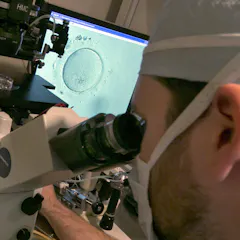
An embryologist uses a microscope to view an embryo, visible on a monitor.
AP Photo/Richard Drew, File
IVF is a decades-old procedure that has allowed increasing numbers of prospective parents to have children. Evolving legislation may put it under threat.
A recent ruling from the Supreme Court of Alabama implies frozen embryos are legally equivalent to living children. This creates risks for IVF providers, and therefore problems for patients.
Pope Francis baptizes 16 infants in the Sistine Chapel on Jan. 7, 2024, in Vatican City.
Vatican Media via Vatican Pool/Getty Images
Surrogacy can exploit women, but others may choose to be involved for altruistic reasons. A scholar points out that surrogacy’s ethical value is dependent upon the people and systems who use it.
After a chance discovery in the lab, this team used IVF to make hundreds of coral babies for restoration projects in New South Wales. So far the IVF babies are doing well in the wild.
Around three quarters of IVF treatment is unsuccessful.
Pexels/liza summer
The landscape has been shifting when it comes to employer interest in employee fertility journeys.
A few days after successful fertilization, an embryo becomes a rapidly dividing ball of cells called a blastocyst.
Juan Gaertner/Science Photo Library via Getty Images
Scientists can create viable eggs from two male mice. In the wake of CRISPR controversies and restrictive abortion laws, two experts start a dialogue on ethical research in reproductive biology.
Mark Raphael Baker, author of The Fiftieth Gate.
Paul Philipson
Mark Raphael Baker is best known for two outstanding memoirs, The Fiftieth Gate, exploring his parents’ Holocaust experience, and Thirty Days, about the death of his first wife.
When faced with the exorbitant costs of continued IVF, Alison and Deacon decide to steal a large sum of money - reflecting the real life desperation many couples feel.
Adults today may have grown up dreaming they would live to see working jet packs and robot assistants but few people imagined it would be possible to create life without reproductive cells.
Professor - Emerging Technologies (Stem Cells) at The University of Melbourne and Group Leader - Stem Cell Ethics & Policy at the Murdoch Children's Research Institute, The University of Melbourne
Visiting Professor in Biomedical Ethics, Murdoch Children's Research Institute; Distinguished Visiting Professor in Law, University of Melbourne; Uehiro Chair in Practical Ethics, University of Oxford