
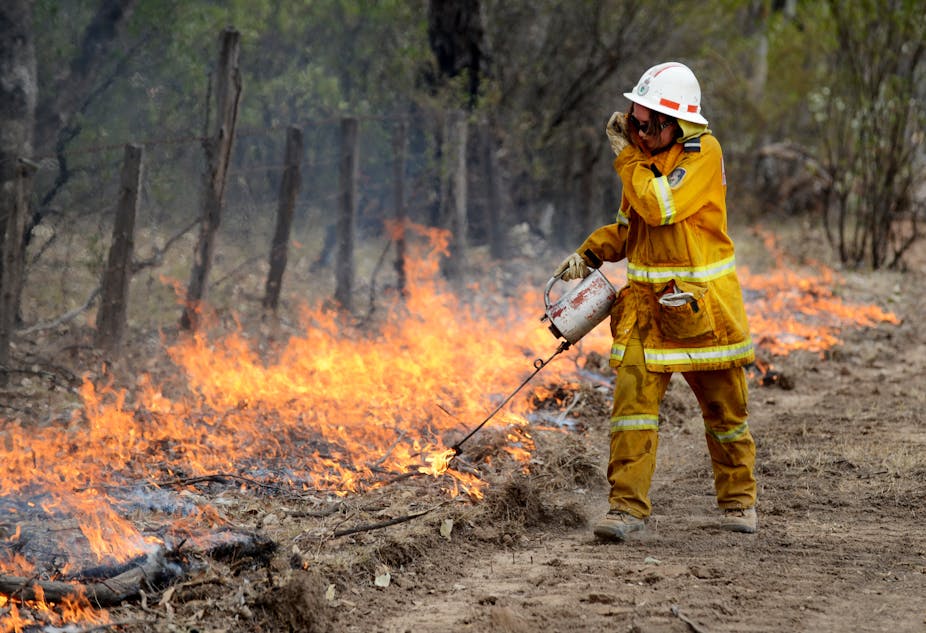
Fires are an inescapable part of life in Australia; they have been occurring for millennia, and regardless of our actions, they will continue.
Much of the vegetation in Australia has evolved to be tolerant of fire, so much so that many species now need it to flourish. In fact, the traits of many Australian plants actively encourage the spread of fire.
As a result, in many parts of the country it is not a matter of if a fire will occur, it is a matter of when. This inevitability results in a complex problem for Australian society. Some fire impacts can be resolved through active management. However society must decide on the level of management intervention and expenditure that it is prepared to bear. Likewise, not all negative outcomes can be prevented, so society must decide on the level of impact that it is prepared to accept.
Recent research has questioned current levels of expenditure on fire management. In theory, finding the ideal level of expenditure is simply a matter of weighing up all the costs and benefits. Increased spending on preparedness (such as education, firefighting and fuel management) is assumed to result in a net reduction in impact (including losses of property, productivity, lives and suppression expenditure and ecological costs and benefits).
The optimal preparedness expenditure is simply that in which preparedness expenditures plus expected fire losses results in the lowest cost for society.
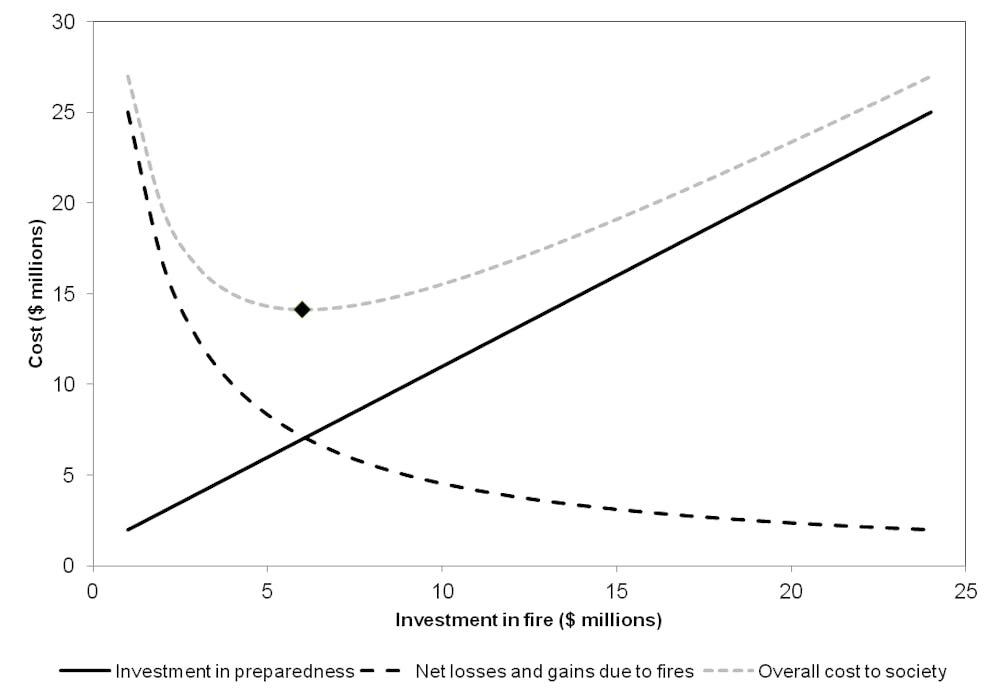
In the real world, fires burn under changing weather conditions through a complex physical environment. They also have impacts on a wide variety of things humans value. Consequently, finding the true cost of a fire is not necessarily a straightforward process.
An expenditure-impact approach assumes that the trade-offs between fire prevention and impacts are known and can be measured in terms of dollars. It also assumes that each fire protection dollar is invested in such a way that it can yield no greater benefit. However, in practice determining the ideal investment is highly complex.
While the potential for fire to affect human society can be easily understood, the true cost of fire is far more difficult to measure. Some effects can be quite tangible, such as the loss of dwellings, assets, livestock and agricultural productivity. Others are not so, such as the value of human lives, perceived “naturalness” and security, air quality, carbon, water quality, ecological values and ecosystem services. Preparedness measures that involve prescribed fire can also have inadvertent impacts on these values.
It also needs to be recognised that impacts are not all negative, some, particularly ecological, can be positive. For example, since the Victorian Black Saturday bushfires, some rare plant species such as the Lake Mountain grevillia and the alpine wattle have flourished. Understanding the impacts on society of a single fire, let alone the trade-offs involved in long term fire planning, is no simple matter; it is a complex potpourri of economics, ecology and sociology.
Likewise, investment in fire prevention can take a wide variety of forms. Education, regulation and enforcement can help reduce ignitions, help make dwellings more defensible and guide decision-making. Investment in firefighting resources can help detect and curtail the growth of existing fires. Investment in prescribed burning can have ecological benefits and assist with fire control.

The complex interface between the natural, fire-prone world and the human environment means that it is no simple task to tease apart the importance of various fire preparedness measures. The effectiveness of strategies may vary under different conditions; under some conditions prescribed burning may be an effective way of reducing fire ferocity to manageable levels, in others it may be less so.
The intrinsic uncertainty of natural systems contribute to this; for example, the efficacy of a prescribed burn may vary based on the season of burning, the length of time since burning and the size and position of the burnt area in the landscape. Likewise, different preparedness strategies contribute to managing fire in different ways and with different costs. No method is likely to be ideal in isolation. It is likely that the best strategy will be a combination of approaches, however finding the ideal mix is no simple task.
So how do we resolve the conundrum of fire management? How do we our invest limited resources to get the best outcome possible?
First we need to accept fire as an intrinsic part of the landscape; it will remain a regular (albeit sometimes unwelcome) visitor. It cannot be considered an adversary that can be defeated.
Second, we need to define goals in a clear, and measurable manner, and design strategies to achieve those goals. Included in this must be recognition of the values that we may have to sacrifice. We need to monitor the results so that we can more clearly understand our approaches and the trade-offs we are making and respond accordingly. We also need to understand that our natural environment is complex and can be unpredictable, and that things may not always behave as we expect.
Above all, we need to move towards a more comprehensive understanding of fire and what it means to the things that we, as a society, value.

Felix MacNeill
Environmental Manager
Would it be useful to find some way of doing detailed post-event analyses to increase learning on what happened in practice and how people actually feel, now that it HAs happened, rather than how they think they feel when they imagine it?
Thomas Duff
Postdoctoral Fellow, Forest and Ecosystem Science at University of Melbourne
Post event information collection looks to be a great way to improve our understanding of what is going on. An unprecented amount of information was collected about the the Black Saturday fires of 2009, including human impacts, ecology and fire behaviour. However its difficult to say how well the findings can be applied to other fires without studying other fires in a similar way. Also of interest would be how people's attitudes and values alter as the time since a bad fire increases.
Ben Beccari
Disaster Manager
The problem with post event data collection is that it tends to focus on the biggest events. It is equally important to collect information on the disasters that didn't happen, to help find out what preventative measures work.
Felix MacNeill
Environmental Manager
Thanks Thomas - good points.
I must admit one tends to automatically assume that someone's opinion AFTER having experienced something will be 'better' than their opinion-in-theory. But this may not necessarily be the case, as it could just as easily produce a counter over-rating of the importance of the experience in contrast with a podssible under-rating without having experienced. there really isn't any kind of 'objective' point, is there?
And, as you add, feeling change over time and a future fire is unlikely to be sufficiently similar to a previous one for the data to be particularly useful.
John Richardson
logged in via Facebook
Couldn't agree more Ben, the big gaps in our knowledge exist, i think because we focus only on the large scale events, which are few and far between. There have been plenty of smaller events that it would be good to examine (and flood and storm events, if we are talking all hazards), but we don't, unfortunately. Good article.
Terence Beath
Retired
There is another problem with collection of peoples' memories of how they felt etc., in that our psychological functioning creates memories of events according to the emotional peak and feeling at the end (could be pain, happiness) and our remembering self is different to our experiencing self. It is quite a complicated area and for solid scientific information I would suggest input from cognitive scientists when designing any experiments or collecting useful data.
See Kahneman's book Thinking Fast and Slow for a quick intro
Ben Beccari
Disaster Manager
The difference between large scale and small scale events can be very important. For bushfire the majority of the fatalities occur in the larger events whereas for flood the majority of fatalities occur across the many smaller events.
Ben Beccari
Disaster Manager
I think it's worth noting that the original paper mentioned in the above piece was primarily focussed on urban fire.
I agree that looking at the costs of bush fire are incredibly complex, but no one has even come up with a good review of the costs of the consequences of bush fire, let alone prevention and preparedness costs.
Thomas Duff
Postdoctoral Fellow, Forest and Ecosystem Science at University of Melbourne
This is a valid point - while bushfire management is often the focus of community debate, issues with intangible values and trade-offs exist for all fires, large or small. And as the original article focuses on, opportunity costs also need to be considered
John Richardson
logged in via Facebook
and part of our challenge is also how do we cost the consequences, I'm yet to see costings that beyond the straight replacement of buildings and infrastructure, how do we cost the disrution to people's lives, the health impacts etc
Ben Beccari
Disaster Manager
There have been some attempts to cost disaster impacts beyond plain insured losses or replacement costs. I've surveyed some of the literature on my blog here: https://casuscalamitas.wordpress.com/2012/12/08/climate-change-extreme-weather-and-emergency-preparedness-senate-inquiry-part-2/
The Victorian Bushfires Royal Commission published a pretty comprehensive costing of the consequences of that event - they deserve particular praise for outlining knowledge gaps.
Black Knight
writer
Yes, this is fire country - but wild or domesticated fire?
A call has been made for a national dialogue on indigenous fire practices in relation to land management and the prevention of hot bushfires.
See reasons at http://preview.tinyurl.com/apofy5r
This has been suggested as a topic for The Conversation and Jane, the Section Editor, Energy & The Environment, is following it up.
Thomas Duff
Postdoctoral Fellow, Forest and Ecosystem Science at University of Melbourne
An interesting counterpoint to Bill Gammage's view is that of forest ecologist Ron Hateley in 'The Victorian bush : its 'original and natural' condition', also explored in radio national's hindsight at: http://www.abc.net.au/radionational/programs/hindsight/the-fire-myth/3790916
His research seems to suggest a more limited approach to indigenous burning.
Regardless of approach, research into historic fire and fire ecology remains important to understanding pattern and change in the vegetation we have now, particularly in the face of changing climate.
Peter Davies
Bio-refinery technology developer
Here is another blog calling for closer look at past indigenous fire practices.
http://co2land.org/2013/01/20/cfi-black-swan-event-treatments/
It was part of a private discussion but the author deemed it of sufficient importance to put it on the web.
Since then we have been privy to exchanges that suggested that some members of the NSW Rural Fire Service are opposed to such practices because they inherently leave far higher levels of charcoal due to their "cool burn" approach, the view…
Read morePeter Ormonde
Peter Ormonde is a Friend of The Conversation.
Farmer
Excellent article and discussion folks.
Word of warning - beware the simple appeal of the cost/benefit analysis.
We tend to be exceptionally good at totting up costs - far less so with benefits ... gets all blurry with things like time and "ecological services" that we really don't have a handle on at all... some things that look like losses and costs end up being benefits and maybe vise versa. Then there's the subtle stuff like what's a one leafed basically invisible bloody orchid actually…
Read moreDianna Arthur
Dianna Arthur is a Friend of The Conversation.
Environmentalist
Thanks for article and the level of discussion looking at the difficulties faced and the benefits to be gained by learning the best way to live with our land rather than on ways to exploit and leave nothing. Refreshing level of discourse.
Colin Kline
logged in via Facebook
-
2013-01-26
AIR WATER TANKERS
#History Of (Australian) Fire Fighting Strategies#
Fire Fighting authorities (& Govts), on both sides of the Pacific, are frequently reported as obdurately pursuing policies that guarantee large numbers of people, animals, homes, forest will be regularly annihilated.
These catastrophes will repeat, and increase, with Global Warming.
Authorities have arrogantly (and frequently) refused to use better & more appropriate technologies, viz - replacing Miniscule…
Read more