Universal Health Coverage: what is it and why does it matter?

The concept is simple but achieving it presents an enormous challenge..
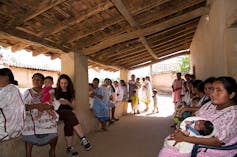
Flickr / PWRDF
Universal Health Coverage (UHC) will be in centre spotlight for the political, development and health communities in 2013. Set to become an umbrella goal for Global Health, it captures and drives wider and more sustainable measures aiming to close the global and regional gaps in healthcare access and the health states of populations.

UHC is described by the World Health Organization as health coverage that “ensures all people can use health services without financial hardship”, based around the simple yet powerful paradigm that “all people should have access to the health services they need”.

Obviously such a goal presents enormous financial, social and political challenges, but UHC encourages concepts such as cost-sharing and risk-pooling to meet collective health costs. It also aims to set a benchmark percentage of GDP which should be earmarked by national governments for health expenditure.

Many questions are raised by such ambitious goals. But as with the MDGs, visionary objectives are an essential first step toward societies and governments exploring and prioritising how to achieve them..

Getting to the point..

In this short clip, the World Bank outlines the main goal of UHC and the potential dangers of unaffordable healthcare.

WEF UHC

For more information, explore the Lancet series on UHC and the fascinating recent article from Dr Felicia Knaul and her team on UHC and Mexico – its quest to achieve health for all. The Guardian, which outlines a recent UN resolution towards achieving UHC and an interesting example from Rwanda and their Mutuelles community-based health insurance program.

Towards UHC…

Flickr / Extranoise
Universal Health Coverage – as a goal and a right – is set to be a strategic focus for the Global Health community moving forward. As a population, knowing what it is, and why it matters is a crucial first step to achieving health for all. Particularly in a time of increasing economic, environmental and political stress.

For more on global health, explore Translational Global Health, from Alessandro and PLOS.

Join the conversation

23 Comments sorted by

    1. Kim Darcy

      Analyst

      In reply to Alessandro R Demaio

      We have had universal health care in Australia for nearly forty years now, so I'm not really sure what this has to do with us.

      report
    2. Michael Mihajlovic

      Retired

      In reply to Kim Darcy

      Kim,
      How about basic human right of all humans?
      How about an obligation by all humans to one-another?

      report
    3. Kim Darcy

      Analyst

      In reply to Michael Mihajlovic

      Michael, what is the authority for these alleged "human rights"? What person/body is responsible for ensuring these "human rights" and against whom?
      What is the source of your claim that *i* or anybody else has 'obligations' to every other human on the planet?

      report
    4. Michael Mihajlovic

      Retired

      In reply to Kim Darcy

      Kim,
      Please consider the moral and ethical responsibilities of members of an advanced and enlightened society.
      Please note this is a global initiative of the world bank.

      report
    5. Kate Rowan-Robinson

      Kate Rowan-Robinson is a Friend of The Conversation.

      Registered Nurse/Sexology Student

      In reply to Kim Darcy

      While we have had universal health care (UHC) in Australia for quite some time now, there are still aspects of care that are not affordable or attainable by everyone. I speak from experience of living in a remote area and illness meant long journeys, much time off work to travel to receive care and expensive travel/accomodation if one had no friends or family near where they received treatment. That issue in itself is complex.

      However, stepping outside Australia, it is still a human right that…

      Read more
    6. Kim Darcy

      Analyst

      In reply to Kate Rowan-Robinson

      Kate, if you choose to live in places doctors and health professionals don't want to work, that is your choice. Suck it up, or move.

      report
    7. Kate Rowan-Robinson

      Kate Rowan-Robinson is a Friend of The Conversation.

      Registered Nurse/Sexology Student

      In reply to Kim Darcy

      I don't know if you had noticed Kim, but I AM a health professional.

      I am also unsure as to whether you actually read the second paragraph of my response, which quoted the UN as stating that UHC should be provided to everyone, regardless of social circumstance. Providing UHC is a complex issue, which is why the UN states that each nations health regulatory body should be responsibe for providing such a scheme as determinants of health differ greatly between nations (ie. Australia's social determinant regarding distance).

      report
    8. Kim Darcy

      Analyst

      In reply to Kate Rowan-Robinson

      Kate are you seriously saying that as an Australian citizen, you think the World Bank or United Nations is the more legitimate body to decide how to spend our taxes than the parliaments we democratically elect every three years? That is really weird. And scary.

      report
    9. Kate Rowan-Robinson

      Kate Rowan-Robinson is a Friend of The Conversation.

      Registered Nurse/Sexology Student

      In reply to Kim Darcy

      I believe we are discussing UHC as a global concept, not just as an Australian concept. As a global concept I believe the UN (along with WHO) are well placed, legitimate bodies to make recommendations in relation to UHC. The World Bank would be well placed to advise on financial systems and funding of UHC. And considering that the UN DOES recommend that each nation should decide how to run its own system (as each nation has differing health needs, values and wants from UHC) I don't find it weird or scary at all.

      report
    10. Mike Hansen

      Mr

      In reply to Michael Mihajlovic

      Michael

      Kim Darcy is echoing the far-right views of groups like the American Tea Party or in Australia The Institute of Public Affairs. Basically groups that have been bought and paid-for by the super rich who would prefer tax dollars to be spent on them rather than the bulk of the population.

      Right-wing libertarians like Darcy imagine that they are great thinkers who have discovered universal truths - the reality is that they are crude propagandists for the 1%.

      report
    11. Kim Darcy

      Analyst

      In reply to Mike Hansen

      Oh Mike, you've blown my cover. Damn! Yep, that's me, jack-booting through all the public hospitals, stomping on the "99%", while I do the bidding of Neoliberal, Zionist, Imperialist, Tea-Partying IPA reading Neoconservative, Creationist, Chrissy Swan watchers.

      report
    12. Kim Darcy

      Analyst

      In reply to Kate Rowan-Robinson

      Kate, what I found weird was not that the UN or World Bank say anything, but that you, as an Australian citizen seem to accord these bodies with greater legitimacy over how Australian governments should spend taxpayer money, than the actual Australian Parliament. That's what I find scary. How many more of my fellow citizens are so willing to hand our Treasury over to unaccountable, invisible, foreign, bureaucratic gnomes in Geneva?

      report
    13. Mike Hansen

      Mr

      In reply to Kim Darcy

      Oh that's right Kim. I forgot. You fancy yourself as a great independent thinker - it is just coincidence that your views are in lockstep with the IPA.

      Although to be fair to Chris Berg and the IPA they would apply more sugar coating to the following statement.
      "Kate, if you choose to live in places doctors and health professionals don't want to work, that is your choice. Suck it up, or move."

      They would say effectively the same thing but use the words "freedom", "free market", "free choice" more frequently.

      report
    14. Kim Darcy

      Analyst

      In reply to Mike Hansen

      Mike, as I have no idea who these people are, I'll just have to watch from the sidelines. And yes, people who choose to live in humpy hellholes millions of miles away from cvilisation can hardly expect civilisation to run to them. Yuk! So, they really do have to suck it up Or move.

      report
    15. Robert Peers

      General Practitioner

      In reply to Kate Rowan-Robinson

      hi kate, hey what's this health professional stuff??? are you trained in health, nutrition and preventive medicine? or are you really a sickness professional, like medicals are?

      nurses do not train to treat healthy people--all your experience is surely with sick people, whose diseases have not been prevented by professional dieticians

      i have studied nutrition and the causes of chronic disease, for 22 years, and i have also identified an anti-ageing plant molecule that may extend life by a healthy…

      Read more
    16. Kate Rowan-Robinson

      Kate Rowan-Robinson is a Friend of The Conversation.

      Registered Nurse/Sexology Student

      In reply to Kim Darcy

      Hi Robert,

      I believe primary health care nurses are trained in preventative health. As a GP I would hope you understand the value of a practice nurse (my previous position). Primary health care nurses aim to prevent disease before its occurance...in a speciality of sexology we would hope to educate people how to prevent STI's and BBV's. My previous area of interest has been major trauma. I've not had the privilige of working as primary health care nurse in trauma, but when I'm more experienced it is my wish.

      And for your general information, as a Registered Nurse I would hope I've been trained in health, nutrition and preventative healthcare (I won't say medicine as I'm not a doctor). The discovery of your anti-aging plant molecule sounds exciting and I look forward to the peer reviewed research.

      report
    17. Kate Rowan-Robinson

      Kate Rowan-Robinson is a Friend of The Conversation.

      Registered Nurse/Sexology Student

      In reply to Kim Darcy

      Kim, I don't know how to make my point any plainer. The UN states that individual governments are the best placed organisations to provide UHC. I am not advocating for bureaucratic gnomes in Geneva to run our treasury, rather that all treasuries make allowances for UHC. Each UHC system will be decided upon by each, independant nation. How Australia chooses to send our UHC dollars is up to whichever elcted government of the day. I don't find spending taxpayers dollars on UHC scary at all.

      report
  1. Rachel van Someren

    logged in via Facebook

    We are very grateful to have almost universal health care (in recognition of Kate Rowan - Robinsons good point about rural & remote populations) in Australia.
    This is always brought home when friends in the USA exclaim over the fact that a family member was able to have a kidney transplant at no cost to us, through our public health system.
    I wonder how long it will be before the USA introduces UHC? Is the 'Obamacare' package close?

    report