Urban farming in Detroit: sowing seeds of hope in the motor city?

“Every year I’d tell myself it’s going to get better… and, sure enough, it didn’t get better.” – John Hantz Once held up as the epicentre of industrialised mass production, Detroit has for decades been portrayed as a failed economy beset with every kind of urban problem. However, recent years have…

5zs79ynq-1352689961
Will an urban farming project be able to revitalise Detroit? tcd123usa via flickr

“Every year I’d tell myself it’s going to get better… and, sure enough, it didn’t get better.”

– John Hantz

Once held up as the epicentre of industrialised mass production, Detroit has for decades been portrayed as a failed economy beset with every kind of urban problem. However, recent years have seen a different narrative emerging, with some observers embracing the idea of Detroit as an “urban laboratory”, a city that provides opportunities to experiment with cutting-edge urban practices.

A key trend associated with this shift in narrative has been a growing enthusiasm for urban farming, which involves turning unoccupied city lots into small farms, usually through the efforts of the local community. The idea is not new – urban farms have popped up in cities around the world, with goals as diverse as ameliorating poverty, improving nutrition, empowering communities, and beautifying the city. Detroit itself hosted an innovative urban farming experiment back in the 1890s, when Mayor “Potato Patch” Pingree turned vacant city lots into farms to combat hunger and unemployment. Detroit’s city government is now once again taking urban farming seriously, developing an urban agriculture ordinance to govern what has previously been an unregulated practice. But perhaps what makes Detroit’s current urban farming movement most notable is its potential scale, given the many square miles of land in the city which is currently sitting vacant.

Yet while media portrayals of Detroit’s small-scale urban farming movement have been largely positive, a proposal which explicitly seeks to address this issue of scale is garnering a more mixed response.

John Hantz, a local resident and successful businessman, has been working since 2009 to develop the world’s largest urban farm in Detroit as a for-profit enterprise. Hantz wants to buy about 140 acres of city-owned land approximately six kilometres from the CBD, in order to plant thousands of hardwood trees. Hantz Farms claims they will improve the area by clearing overgrowth and rubbish and by demolishing abandoned houses which have fallen into disrepair – tasks which the city, facing possible bankruptcy, can little afford to do itself. Yet despite these contributions, persistent questions have been raised about whether the project is really about helping the community, beautifying the city, or simply generating personal wealth.

On a recent visit to Detroit, we sought an interview with Hantz to try to find out. Sitting in the high-rise Hantz Group offices, amidst bookcases filled with titles like “Good to Great” and “Think and Grow Rich”, it seems clear that Hantz is not closely aligned with the grassroots activists who have championed small-scale urban farming in Detroit. Yet when asked about his motivation, Hantz – who has spent his career in financial services and investment – seems bemused at the notion of the farm being about personal wealth creation. Significant returns on Hantz’s initial $5 million farm investment are unlikely to come in the short term, given Detroit’s ongoing population decline and weak property market, and the decades it may take to produce profitable harvests. And while Hantz Farms claims it will help to “grow the City’s population base and create an economic catalyst by stimulating new business opportunities and therefore, jobs”, the economic benefits of a large-scale urban farm like this remain untested.
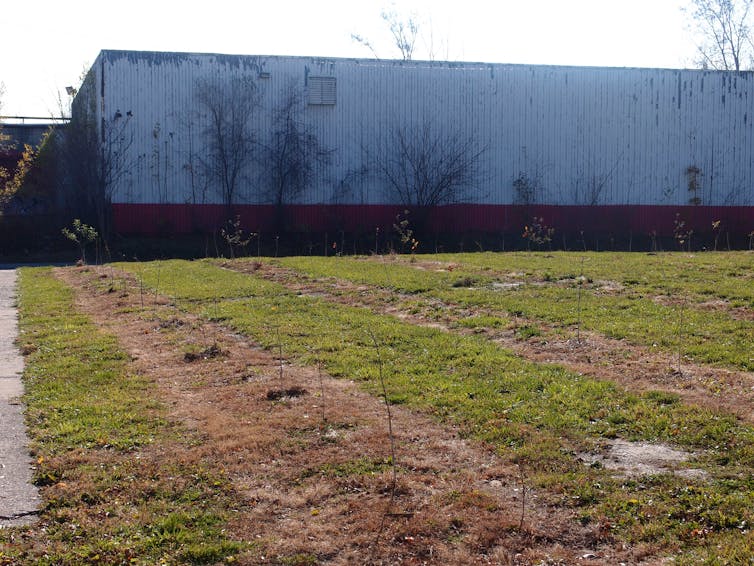
A pilot site for Hantz Farms in Detroit. Laura Crommelin

At the same time, however, Hantz is driven both by personal benefit and by economics. He lives near the proposed farm site, and one of his key motivations is intensely personal. He puts it simply: “I don’t want to move.” But after 20 years of watching the abandonment of properties undermine nearby neighbourhoods, it was a mix of professional and personal philosophies that informed his response:

“Economics is my mainstay, that’s what I’m good at, economics and finance. So I’m trying to think what is the problem?…one day it hit me and I said well, the problem is we don’t have any scarcity…we have to take some of this excess capacity out of circulation to stabilise the markets to actually begin to start the recovery… So it’s like, well, I grew up [on the urban fringe]…I’ve lived on apple orchards…So why don’t we just do a farm?”

While Hantz may see the farm as a simple solution to an economic problem, others see more complications. One of the more common critiques is that this may be a “land grab” disguised as a beautification project. After all, Hantz’s proposal involves purchasing an area almost as large as Sydney’s Domain and Botanic Gardens combined, for a total cost of approximately $500,000. Hantz counters this criticism with another economic perspective, arguing that the government needs to cease seeing the empty lots it owns as assets, because “something that you…lose hundreds and hundreds of millions of dollars on is not an asset.” Instead, Hantz argues that increased private ownership should be encouraged across the board, not only for institutional buyers like him, because it underpins a successful city:

“Well, the problem is if you have 600,000 residents in a normal city, if there’s private property rights they cut their own grass, they provide this pride benefit that makes a city great … when you get this public ownership, it’s everybody’s and it’s nobody’s. So what happens is that everybody just sort of says that’s someone else’s problem…”

Listening to Hantz tell his story, it is clear that while his proposal intersects with cutting edge trends in urban planning, it is fundamentally traditional at heart. Hantz seems to be putting his faith – and his money – behind a belief that cities become great by facilitating individualism, entrepreneurialism and capitalism. It is in some ways a quintessentially American vision, and one that is particularly potent in the context of the nation’s current economic downturn.

It remains to be seen if this is a vision that can help Detroit to address its challenges, and it certainly runs counter to some of the more collective, collaborative approaches proposed in recent years. Hantz himself is fine with this mix of methods; in his view, Detroiters “have so many opportunities with the issues we face that we could try every idea.” having recently approved his proposal, it seems Hantz will now get to test the idea he hopes will be a “game changer” for Detroit".

Articles also by These Authors

Sign in to Favourite

Want to follow The Conversation?

Sign up to our free newsletter to get the day's top stories in your inbox each morning, with a special wrap on Saturday.

Help us have better conversations — donate

Join the conversation

12 Comments sorted by

  1. John Newlands

    tree changer

    I think urban farming is the way of the future. More likely the Havana model than the Detroit model. Neither is the feelgood community gardening which is unlikely to be productive enough. The current mindset is people in the suburbs have service industry jobs while big machines and strong chemicals grow food outside the city limits. When diesel is $3 a litre and a 25 kg bag of mixed fertiliser is $100 farming will have to come to the city.

    Conceivably this could include the use of sewage liquids and solids to grow crops. Raised beds can be tilled by low powered tractors unlike the giant machines we see in the wheat belt. Up to now grain has given us not only bread, pasta and cereal but fattens the animals that end up in fast food. FAO suggest we could eat more root veg and less grain. Spuds will grow nicely in raised beds of sewage sludge. This could be poetic justice for urban sprawl consuming the best soil and rainfall areas.

    report
    1. Tim Scanlon

      Debunker

      In reply to John Newlands

      Farmers don't buy fertiliser in 25kg bags. Farmers have been moving away from soil degrading practices like tillage for decades. Farmers prefer not to contaminate their produce with Ecoli. Farmers are far more efficient per unit of fertiliser and water than gardeners are. Which illustrates that you don't seem to understand the scale of agriculture and the science behind it.

      Now, I'm not saying you can't have urban food production, but it isn't going to replace agriculture, especially not broadacre agriculture. It might go some way to reducing the reliance upon market gardens which are irrigation intensive. But urban food production is not economically nor resource efficient enough, it essentially relies upon donations of time and resources.

      A few friends of mine were lending their expertise to some urban farms in the Carolina's in the US. The main reason those farms were running was as a community integration program, especially for troubled youth.

      report
  2. John Newlands

    tree changer

    I used the example of bagged fertiliser so urbanites can relate to it. I sell hay and agist livestock for full time farmers.

    Tim how do you propose that the 'efficient' farmers react under this scenario... diesel and fertiliser have tripled in price while urban incomes have remained steady?

    This already happened to Cuba when Soviet support collapsed. A comparable scenario could emerge world wide due to the increasing cost of farm inputs. I see no alternative to increasing the amount of urban agriculture.
    http://en.wikipedia.org/wiki/Urban_agriculture

    report
    1. Tim Scanlon

      Debunker

      In reply to John Newlands

      The cost price squeeze has been going on in agriculture for over 50 years, John. We've gotten more efficient as a result. My economist colleagues suggest that there are plenty of efficiencies still to be had, although I'd argue that this is for the bottom 75% of farm businesses.

      Also, urban incomes have SFA to do with agriculture. The gap between price paid on farm and price paid in store has risen, farmers are being paid less and less for the same produce. At the same time, urban incomes spend…

      Read more
  3. Comment removed by moderator.

  4. Suzy Gneist

    logged in via Facebook

    Tim, I wonder when you speak of the inefficiency of small acre urban farming that you list water inputs but I would think the reduction in transport costs and large scale inputs would also have benefits. And for me, the social aspects of bringing food growing back into communities have other benefits - as the youth program's you mention, like subsidising the wealth of lower economic, youth, elderly and un(der)employed.
    It may not be as clear cut a decision of overall success as cost efficiency and water input being the deciding factors alone.

    report
    1. Tim Scanlon

      Debunker

      In reply to Suzy Gneist

      From the plant's point of view, it requires a certain amount of nutrients and water to grow. So farmers have gotten very good at utilising those inputs efficiently. Typically in urban farming/gardening over-fertilising and over-watering are the norm (I haven't got my reference list at home, but I can dig up the comparison paper) thus it is hard to make any comparisons.

      On the fuel and transport side of things, I agree you lower that cost, but you don't eliminate it as some food is always coming from agriculture.

      Community project programs (etc) are worthwhile initiatives but I don't think we should pretend that they are agriculture and that they will replace agriculture (as John was trying to imply with his comments).

      report
  5. Michael Shand

    Michael Shand is a Friend of The Conversation.

    Software Tester

    Hi Tim, as always you have some very insightful comments and informed views here. The only thing I might suggest is that you seem to be comparing commercial style factory farming with urban commercial style factory farming. Its true your not going to replace large farms with urban farms but yoou dont need to. Like after I plant this fejoa tree......I ignore it.....and then for 3 months out of the year i get delicious fejoa's - the tree cost me $8 and I havent tended to it except to pick fruit…

    Read more
    1. Tim Scanlon

      Debunker

      In reply to Michael Shand

      I agree, but that is called gardening. We seem to have supplanted gardening with "lawns and flowers" at some stage, but it used to be that we grew a few fruit trees, beans, pumpkins, etc. As a child I remember our garden had an orange, lemon, mandarin, almond, plum, apricot and apple (that never gave fruit) trees. We then had a bed that grew sweet peas, strawberries (when the snails didn't eat them), pumpkins, sweet corn, spinach, broccoli and zucchini. That sounds like a big garden, but it was just an average sized block (admittedly on a farm with a larger water catchment available than just our roof).

      So I'd like to see people replace lawns and ornaments with some fruiting trees. Once they get big enough they don't need much watering. A couple of friends actually grow a lot of vegetables in their backyard and they live in a duplex, so the garden is tiny. But this is still just a hobby. Community gardens are another level again.

      report
  6. John Robert Davidson

    Retired engineer

    We spent a month travelling around South Korea in May. What struck us was the the amount of opportunistic farming going on in places raging from the center of Seoul to more rural centers. The "farms" included large pots growing edible greens in alleyways in Seoul to vegetable patches the size of a table top in tiny places where there was enough room to grow something in more rural environments. My favourite was a "farm" that consisted of a woven plastic bag full of spoil with sweet potatoes growing…

    Read more
  7. Dale Bloom

    Analyst

    This is an extremely interesting article.

    Detroit went into considerable decline with the loss of so much car manufacturing from the US to certain Asian countries.

    This is shown rather dramatically in the Times photogallery “Detroit’s beautiful, horrible decline”

    http://www.time.com/time/photogallery/0,29307,1882089,00.html

    Not much can be done to stop that decline, so why not turn the land back into crop farming?

    The same for a number of Australian cities, that seem to exist by grabbing the wealth that was origionally earnt elsewhere, or exist only because of the ponzi demography industry.

    report