
Victorian TAFE cuts: an attack on working people

The phrase “class warfare” has been thrown around a lot in the media and within political circles recently – usually without much basis. But in Victoria it is very real; the current Liberal Government has declared open class warfare on the state’s workers through the drastic downsizing of publicly funded…

Hrpwmxsy-1338861648
Cutting TAFE funding effects the people that need education and training most.

The phrase “class warfare” has been thrown around a lot in the media and within political circles recently – usually without much basis.

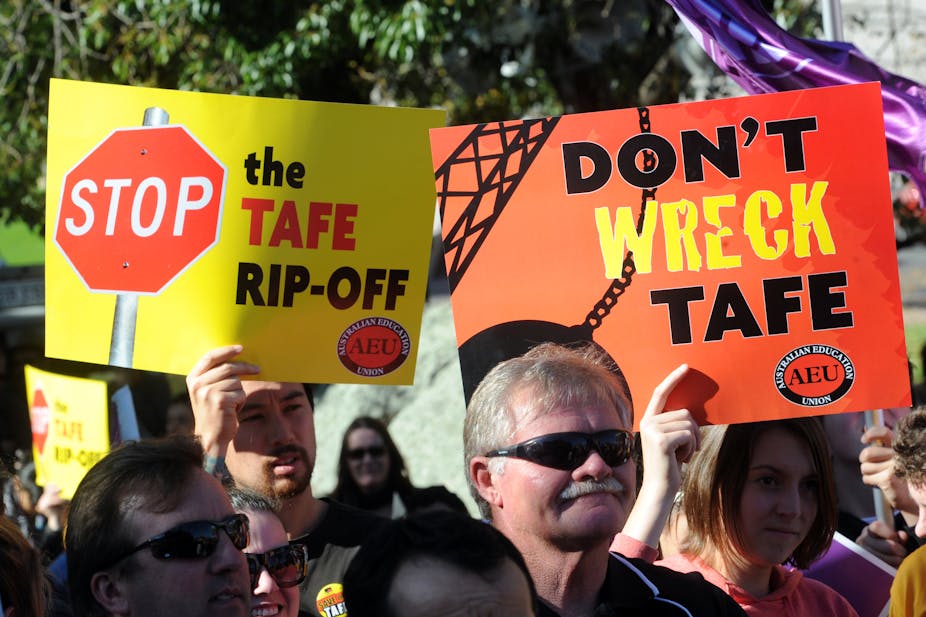
But in Victoria it is very real; the current Liberal Government has declared open class warfare on the state’s workers through the drastic downsizing of publicly funded TAFE institutes.

TAFE in Victoria has a historical and visceral link to the education of working people. But it is under attack because the state government has gone for what they think is a soft target. After all, those who rely most on publicly funded vocational education are those who have minimal access to government or mainstream media to protest the changes.

TAFE groups are vigorously campaigning against the changes, but you can imagine if higher education was treated in the same way, there would be nationwide outrage. Meanwhile, the human impact of these changes will last well beyond the next electoral cycle.

The wrong changes

In its most recent budget the Victorian Government set aside $1.2 billion for vocational education and training (VET) needs and introduced a range of new fee-setting conditions to control a projected funding blowout of $400 million.

In addition to the fee changes they decided to remove the $170 million Full Service Provider payment to TAFE institutes, used for meeting an essential range of student service requirements.

The new funding model has been openly engineered to reduce the size of the sector and contribute to a budget surplus at the educational cost of Victoria’s working people. With course closures being announced across the sector it is unlikely the full $1.2 billion will ever be spent. This is at a time when investment in vocational education is crucial.

But this is not solely down to a Liberal government. The disappointing truth is this tactical retreat from publicly funded vocational education began with the previous Labor government.

Building communities

TAFE institutes and those that preceded them have always had a special position in Australian society, building the capacity of people and their communities. Often many students are those requiring more than one chance to find their way through post-secondary education.

There are dozens of TAFE teachers with stories about students who left school at Year 9 but enrolled in the TAFE system to seek a better life with better qualifications. But making further education for early school leavers more expensive, threatens to disengage those who left school undereducated and unqualified. This can only mean greater unemployment and social exclusion.

It is the real community capability building of TAFE that is lost in the economic ideology of the current and previous policies. Financial graphs, pie charts, and tables of numbers do not measure or promote the social mission that is an inseparable part of TAFE identity.

A right to public education

It will now be hard to define TAFE as public education given up to 70% of operational costs will be paid directly by students. People’s rights to well-funded public education have been forgotten to initiate an ideologically constructed user pays market.

In no way is this a strategy to drive education with social benefit.

The attractiveness of affordable fees and concessions has always drawn those from low socio-economic backgrounds to TAFE. There they have been supported by a range of services that include language and literacy classes, councillors, libraries and learning support.

The $170 million Full Service Provider funding underpinned these services. To retain any reasonable array of student services TAFE institutes will have to pass that cost onto students, further pushing up fees in 2013.

A user pays system is only effective if the user can afford to pay, concession rates in the new fee model are in some cases almost the same as current non-discounted fees and no concessions are available for Diploma or Advanced Diploma qualifications.

Students enrolled in those higher qualifications can access deferred fee payment through VET-Fee-Help, but lower level qualifications are ineligible.

Prisons or schools?

The current political direction, pursued through successive governments shows a preference for building prisons over building communities. Good education policy is left behind, while a desalinisation plant sits idle. These are the places where real investment of public money has been wasted.

To continue to offer accessible vocational education to the workers of Victoria the Victorian TAFE system requires rescue from four years of ill planned policy, not brutal and disruptive change.

Attacking the education institutes of the workers may well backfire as the tens of thousands of people that use TAFE each year and their families remember and take their dissatisfaction to the polls.

Sign in to Favourite

Want to follow The Conversation?

Sign up to our free newsletter to get the day's top stories in your inbox each morning, with a special wrap on Saturday.

Spinner
Help evidence based journalism become the norm and donate

Join the conversation

16 Comments sorted by

  1. Gavin Moodie

    Principal Policy Adviser

    The Victorian Government's new funding rates are little more than guesses: it has done no modelling of the effect of its changes on enrolments, so within 6 months it will make more big changes with little notice to try to shape market outcomes to its liking.

    report
    1. Jenny McIntyre

      Librarian

      In reply to Gavin Moodie

      In six months time we will be lucky to retain anything like a properly functioning library, disability support, student counsellors etc at the regional TAFE where I work. The cost of these services is not a waste of taxpayers money, they run off the smell of an oily rag anyway. The majority of our students are genuinely trying to improve their skills. I don't see any frivolous courses being run. The funding cuts are a disaster.

      report
  2. Troy Barry

    Postgraduate student

    Reducing the wastage of taxation sourced funds is saving, not attacking, working people. It's hard to think of a more egregious example of unecessary, unproductive middle-class welfare than publical funded art classes for occupational therapists as described in the linked article.

    report
    1. Peter Ormonde

      Peter Ormonde is a Friend of The Conversation.

      Farmer

      In reply to Troy Barry

      Troy,

      I've had a few dealings with Occupational Therapists in recent years. They help people who are physically or emotionally shattered rebuild their lives. And very often having the capacity to daub a bit of paint on a board, or sketch or try and regain the use of damaged hands, eyes and minds is quite vital actually in putting people back together and maybe giving them some sense of meaning or purpose. You've obviously never seen what OT's do for a living Troy...let's hope you don't have to. Middle class welfare indeed!

      report
    2. Troy Barry

      Postgraduate student

      In reply to Peter Ormonde

      Actually my sister is an Occupational Therapist working in the charity sector. OTs are great people doing good work - but that does not mean Victorian workers should pay for their art classes. With an average salary about three times the minimum wage, there's no equitable reason for a storeman or a office cleaner to be subsidising an OT's recreational activities.

      report
    3. Emma Anderson

      Artist and Science Junkie

      In reply to Troy Barry

      Would you prefer that they went to the universities for art classes over a 3 year period and a cost of 30 grand?

      I'll give you a hint. With the exception of places like CoFA and SCA, most BFA schools have been canned.

      Call it an anti-art thing, but I'm on the fence actually - three years to learn sculpting sounds like a waste; learn the basics at TAFE and then practice as a trade with a master sounds more sensible to me (think the old guild system).

      BPsych does not teach art skills though…

      Read more
  3. Paul Atkinson

    Social Worker

    Good article, David, and thanks for bringing prisons into it. If you check out prison statistics (the latest available online: http://www.justice.vic.gov.au/resources/a/9/a9e95380404a9d609076fbf5f2791d4a/statistical_profile_victorian_prison_system_2005-06to2009-10.pdf see p37) it looks like Technical & Trade qualifications are a significantly more protective factor than university qualifications. There were between 1 and 6 of the former and between 69 and 92 of the latter out of 4000+ prisoners.

    As well as having plenty of other purposes, free and quality public education is one of the best answers we have for reducing crime not the very expensive option of more police, PSOs and prisons. Another way of thinking about it is that the money we are cutting from TAFE now will end up in the hands of lawyers and magistrates and prison guards and multinational corporations like SERCO and G4S.

    report
  4. Andrew Hack

    IT Project Manager

    As nice as it is to be able to offer free (or at least very cheap) tertiary education particularly to people who cannot afford it, when you run these programs there will always be those who take advantage and spoil it for everyone else.

    My experiences with TAFE years ago were that only a very small percentage of people would actually complete their course and then go on to actually use it when joining the workforce. There is an incredible amount of waste of public funds going towards subsidizing…

    Read more
  5. Andrew Smith

    logged in via LinkedIn

    Firstly, the expression "class warfare" is something of a cliche and has been imported from the USA by Australian media and politicians....

    Ironically, although most skills shortages in Australia are vocational based, the never ending quest to satisfy "middle class" aspirations sees higher education in the box seat.

    No suprise at the treatment of VET/TAFE sector and the seeds were sown some years ago in the international education sector with accusations (sometimes true) that private VET (and…

    Read more
    1. Gavin Moodie

      Principal Policy Adviser

      In reply to Andrew Smith

      When ever did prime minister Gillard or any other member of the Australian government claim that vocational education is "lower value education"?

      report
    2. Andrew Smith

      logged in via LinkedIn

      In reply to Gavin Moodie

      Indirectly via Senator Evans, and in the international or overseas student context. When the significant skill shortages in Australia exist, now and especially in future are vocational based, much is being said about higher education qualifications, but not VET.

      Indirect comments have been made about the value of higher education without specifying courses or occupation outcomes, and through her Minister Senator Evans re. drops in overseas students:

      " Senator Evans was “not concerned by the…

      Read more
    3. Gavin Moodie

      Principal Policy Adviser

      In reply to Andrew Smith

      Rubbish. You had "lower value education" in quotes. Neither Gillard nor Evans said anything remotely like that and have being saying quite the opposite, as indeed has the Opposition.

      International enrolments had grown unsustainably fast in vocational education, mostly fuelled by immigration scams, and they had to be stopped. Numerous private for profit vocational colleges have been closed for failures of standards and quality, as have some private for profit higher education colleges.

      report
    4. Andrew Smith

      logged in via LinkedIn

      In reply to Gavin Moodie

      Thanks for your input, when time allows I shall find the quotes, but I am sure universities would have been ecstatic to have fast growing international enrolments too.....

      It had been at least strongly intimated by the government when discussing the study to immigration route (and has happened) that higher education would be given advantages over vocational because it is perceived as higher value education with presumably higher value outcomes e.g. administrative managers?

      The study to immigration…

      Read more
    5. Gavin Moodie

      Principal Policy Adviser

      In reply to Andrew Smith

      16 vocational colleges were closed in 2009, at least 15 in 2010 and at least 49 failed to get re registration in late 2010. One of the vocational colleges closed was Austech Institute for Further Education.

      report
    6. Andrew Smith

      Education Consultant at Australian & International Education Centre

      In reply to Gavin Moodie

      Understand, though post event emergency audits reacting to media/fed govt. demands, not through pre existing registration and quality system.

      An excellent overview appeared in The Monthly 18 months ago from Margaret Simons http://www.themonthly.com.au/monthly-essays-margaret-simons-exodus-international-student-sector-2855 including various views and insights.

      Simon Marginson stated:

      “Every step in this was foreseeable. It is government negligence.” The fault lies with ministers from both sides of politics but also with government departments" (I would add especially state govt. responsible for registration etc.).

      However, on topic, TAFE and VET are becoming even more important as an economic alternative to university and/or pathway, i.e. students could benefit from practical study, work and travel after high school.

      report