
Violent videogames should worry us (but shouldn’t be banned)

The Connecticut town of Southington last week introduced a videogames return program, offering a $25 gift card to parents who wanted to rid their households of violent titles. The program comes in the wake of the December 14 shootings at the Sandy Hook Elementary School in Newtown – roughly 50km south…

Rn3t3k4z-1357605715
In the wake of the Sandy Hook shootings, we need to more concerned than ever about the effects of violent videogames. JBLivin/Flickr

The Connecticut town of Southington last week introduced a videogames return program, offering a $25 gift card to parents who wanted to rid their households of violent titles.

The program comes in the wake of the December 14 shootings at the Sandy Hook Elementary School in Newtown – roughly 50km south west of Southington – which claimed the lives of 20 children and six staff members.

The main aim of the “buy-back” initiative is to create a forum where the media’s role in cultures of violence can be discussed. It is not an attempt to demonise games or the people who play them.

School officials recognise violence as a complicated social problem. They are aware that the media violence debate is but a strand of a much bigger conversation on the causes of the real thing.

The Southington buy-back scheme demonstrates a sophisticated understanding of the lessons of research on the effects of playing violent videogames. It finds unlikely allies within the games community, as gamers have stepped forward to consider what a love of violent videogames really means, after Newtown.

In this sense, while elements of the National Rifle Association (NRA) seek to divert attention from the role that gun ownership plays in mass murder, gamers appear more willing to grasp the JFK nettle, asking what they can do for their country.

Right after the Sandy Hook massacre, the NRA pointed an accusing finger at the videogames industry. Their position has attracted congressional support. One reaction to these developments has been to argue that studies on the effects of videogame violence on gamers are inconclusive.

They are not.

In 2010, the noted effects researcher Craig Anderson was lead author of a survey which carefully analysed the results of 130 studies on videogame violence. Anderson’s findings were quite clear.

There is reliable evidence that a long-term diet of violent game playing leads to an increase in real-life aggression. The size of the effects noted in these studies were small, but statistically and socially significant.

In other words, gaming violence isn’t the major cause of real-world violence, but it probably is enough of a catalyst to warrant concern. All the more so because while many things can provoke aggression – for instance, non-violent games can do the same thing if they are frustratingly difficult to play – violent videogames are designed to spark aggressive responses.

At the same time, Anderson and colleagues cautioned that the policy implications of these findings are unclear.

First, where the research addresses aggression, social anxieties are focused on physical violence. In this way, most of what we know about (aggression) doesn’t directly address that which worries us most (physical violence).

Second, it may also be that videogame violence also has a range of positive effects. The problem, in this regard, is that there is a bias in effects studies toward looking for the damage games can cause among some groups.

In either case, the confident conclusion that videogame violence is bad for a significant number of people does not imply prohibition. Instead, Anderson argues that videogame violence is an environmental risk that has to be managed.

The problem, then, is that the research on videogame violence does not lend itself to quick and easy, crowd-pleasing policy action. In the resultant political vacuum, it’s been interesting to see gaming insiders step up to reflect on their role in glamorising guns.

Games reviewers have challenged the industry and its consumers to take action. The games industry has been accused of playing into the hands of the NRA, by becoming over-reliant on violence as a quick and easy narrative device.

This laziness has been criticised as an abrogation of creative responsibility; a failure of games and gaming as a form of creative expression.

Perhaps the most chilling exemplar here has been the collusion between the games and gun industries, where the former has become a product placement vehicle for the latter.

Approaching gaming as an art form, games reviewers have called for the industry to take more responsibility in making the genre about expression, rather than commerce.

This mirrors the argument put forward by MIT media scholar Henry Jenkins, in the wake of the 1999 Columbine Massacre which claimed 13 lives. There, too, first-person shooter games were identified as catalysts for mass murder.

Jenkins argued against banning games, but acknowledged there were reasons to worry about the prevalence of violence in them. The trouble with most gaming violence, for Jenkins, was that it was boring.

Gamers were offered the same scenarios and options time and time again, which meant that the genre rarely fulfilled its unique capacity to make users reflect on the morality of the choices they made.

Jenkins argued that videogames could spark a productive conversation about the motivations toward violence, and the fact that they rarely did was cause for concern indeed.

This is why the positions being taken by the Southington school system and the gaming community are so smart. Reviewers who are, in the end, part of a promotional machine that popularises the gaming industry, are exploring how they can become part of the solution by embracing a position as part of the problem.

By doing so, they enable a dialogue with people who are quite legitimately concerned about violent videogames – including parents and teachers in Southington.

Together, these groups have set a leadership standard for a debate on media and violence that might actually achieve something.

Join the conversation

154 Comments sorted by

  1. Mike Pottenger

    Lecturer, Statistics & Political Economy at University of Melbourne

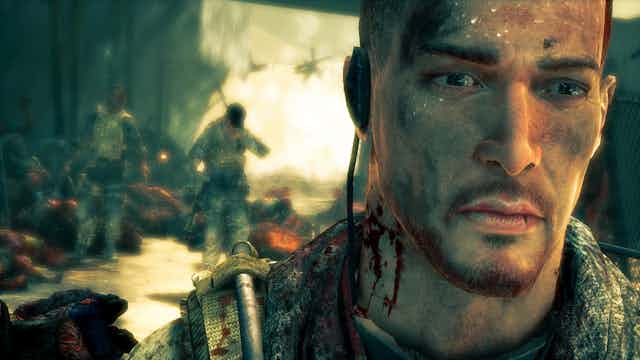
    As an aside, and at the risk of sounding pedantic, using an image from Spec Ops: The Line doesn't necessarily strengthen your case - this game is quite self-reflexive and critical about violence and war, and deliberately presents players with some sobering scenarios that made it uncomfortable to play. That screenshot is of one of those very scenes. The game is more Platoon or Apocalypse Now than Rambo or Commando. That said, I haven't had a chance to read the meta-study yet, so it may be that the effects described were observed regardless of whether or not the violence was presented in a glorified and/or uncritical manner (though I would imagine such distinctions would be difficult to make in such a study).

    report
    1. Andy Ruddock

      Senior Lecturer, Research Unit in Media Studies, Monash University at Monash University

      In reply to Mike Pottenger

      Funnily enough that game did come up in the editing of this article.

      A few points. I think Henry Jenkins and the reviewers I have mentioned in this article would make the point that one game doesn't change general trends in the industry as a whole. Perhaps the fact that this game is such a different, uncomfortable experience simply draws attention to how infrequent these sorts of games, which indeed exploit the full potential of the genre, truly are.

      In some ways, that's not the point here. I think it's really interesting that many who do love gaming, and would no doubt pull all kinds of holes in Anderson's research, are nevertheless making the case that the games industry does need to do more to reflect on how it uses violence. Although this is a familiar debate, for me, this has taken it in a new direction.

      report
    2. Mike Pottenger

      Lecturer, Statistics & Political Economy at University of Melbourne

      In reply to Mike Pottenger

      "...one game doesn't change general trends in the industry as a whole"

      Sure - there's no point trying to focus on an outlier to disprove a case!

      Will have to read over the study at some today. Interested to see (a) what they used as a compatible measure of aggression between studies, (b) what sort of modelling they used, and (c) whether the effects found were practically as well as statistically significant.

      report
    3. Matt de Neef

      Editor at The Conversation

      In reply to Mike Pottenger

      Hi Mike, the use of that image was my suggestion. And as Andy has mentioned, we also discussed adding a section about The Line to the piece - again, my suggestion.

      I think the use of the image from Spec Ops fits well with the headline and the tone of the piece - i.e. we should be concerned about violence, as Walker appears to be in that shot.

      report
    4. Mike Pottenger

      Lecturer, Statistics & Political Economy at University of Melbourne

      In reply to Matt de Neef

      Gotcha - as noted, it was more of an aside than a direct criticism.

      Some recognition of The Line, or The Walking Dead, or even something like Hotline Miami in terms of the way these games involve but also confront players with quite extreme violence would have been interesting.

      report
    5. Andy Ruddock

      Senior Lecturer, Research Unit in Media Studies, Monash University at Monash University

      In reply to Mike Pottenger

      That's true, Mike.

      The thing is, you get 800 words for these things. Matt did suggest that angle, and I tried to imply your position by indicating that gamers are taking the industry to task for certain things that they find troubling-like gun placement in games-this based on their understanding that there is 'good' violence that does exactly as you describe. And in this sense, the gamers are doing just what Jenkins predicted they would do back in 2006.

      report
  2. Peter Miller

    Digital Artist/Sound Designer/Composer at Scribbletronics

    Y'know, everytime I read an article like this I remember the exact same kinds of things being written when I was a teenager. In those days, there was no such thing as 'video games' (or even 'video' or computers) - the bête noire was the game that my friends and I played with paper and pencils and little metal figures and polyhedral dice - Dungeons and Dragons. D&D, the psychologists told us, was turning the young folk into suicidally motivated homicidal psychopaths. We thought the psychologists were…

    Read more
    1. Mike Pottenger

      Lecturer, Statistics & Political Economy at University of Melbourne

      In reply to Peter Miller

      "The size of the effects noted in these studies were small, but statistically and socially significant"

      I'm not familiar with the definition of 'socially significant', either. Now I really will have to sit down and read through this thing.

      report
    2. Daniel Teghe

      Sociologist

      In reply to Peter Miller

      Video games are part of broader media context. Players are enculturated into certain games (first-shooters, mainly) by a diet of junk movies, survivalist fiction, peer pressure, apocalyptic narratives, and glorification of 'heroic' militarism. There could well be some link between cultural drivers and deranged, if not dangerous, individual behaviour. Yet this link needs to be more convincingly established, and leaving out the sociocultural context which as a whole influences individual actors is…

      Read more
    3. Andy Ruddock

      Senior Lecturer, Research Unit in Media Studies, Monash University at Monash University

      In reply to Daniel Teghe

      Daniel, there is nothing in my article which argues that videogames are independently responsible for any sort of social effect, and I explicitly draw attention to the recognition of positive effects, one of which is that gamers are leading a discussion on the causes of violence. There is nothing in this article which is anti-gamer.

      This is *precisely* the sort of thinking I'm seeking to avoid. A close examination of Anderson's work shows that effects researchers *agree* that media influence…

      Read more
    4. Daniel Teghe

      Sociologist

      In reply to Andy Ruddock

      Andy, I don't think I said anything in my posting about your article being anti-gamers. Indeed, you explicitly make the point about it not being so in a few places. However, your article implicitly discusses the moral panic derived from the effects of violence in the media, including games, even if you might not realise that that's what you're actually writing about. My original point-in-response was that video games, including violent ones, reflect broader cultural contexts. I understand the work…

      Read more
    5. Andy Ruddock

      Senior Lecturer, Research Unit in Media Studies, Monash University at Monash University

      In reply to Daniel Teghe

      Daniel, you miss the fact that Anderson identifies video game violence as a risk factor, alongside other environmental factors, where those risks are only actualised when combined with other risk factors. So the effects aren't direct, and that isn't what the quote you cite claims.

      Behavioral researchers do engage with sociological contexts. George Comstock being a case in point.

      report
    6. Daniel Teghe

      Sociologist

      In reply to Andy Ruddock

      Andy, I know how to read literature of this kind. Anderson et al conclude that "exposure to violent video games is a CAUSAL risk factor for ..." [my emphasis]. In other words, they say research shows that violent gaming content can cause aggressive behaviour in individuals (you are consistently leaving out the concept "causal"). I am at pains to see other interpretations for this stark statement. The 'variables' which they consider are (6) methodological conditions. Then they briefly consider cultural…

      Read more
    7. Andy Ruddock

      Senior Lecturer, Research Unit in Media Studies, Monash University at Monash University

      In reply to Daniel Teghe

      On the contrary. I'm saying there are ways of combining insights from effects research with the sociological perspectives you mention. The combination of causal with risk factor is important.

      report
    8. Peter Ormonde

      Peter Ormonde is a Friend of The Conversation.

      Farmer

      In reply to Daniel Teghe

      To be honest I suspect that any examination of "causaliy" that does not confront the glaring cultural specificity of this phenomenon.

      We do not see kiddies with Kalashnikovs in Mumbai taking out mum and her school. Or picture theatres. Or shopping centres. More schools... With the madness of Breivik there is an "outlier" - but, fundamentally this is an American problem. 27 random massacres since 1983 from memory. Gotta be more than 4 full DOAs to get on the list.

      It is not so much whether video games kill people. I think no more than violent and angry TV, music videos, movies and the whole package. It's as if Bruce Willis had taken over the school curriculum.

      You need fertile soil to plant a seed like this I reckon.

      report
  3. David Doe

    Videogame Producer

    Is that the same Craig Anderson that measured aggression as "punishing" an opponent by blasting them with a loud noise?

    And the same Brad Bushman that compared playing games to smoking cigarettes?

    It is? Oh good, more exposure for their roundly ridiculed study. In this episode of duelling psychologists, Anderson and Bushman have already been roundly defeated.

    Many courts have already decided that "we note that other courts have either rejected Dr. Anderson’s research or found it insufficient…

    Read more
  4. Michael Shand

    Michael Shand is a Friend of The Conversation.

    Software Tester

    The Author here is full of it, If you want to talk about rela studies into violence in society and our environment take a look at the effects of Lead Exposure or Superstitious beliefs that teach children to externalise blame and to judge things as plain right or wrong.

    You know they have violent video games and movies in japan?...they also have them here in Australia?

    Why are we not overwhelmingly violent?

    You have failed to establish any causation nor did you show that you had a strong correlation in this study, all and all, the Author is only expressing his own private prejudice and written a fluff piece

    I am disappointed

    report
  5. Peter Ormonde

    Peter Ormonde is a Friend of The Conversation.

    Farmer

    Excellent and considered piece.

    It's chicken and egg stuff a bit isn't it - this vicious circle of violence and guns in everyday life - from schools to post offices, the street and the bedroom.

    Correlation between the lonely isolated perpetrators of mass murder and obsessive playing of violent videos is well established. Seems they all do it. Causality on the other hand is difficult and disputed.

    But connected they are.

    And I would urge those involved in the industry not to react defensively to these criticisms (no crouching and shooting from cover) but to seriously consider the evidence of these studies and seek to apply the best science and psychology in designing their gadgets. Too important to play hunches this.

    report
    1. Stephen Pritchard

      Researcher, cognitive science

      In reply to Peter Ormonde

      "Correlation between the lonely isolated perpetrators of mass murder and obsessive playing of violent videos is well established. Seems they all do it."

      Actually, I would think that a very large majority of young males would play violent video games, not just the ones who commit mass murder.

      ""Too important to play hunches"
      Indeed.

      Reports are that Adam Lanza played games like Starcraft and Warcraft, which, are strategy and role playing games. While they contain violence, are a long way…

      Read more
    2. Peter Miller

      Digital Artist/Sound Designer/Composer at Scribbletronics

      In reply to Peter Ormonde

      But they don't necessarily "all do it", Peter. There's cognitive bias at work here. Martin Bryant didn't play video games. Charles Manson didn't play video games. Ivan Milat didn't play video games. You may as well say 'they all eat exclusively (obsessively?) at McDonalds' - it's the same logic. The fact that people with these kinds of behavioural problems are *attracted* to violence really tells us only that they are attracted to violence. Before video games, such people tortured cats and read war comics.

      Don't get me wrong, I think there's something deeply strange in our culture that it's acceptable in a film to show people getting their heads blown off, but the moment a woman exposes her breasts that's shocking. But the *reasons* we're attracted to seeing this kind of violence are what we should be examining here, not the manifestation of those reasons. Games don't kill people. People kill people.

      report
  6. Michael Kasumovic

    Lecturer, ARC DECRA Fellow at University of New South Wales

    Should we enter into a discourse about how video games portray violence? Of course! But we should also be discussing how depictions of violence in other media or sports affect our view of violence. We should then continue on to discuss how mental illness and socio-economic disparity are also correlated with violence. There is no one cause.

    Despite the pleasant ending to your article, your message seems overly negative. You tote Anderson’s argument that violent video games conclusively cause violence…

    Read more
  7. Benjamin Arrow

    Benjamin Arrow is a Friend of The Conversation.

    logged in via Facebook

    Sport appears to conjure up violent acts in almost every arena, and these violent acts are supported by spectators cheering on the perpetrators of violence. Sport is not rated and so can be consumed by people of all ages. Should we be seeking to abolish all violence in all areas of our lives or should we realise that fantasy violence portrayed in video games may only be a tiny part of a larger problem?

    I suppose adults are becoming less and less responsible as its more easy to blame something else than yourself.

    report
  8. Kim Kleidon

    logged in via Facebook

    I am a mother of 2 children who were raised in the Atari to Playstation era. I believe it's the responsibility of parents to set the parameters of what's acceptable, and I refused to allow violent games into our home, in fact the internet was only introduced when they were 17/18.
    I had several reasons, firstly I had been raised in a physically violent household and wanted to remove as much as possible, secondly there had been talk of 'virtual reality' technology being used in the conditioning of…

    Read more
  9. Andy Ruddock

    Senior Lecturer, Research Unit in Media Studies, Monash University at Monash University

    Thanks for the comments.

    This article congratulates gamers-people who play and enjoy video violence-for taking a leadership role in a discussion on the causes of the real thing. It recognizes that violent video games are a useful resource for thinking about why violence appears glamourous to some. It points out that many people who enjoy violent video games are behaving more responsibly than people who own guns in leading discussions about what is to be done, after Sandy Hook.

    In this sense…

    Read more
    1. Michael Shand

      Michael Shand is a Friend of The Conversation.

      Software Tester

      In reply to Andy Ruddock

      Backpedal Backpedal Backpedal....what I meant when I said

      "One reaction to these developments has been to argue that studies on the effects of videogame violence on gamers are inconclusive.

      They are not."

      Yeah, What I Actually meant was that the studies are inconclusive......Nice one Andy, I feel you had good intentions with this piece but your framing was way off and propaghandist in nature

      report
    2. Daniel Teghe

      Sociologist

      In reply to Andy Ruddock

      Hi Andy. These are useful clarifications on the argument you're making. However, I must say that the statement about "having power" really grates with me ("a story about who has power, and who does not"). Power cannot "be had", I haven't yet seen anyone carrying it around. There can only be capacity to exercise and/or resist power.
      Sorry, I guess I am just a pedantic sociologist.

      report
  10. Noely

    logged in via Twitter

    I am not an academic, but I am a 45 year old that hear a lot of the same when I was a teenager, now my daughter is 19 and I am still seeing the same comments. I don't think violence in video games is the biggest problem here, the violence in the games seems to have increased at around the same rate as violence in movies, TV Shows, hell even the News reports?

    I feel they are just an easy target and it really annoys me as there is, in my opinion, a much bigger issue with gaming and that is the…

    Read more
    1. Andy Ruddock

      Senior Lecturer, Research Unit in Media Studies, Monash University at Monash University

      In reply to Noely

      But Noely, Southington isn't trying to ban it, and what I'm saying is that gaming can be a place where society can consider violence in all its forms. The article is positioning games as a resource, not a target.

      report
    2. Noely

      logged in via Twitter

      In reply to Noely

      I understand that is what you are trying to put across, unfortunately it will be used as "another eminent academic advocates for caution with violent video games"... Sorry, but I am sure at some stage some comments from your article will be pulled out and tossed with others in future to add to the ridiculous hysteria that the likes of ACA & Today Tonight like to toss out to hype up hysteria out in the suburbs :(

      report
  11. Mike Imelfort

    Bioinformatician

    Would book burning by any other name smell as sour?

    report
  12. Clifford Chapman

    Retired English Teacher

    Peter Miller

    Very much agree with you - these games reveal far more about us as a being than we'd like to admit, I reckon, and it's not much of a leap to connect their manufacture, sale and use with governments worldwide researching, purchasing, selling and using 'legitimate' weaponry.

    And when you juxtapose that with the sort of reaction you've alluded to with the bare breast, that's one sick puppy we're talking about.

    report
    1. David Elliott

      PhD Student, Monash University

      In reply to Clifford Chapman

      It's 'not much of a leap' to equate the sale of computer games to the sale of weaponry?

      This is an utterly ridiculous, ignorant, and archaic thing to say. Shame on you.

      report
  13. David Elliott

    PhD Student, Monash University

    Dr. Ruddock has written a disconcertingly facile and shallow appraisal of the relationship between video game violence and real world violence here, and I'd be most interested to know what his actual experience with the medium is. One does not become an authority on cinema by virtue of having 'seen movies', and there are a number of points here which cause me to seriously question the legitimacy of this commentary.

    This argument is cyclical. It occurs once a generation. Many years ago, rock music…

    Read more
    1. David Elliott

      PhD Student, Monash University

      In reply to David Elliott

      Peter,

      In what way? Could you expand on that? Are you suggesting that any defence of a cultural/technological medium is the equivalent of a proselytizing pro-firearms evangelist?

      report
    2. Peter Ormonde

      Peter Ormonde is a Friend of The Conversation.

      Farmer

      In reply to David Elliott

      As an infrequent visitor to the world of popular culture I am routinely concussed after a scroot at what you folks - well someone - most of them out there - watch for fun and relaxation.

      Wall-to-wall American cop shows - formulaic and re-assuring in a brutally graphic violent kinda way. Titles thrown together like a heap of useless scrabble letters. The forces of Good and their guns and pretend science always win against Bad. Even the "dialogue" seems to have been generated by some sort of single…

      Read more
    3. David Elliott

      PhD Student, Monash University

      In reply to David Elliott

      Peter,

      I'm not sure what you're trying to say here. It seems that you are suggesting that there is an overwhelmingly pervasive media atmosphere of amoral violence, and that you do not like it - all the way down to conversations which 'sound like bursts of fire from a pack of Uzis'.

      I suppose what I'm interested in is why you believe that 'video games' are 'violent'?

      Video games, Peter, are a medium. Some are violent. Many are not. In fact, many of the most popular ones are not. Pokemon is…

      Read more
    4. Peter Ormonde

      Peter Ormonde is a Friend of The Conversation.

      Farmer

      In reply to David Elliott

      The detail of the violence culture turns up in things like this for example

      http://www.dailymail.co.uk/sciencetech/article-2212899/Marine-marksman-sheds-light-gunmen-hood-unwittingly-use-known-aiming-technique.html

      Now who or what is to blame - gangsta rap videos? TV cop shows? Video games? Movies? or all of it?

      I'm not saying that it makes them better markmen at all - the jury is still out on tat and the US Army is doing serious comparative research using screen-based RPG training…

      Read more
    5. Clifford Chapman

      Retired English Teacher

      In reply to David Elliott

      David Elliot

      Do you do it consciously or are you unaware of how, even in this latest post, you reveal yourself, like with your last sentence? Matter of fact, reading such words you provided even more evidence in support of my position, and the very admission on your part that you can't see that, drips like irony onto the whole question of why such games reflect a sick society.

      You protested to someone else regarding insults, yet in a post to him rudely said something like: 'Go play in your garden.' Are you really unaware of just what you keep saying about yourself?

      In your first post to me, which initiated the communication, you referred to me and/or my comments as being 'ignorant'.

      Like I said earlier: 'The laddie doth protest too much, methinks.'

      report
    6. lavinia kay moore

      child and family counsellor

      In reply to Peter Ormonde

      Well said Peter.
      I consider that any medium that dulls an individual's tendency to make ethical choices about not being violent/abusive seems to me to be conducive to that same individual making unethical choices, including choosing to abuse or violate another.
      The problem is that for them it may seem like just another game. Sometimes reality and fantasy have no boundaries between them.
      And by the way when Obama displayed "concern" about the recent shooting he said that their children are our…

      Read more
  14. Tim Comber

    logged in via Facebook

    When I was little comics caused violence, then of course it was TV. In the late 60's it was violence in the movies and now it is video games. I can imagine a wise man in ancient Greece blaming the Iliad for the breakdown in society! Personally I believe that when some thug is caught the first excuse that they think of is that the devil (comics, TV, movies...) made me do it.

    report
    1. David Elliott

      PhD Student, Monash University

      In reply to Tim Comber

      Peter,

      You've linked a tabloid article and given me an anecdote and some things that you MIGHT believe, maybe.

      You have claimed that you have access to strong evidence which proves your arguments - could you post it?

      report
    2. Trent Yarwood

      Infectious Diseases Physician at Queensland Health and Associate Lecturer at University of Queensland

      In reply to Tim Comber

      Oh, yes, this exactly. In reverse chronological order:

      * Social Networks
      * Video Games
      * Dungeons & Dragons
      * Drugs
      * Free Love
      * Rock and Roll
      * Dance Halls
      * Alcohol
      etc etc back to the Iliad. All responsible for the complete destruction of humanity.

      report
    3. Clifford Chapman

      Retired English Teacher

      In reply to Tim Comber

      David Elliot

      'Insult me all you like'!

      You need to take a cold, hard look at yourself, preferably with the word 'hypocrisy' written large before you.

      Let me assure you that it's only in your fevered imagination that I 'posted something foolish, and have attempted to defend it with nonsense'. Your inability to think outside the square makes you reveal your cards for all to see. And as for your straw: 'As others have pointed out', that's news to me. What is that, a variation on a theme of security in numbers? By all means take comfort in being supported by the crowd cos there's a fearfulness loneliness in their core, that's for sure.

      'Continue with the ad hominem insults' - Your gall takes the breath away, I'll grant you that.

      report
    4. David Elliott

      PhD Student, Monash University

      In reply to Tim Comber

      Clifford,

      Please - point out where I have insulted you. I described your posts as 'nonsensical'. I did that because your posts are, in fact, nonsensical.

      You have contributed nothing to this discussion, and you are wasting everybody's time.

      report
  15. Matt de Neef

    Editor at The Conversation

    "Jenkins argued that videogames could spark a productive conversation about the motivations toward violence, and the fact that they rarely did was cause for concern indeed."

    A recent exception to this is the excellent third-person shooter Spec Ops: The Line. One of the most thought-provoking and emotionally challenging games I've played in a while. If you've got some spare time and want to play a game that DOES spark a productive conversation about our attitudes towards violence, pick up a copy of The Line.

    I'd also highly recommend Killing is Harmless (http://stolenprojects.com/), a book-length critical analysis of Spec Ops: The Line, written by Brendan Keogh (who's also written a number of great pieces for The Conversation: https://theconversation.edu.au/profiles/brendan-keogh-8315). It's a great read.

    report
    1. David Elliott

      PhD Student, Monash University

      In reply to Matt de Neef

      This is an excellent reference, Matt. I'd say that there are a LOT of games which are provocative and complex, requiring real emotional and ethical responses to situations. 'The Walking Dead' is one example, and has been singled out as a highlight of 2012. The 'Mass Effect' games are a clear example, as is 'The Elder Scrolls' and 'Fallout' series. The later 'Grand Theft Auto' games are operatic crime dramas which balance their excesses with rich, complex narratives and characters, and 'Hitman: Absolution…

      Read more
    2. Peter Ormonde

      Peter Ormonde is a Friend of The Conversation.

      Farmer

      In reply to Matt de Neef

      Not "amoral" violence - just violence and anger. Not just in what is being shown - but also how it is shown - how it is scripted.

      To be honest my personal experience of the gaming community is most limited. Playing a few rounds with my son aged 14. It was too boring. Not my cup of tea at all. Not his either eventually after all the testosterone wore off. All too "real" ... the sounds more than the rather crude graphics. I remember he had one where you could charge a bunker with a bayonette…

      Read more
    3. David Elliott

      PhD Student, Monash University

      In reply to Matt de Neef

      But, Peter, don't you see that there is something quite strange about your desire to comment on a medium that you've admitted you have no interest in, no understanding of, and no desire to learn about?

      I suggested that the communities you are critiquing would be happy to try to teach you about the appeal of these texts, and to include you in their activities - yet, bizarrely, you equated this olive branch with recruitment by gun clubs and the Ku Klux Klan?

      I think that you are reading into video games what you WANT to read into them, and not what is objectively real. This is part of the reason why conversations surrounding video games are often plagued with misinformation, alarmist rhetoric, and falsehood.

      report
    4. Peter Ormonde

      Peter Ormonde is a Friend of The Conversation.

      Farmer

      In reply to Matt de Neef

      Or PS

      I should point out that I have a touch of PTSD - one aspect of which is a hypersensitivity to sound - loud noises repell me like aeroguard - sudden noises have me jumping out of my skin.

      Perhaps it also makes me overly sensitive to violence and anger. I cannot - will not - yell at my dogs. Cannot stand others doing it. Cannot stand overhearing it. Like they were talking to the kids or something.

      Perhaps it's the very pervasiveness of anger and violence in our "entertainment" that…

      Read more
    5. David Elliott

      PhD Student, Monash University

      In reply to Matt de Neef

      Peter,

      I'm very sorry to hear that you suffer from PTSD. That would be awful. And I, like you, abhor violence in all forms - particularly towards animals.

      But, don't make the mistake of using the surface features of these texts as an indicator of how they are being used. Some games are violent - some of the time. But, there is an enormous amount of socially responsible, collaborative, communal activity being conducted between participants. You find a night in front of Channel 9 disturbing and exhausting? I don't blame you. One alternative is to spend a night engaged in a video game community, watching young people shunning the shallowness and artifice of mass-produced pop culture, and engaging in collaborative adventures, helping one another, teaching one another the game mechanics, bringing in people need help, and protecting those who are still learning.

      You look at a game and see a maelstrom of antisocial activity? I see the absolute opposite.

      report
    6. Peter Ormonde

      Peter Ormonde is a Friend of The Conversation.

      Farmer

      In reply to Matt de Neef

      Yep - dead right - no interest in pretending to shoot folks whatsoever. I should just get out of the way and leave you gamers to decide the issue amongst yourselves I guess.

      Along the same lines, Charlton, how can I understand the gun issue if I am not an active participant in my local warm affectionate gun-toting community? How could I understand?

      Or, to quote the Grand Wizard, how can I understand the thinking of racialists or their consequences without a few months in the KKK getting to…

      Read more
    7. David Elliott

      PhD Student, Monash University

      In reply to Matt de Neef

      Well, Peter, yes - I do think that it is rather important that one have prior knowledge of a medium before one presumes to question the morality of it. You have admitted that you have no knowledge of games, no interest in games, and no experience with games - yet, you both reject an invitation to join the community and learn about them, and you continue to insist that you are making valid points in evaluating their morality, and their alleged power to corrupt.

      You're trying to equate the playing…

      Read more
    8. Peter Ormonde

      Peter Ormonde is a Friend of The Conversation.

      Farmer

      In reply to Matt de Neef

      David,

      Now I'd be assuming here that the subject in question is not far removed from your field of PhD study - that be right?

      So here's a question that mystifies me: Who actually studies this stuff and its social impacts? Or are there none?

      For example - here's a neat PhD topic - the impact of the on-line gaming community on instances of self-harm and suicide amongst vulnerable groups.

      See this "argument" seems to be profoundly devoid of facts - save for the observable fact that…

      Read more
    9. David Elliott

      PhD Student, Monash University

      In reply to Matt de Neef

      Peter,

      I'm not sure why you're attempting to attack or discredit me via my work - but, in answer to your question, people study video games for myriad reasons. Some study the educational benefits of video games in various formal settings, others are interested in the power of video games as simulations, and others stuff explore the cultural and social dimensions of networked communities.

      Could you link us to this 'serious data' linking 'success' as a mass murderer to success in a video game…

      Read more
    10. Peter Ormonde

      Peter Ormonde is a Friend of The Conversation.

      Farmer

      In reply to Matt de Neef

      David,

      There is no need to crouch behind the bush and fire from a concealed forward position. I am not seeking to attack or discredit you or your work in any way.

      I have no interest in playing games of any sort. Nor do I have any interest in watching CSI, NCIS, etc etc or immersing myself in anything violent or angry.

      Now you say this is not a sincere characterisation of the on-line gaming community or of individual players - yet you react defensively to any comment or criticism. Hardly the warm welcoming open sort of acceptance one would expect is it?

      Only gamers can know. It's not about the violence it's about making friends and playing with them without leaving my room.

      Only gamers can know - like only Charlton Heston could know. Like only a Grand Wizard could know.

      Got any decent data on the market shares between violent games and non-violent David? Who buys what? That should be easy to get.

      Or are you PhD fellas just blowing folks up all day?

      report
    11. David Elliott

      PhD Student, Monash University

      In reply to Matt de Neef

      Peter,

      Absolutely. Why don't we look at the sales charts for the week ending December 29th, 2012?

      http://www.vgchartz.com/weekly/41273/Global/

      'Call Of Duty - Black Ops 2' is, I'm sure you would describe, a 'violent' game.

      Halo 4 is a science-fiction FPS, in which players must defeat cartoonish monsters in a Star Wars-esque game world.

      Just Dance 4 is a dancing game.

      Far Cry 3 is another game which you would describe as 'violent'.

      New Super Mario Brothers 2 is a cartoon platform…

      Read more
    12. Clifford Chapman

      Retired English Teacher

      In reply to Matt de Neef

      David Elliot

      You know, you really do reveal a lot of aggression in just a few of your posts on this thread, and not only to me, I hasten to add, just in case I get added to a list of 'enemies to nuke' in a video game you're playing.

      As for me justifying my assertion that 'the sale of games can be equated with the sale of firearms', my actual words were: 'and it's not much of a leap to connect their manufacture, sale and use with governments researching, purchasing, selling and using' etc.

      Is that linguistic sleight of hand on your part indicative of the research skills and standards you employ at Monash?

      report
    13. Grant Phillips

      project officer

      In reply to Matt de Neef

      @ Peter

      I think what should be made clear about depictions of violence.

      Like you said, the violence is pretend. I think it needs to be mentioned, for people like yourself, that depictions of violence in movies and games are simply depictions.

      This is a very important distinction to make,

      report
    14. David Elliott

      PhD Student, Monash University

      In reply to Matt de Neef

      Clifford,

      Insult me all you like. I don't especially care.

      The fact is - you posted something foolish, and have attempted to defend it with nonsense. As others have pointed out.

      But, please. Continue with the ad hominem insults.

      report
    15. Dania Ng

      Retired factory worker

      In reply to Matt de Neef

      David. I have been reading this thread with interest, and I appreciate the points you're trying to make. Unfortunately, you have run into a couple of inveterate trolls here, who have targeted you for their own self-gratification. It has been my experience previously with them that they do not have a principled or informed stand, and are only interested in demeaning their target. They use the exchanges they seed with ad hom attacks to rise the tone of the exchanges and they become increasingly aggressive…

      Read more
  16. Clifford Chapman

    Retired English Teacher

    David Elliot

    Save your misplaced outrage for the ignorance in your own mirror - I'll not be served morality and ethics by apologists for corrupt and rotten governments. Shame on you, sir, for accepting the rationalisation of language that calls Ministries for War and their Ministers, Defence. We may not like the realities but I'll plump for Blake's 'The Tyger' in its analysis of man over your wishful thinking and the nonsense of The Geneva Convention.

    You tell me, Mr. Elliot, what is legitimate about scientists developing land mines that are so fine in their responses that even a child will set them off, all of which research is funded by governments world-wide.

    report
    1. David Elliott

      PhD Student, Monash University

      In reply to Clifford Chapman

      Clifford,

      I have absolutely no idea what you are talking about.

      You suggested that the manufacture and sale of computer games could be equated with the manufacture and sale of firearms.

      This is an utterly ridiculous thing to say, and has absolutely no basis in reality.

      Your response is nonsensical and confused. Could you elaborate?

      report
    2. Clifford Chapman

      Retired English Teacher

      In reply to Clifford Chapman

      David Elliot

      Really? So how, then, do you explain something to someone who has to ask?

      And why, pray (prey?), label me 'ignorant' if you were unaware of the actual points I was raising and making? There is irony, aplenty, in governments advocating peace, is there not?

      You need to look below the surface and the superficial. A deadly creature lurks within, where in the daily war of human existence, everyone becomes enemy, and far from my reply being, as you subjectively assert, 'nonsensical and confused', it is a revelation of oneself. Thus I would not explain to you but ask that you read Blake's phenomenal poem 'The Tyger'.

      Notice how he changed the one word 'Could' in the first line to the word 'Dare' in the last. There spoke a poet that saw into man's soul.

      report
    3. David Elliott

      PhD Student, Monash University

      In reply to Clifford Chapman

      Clifford,

      Your bizarre rants don't really do a lot of elaborate on your assertion that the manufacture and sale of computer games should/could/is equated with the sale of firearms.

      I reiterate that your responses are confused, nonsensical non-answers - and I ask you, again, to justify this position, without the forced theatrics.

      report
    4. Clifford Chapman

      Retired English Teacher

      In reply to Clifford Chapman

      David Elliot

      Em so it's 'bizarre rants' now, is it?

      You need to be careful of what you are writing - half the time your comments come across as being little more than knee-jerk reactions to what you seem to perceive as almost personal criticisms, and make me think along Shakespeare's lines, as in 'the laddie doth protest too much, methinks'.

      Of course, I doubt if you'd be interested in knowing that one of Jung's most perceptive comments on Blake related to his being so frequently termed…

      Read more
    5. David Elliott

      PhD Student, Monash University

      In reply to Clifford Chapman

      Clifford,

      That's nice.

      Are you going to justify your assertion that the sale of games can be equated with the sale of firearms, or are you simply going to spew incoherent nonsense?

      report
    6. Grant Phillips

      project officer

      In reply to Clifford Chapman

      @ Clifford

      I am having trouble following your comment trail regarding violence in media.

      Can you clarify your position?

      report
  17. Phillip Dawson

    Lecturer in Learning and Teaching at Monash University

    I'm an avid reader of meta-analyses and systematic reviews in my own discipline of education. The effect sizes in the Anderson et al. article would be considered very small if they related to an educational intervention and we wouldn't really recommend any action be taken as a result. Could someone with a psychology or social science background help me understand why I should be concerned by such small effect sizes?

    report
  18. Dave Satterthwaite

    logged in via Facebook

    I'd be supremely hesitant in declaring that one, or even a handful, of studies on such a nebulous topic was 'conclusive' via a dramatic solo par.

    report
  19. Richard Hockey

    logged in via Facebook

    Just like Craig Andersen you have cherry picked your sources. For an academic this is a poorly researched piece of work. You have even fallen into the trap of associating the Columbine shootings with computer games, which were later shown to have played little or no part. If this piece had been handed in by one of your students you would give it a an F.

    report
    1. Alan John Hunter

      Retired

      In reply to Richard Hockey

      "Columbine shootings with computer games, which were later shown to have played little or no part"
      Shown by whom?.
      In quoting any "research" from the USA one must follow the money, there are some there who will give you a tailor made response on just about any subject under the sun, for a price or because of their idealogical bent.

      report
    2. David Elliott

      PhD Student, Monash University

      In reply to Richard Hockey

      Alan, the burden of proof is on those making the assertion.

      There has never been a causal relationship established between video games and violence - particularly after Columbine. It incorrect and misleading to imply that there has.

      report
    3. Grant Phillips

      project officer

      In reply to Richard Hockey

      @ Alan

      Here you go:

      "The Final report and findings of the safe school initiative: Implications for the prevention of school attacks in the United States" will probably answer your questions about columbine.

      http://www.secretservice.gov/ntac/ssi_final_report.pdf

      It's findings indicated that:

      "Over half of the attackers demonstrated some interest in violence, through movies,video games, books, and other media (59 percent, n=24). However, there was no one common type of interest in violence…

      Read more
  20. Alan John Hunter

    Retired

    Judging by the aggressive responses by progamers , one would assume.
    (1) Video games cause aggression.
    or
    (2) Aggressive people play video games.

    Of course they won’t see that as aggression, as aggression is or has become so ingrained in their psyche they can’t recognise it.

    If advertising made McDonalds what they are today, then violent video games must surely have a role in violence in society, as by any standard you would like apply these games are advertising and glorifying violence, and propagating the concept of solving your problems with violence i.e. if you have a problem killing people will fix it.

    report
    1. David Elliott

      PhD Student, Monash University

      In reply to Alan John Hunter

      Alan,

      I think you'll find that many of the posters here are frustrated at these relentless and slanderous attacks on an emergent medium. Expressing that frustration is appropriate, in this context.

      Why do you believe that video games 'advertise and glorify violence'? Which games are you referring to? Could you tell us a little bit about your experience with them, and which parts you felt had these antisocial side effects?

      report
    2. Alan John Hunter

      Retired

      In reply to Alan John Hunter

      "relentless and slanderous attacks"
      I would venture you have a wee persecution problem.

      'advertise and glorify violence' well thats pretty simple, all violent video games.
      In short MacDonalds have been successful through saturation advertising, violent videos, TV and movies are saturating society.

      Do any of them say " lets have hug and sit down and try to resolve our differences like mature adults without killing each other".

      I have no experience with any of them, so I am not polluted by them.

      Please explain the positive social effects of violence?

      And by the by I include violent movies and television in my prevoius comment.

      report
    3. David Elliott

      PhD Student, Monash University

      In reply to Alan John Hunter

      Alan,

      You clearly have not been following the debate surrounding video games that has raged for decades. If you had, you would understand why the discussion can, at times, seem exhausting.

      Do any games say 'let's hug and sit down and try to resolve our differences like mature adults without killing each other'?

      Absolutely. Without question, yes - they absolutely do.

      'Mass Effect' can be played without killing a single person - and there are bonuses awarded for doing so. Ditto, 'Deus Ex…

      Read more
    4. Alan John Hunter

      Retired

      In reply to Alan John Hunter

      Dear David Where oh where did I say anything about non violent video, my comments are directed solely towards violent video, TV, movies.
      I was unaware that there were hugging video games, however I would venture that there are not many and that they are not very popular.

      report
    5. Alan John Hunter

      Retired

      In reply to Alan John Hunter

      By the way you seem pretty immersed in this stuff, shouldn't you be studying, chasing girls or blokes, going to parties and stuff like that?.

      report
    6. David Elliott

      PhD Student, Monash University

      In reply to Alan John Hunter

      Alan,

      I'm a little too old to be chasing girls, blokes, or parties.

      And, you're too old to be discussing a medium you have no interest in.

      Why don't we do each other a favour and end this conversation now?

      report
  21. Comment removed by moderator.

  22. Grant Phillips

    project officer

    Andy appears to be a new entrant to the ongoing and much argued field of video games and violence, as you have cited Dr Craig Anderson.

    Dr Craig Anderson is well known in this area and his research has been discredited; in the US supreme court no less.

    http://www.supremecourt.gov/opinions/10pdf/08-1448.pdf

    The court states that:

    "The State’s evidence is not compelling. California relies primarily on the research of Dr. Craig Anderson and a few other research psychologists whose studies…

    Read more
    1. Andy Ruddock

      Senior Lecturer, Research Unit in Media Studies, Monash University at Monash University

      In reply to Grant Phillips

      Thanks Grant.

      I've actually addressed these these reservations in my earlier comment.

      The Supreme Court's reservations about Anderson's work do not amount to a discrediting of his work. Indeed, Anderson has agreed with their recent decisions on media violence.

      http://www.psychology.iastate.edu/faculty/caa/Multimedia/VGV-SC-OpEdDDAGCAA.pdf

      Again, the linked meta-analysis agrees that the nature of the evidence on media violence does not support prohibition.

      The problem of using violence proxies, for ethical reasons, is well discussed in the literature on effects, but does not amount to the conclusion that the case for effects is bankrupt. See Barry Gunter in 2008's American Behavioral Scientist on this.

      report
  23. Peter Miller

    Digital Artist/Sound Designer/Composer at Scribbletronics

    Another subtext at work here is the unspoken (but quite emphatic) assumption by pretty much everyone that we are seeing a general societal increase in violence. I'd love to see some science on that. The popular view is always that the age in which one lives is more violent than previous times - people of today tend to forget the horrendous grimness of fin de siecle London or Paris, or the relentless dog-eat-dog of early New York and the American wild west, for example.

    We have many, many more humans than ever before, and an instant, ubiquitous and voyeuristic media presence that picks up any violent infraction and puts it before the eyes of all. I wonder if there's any evidence at all that violent behaviour is *really* increasing in any proportionate way...

    report
    1. Andy Ruddock

      Senior Lecturer, Research Unit in Media Studies, Monash University at Monash University

      In reply to Peter Miller

      That isn't the subtext of the article.

      Although it is, of course, the argument that the NRA are using to resist gun control.

      report
    2. Peter Miller

      Digital Artist/Sound Designer/Composer at Scribbletronics

      In reply to Andy Ruddock

      @Andy: It's a subtext of the discussion in general. If the quotient of violence and aggression present in the community is stable or decreasing, then the whole discussion is fairly meaningless. It only has meaning if you assert that for some reason violence in games is causing an abnormal shift in behaviour which contributes to something novel in this respect (that is, violent behaviour that is above and beyond that which we would see anyway). Otherwise it's fairly reasonable to presume that games are just a part of a cultural phenomenon in which violence is present.

      I don't know if there is more violence in our contemporary affluent societies. My hunch (and my knowledge of history) tells me that we're seeing an emergent phenomenon arising from massive media ubiquity, and while we might *think* there's more violence, most of us live in relative safety. But I don't know. That's why I asked the question: 'Is there evidence of such a thing?'

      report
  24. Grant Phillips

    project officer

    Andy

    Wrong and wrong. Seriously...

    "This mirrors the argument put forward by MIT media scholar Henry Jenkins, in the wake of the 1999 Columbine Massacre which claimed 13 lives. There, too, first-person shooter games were identified as catalysts for mass murder."

    http://www.secretservice.gov/ntac/ssi_final_report.pdf

    report
    1. Andy Ruddock

      Senior Lecturer, Research Unit in Media Studies, Monash University at Monash University

      In reply to Grant Phillips

      No, Grant, my point was that Jenkins used the fact that FPS were mentioned as catalysts for the violence to explain why banning video games was a bad idea, since these games are an important resource and teaching tool, especially when it comes to discussing violence.

      And, once again, what I am saying is that gaming communities are doing an admirable job in leading a discussion on the social causes of violence, which is one of the positive aspects of violent game play that even Anderson admits probably exist.

      report
    2. Grant Phillips

      project officer

      In reply to Grant Phillips

      @ Andy

      Thanks for the reply.

      I think I understand what you mean.

      Putting all of your arguments together though, the theme of your article, to me anyway, is that that video games equal violent outcomes.

      But, the evidence isn't there; except from two well known advocates, Anderson and Jenkins. One who has produced research in the area which has been publically acknowledged to have serious flaws in methodology, and the other who thinks that people build moral frameworks around consumed media and can’t differentiate between depicted and real violence.

      report
    3. Andy Ruddock

      Senior Lecturer, Research Unit in Media Studies, Monash University at Monash University

      In reply to Grant Phillips

      Grant, those aren't accurate descriptions of Anderson and Jenkins. What you call serious flaws are methodological limitations that Anderson acknowledges when making the case that his work cannot be used as a justification for banning games.

      And Jenkins believes that most of the people, most of the time, use media in positive ways, know fact from fantasy, and further that banning violent games would harm the cultural environment of young people. What I've done in this article is report on the less…

      Read more
    4. Dianna Arthur

      Dianna Arthur is a Friend of The Conversation.

      Environmentalist

      In reply to Grant Phillips

      @ Andy Ruddock

      Indeed, Craig Anderson notes:

      "Unanswered Questions

      Several major gaps remain in the violent video game literature. One especially large gap is the lack of longitudinal studies testing the link between habitual violent video game exposure and later aggression, while controlling for earlier levels of aggression and other risk factors. Indeed, of the four major types of empirical studies mentioned earlier, this is the only type missing. There are such studies focusing on television…

      Read more
  25. Trent Yarwood

    Infectious Diseases Physician at Queensland Health and Associate Lecturer at University of Queensland

    I agree with the general thread of the comments.

    While it is laudable that the author wants games and gamers to take ownership of the issue and play a greater role in dealing with this, the "evidence" is poorly selected.

    An Australian article on videogame violence that ignores the fact our own government has done a comprehensive literature review on this topic ( http://www.classification.gov.au/Pages/Public/Media-And-Student-Resources/Other%20Resources/Literature%20review%20on%20the%20impact

    Read more
    1. Andy Ruddock

      Senior Lecturer, Research Unit in Media Studies, Monash University at Monash University

      In reply to Trent Yarwood

      No, I don't want gamers to do anything. I just think it's interesting that many are choosing to do so.

      report
  26. George Naumovski

    Online Political Activist

    Banning something will not do anything. As to worry us, well before the electronic age, wars started WW1, WW2 people were killing each other, mass murders and so on. To ban guns to ban the games to ban things will not do anything.

    What about movies, since the 1980’s the movies “action movies” were full of violence, guns blazing, blowing up this and that or everything in their way!

    We humans like watching violence and it seems some are now doing it when we go out to have fun as in looking for a fight as they are intoxicated, so might as well ban alcohol as well if you want to just ban things!

    What needs to be done is to study why we like violence and is it imprinted in us to like this to do this?

    report
    1. Peter Ormonde

      Peter Ormonde is a Friend of The Conversation.

      Farmer

      In reply to George Naumovski

      Jings I usually know when I'm launching into an ad hominem and I'm sorry you take my comments as a personal attack. Damn John Howard and his nanny state gun laws!

      Here's a neat little summary of where we're up to with video games and the link to violence. It's from that mob of moralising do- gooders the American Psychological Association: http://www.apa.org/science/about/psa/2003/10/anderson.aspx, written by this self same Anderson fella.

      Doesn't look good does it David?

      I am still trying to get my head around the notion of a non-violent shooter game. There's some sort of sliding scale at work under this.

      report
    2. David Elliott

      PhD Student, Monash University

      In reply to George Naumovski

      What doesn't look good, Peter?

      You posted a discredited article by a discredited researcher. What would you like me to say?

      You don't understand games, Peter. You know nothing about them. Don't 'try to get your head around them'. Just let it go. They're not for you. Go play in your garden.

      report
  27. Peter Ormonde

    Peter Ormonde is a Friend of The Conversation.

    Farmer

    I'm sorry David but your categorisation of that list I would describe as desensitised to violence.

    And poor statistical sampling.

    I would not regard, for example, Halo 4 as Bambi benign, nor Assassin's Creed ... all about death and weapons and violence in the end - no matter how convoluted and enchanted the story. But still hardly military grade.

    In like fashion I - and most of the NSW Police Force - would not regard Need for Speed as a bit of a lighthearted family drive. Half the kids…

    Read more
    1. David Elliott

      PhD Student, Monash University

      In reply to Peter Ormonde

      Peter,

      Again, you seem to believe that making baseless assertions and launching ad hominem attacks is somehow a decent and valuable substitute for data and reasoned, researched arguments.

      You admit that you've never played any of the games listed - yet, you feel qualified to make value judgements on their contents.

      Apparently, you've now decided that 'Need For Speed' trains people for hoon driving. YOu're basing that on absolutely nothing.

      I'm not sure what your point is with the link…

      Read more
  28. Alan John Hunter

    Retired

    To sum up this debate, we have basically 3 camps.
    (1) Those who believe violent video games, TV and movies contribute to violence., probably non gamers.
    (2)Those who believe violent video games, TV and movies don't contribute to violence., probably gamers.
    (3)Those who believe nothing should be banned, which was never a proposition anyway.
    Nobody is going to change anybody else's mind, so the whole debate is pointless, there have been some relevant points raised but mostly it is just crap, people arguing from an entrenched position, who won't concede a millimetre, which basically means its not a objective debate but a subjective arguement.

    report
  29. Dianna Arthur

    Dianna Arthur is a Friend of The Conversation.

    Environmentalist

    I have never been able to 'get' the humour of the Three Stooges, yet many of my most trusted and beloved male friends do and some like to play violent video games as well. I have yet to see signs of them running amok with an Uzi.

    That said, I do not believe we can unscramble the very real violence that permeates our world from all the pretend. How to prove that violence can be inculcated in people via gaming when our world is already violent?

    Similar arguments occur with the viewing of violent…

    Read more
    1. David Elliott

      PhD Student, Monash University

      In reply to Dianna Arthur

      Dianna,

      Are you claiming that there may have been a causal link between the gang rape of the Indian student, and computer games?

      Is that really what you suspect? You believe that, in some way, an act so heinous, reprehensible, and monstrous had it's genesis on an Xbox?

      report
    2. David Elliott

      PhD Student, Monash University

      In reply to Dianna Arthur

      Why are you singling out video games, though?

      Are you interested in finding out if the perpetrators indulged in the viewing of organized sport, too?

      report
    3. David Elliott

      PhD Student, Monash University

      In reply to Dianna Arthur

      Yes, Dianna.

      And, you said that 'it is counter intuitive to claim that such forms of entertainment have zero effect on anyone'.

      Therefore, I am asking you if that is a claim that you apply to multiple forms of media - or just video games.

      report
    4. Dianna Arthur

      Dianna Arthur is a Friend of The Conversation.

      Environmentalist

      In reply to Dianna Arthur

      David

      I have already stated that our society is one of violence and that violent video games constitute a part of what is considered by many as acceptable.

      My questions were asking why we have to accept a violent society, given that there are alternatives to behavioural conflict by way of reasoned resolution.

      To which I will add a further question.

      Why are you so defensive?

      report
    5. David Elliott

      PhD Student, Monash University

      In reply to Dianna Arthur

      Dianna,

      Why on earth would you find my responses defensive? You introduced the awful case in India into a conversation about video games, and I asked you to expand on some of your points. Nothing defensive at all.

      report
    6. Dianna Arthur

      Dianna Arthur is a Friend of The Conversation.

      Environmentalist

      In reply to Dianna Arthur

      David

      You have systematically attacked everyone who holds a differing view point to your own on this thread.

      You do understand that no-one is going to take your Xbox away? Therefore, chill out.

      We know that violence is a dark and ever present part of our society and to dismiss the influence of games that rely on violent actions is the behaviour of denial.

      report
    7. David Elliott

      PhD Student, Monash University

      In reply to Dianna Arthur

      Dianna,

      That is a lie. I have not 'attacked everyone who holds a differing viewpoint'. I have defended a medium, and asked people to justify their positions. On the contrary, I have been insulted and treated with disrespect by a number of posters here, despite treating them with civility.

      Your assertion is false, and I stand by that. Your posts are the equivalent of saying 'Oh, I know I have no evidence to PROVE what, I'm saying - but, come on! EVERYONE knows this is true!'

      I'm asking for…

      Read more
    8. David Elliott

      PhD Student, Monash University

      In reply to Dianna Arthur

      As do I, Dianna.

      I've asked you for evidence of your contention - rather than simply provide it, you have chosen to engage in childish ad hominem. Disappointing.

      report
  30. Tim Scanlon

    Debunker

    So it is okay to send people off to war but video games need to be controlled? Should we also only have the news report on puppies so that people aren't exposed to violence in the media?

    Fallacies aside, one researcher with a couple of inconclusive papers (no differences found between non-violent and violent video games for responses) http://www.psychology.iastate.edu/faculty/caa/abstracts/2005-2009/07CAB.pdf is not really the basis for a conclusion on what is a very complex subject. Most studies…

    Read more
  31. Alan John Hunter

    Retired

    David.
    I once had a 16 year old juvenile delinquent, working for me, he had nowhere to live, I had a spare bed, he moved in temporarily along with a heap of stolen property. I questioned about this, he was using relatively sophisticated burglary techniques (for a 16 year old), I asked where he learnt how to do all this stuff, TV he replied.
    I realise that this is only one case, but then he is the burglar I have ever met, so your contention that people don’t learn from video, movies TV is utter garbage.

    report
    1. David Elliott

      PhD Student, Monash University

      In reply to Alan John Hunter

      Alan,

      Could you point me to the television show that teaches people how to become professional criminals? I'm interested in seeing where this anecdote comes from.

      report
    2. Peter Ormonde

      Peter Ormonde is a Friend of The Conversation.

      Farmer

      In reply to Alan John Hunter

      I know I am a much more proficient murderer thanks to CSI the other night ... could have been NCIS or any other of 'em, not sure - everyone was beautiful though ...

      I would not wrap the corpse in my dog's blanket. And I would hold the gun sideways. I would use someone else's gun, gloves and throw it away in the ocean many miles away. I would dispose of the body in a fridge 5 miles offshore. And it would not be anyone I knew directly and I would leave for a long holiday that afternoon - somewhere cool. And I would pay absolutely no attention to glamorous police models lounging about the pool all hot-wired to the van out front.

      report
  32. Anthony Nolan

    Ruminant

    I just think gamers are pussies who are scared of real violence. I'd have more respect for youse if yez got on the mat or went piggin' boys and girls.

    report
    1. Alan John Hunter

      Retired

      In reply to Anthony Nolan

      That was 45 years ago, I can however point you to thousands of video games, TV shows and movies that teach you how to kill people.

      report
  33. Clifford Chapman

    Retired English Teacher

    Grant Phillips

    Em, you write to me: 'I am having trouble following your comment trail regarding violence in the media', and I'm not surprised, I haven't laid any baits on that topic, so there's no trail to follow.

    I guess if I had to settle for something, it would mirror the perceptive words attributed to Herbert Marshall McLuhan: 'If it bleeds, it leads', and I think this not only has it in a nutshell but also well fits with his idea that the medium is (or becomes) the message.

    Both these ideas reflect not just the content presented but the presenter of it - thus the media is not a neutral factor in the equation, a view examined by Ben Elton in his novel 'Popcorn'.

    report
  34. Jonathan Marshall

    Founder

    Video Game buy-back !!!!

    How misguided

    Why not a Gun buy-back effort - the instrument I think we can all agree did the killing

    report
  35. Dave Satterthwaite

    logged in via Facebook

    Is it time to revisit the 'violence in written texts' argument yet? I actually prefer that one to the discussions of visual media such as games and movies, given that more sophistication is required to discuss the alleged effects or lack thereof.

    The simplicity of the 'monkey see, monkey do' notional thinking is to my mind a serious blinder and limits forward movement on the issue.

    report
    1. Clifford Chapman

      Retired English Teacher

      In reply to Dave Satterthwaite

      That's a very interesting post and viewpoint you've raised, Dave Satterthwaite, and vastly superior, in my view, to the knee-jerk reactions of the video games apologists.

      It's like you are saying that while our visual perception is obviously strong and immediate, the sixth sense offers a deeper and more implicit fertility. Am I rightly reading that into your post or am I on the wrong lines?

      I do like it, though, the idea. Would you say the reading of such texts, is, then, more reflective in its likely or possible influences and effects? It would be hard to argue that their effects were neutral or they would have no effects, unless the reading of them was simply an act of the present so that once shut, the book would not feature in the consciousness. But such a position would be reducing us to a very basic level of sensory perception.

      I'll have to think about it for a while but thanks for raising the bar.

      report
    2. Dave Satterthwaite

      logged in via Facebook

      In reply to Dave Satterthwaite

      Hi Clifford,

      That's exactly what I am saying. As someone who is both a prolific reader and game player, I guess I am also a prime candidate for observation :)

      It's clearly a different form of sensory intake and I think the discussion of how that may then find its way into behavioural outputs is a more practical examination than general hand-waving about imitative behaviour.

      The real discussion here is *how* observation, in any way, can become behaviour-affective. There's no 'moral' difference between a violent video game and a violent novel on a functional level - and functionality is where these discussions should focus, not on moralising from any camp.

      report
  36. Clifford Chapman

    Retired English Teacher

    Dave Satterthwaite

    This is also well said by you and far more intelligent in its possible implicit links between the texts and their effects upon us than crass populism. In fact, in a way, it's possible that if we could reflect more on this aspect of our being, we might be able to move forward morally and ethically.

    I do appreciate this angle of looking at the argument - it's much more thoughtful, and it shows an awareness that we have to move beyond the simplistic view that what we do and how we behave is not open to an in-depth analysis.

    report
  37. Clifford Chapman

    Retired English Teacher

    Grant Phillips

    Why ask the original question in the first place, if you were not seeking a sincere dialogue?

    It doesn't say much for you, does it?

    A little disingenuous, I'd say, and not befitting a man.

    report
    1. Grant Phillips

      project officer

      In reply to Clifford Chapman

      Requesting sincere dialogue then launching into ad hominem attack either demonstrates an unwillingness to argue the issues or is simply an error in reasoning.

      Just stating that someone is disingenuous or not a man doesn't mean that your argument is correct. This is just a way of removing arguments from the debate.

      So, one example, using the evidence from the United Nations Office on Drugs and Crime, instead of argumentum ad hominem is:

      A ten-country comparison shows lower gun crime in…

      Read more
    2. Clifford Chapman

      Retired English Teacher

      In reply to Grant Phillips

      Why don't you tel me something I don't already know?

      Try to rewrite the history as much as you like, you initiated an unsolicited communication directly to me with:

      'I am having trouble following your comment thread regarding violence in the media.

      Can you clarify your position?'

      And when I replied sincerely that basically I'd agree with the idea: 'If it bleeds, it leads', and 'the message is the medium', you immediately responded with: 'So you have nothing to contribute?', a response…

      Read more
    3. Peter Ormonde

      Peter Ormonde is a Friend of The Conversation.

      Farmer

      In reply to Grant Phillips

      I don't think anyone would be suggesting anything so blunt and crude as a direct equation of violent games = violent crime = gun deaths. The issue is not about the background level of violence in a society - it is about a particular form of violence: the random massacre with crowd killer weaponry - the "statement in slaughter".

      I don't think everyone who picks up a joystick is destined to follow the footsteps of Martin Bryant or that Norwegian hate-monger. But some do. As do folks who watch…

      Read more
    4. Andy Ruddock

      Senior Lecturer, Research Unit in Media Studies, Monash University at Monash University

      In reply to Peter Ormonde

      Peter

      Much of that might be true, but what I wanted to focus attention on in this piece is the way that people who indulge in and enjoy videogame violence are using what they have learned as members of gaming communities to try to lead the media/violence debate in new directions-as such indicating how this media form is good for many, and indeed how the world would be a poorer place without it.

      Others on this thread have commented on the similarities between this case and earlier ones where…

      Read more
    5. lavinia kay moore

      child and family counsellor

      In reply to Peter Ormonde

      Peter. hello again.
      The whole thing about violence is that it is an option for those who think that the very act of violence will let them win: something.
      If a person plays games that link "winning" with the death /destruction of another, surely they would not continue unless they got some enjoyment out of it. And the question is, does the enjoyment stem more from the winning, per se, or how they achieved the win?
      Family court counsellors for many years had to work hard to convince legally trained…

      Read more
    6. Peter Ormonde

      Peter Ormonde is a Friend of The Conversation.

      Farmer

      In reply to lavinia kay moore

      G'day Lavinia

      As a fella who has spent far too much of his allotted span in Family Courts for various three ring events, I don't know how you folks do it. A monument to intransigence the whole business. And so sad.

      To unleash even the nicest lawyers into such circumstances is just adding fuel to the whole business - like they all come with a bottle of shellite under their robes. It builds us and them into it as it must. Very hard to get the kids or grandparents a decent run.

      Returning…

      Read more
  38. Richard Hockey

    logged in via Facebook

    Andersen's meta analysis of video game violence is not the only one. There is another by FERGUSON and KILBURN with found:
    "Results from the current analysis do not support the conclusion that media violence leads to aggressive behavior. It cannot be concluded at this time that media violence presents a significant public health risk. (J Pediatr 2009;154:759-63) "
    As I said before you cherry picked your sources.
    R

    report
    1. Richard Hockey

      logged in via Facebook

      In reply to Richard Hockey

      Ferguson and Kilburn also published a critique of Anderson's analysis.
      "Much Ado About Nothing: The Misestimation and Overinterpretation
      of Violent Video Game Effects in Eastern and Western Nations:
      Comment on Anderson et al. (2010)" Psychological Bulletin 2010, Vol. 136, No. 2, 174–178

      In the same issue there was another article by one of Anderson's fanboys which was critical of Ferguson and others accusing them of having a vested interest in defending video games, one of the worst cases of ad hominem attacks in a scholarly journal I have seen.
      It has been claimed elsewhere that the NRA fund research into the link between media violence and aggression.
      R

      report
  39. Comment removed by moderator.

  40. Alan John Hunter

    Retired

    I object to my comment being removed, I think you should look more closely at David Elliott's comments to Peter Ormonde and myself, mine might have went a tad further than his, but his were contemptuous and insulting as well as in correct.
    Could you please return mine, so I can remove the offensive sections.
    Cheers Alan

    report
  41. Byron Smith

    PhD candidate in Christian Ethics at University of Edinburgh

    Thanks for an interesting piece.

    I would encourage those interested in social violence to look carefully at a variety of recent studies that have examined the links between exposure to lead and violent crime rates. There are some compelling features of these studies, which are considerably more complex than noting the rise and fall of lead exposure has mirrored the rise and fall of social violence from the mid-20thC.

    You can read a good summary with links to the research here: http://www.monbiot.com/2013/01/07/the-grime-behind-the-crime/.

    report
    1. Daniel Teghe

      Sociologist

      In reply to Byron Smith

      Brilliant, thanks Byron. The link made by the studies mentioned makes sense.

      report
  42. aligatorhardt

    logged in via Twitter

    Violence in society has gone down during the time video games have existed. The number of people who commit murder is insignificant compared to the number of people playing violent video games. All manner of speculative conclusions can be imagined by those hoping to advance an agenda, but the numbers show that video games are not increasing violence in society. The crimes of psychopaths are their own, not everyone else's.

    report
  43. Richard Hockey

    logged in via Facebook

    To keep all this in perspective you should read:
    Pinker,S. (2011) The Better Angels of Our Nature: Why Violence Has Declined. New York: Viking 2011.

    R

    report