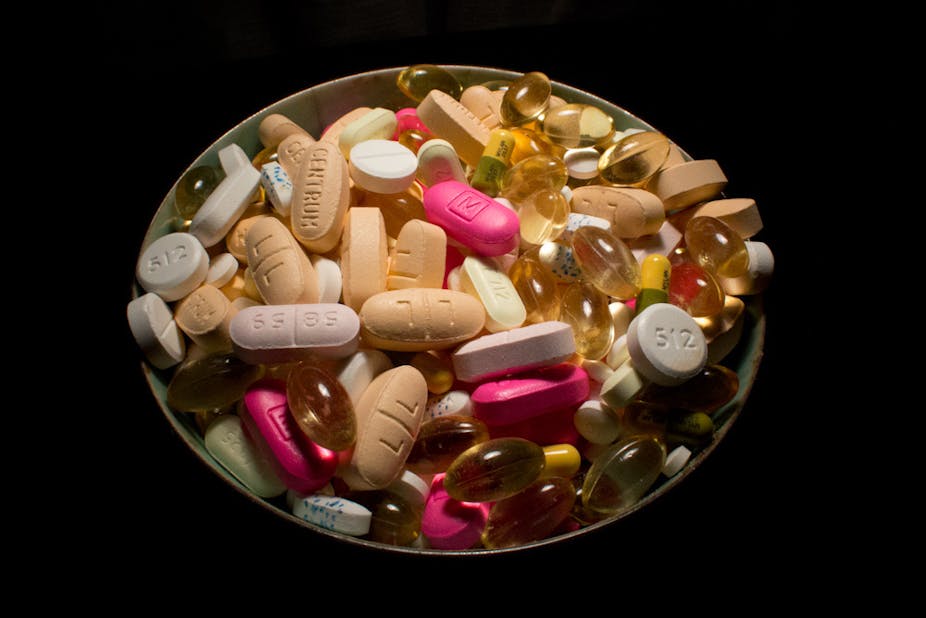
Dietary supplements are big business, and often people are easily drawn in by marketing claims and anecdotes that vitamin pills may be the answer to all their health concerns.
People with cancer tend to be very keen to find that “special something” to give them an edge in their fight against what is usually a frightening diagnosis. They’re also often surrounded by well-meaning family members and friends who suggest different types of supplements to help keep them strong or keep their “energy levels up”.
A study of supplement use by cancer patients in the United States found that between 64% and 81% of cancer patients and survivors used a vitamin or mineral supplement. And up to a third of cancer patients starting using supplements after they had been diagnosed. That’s a lot of people.
Those facing a battle with cancer deserve to know the full picture of what will and won’t help them survive their illness. With this in mind, a story in Thursday’s Fairfax papers about cancer patients and multivitamins deserves close examination.
The newspapers report world-renowned scientist Professor James Watson, who discovered the double helix structure of DNA, suggesting that patients could be undermining their cancer treatment by taking a high dose antioxidants. The reports are based on an article Watson published in the journal Open Biology, where he suggests that the reason late-stage cancers often become untreatable is because they produce high levels of antioxidants which block chemotherapy and radiotherapy from working.
The rationale for his argument is that antioxidants can be helpful in healthy people because they attack free radicals, which can damage DNA. But because many cancer treatments use free radicals to kill tumour cells, the counter argument may apply for those undergoing cancer treatment – the antioxidant supplements may prevent treatment from fulfilling its purpose.
Diet supplements and cancer
In a 2007 report, the World Research Cancer Fund assessed 39 randomised control trials of micronutrient supplementation in cancer survivors including retinol, beta-carotene, vitamin B6, multivitamins, vitamin E, selenium and isoflavones. It concluded that the evidence “does not show that diet supplements have any benefits in cancer survivors”.
What’s more, large-scale randomised controlled trials on the efficacy of dietary supplements for reducing the risk of cancer have raised serious safety concerns. Two of the trials (here and here), which involve people given high doses of beta-carotene, found the supplement was associated with a higher risk of lung cancer in smokers, while a third study showed neither benefit nor harm.
Most water-soluble vitamins (such as B vitamins and vitamin C) are thought to be harmless at pharmacological doses, but there are some concerns about the safety of other nutrients such as selenium, beta-carotene, magnesium and chromium, which are known to be toxic at such doses.
A meta-analysis of 47 high-quality trials found there was a slightly increased risk of mortality from antioxidant supplements in the general population. In particular, the analysis concluded that vitamin C and selenium had no significant effect on mortality and required further study but taking beta-carotene, vitamin A, and vitamin E may increase mortality.
The most recent review of multivitamin studies involving 91,000 participants found daily vitamin supplements don’t reduce the risk of dying from cancer or other causes of death.
What works
After not smoking, the most important steps people can take to lower their cancer risk are maintaining a healthy weight, being physically active and following a healthy diet. While it appears that people who eat more fruits and vegetables, which are rich sources of antioxidants, may have a lower risk of some types of cancer, the specific components that provide the protective effect are not definitively known.
It’s not possible to replicate the nutrient combinations found in food in supplement form, and because of the potential adverse effects high-dose supplementation may have, whole foods are more beneficial than supplements. The World Cancer Research Fund states that dietary supplements are not recommended for cancer prevention and people should aim to meet their nutritional needs through diet alone.
Supplements should only be taken when clinically required. There are some people with cancer who may require dietary supplements due to the side effects of their treatment or other health issues. And diet supplements may be needed by people with cancer who have a biochemically confirmed nutrient deficiency; where dietary intakes have been inadequate; and for problems related to cancer treatment or other health issues that may arise requiring supplementation.
There’s no evidence that diet supplements are a panacea for people who have cancer or for anyone who wants to prevent it. The adage that fresh fruit and veg is best still stands. People undergoing cancer treatment should always talk to their doctor about the other medication and supplements they may be taking, and seek the advice of a qualified dietitian regarding their nutrition if needed.
Sue Ieraci
Public hospital clinician
Thanks for the informative article.
One of the key bits of information here is that there is no single disease called "cancer". The genetics, risk factors, treatment options and clinical course of primary brain cancer, for example, are vastly different to bowel cancer, breast cancer and leukaemia. They are all different cell types, under different chemical and hormonal influences.
Any single therapy that is purported to cure "cancer" is highly likely to be a fraud.
Ann Bell
logged in via Facebook
My grandfather died of Hodgkins, my dad of Grawitz, mum has had breast cancer twice, I have the good (well curable at least) sort of cancer for the second time - thyroid cancer. I have received such wisdom as balance your blood ph levels, take gingko, take extra large doses of vitamins or herbs as they can't hurt, amazing really how many people are expert amateurs. :)
Edward John Fearn
Edward John Fearn is a Friend of The Conversation.
Hypnotherapist and Naturopath
Hi Ann
There is certainly some supporting evidence that Ginkgo bilobo extract may protect from possible genotoxic damage associated with treatment in patients requiring therapy for thyroid cancer, without affecting the clinical outcome.
http://www.ncbi.nlm.nih.gov/pubmed/22181338
A number other herbal medicines may also be of some value in cancer support as the following papers demonstrate:
A randomised, double blind, placebo controlled pilot study in 49 children with acute lymphoblastic…
Read moreRosemary Stanton
Nutritionist & Visiting Fellow at University of New South Wales
Edward
Thank you for providing references - although some may not be relevant to the antioxidant question in this discussion.
Read moreI checked your references and make the following comments:
Ref 1. Milk thistle extract in this study was to reduce some aspects of the toxicity of the chemotherapy the children required. The researchers note, however, that the small numbers provided insufficient power to draw any meaningful conclusion. Unfortunately, it's easy to find internet sites that claim milk thistle…
Edward John Fearn
Edward John Fearn is a Friend of The Conversation.
Hypnotherapist and Naturopath
Thank you for the in depth reply Rosemary,
I will attempt to cover all the points that you raised...
The paper on the Effects of red ginseng upon postoperative immunity and survival in patients with stage III gastric cancer used Panax ginseng, sometimes referred to as Asian ginseng. The extract can be found below.
http://www.unboundmedicine.com/5minute/ub/citation/12568276/Effects_of_red_ginseng_upon_postoperative_immunity_and_survival_in_patients_with_stage_III_gastric_cancer_
The…
Read moreSue Ieraci
Public hospital clinician
Hi, Edward. That first Korean paper on Ginseng only included 42 patients. I don't have access to the full paper. Can you go through their methodology and data for the rest of us?
Edward John Fearn
Edward John Fearn is a Friend of The Conversation.
Hypnotherapist and Naturopath
Hi Sue
I am afraid I don’t have access to the entire study, just some hand written notes and printed copies from overheads from I think one of Ass Prof Kerry Bones quite extensive workshops on integrated Cancer support.
It might be helpful however to examine some of the mechanisms in which P Ginseng may play a role in gastric cancer prevention and possibly even as an adjunct to treatment.
A large case-control study (1,2) and a small cohort study (3) have suggested that ginseng use is associated…
Read moreSue Ieraci
Public hospital clinician
Thanks, Edward. That small study you copied looked at 84 patients who received standard therapy (triple antibiotics) to eradicate H pylori, followed by a red ginseng regime. They found no statistical difference in additional eradication following the ginseng. All of the cellular changes they described occurred after all the patients were treated with standard antibiotic therapy. I don't see strong evidence here, although ginseng may do no harm if it doesn;t replace standard therapy, and doesn't interact with any other therapies.
Incidentally, the paper you cited declared funding from the Korea Ginseng Corporation. (I'm serious).
Edward John Fearn
Edward John Fearn is a Friend of The Conversation.
Hypnotherapist and Naturopath
Thanks Sue
As usual your evaluation was quite insightful, I read that paper through twice and failed to see the funding declaration at the bottom of the page on both occasions. (Just got my first set of reading glasses a week ago...)
One of the clear advantages of Ginseng, is the growing body of evidence that demonstrates improvements in cancer related fatigue. Both “Panax Ginseng” and “American Ginseng” seem to show some promise in this area.
http://www.atkinsginseng.com/Articles/fulltext…
Read moreRosemary Stanton
Nutritionist & Visiting Fellow at University of New South Wales
Thanks Kathy for this article.
To Ann Bell
There's a problem when people assume 'wisdom' is being dispensed when it is clearly not 'wisdom'.
The problem is that when there is a genuine gap in medical knowledge (and there are many), some people feel an urge to fill in that gap. Even worse, some take a conspiracy approach and assume that the medical profession silences solutions.
The promotion of 'antioxidants' is an example. Foods contain literally thousands of these substances, most with…
Read morePamela H.
logged in via email @hotmail.com
I would take this with a grain of salt.
Rosemary Stanton
Nutritionist & Visiting Fellow at University of New South Wales
Not sure what you would take with a grain of salt, Pamela. Can you be more specific?
Laurie Willberg
Journalist
The World Cancer Research Fund has a vested interest in collecting yet more donations like most Cancer Societies worldwide with extensive ties to the pharmaceutical companies that produce chemotherapy drugs. Their primary reason for being is self propagation. It's a no-brainer that they would attempt to undermine any orthomolecular approach to cancer prevention.
Read moreThe vitamin E study referenced by mainstream journals used synthetic E which is not the same as natural tocopherols. Most educated health…
Dave Hawkes
Research Officer (Viral tools and Neuropeptides) at The Florey Institute of Neuroscience and Mental Health
Yet again Laurie you have thrown a lot of accusations, conspiracies, and random statements without any evidence. Please supply the reason (chemical formulas and diagrams appreciated) why synthetic vitamin E is different from "natural" vitamin E. Your citation of the Journal of Orthomolecular Medicine led me to try and find article through searches of PubMed, but to no avail. A quick check of Wikipedia reveals that the journal is not considered of a high enough standard to be included.
Tim Scanlon
Debunker
Conspiracies, accusations, unreferenced statements and still not one shred of verified evidence from Laurie.
Calling "natural" and "synthetic" vitamin E as different and having differing health impacts shows that chemistry is not your strong suit.
Also, promoting a journal and field of quackery that is part of an AIDS denial movement is just crass. http://en.wikipedia.org/wiki/Journal_of_Orthomolecular_Medicine#Controversial_status
http://www.sciencedirect.com/science/article/pii/S0083672906750130
http://www.sciencedirect.com/science/article/pii/S0140673606697171
http://www.plosmedicine.org/article/info:doi/10.1371/journal.pmed.0040256
Peter Pain
Director
I beg to differ.
Read moreThere are reputable supplementation manufacturing companies who do know the difference between "synthetic" and "natural" supplementation.
The distinction is usually drawn to describe as "synthetic" as meaning a purified form of the particular vitamin, often created through a chemical process to produce a pure form. Everyday examples are Ascorbic Acid described as Vitamin C.
"Natural" supplementation is taken to mean a supplement created from a whole food or plant, having an enhanced…
Tim Scanlon
Debunker
Peter, if you look at what Laurie is referring to with the Journal of Orthomolecular Medicine reference, you will see that what her definition is different and based on the debunked work of Linus Pauling and the degenerate Matthias Rath.
Read more here:
http://www.sciencebasedmedicine.org/index.php/how-do-scientists-become-cranks-and-doctors-quacks/
http://www.sciencebasedmedicine.org/index.php/should-i-take-a-multivitamin/
Laurie Willberg
Journalist
Well, Dave, as I mentioned to Tim, Wikipedia is about the least scholarly reference you could possibly cite. Try using it as a reference in a University essay and wait for those failing grades to come back.
Natural Vitamin E is derived from vegetable oils, primarily soybean oil. Synthetic Vitamin E is produced from petrochemicals. A key difference scientists are examining is the structure of the compounds.
•Natural Vitamin E is a single stereoisomer.
•Synthetic E is a mixture of eight stereoisomers, only one of which is the same as natural Vitamin E (alpha-tocopherol).
In synthetic Vitamin E, seven of the stereoisomers have different molecular configurations and lower biological activities when compared to natural Vitamin E. That means, the synthetic versions are less capable at providing health benefits in the body
Tim Scanlon
Debunker
Massive chemistry fail Laurie. You are wrong, Vitamin E is eight isomers with one of those isomers, d- alpha-tocopherol being the most biologically available form. Synthetic forms merely replicate these isomers and they also make homologues, which contain an extra CH2 which rotates the phytyl group.
So, not only are the "natural" Vitamin E isomers available, extra ones are also available. Given that d-alpha-tocopherol is the most readily absorbed these other isomers are generally not utilised…
Read moreSue Ieraci
Public hospital clinician
Confusing, Peter Pain. You say that the combination of ingredients from the whole plant is preferable to single extracts. This is exactly what the author of the article states - it's the premise of this discussion.
Why, then, would you promote extracting certain combinations of ingredients without others? What evidence is there that doing this is preferable to just eating the whole food?
Also, you say that supplementation for healthy people is supported by JAMA. DId you know that JAMA is a journal? How can a journal support any particular approach?
Could you pls link to those clinical and epidemiological studies that you claim show a benefit of supplements for healthy people?
Chris Booker
Research scientist
"The World Cancer Research Fund has a vested interest in collecting yet more donations like most Cancer Societies worldwide with extensive ties to the pharmaceutical companies that produce chemotherapy drugs"
evidence please.. because I don't see any. Let's see: a charity dedicated to amassing and summating vast quantities of medical evidence on the role of diet and physical activity in cancer prevention, being funded by a pharmaceutical company that makes money off chemicals used in treating cancer? Maybe you should have thought that accusation through...
Laurie Willberg
Journalist
Natural vitamin E is superior, including bioavailablity, however natural medicine is not your specialty, is it. Your confirmation bias is showing.
Dave Hawkes
Research Officer (Viral tools and Neuropeptides) at The Florey Institute of Neuroscience and Mental Health
Evidence? Just because someone with no credentials or qualifications says something it doesn't mean people will take it as a fact. Please provide links to (ideally, double-blind, randomized, placebo controlled human clinical) studies that support your statement.
Laurie Willberg
Journalist
You don't "see any" because you don't want to.
Let's start with the American Cancer Society http://www.preventcancer.com/losing/acs/wealthiest_links.htm
the wealthiest non-profit in the world. People are boycotting it because they're investing in real estate and automobiles for their executive.
Check out SourceWatch for the details on where the big money comes from.
Yes, Chris, I "thought that accusation through" because the evidence is in.
Tim Scanlon
Debunker
And once again you fail to provide any actual evidence, just more hearsay and conjecture.
I've already explained the chemistry behind vitamin E supplements, with references. Unless you can come up with some amazing insights, with references to actual evidence, then it is safe to say that you are lacking in substance and proof.
Chris Booker
Research scientist
I'm talking about WCRF International, the institute which authored the reports you seem to so passionately disbelieve (out of some strange notion they have a conflict of interest with pharmaceutical companies). WCRF International consists of:
American Institute for Cancer Research
WCRF UK
WCRF Netherlands
WCRF Hong Kong
source: http://www.wcrf.org/wcrf_global_network/wcrf_international/index.php
The American Cancer Society isn't on that list.
Now maybe you could explain why WCRF International, by reviewing scientific evidence and publishing reports of their conclusions - showing that increasing physical activity, reducing overweight, and modifying dietary intake is likely to reduce the risk of lifestyle-related cancers,
somehow adds up to "It's a no-brainer that they would attempt to undermine any orthomolecular approach to cancer prevention."
Rosemary Stanton
Nutritionist & Visiting Fellow at University of New South Wales
Indeed, Laurie has got the chemistry wrong.
Naturally occurring vitamin E consists of 8 related compounds (alpha, beta, delta and gamma tocopherols and alpha, beta, gamma and delta tocotrienols).
Food sources include seeds, nuts, wholegrains (especially the germ of wheat) and vegetables.
Initially, only alpha tocopherol levels in the blood were measured and alpha tocopherol was assumed to be the only one of the vitamin E family to be relevant for health. That was a bit like the assumption…
Read moreRosemary Stanton
Nutritionist & Visiting Fellow at University of New South Wales
Laurie
SInce your earlier post showed you had the facts wrong on what 'natural' vitamin E is, perhaps this is a topic you should leave to those who understand some biochemistry.
Laurie Willberg
Journalist
Not reading isn't any better than not being able to, Tim. In your case, massive reading fail.
The take-home message is your pathetic attempt to bolster anything synthetic or chemical as being superior to anything natural despite any evidence to the contrary.
Consumers are interested in comparative studies in order to know "which one" to buy. If you're really interested in studies, since you don't like the Journal of Orthomolecular Medicine you can subscribe to Natural Standard online. Fortunately nobody consults you as a preventive health care provider -- you may have noticed you aren't one. Dithering about chemistry gets you a big nothing except perhaps a boost to your ego.
Tim Scanlon
Debunker
Wow. Laurie, considering you were just lecturing someone else about ad homenium attacks, to use one on me just shows how weak your position is and how hypocritical you are.
Unlike my arguments, which have attacked your arguments rather than you personally, you have repeatedly denigrated me for having actual knowledge about topics. The fact that you haven't referenced any reputable sources of information and have shown a complete lack of knowledge on the subject of vitamin E.
Your strawman argument…
Read moreTim Scanlon
Debunker
Just to clarify, I don't regard myself as having expertise in biochemistry nor nutrition, but I have studied both at a cursory level.
Laurie Willberg
Journalist
@Tim Scanlon
Up to your old tricks of posting your opinions, and those from skeptic-group blogs as facts again. Wikipedia is most certainly not a scholarly resource, and certainly not since "skeptools" was created as an online resource for people with a definitive bias against natural medicine to "edit" and manipulate the information there in an unfavourable/negative way. How mature of you to label researchers in a field you don't like as "degenerate".
A real degenerate is someone like James Randi who was arrested by the Toronto police for soliciting phone sex from underage boys.
Nobody has "debunked" Linus Pauling's work. Science bloggers/skeptics seem to love to philosophize and lob cheap shots at anything non-mainstream, however they do no actual research so have zero credibility in the medical or any other field. They should really stick with their origins -- writing diatribes against clairvoyants and UFOs.
Tim Scanlon
Debunker
Yes, curse me for using science as my opinion.
Let's take a look at the research that has debunked Pauling's work on Vitamin C:
Read moreCreagan ET and others. Failure of high-dose vitamin C (ascorbic acid) therapy to benefit patients with advanced cancer. A controlled trial. New England Journal of Medicine 301:687-690, 1979.
Moertel CG and others. High-dose vitamin C versus placebo in the treatment of patients with advanced cancer who have had no prior chemotherapy. A randomized double-blind comparison…
Sue Ieraci
Public hospital clinician
Linus Pauling was primarily a chemist. He won his first Nobel prize for elucidation of the nature of chemical bonding. He had also used XRays to investigate crystalline molecular structure.
In the 1940's, he worked on organic chemistry, looking at proteins (specifically antibodies) and looking for a replacement for blood plasma.
Towards the end of WWII, he became concerned about damage from atomic radiation and began campaigning against nuclear testing. He was an exceptionally talented scientist and admirable person.
IN relation to VItamin C, however, his theorising was not borne out by evidence. The theories that he coined "orthomolecular" were based on theoretical speculation - not clinical or laboratory studies.
Geoff Russell
Computer Programmer, Author
Pauling got the radiation stuff completely and utterly wrong also. Being really clever doesn't necessarily make you right.
Dave Hawkes
Research Officer (Viral tools and Neuropeptides) at The Florey Institute of Neuroscience and Mental Health
Hi again Laurie, You have made a number of posts and accusations on this thread without a single reference or link. I searched for your accusations against James Randi and the only place they appear is on "The Bolen Report" which is a site run by a notorious crackpot. If you have a link to further evidence please feel free to include it. You describe yourself as a journalist but when I search for your articles all I can find is a blog post o a homeopathy site and a lot of comments you have made such as in this thread. You don't have any evidence to back anything you say up, if you do please attach links in your next post
Laurie Willberg
Journalist
You might look up the archives of the Toronto Star re: James Randi. It happened decades ago. Since hardly anyone has heard of him or remembers him it's not surprising that his antics aren't referenced much any longer. Nobody cares.
It seems anyone who disagrees with you is a "crackpot". That seems to be the favorite last resort of "skeptics" -- an ad hominem remark. You seem to be labouring under some delusion that your opinions are superior to mine. Suppose you post links -- other than scienceblogs or other pseudo-skeptic opinion sites -- that counter them. Your claims that I "made things up" is a typical and very transparent skeptic tactic.
Dave Hawkes
Research Officer (Viral tools and Neuropeptides) at The Florey Institute of Neuroscience and Mental Health
What part of "post a link" was unclear. As I said all links I found to the accusation you made were by Tim Bolen. I stand by my description of Tim Bolen but as it is personal opinion (crackpot is purely an opinion unlike if I called him tall which is based on a fact) I don't need to supply evidence. You however have made definitive statements about Vitamin E (the topic of this article) that you have inferred were facts. Please provide evidence for even this single statement;
"Natural vitamin E is superior, including bioavailablity"
I should also point out that I have not attacked you or said that your opinions were any less valid than mine, just that if you make statements of fact you need to supply evidence.
Tom Hennessy
Retired
"In 1937 Vitamin E was finally synthesized as a chemical laboratory product and more researchers began to use it, but no one was to know until 1962 that the synthetic product would be proved by the strictest tests to be only one-fifth as powerful as the product derived from natural sources"
Dave Hawkes
Research Officer (Viral tools and Neuropeptides) at The Florey Institute of Neuroscience and Mental Health
Hi Tom,
Could you please provide a citation for this
Tim Scanlon
Debunker
Tom, I have already referenced the science of vitamin E. The figure is actually 0.75, and is down to the transportation of the rotated pytyl group between liposomal membranes is lower. And this also varies by what isomers of vitamin E are present, with d-alpha-tocopherol being the most bioavailable, and it being in differing volumes in some supplements. https://theconversation.edu.au/vitamin-pills-role-in-recovering-from-cancer-11535#
Tom Hennessy
Retired
I might actually have to pull out a book to get a rerference for the very old studies which found five times difference.
"Human plasma and tissue alpha-tocopherol concentrations in response to supplementation with deuterated natural and synthetic vitamin E"
"The results indicated that natural vitamin E has roughly twice the availability of synthetic vitamin E"
http://www.ncbi.nlm.nih.gov/pubmed/9537614
Tom Hennessy
Retired
I guess its who you talk to , I found the quote but they didn't give any reference , just offhandedly said as if it was well known. This one though , agrees.
"Natural-source water-dispersible forms of vitamin E were 5-6 times more bioavailable than synthetic vitamin E acetate, and a 5000-IU dose more than doubled serum vitamin E levels within 12 hr."
http://www.ker.com/library/health/2010/07/form-of--tocopherol-affects-vitamin-e-bioavailability-in-thoroughbred-horses.html
Rosemary Stanton
Nutritionist & Visiting Fellow at University of New South Wales
A vague reference to the Toronto Star is not good enough. A google search shows others on several blogs have made the same vague and unsubstantiated accusation. Please be more specific and if you are just repeating a rumour, please say so.
Rosemary Stanton
Nutritionist & Visiting Fellow at University of New South Wales
Tom
Comment in AJCN http://ajcn.nutrition.org/content/72/1/201.long based on your quoted reference
http://www.ncbi.nlm.nih.gov/pubmed/9537614 reports that 1 mg natural vitamin E is equivalent to 2 mg synthetic vitamin E.
The authors in the AJCN published comment note that much of the problem has arisen from manufacturers trying to convert the different potencies of various forms of vitamin E by using international units rather than milligrams. In doing so, they have ignored the role of the tocopherol transfer protein in the liver. As they explain, this transfer protein is the major discriminating locus for selecting the appropriate isomer (which is RRR-αtocopherol) for secretion into plasma lipoproteins, taking account of both newly ingested vitamin E and recycled forms of the vitamin within the body.
Tim Scanlon
Debunker
Correct me if I'm wrong, but those are not the same isomers of vitamin E being compared. I think one is the homologue with the rotated phytyl group. If this is the case, then it isn't really that interesting as I've already mentioned this point.
Alie Thompson
logged in via Facebook
Dear Tom
A verbatim quote from whale.to is not a citation (http://www.whale.to/a/vite.html). I am sure, if there is real scientific evidence for your assertions, you will be able to provide it.
Good work with the quotation marks though. There is still hope once you've read some real science.
Sue Ieraci
Public hospital clinician
"Since hardly anyone has heard of him or remembers him"
Wrong again, Laurie Willberg. James Randi was a speaker at the 2012 Australian Skeptics conference in Melbourne. Since he's now into his eighties, it is not surprising that he is not as active as previously.
Randi was never arrested by Totonto police - though he was sued for libel (unsuccessfully) by someone who had been convicted of child molestation.
Clearly he remains a thorn in the side for homeopathy proponents.
Tom Hennessy
Retired
It depends on who made the verbatim quote isn't it. If one were to use a quote , of which you are familiar , one might think the very fact he made the quote may be enough to staunch any possible disagreement as to whether the statement has any authority ? I used the quote marks so you could find it if you wished to find it and the fact one Herbert Bailey said it is enough , to me , to take the statement as if there was and is Science backing it , but , as I said , he said it without giving a citation and therefore WHY he said it so offhandedly without giving a citation remains to be discovered. I suppose at the time of the writing the evidence was apparent and since has disappeared in the great expanse of scientific evidence out there somewhere. Probably Russia since they did some of the best work.
Tom Hennessy
Retired
"There’s no evidence that diet supplements are a panacea for people who have cancer"
Actually , this , just in.
"IP6 backed for prostate cancer prevention"
Tom Hennessy
Retired
http://www.ip-6.net/
Coincidentally , natures premiere iron chelator.
Found in the chaff of your grain and other plants to a lesser extent , unleavened bread is high in it.
Tim Scanlon
Debunker
Battling to find a real reference past about 1999. Sounds like IP6 has/had potential, but it is already present in quantity in the diet. I'd be interested to hear from the cancer researchers as to what the story is with IP6.
http://jn.nutrition.org/content/133/11/3778S.short
Tim Scanlon
Debunker
Another reference of it being used to enhance chemotherapy.
http://www.tandfonline.com/doi/abs/10.1207/s15327914nc5502_1
Chris Oliver
Blackmores Institute Research Director at Blackmores Ltd
The problem with the article about the Watson comments on antioxidants and cancer is that many people have actually not read Watson’s article. For a start some sections of the media have cited Watson’s paper as a ‘new study’ – it’s not, it’s an opinion piece. The idea that antioxidants may have a conflicting role in cancer treatment is not new either; it was raised as early as 1999. Watson’s aim in writing his article was as much directed at current cancer treatment and research as it was against…
Read moreSue Ieraci
Public hospital clinician
Chris Oliver from Blackmores says "Best we cross off diets rich in fruit and vegetables which are contain antioxidants for cancer prevention or cancer sufferers? I think not."
Chris, did you actually read the article? The author is recommending a diet of good food rather than supplements.
Perhaps Blackmores could diversify into fresh food providores.