Water-based battery a step up for renewable energy

Energy storage will be critically important as we work towards sustainable living. Developing cost-effective ways to store large amounts of electricity from wind turbines and solar farms will be essential in turning from fossil fuels to renewables as our primary source of energy. As these technologies…

Psztyq7f-1346206590
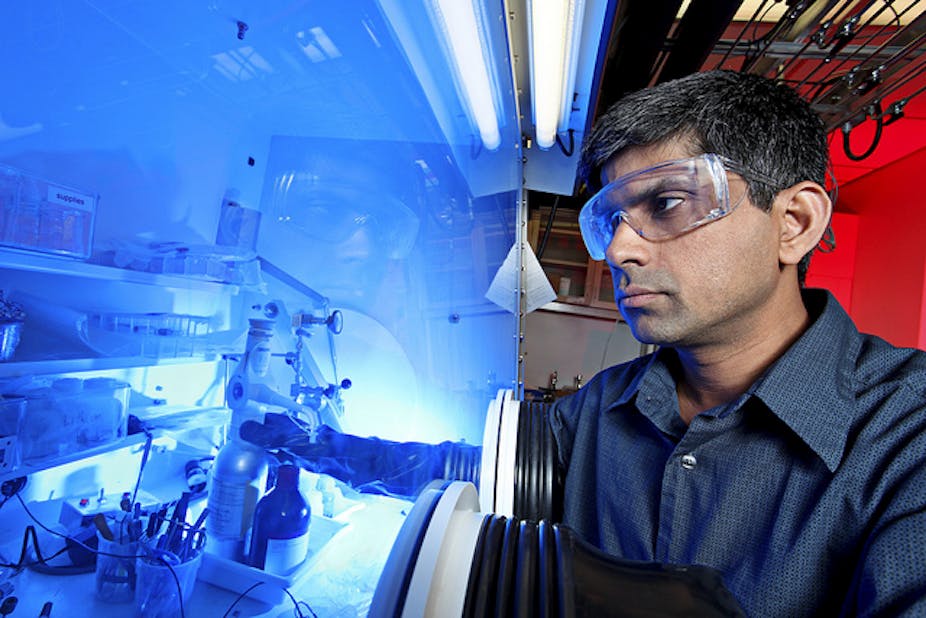
New research has uncovered significant environmental benefits in converting to a water-based battery. oakridgelabnews/Flickr

Energy storage will be critically important as we work towards sustainable living. Developing cost-effective ways to store large amounts of electricity from wind turbines and solar farms will be essential in turning from fossil fuels to renewables as our primary source of energy.

As these technologies develop and our reliance on them grows, there will be an increasing need for rechargeable energy storage capability. Although wind and solar generated electricity is becoming increasingly popular in many countries including Australia, these natural sources provide only intermittent energy; thus energy storage systems (like batteries) are required to store the energy until needed by the electrical grid.

A water-based sodium battery is an affordable and safe option to store power from renewable generation.

Batteries with high energy density (large storage capability) enabling back up for wind and solar power typically can’t store much energy. They have historically been based on lead-acid (Pb-acid) chemistry. As a positive, Pb-acid batteries are known to last up to a decade depending on the depth of discharge (if you discharge them regularly they last longer; irregular discharges shorten their life). However, they employ highly toxic electrodes and use highly corrosive sulphuric acid as the electrolyte, and only provide meagre energy density.

These issues highlight the critical need to replace the Pb-acid battery. But high cost and safety issues of alternative battery chemistries present significant challenges. The lithium-ion battery is one viable alternative, although the trade-offs between performance, safety and cost have significantly hampered its utility.

Lithium batteries can have an extended cycle life if they are used relatively gently (they can’t be fully discharged, for example). This means their energy density is inadequate for the price. The electrolytes in lithium batteries have some problems: they can be toxic, flammable and have other safety issues. They’re also expensive, meaning the manufacturing costs of lithium batteries are high.

For safety concerns, water based electrolytes are the natural choice in this field. Water is cheaper than organic solvents and has fewer disposal and safety issues. The ionic conductivity of aqueous electrolytes is two orders of magnitude greater than that of organic electrolytes. This allows higher discharge rates (you can run the battery flat more often) and lower voltage drops due to high conductivity of the water based electrolyte.

The aqueous battery is particularly interesting in land-based applications, such as electric grid stabilisation. In these situations, low weight and and high capacity are not critically important.

Another benefit of the water-based sodium battery is that sodium deposits are in plentiful supply around the world and at lower cost than lithium resources. It works at room temperature and uses sodium ions, an ingredient in cooking salt. The sodium-ion battery is a promising energy storage device that can be placed in power generation areas.

This new concept – patented at Murdoch University – replaces lithium with a sodium component in the device’s makeup, resulting in a more environmentally friendly system. The battery offers a four-fold energy increase, whereas conventional approaches can hope for a one-fold increase at best.

A key outcome of this research is it addresses one of the biggest technical challenges to a cleaner electricity system — affordable storage. Its findings bring an increased capability to store renewable power and with it, a reduced dependence on natural gas power plants.

Australia can have a streamlined electricity supply system, and manage its generation and storage to maximise the benefits to the local community. This will be done to increase efficiency and lower the cost of energy production, and to facilitate the use of intermittent energy sources such as wind and solar power.

Sign in to Favourite

Want to follow The Conversation?

Sign up to our free newsletter to get the day's top stories in your inbox each morning, with a special wrap on Saturday.

Spinner
Help us have better conversations — donate

Join the conversation

29 Comments sorted by

  1. John Newlands

    tree changer

    I think energy storage has to be practical at the gigawatt-hour scale and add less than 50% to generation costs. Example; a city needs 2 GW of power for 10 hours on a winter night with realtime generation cost 10c per kwh. Thus energy storage should be 20 Gwh costing less than 15c (delivered wholesale cost) per kwh. That appears to be beyond the capability of current batteries.

    Some have suggested now PV is cheap that home batteries (or plugged in electric cars) and smart meters could solve the energy storage problem by spreading it over millions of homes. However the tens of billions in public and private cost would be so high I'm not sure if we can ever get there. A substantial fraction of nuclear baseload would make the storage task simpler.

    report
    1. William Ferguson

      Software Developer

      In reply to John Newlands

      Without having *any* figures on the cost of storage $/kWh how can you say " the tens of billions in public and private cost would be so high"?

      In my opinion, distributed generation and distributed storage is a no brainer (once they achieve reasonable price point parity) as they are less susceptible to disruption.

      They are a couple of storage options that look likely to come to market within the next 0-4 years that would seem to offer quite good storage options for a reasonable price. I have been considering a 100kWh system for our house, enough for 4 days of solid usage. Currently cost (and dropping) $25,000, Size 3000L (same as my water tank). So 20GWh of storage is 200K systems for a cost of $5B.

      NB for 20GWh you're talking about a pretty big city. On the range of about 2 million households or 5 million people.

      I'm keen to hear what the price/kWh of this Sodium storage will be, because as noted for grid storage, weight and to some extent size are not that important.

      report
    2. David Jones

      Engineer

      In reply to John Newlands

      John,

      we have had the ability to do this for about 100 years. It is called pumped storage hydro. There are about 60 GW of installed capacity world wide including over 1 GW here in Australia.

      I invite you to look at Splityard Creek Dam. It is the small reservoir just east of Wivenhoe Dam, near Brisbane. Splityard Creek is the upper storage for a 500 MW PSH system which was built in about 1980. It does exactly what you request only at 0.5 GW rather than 2 GW.

      There are 23 dams in Australia which have reservoir capacities greater than 1 million Ml (Wivenhoe is 1.16 million Ml), many of which are suitable for similar schemes. Splityard creek is only 28 thousand Ml; tiny in comparison with Wivenhoe. It is possible to build much larger schemes than this in Australia.

      Pumped Storage Hydro does not consume water or interfere with fish passage.

      report
    3. Alan John Emmerson

      Former chief engineer , Civil Aviation Authority

      In reply to David Jones

      Rather more years than that in fact David. The blast furnaces at Coalbrookdale had blowers that were driven by water wheels fed from reservoirs that were filled by steam driven pumps. PSH in 1750 or there abouts.

      report
    4. John Newlands

      tree changer

      In reply to William Ferguson

      I presume that $25k does not include the costs of a large PV array. While the panels may last 20+ years I presume the batteries will need replacement within 10 years. That would be $2.5k a year straight line depreciation on $25k. As well as the high levelised cost many tiny suburban backyards could not accommodate a battery shed, rainwater tank and no doubt the vegie patch that goes with self sufficiency. Given the dramas with pink batts thousands of home battery banks sound like a problem waiting to happen.

      In order to draw Gwh from thousands of home batteries some kind of reverse smart metering system would be required. More expense. There may be other problems with reversing the normal current flow. I find it hard to imagine an aluminium smelter drawing 200 MW from thousands of home batteries at 2 a.m.. If somebody puts up the money for a trial I'll be in it.

      report
    5. Zvyozdochka

      logged in via Twitter

      In reply to David Jones

      I was expecting the word "nuclear" in your post and you didn't disappoint.

      "Tens of billions in public and private cost would be so high I'm not sure if we can ever get there" as opposed to the tens of billions spent installing exactly the same infrastructure we do now. More of the same grid design thinking is precisely the problem.

      Money is being spent on energy infrastucture now - it needs to be more creative and forward thinking than 100 years ago.

      report
    6. William Ferguson

      Software Developer

      In reply to John Newlands

      Why would I want a PV array? I was considering using the storage to arbitrage peak/off-peak power.The cost of these batteries is failing by about 20%/annum. In 4 years time they'll be half the price. At some point in the near future they energy arbitrage will be a viable income stream. I'd like to know when.

      And no, the battery tech I am considering looks likely to have a 60+ years lifespan. You're really thinking in the past here John, we're not talking lead/acid and neither is the author. Zinc/Air or maybe this Sodium/Water

      A 3KL battery (like my 3KL water tank) could fit snugly against the side of my house. 2m * 2m * 0.75m. Not so large.

      report
    7. Zvyozdochka

      logged in via Twitter

      In reply to Zvyozdochka

      Forgive me David, my reply was actually intended to John Newlands.

      report
    8. David Jones

      Engineer

      In reply to Zvyozdochka

      Thankyou, I was a bit puzzled by the comment.

      I am not at all in favour of nuclear energy. I see pumped storage as a perfect complement to renewable energy.

      report
    9. Michael Hay

      retired

      In reply to David Jones

      To David Jones: Where is the need to build 'much larger schemes'?. Would it not be better the merely increase the number of schemes, each one matched the greater or lesser amount of water storage available - even to the point of constructing water-wheels on permanent creeks. Such electricity does not require battery storage as the creeks and rivers chosen would only be those with a permanent supply. Even in our much-vaunted "land of droughts" has a tropical section with over-much water supply.

      report
  2. Tim van Gelder

    University of Melbourne

    This sounds great (though my "if it sounds too good to be true, it probably is" reflex is kicking in). What I'd like to hear more about is: how soon will these be available for household use, at what cost, and with what practical drawbacks?

    report
    1. Alan John Emmerson

      Former chief engineer , Civil Aviation Authority

      In reply to Tim van Gelder

      What is actually new here? We already have " water based" batteries in the lead acid scheme and we already have alkaline batteries using potasium.
      hydroxide .as an electrolyte

      Is the active material in the plates some thing new?

      Batteries can be dreadfully inefficient. The amphours needed to recharge a battery divided by the amphrs it will deliver is called the recharge factor . Recharge factors of about 1.25 were common for NiCd alkaline batteries. What recharge factor is expected with the new battery?

      report
  3. David Collett

    IT Application Developer at Web Generation

    Excellent! Thanks for doing this work and taking us closer to getting all our power from renewable energy.

    Very exciting stuff.

    report
  4. Ian Donald Lowe

    Seeker of Truth

    Thank you for this article. I agree that it is the energy storage issue that needs to be addressed if renewable energy sources are to become viable. (There must also be a shift to lower energy usage on an individual level, which helps reduce storage needs as well.)
    I wonder if the authors are aware of the work done at Pyramid Hill Salt works and the saline pond system they use to generate heat? Also, there have been proposals to develop a large-scale solar/thermal tower in the Mildura region that…

    Read more
    1. Michael Hay

      retired

      In reply to Ian Donald Lowe

      Thank you, Oh seeker of the truth. Perhaps you may have inspired some engineers and inventors to think outside the square and to place use of the imagination well before the 'can't be done' and the 'too costly' are rushed in to quell the results. If we had enough thinkers and innovators being vocal surely someone would see the benefits of practical solutions.

      report
    2. Luke Weston

      Physicist / electronic engineer

      In reply to Gary Murphy

      Two plants, each of 50 MW nameplate power capacity. They will each produce 160 GWh of power [sic] per year.

      160 GWh / (50 MW * 1 year) = 36.5% capacity factor.

      For comparison, Loy Yang A for example generated 14.925 TWh in 2011, with a 88.67% capacity factor.

      When it comes to actual coal generation replacement, basic energy numeracy shows us that these solar plants held up as a wonderful example by the "renewable" evangelists are just a joke.

      Obviously that heat storage is trivial in…

      Read more
    3. William Ferguson

      Software Developer

      In reply to Luke Weston

      Luke, you've brought to wrong argument to this particular street fight.

      The topic on hand is energy storage. Generation is another entirely different topic.

      report
  5. Mark Amey

    logged in via Facebook

    Lovely work.

    As usual, us average punters are indebted to scientists and engineers who are working hard in fields that rarely cross our minds.

    Thumbs up!!

    report
  6. John Harland

    bicycle technician

    it is refreshing to read about research into costs per kilowatt-hour.

    So much less headline-attracting than reducing mass and bulk of batteries, but so much more relevant to many purposes.

    However the energy recovery - the in:out ratio - is also important but seemingly not answered in the article.

    report
  7. Ken Fabian

    Mr

    I don't think pumped hydro at large scale is viable in Australia because of constraints of geography and climate. Batteries may indeed get lots cheaper and for those with rooftop solar the attraction of in-home storage like this technology in Europe is obvious - http://www.eurekanetwork.org/c/document_library/get_file?uuid=66e19fb9-d4b8-4afa-bc37-c4a7b7a574c6&groupId=10137
    - enough for a single evening peak and overnight - might see it gain a market here; run directly from solar when available…

    Read more
    1. Michael Hay

      retired

      In reply to Ken Fabian

      Ken, the land from the the Barkly Tableland falls to the south. No need for pumping, gravity will suffice - and north of the Barkly is a tropical, very wet area. Perhaps a transfer of water is fully feasible - and there is a need for more water in the Darling River and the Coorong.

      report
  8. Gerard Dean

    Managing Director

    I am confused!

    "The battery offers a four-fold energy increase, whereas conventional approaches can hope for a one-fold increase at best."

    What does the statement mean?

    - Does it mean that lithium battery technology might double its capacity in coming years (1 fold increase)?
    - Does it mean that the water based battery can hold 4 times the energy per volume than a lithium battery?
    - Or that the water based battery will have 4 times the capacity of a lithium battery in future?
    - Or that the water based battery can be improved in coming years to hold 4 times the energy than it does at the moment?

    It would be great if the authors could clarify what is meant by the claim.

    Thanks

    Gerard Dean

    report
    1. Gerard Dean

      Managing Director

      In reply to Gerard Dean

      Hello, hello

      I am very interested in batteries, so it would be great if someone could explain the above question I posed. The reason I ask is because lithium batteries have quickly replaced nickel cadmium and nickel metal hydride batteries in heavy discharge devices such as power tools.

      The article appears to hint that the water battery has a higher performance than the lithium battery. If this is so, it is extraordinary.

      Most of the world's lithium is in Bolivia and is a finite resource, so the water based battery is very interesting.

      Thank you

      Gerard Dean

      report
  9. Luke Weston

    Physicist / electronic engineer

    For a little bit more technical detail about what a sodium-ion battery with an aqueous electrolyte actually is and what type of chemistry and materials it involves (which I have to admit I found a little lacking in this piece) I quickly looked up a couple more resources which other readers may find interesting:

    http://www.abaa5.org/files/downloads/abstract_okada.pdf

    http://www.sandia.gov/eesat/2011/papers/Tuesday/05_Whitacre_EESAT_Abstract.pdf

    report
    1. Manickam Minakshi-Sundaram

      Senior Research Fellow at Murdoch University

      In reply to Luke Weston

      Hi Luke, Gerard and others,

      First of all many thanks for all your comments on our article. It is so nice to see this many people are interested in energy (battery) research. Apologies for getting back to you late (Gerard). Actually I was away from internet in the past few days. Danielle will be away until 29th of this month.

      Luke, Gerard : In this article, the type of chemistry and materials involved in our sodium battery technology is intentionally left lacking (without giving a clear picture…

      Read more
    2. Gerard Dean

      Managing Director

      In reply to Manickam Minakshi-Sundaram

      Thanks for the response Dr Minakshi, greatly appreciated.

      I am not an expert in this area, although I do use batteries in my work , so I am aware of the capacities of mainstream battery systems. This tells me that obtaining up to 4 times the energy density of lead acid and lithium batteries is not bad at all, actually, it is pretty amazing.

      The other plus is the reduction in heavy metals which is great. Years ago dry batteries contained lead, then nickel cadmium batteries dominated the rechargeable market until replaced by metal nickel hydride and now lithium.

      Unfortunately I cannot help with research funds having pre-committed my small company's R&D budget to improving our products, however I do wish you well in the project.

      Thanks

      Gerard Dean

      report
  10. Manickam Minakshi-Sundaram

    Senior Research Fellow at Murdoch University

    Reply to Luke Weston,

    Hi Luke, Gerard and others,

    First of all many thanks for all your comments on our article. It is so nice to see this many people are interested in energy (battery) research. Apologies for getting back to you late (Gerard). Actually I was away from internet in the past few days. Danielle will be away until 29th of this month.

    Luke, Gerard : In this article, the type of chemistry and materials involved in our sodium battery technology is intentionally left lacking (without…

    Read more
    1. William Ferguson

      Software Developer

      In reply to Manickam Minakshi-Sundaram

      Wow, 300Wh/Kg. congratulations Manickam that is impressive.
      When you release details will you be able to provide some base estimate on cost per Wh?

      report