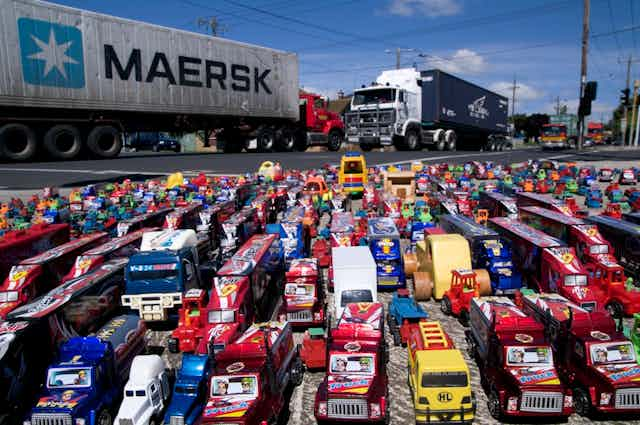

Over the next 50 years the world will increasingly confront a dilemma. On the one hand, the global economy and local lifestyles depend on the mobility of people and goods. On the other, that mobility depends on a diminishing supply of cheap oil and the urgent need to reduce carbon emissions and other environmental impacts.
Reducing Australian carbon emissions to near zero over 50 years will require a transformation in the way we think about urban transport.
Local transport is a global problem
City transport – traffic congestion, motorways, rail services and timetables, bus routes – are local issues aren’t they? Don’t they mostly have to do with cars, trains, buses and commuting? Well, no.
Urban transport confronts a global dilemma which will not be resolved by patching up the transport systems of our cities with a new motorway link here, a new rail service there, and a few new bike paths and footpaths. The global problem is not mainly one of passenger traffic, but of goods traffic.
The mobility of people and goods worldwide is still at present almost completely (98%) dependent on cheap oil, and the economies of cities are connected seamlessly with the global economy. But the supply of oil is now close to a ceiling, and the environmental impact of burning fossil fuel is unacceptable.
The annual figure for merchandise trade (intra and inter-regional) just after the global financial crisis in 2009 stood at $US12.178 trillion. That is goods in motion.
The US economic journalist Thomas Friedman wrote of the intensively organised travels of Dell digital notebook parts. Key elements of the notebook’s hardware come from the Philippines, Malaysia, Taiwan, Germany, Mexico, Singapore, Thailand, India, Israel, and of course many different cities in China. This is just one example.

Almost everything we use now has a large element of mobility built into it: not only food, but white goods, electrical equipment, computers, clothes, furniture, cars and their components, even books. We can reasonably speak of the “embedded mobility” in almost all consumer goods.
These global movements of goods shape cities. Efficient flows of goods need unimpeded access of freight to and from the logistics nodes of warehouses and factories. Affordable space is needed for these nodes to spread out their sheds. In Europe distribution centres may be 70km away from ports. In the New York region and the Inland Empire east of Los Angeles there is “freight sprawl”. Growth in the global economy is dependent on increasing – not diminishing – mobility.
We can’t keep banking on oil
The other horn of the dilemma has two parts. First, renewed global growth is incompatible with oil dependence. The price of oil puts a cap on growth because when demand increases the price of the limited oil supply rises.
Second, dependence on oil or any fossil fuel is incompatible with saving the earth from runaway global warming. In order to avoid “dangerous anthropogenic climatic change”, the climate conference in Copenhagen in late 2009 endorsed the European Union target of restricting the average global temperature rise since the start of the industrial era to 2 degrees Celsius.
If we accept this limit, the world would have to cut CO2 emissions in the year 2050 to about 15% of their year 2000 value. This ambitious reduction target would mean that global annual fossil fuel use would have to be limited to about 50 exojoules (1018 joules), rather than the 437 exojoules we used in 2010.
We cannot expect developing nations like China and India to bring their fossil-fuelled economic growth to a halt while the people of the rich nations continue to pollute much more than they do.

Emissions equality means zero-emissions transport
If emissions were to converge towards equality for all the projected 9.15 billion humans on the planet by 2050, allowable emissions would be only 0.377 tonnes per capita. That means that Australian 2009 CO2 emissions would need to be cut by a factor of 47, to near zero.
At 0.377 tonnes per capita, even industrialising countries such as China, India, and Indonesia would have to make large emissions reductions.
Since emissions from the transport sector are growing fast both in relative and absolute terms, it is unthinkable that transport can be exempt from the need to reduce emissions to near zero. Putting a price on carbon emissions by itself will not achieve this reduction.
To address the global dilemma of mobility all governments in Australia have to start thinking out how, step by step, city transport systems can move towards near-zero carbon emissions by 2050. That can only occur with reform across entire urban transport systems, both passenger and freight.
Passenger transport systems will provide for most motorised journeys with trains, light rail and buses powered by renewable energy. A much larger proportion of journeys will be made on foot or bicycle, not only in inner urban areas but also in outer suburbs. Electric cars will be needed for those who cannot use public or active transport. They too will be powered by renewable energy.
Long-distance freight will move mostly by rail. Local freight will still depend on trucks and vans, but these will need to be electrically powered. Today’s motorways will be used mostly for freight transport.
Gradually the shape of our cities will need to become more polycentric, bringing services and jobs – and high quality commercial hubs – closer to where people live. The upside of such reforms is a healthier lifestyle and pleasanter cities with a fairer distribution of public transport access.
The downside of not making the move is reduced mobility for most, and continued downward pressure on economic growth.
This article owes a debt to the work of the many authors published in Transforming Urban Transport, Routledge, 2012, particularly Kevin O'Connor, Patrick Moriarty and Damon Honnery.
Gerard Dean
Managing Director
Good Professor Low,
"Wean transport of fossil fuels, or grind to a halt". A wonderful title - I couldn't put it better myself.
Fueling the B double trucks with batteries so they can bring 50 tonne loads of food into Melbourne is a challenge, so may I suggest we first cut fossil fuel usage that is discretionary, that is done for personal pleasure and that is not part of the daily grind of driving to work or the forklift.
We should stop burning fossil based JetA1 fuel for our holidays…
Read moreMichael Pulsford
Lecturer, RMIT School Of Art
I absolutely agree with you that we should all fly as little as possible, ideally not at all. Flying is responsible for between 2-5% of human-caused warming, from what I've read; not the majority, but enough that it's worth taking seriously. Until there are alternatives to fossil fuels for air travel we shouldn't fly.
There is, however, still the question of what to do about the other 95-98% of our contribution to warming. Given we probably can't eliminate flying altogether, it mightn't be a great idea to wait until absolutely everyone has quit flying altogether before we start to work on things like making food transport less energy intensive.
Gerard Dean
Managing Director
Hey Professor,
I think that the following statement is incorrect, but I could be wrong, ' We cannot expect developing nations like China and India to bring their fossil-fuelled economic growth to a halt while the people of the rich nations continue to pollute much more than they do."
It is my understanding that China is now the largest emitter of greenhouse gases. No doubt Messr's Hansen and Harrigan will investigate and get back to us on this one.
Don't get me wrong, I am not knocking Chinese peasants clawing their way out of desperate poverty by using fossil fuels and western technology.As a matter of fact, I reckon it is great.
Gerard Dean
Chris O'Neill
Telecommunications Engineer
I think he was referring to their per capita emissions.
Mark Harrigan
Dr
Denier Dean could look up the data if he wished - but he prefers to remain in zombie like ignorance so he can continue to troll about personal A1 Jetfuel consumption and carry on as if this were a reason to avoid concerted policy action to address climate change.
Part of the problem is the focus on country emissions - whether gross or per capita - which is more a reflection of the mismatch between the narrow focus of the jurisdictions around which we are organised to take action, and the scope…
Read moreChris Harries
logged in via Facebook
Good article Nicholas.
When mentioning sustainable transport I find that nearly everyone's imagination gravitates immediately to electric cars, albeit without any energy analysis. The simple dream goes like: 'when oil prices get too high I will simply step out of my petrol car and seamlessly slip into a similar vehicle powered by zero pollution electricity'.
I think that it's worth expanding your point that electric cars would gave to be powered via renewable energy because, according to most…
Read moreDavid Jones
Engineer
Actually, public transport is not necessarily better in energy use terms than EVs. Heavy rail has a typical vehicle mass per passenger of 180 kg (full, seated) whereas an EV would have about 200 kg and remember that an EV always has at least 20% of its capacity used. Railed vehicles may have better rolling drag but (at least in Melbourne) they are effectively non-regenerating so may be no better overall in kWh/passenger km.
Given the convenience etc. of cars, I don't think they will be replaced by public transport in a major way (not for this reason).
Typical car usage in Australia is about 40 km/day. This equates to roughly 8 kWh/day in an EV, which is just a typical rooftop domestic solar array output.
John Newlands
tree changer
I think this problem will hit us harder than climate change. A kilogram of diesel has about 40 megajoules of thermal energy whereas a kg of lead acid battery, albeit reusable, contains 0.15 MJ electrical energy. In this case the same weight of hydrocarbons stores more than 200X the energy of batteries. Hydrocarbons are also essential as fuel and fertiliser in farming and to make plastics. Batteries will be of little help. Lack of liquid fuels could decimate food production and distribution…
Read moreGerard Dean
Managing Director
Problems, always problems.
Given that most of our bulk food is grown by broad acre, dry earth farming methods as used in the Wimmera - home of the brave - what is going to power the following.
- Bulk transport of super phosphate from port to paddock. Presently by diesel truck.
Read more- Bulk transport of seed grain from processor to paddock. Presently by diesel truck.
- Plowing and harvesting in paddock. Presently done by diesel powered tractors.
- Bulk transport of grain to railway silo. Presently…
Paul Wittwer
Orchardist
Fuel cells use liquid or gaseous fuels much more efficiently than IC engines and lend themselves better to large transport including tractors.
Liquid fuels can be grown by each farmer for own use or for sale.
Given declining reserves and quality of phosphate, ways need to be found for using phosphate much more efficiently as well as releasing locked up reserves in farming soils. More concentrated forms are already being used extensively. All this will reduce transport requirements.
Battery powered cars are achieving speeds of 130k/h or more and ranges of 160km or more. While still well behind polluting vehicles in range and speed, its not accurate to describe them as low speed, low KM.
David Boxall
logged in via Facebook
Paul Wittwer: "Battery powered cars are achieving speeds of 130k/h or more and ranges of 160km or more." Show me one that will do 130 km/h for 160 km and I'll show you one with insufficient range.
110 km/h will do me, but I need 500 km range and 5 minute recharge.
John Newton
Author Journalist
I remember seeing, some years ago, an illustration of a large freight sailing ship, which would be powered by wind when possible and switch to an other form of energy - solar? - when the wind didn't blow and the ship wouldn't go.
What happened to that idea? Much of what we need to transport is not time dependent - imported wine, clothes, rice, coffee et cetera - ideal method of low energy transport
Robert Shield
Production Manager
Some of the responses are off target.
The point of the article is that too much stuff is being moved around.
The solution is let's buy less stuff!
I might like a new Porsche but my finances won't support it. The world is in the same state as my finances...
Chris Harries
logged in via Facebook
On the issue of flying in jet aircraft, this is our most energy dense form of human activity. Just four hours in the air consumes a person's entire year's ration of carbon – if carbon use was distributed evenly across the planet.
One jet flight to Europe and back = a typical year's worth of our car energy usage. Insulating our roof spaces or changing our light bulbs are of almost no consequence if we are earning frequent flyer points at the same time.
This is a delicate subject because all sectors of society have taken to flying, not least people with strong environmental ethics who love their planet so much that they like to crawl all over it.
When it comes to what we can do personally regarding oil depletion and greenhouse emissions, limiting our air travel should arguably by our top priority. That needs to be said without smugness or reinforcement of guilt complexes. We're all in the same boat when it comes to behaviour change.
Michael Pulsford
Lecturer, RMIT School Of Art
I certainly agree we should all fly as little as possible, As you say, it can be an individual's greatest personal contribution to warming. And perhaps it should be our first priority in terms of a personal energy audit.
I don't think it should be our first overall priority, though, and I doubt we should spend too much time or angst on it. Because even if we all instantly eliminated all air travel from our lives, we'd still have only made a 2-5% dent in contributing to human-related warming. I think we're better off tackling the biggest culprits first: power generation, the kind of transport Mr Low discusses in this article, agricultural practices, and so on. It's true flying-related emissions dwarf our personal contributions from things like light bulbs. But these large-scale societal practices dwarf our personal flying-related emissions, too.
David Leigh
logged in via Facebook
A good article Nicholas,
I feel there are more versions of sustainable and renewable energy available, to compliment electric vehicles. The trials conducted globally, by bus transport companies, using hydrogen fuel cells were quite impressive. The drivers liked the vehicles and so did the passengers. I was a little sceptical about oil companies providing the hydrogen however.
Hemp, used to manufacture stronger and lighter vehicles and hemp bio-diesel used to power them, is a simple but effective…
Read moreGerard Dean
Managing Director
David
You make some interesting points, not all of them off the planet. I don't agree that we can grow a large component of the fuel we need, because of the huge volume of liquid fuels, 50 billion litres, we burn in Australia every year. Based on growing corn for ethanol as in the USA, we would have to stop growing food and increase the acreage by at least 25% to match that amount.
However, you do make an interesting point about manufacturing locally. I am the founder and manager of a small…
Read moreMark Harrigan
Dr
@ Gerard Dean
Who Cares? Your zombie like denialism of climate change where you mouth of at other's supposed hypocrisies and then use this as an excsue for your own excess use of fossile fuels where you proudly announce your denialism via constant trolling shows you have no concern for your fellow countrymen and humans.
So if your company goes under becuase "it's hard" the only synpathy I have is for your employees.
Gerard Dean
Managing Director
Who cares Dr Harrigan!
Well Mr Leigh and myself care enough to bemoan the death of Australian manufacturing!
You prefer to call me a 'zombie like denialist'. Well, each to their own.
Professor Low has written an interesting article which indicates he does not understand the massive amount of energy a modern city uses to keep it's inhabitants alive. I suggest that next time he is driving his European car on a freeway, he looks out the window. What will he see:
- Diesel powered B Doubles…
Read moreGrant Burfield
Dr
I think you mean 10^18 joules. 1018 joules (~ 1KW second) would barely get a teaspoon of water above ambient.
Nicholas Low
Professor in Urban and Environmental Planning at University of Melbourne
Thanks, I got it corrected ASAP! It was a typo that tends to creep in.
Nick
Alan Kesby
Retired
Weaning transport off fossil fuel is not only good for emissions, but will also sustain the chemical industry.
Fossil fuels are the base raw material for the "stuff" of modern civilisation. Plastics, synthetic fibres, paint, pharmaceuticals, and the list goes on.
In the long term, I'm sure that these raw materials can be derived from bacteria or algae farming, but until thenwe may need to quarantine stocks of oil and gas for chemicals rather than transport.
Tim Scanlon
Debunker
Something I was thinking of today was F1 and touring car racing. All of the big innovations in engines and safety have come from research and engineering done for racing. What we need is for F1 and touring car to be changed from fossil fuel races to renewable races. I'm not talking solar car races (although that is an option) or biofuel races, I'm talking next generation of engines and fuels. If these guys can develop an engine that can propel a car around a race track faster than you can blink, then that technology is going to be exactly what we need to transport people and goods around the world. This is especially useful for heavy machinery advancement, as we need a replacement for diesel powered engines in agriculture.
David Leigh
logged in via Facebook
Gerard, thanks for your comments. The real point is that you cannot compare corn-based fuel production to hemp. Australian ingenuity has turned a complex European problem into a simple one, with the invention of a portable decorticator, in Victoria. This now means that hemp can be grown for fibre, fuel and food in the same crop. Attached to a header, the crop can be cut, the bast fibres separated from the hurd and the grain taken at the same time. This usually occurs on the second rotation of hemp…
Read moreDavid Leigh
logged in via Facebook
I should also have said in the first paragraph that the oil is pressed from the seeds to make bio-Diesel and the seed meal used as food.
David Boxall
logged in via Facebook
David Leigh: "Hemp, used to manufacture stronger and lighter vehicles and hemp bio-diesel used to power them, ...". Interesting thought. I once bought a shopping bag that was made from hemp fibre. You'd think it would be as rough as sackcloth, but it had the feel of fine linen. It lasted for decades of heavy use. Unfortunately, the cannabis aspect tends to drive a certain authoritarian minority into a frenzy, which terrifies the politicians.
"Gerard Dean": "I don't agree that we can grow a large…
Read moreDavid Leigh
logged in via Facebook
David Boxhall, the interesting part about cannabis is that commercial hemp, grown on a large scale, will decimate illegal crops within kilometres, by cross pollination, a fact the police are very keen to point out. Those fear campaigns were put about Courtold and Dupont years ago, to force the continued the use of hydrocarbon waste for fibre. Interestingly, I wrote an article recently in "Tasmanian Country", about converting to a plantation-based, solid wood product, timber industry, instead of wood…
Read more