
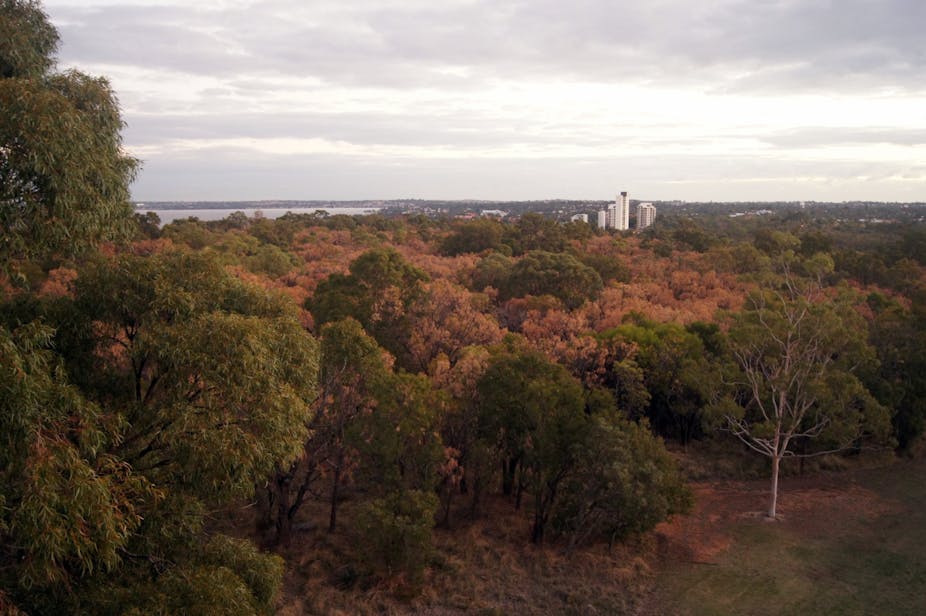
Recent, unprecedented, climate-driven forest collapses in Western Australia show us that ecosystem change can be sudden, dramatic and catastrophic. These collapses are a clear signal that we must develop new strategies to mitigate or prevent the future effects of climate change in Australian woodlands and forests. But society’s view of forests is ever-changing: are we willing to understand ecosystems and adapt to changing conditions?
The south west of Western Australia has experienced a long-term climate shift since the early 1970s, resulting in dryer and hotter than average conditions. This shifted baseline, or average, has also led to more frequent extreme events. In 2010, the region experienced the driest and second hottest year on record.
These climate changes have resulted in significant decreases in stream-flow and groundwater levels. For example, formerly permanent streams now stop flowing for considerable periods. Groundwater levels have fallen up to 11 meters in some forested areas, with larger decreases in populated areas. Clearly, soil water reserves have dried out substantially and will likely continue to do so; we are now starting to see the implications of this. Although most of the West Australian society, particularly those in urban environments, may be well-buffered from these changes, ecosystems are not.
The climatic changes occurring in the south west of Western Australia are contributing to deteriorating woodland and forest health. In the past 20 years, insect infestations and fungal diseases have plagued many iconic tree species, including tuart, wandoo, flooded gum, marri, and WA peppermint, increasing their mortality rates. Many of these disorders are likely triggered or incited by changing climate conditions.

In extreme climate conditions, woodland and forest health suffers most. For instance, during the record dry and hot period in 2010 and 2011, large patches of trees throughout the region suddenly collapsed, with little recovery in some areas. Along the coastal plain surrounding Perth, some areas of Banksia woodland suffered losses as high as 70-80%, while over 500 ha of tuart woodland collapsed and over 15,000 ha of exotic pine plantations (~70% north of Perth) were destroyed. In the northern jarrah forest, over 16,000 ha of forest suddenly collapsed, with mortality rates 10.5 times greater than normal.
In several ecosystems, species have died out and not been replaced, permanently shifting vegetation structure and ecosystem function. Some believe that species and ecosystems will transition slowly in response to climate change. But following the extreme conditions experienced in 2010-11, we now know the transition in many West Australian woodlands and forests will likely occur in sudden, catastrophic, step changes. Many species may not have time to adapt.
These often sudden and dramatic shifts in vegetation health, structure and function have profound consequences on associated flora and fauna, including many critically endangered species. The Mediterranean type-ecosystems of the south west were recently named among the top 10 ecosystems most vulnerable to climate-induced tipping points and degradation by a panel of 26 leading Australian ecologists. The region is one of 35 global biodiversity hotspots, harbouring approximately 1500 plant species, most of which aren’t found anywhere else.
Among the most well known animal species is the near-extinct Carnaby’s Black Cockatoo, which relies heavily on Banksia and pine food resources made scarce by habitat conversion. Tree collapse on the coastal plain in 2010-11 likely played a role in the 34% decline in the Carnaby’s Black Cockatoo population in the Greater Perth Region between 2010 and 2011.

Many more plant and animal species are susceptible to similar collapses given the current climate trajectory and future climate predictions. Indeed, many of the traditional values that forests have provided could well be under threat.
Historically, Australian forests have been valued for the resources they provide: timber, charcoal, water, recreation, sequestered carbon, and biodiversity amongst others. With failing forest health, all of these resources are affected. The threats to forests from climate change cross ideological boundaries: this isn’t just a “green” issue. The management of forests is at a crossroads, where decisions about their future need to be made.
To do this, society needs to answer some basic questions:
Do we still value forests?
What do we want forests to look like in the future?
What are we doing now to preserve forest health in this period of climate change?
Should additional strategies and methods be developed to help forests have time to adapt to these changes?
Although the recent forest collapses in WA are tragic, they are also a valuable opportunity to understand forest susceptibility, stress thresholds, interactions among stress factors (such as insect pests and fungal pathogens) and forest tipping points. Better understanding these aspects is critical if we want to prevent future collapse.
Dorothy Bishop
logged in via Twitter
Please do consider supporting the Black Cockatoo preservation society http://ccwa.org.au/content/black-cockatoo-preservation-society?page=11
el don
logged in via Twitter
all very depressing, and not at all surprising given what we've been reading in scientific journals and hearing in presentations for many years now. tipping points seem to be the order of the day.
it's a good, concise, to-the-point article.
thanks.
Glen Daly
Retired
It is very likely that the SW of WA is the canary in the coal mine with regard to environmental change due to anthropengenic climate change.
Meanwhile,precisely nothing meaningful is being done to reduce Australian carbon emissions. The carbon tax is a sick joke and a cover story for continuing business as usul.
Philip Dowling
IT teacher
This is a very interesting article. It is particularly interesting because three people have put their name to it. These three people are all more academically qualified than me.
So which of the three did not contribute a "likely" to the article?
Could any of the three please indicate on which year likely became an accepted scientific term?
Could any of the three please indicate where I might find a scientific definition of this term?
Jeremy Hall
PhD student
What? Are you implying that you don't think anyone should take action to prevent something that is merely "likely" as opposed to certain?
If so, fair enough. Personally I care about leaving a decent world for others to live in, so I think that even a 50% "likelihood" that we're responsible for things like this is grounds for action.
I also think, as the real liklihood rises toward 100% (it will never quite get there - science doesn't work like that), that those demanding total certainty before they'll support any action are being selfish and irresponsible in the extreme.)
Grendelus Malleolus
Senior Nerd
It likely that you are a reasonably intelligent human being and just as likely that your views are sincerely held, but to pretend that in science that a likely qualifier may be appropriately applied is more likely just trolling.
Likely. You are in the land of it. Like it or lump it.
Garry Claridge
Systems Analyst
When I studied probability and statistics (I am an Operation Research scientist) the term "likelihood" was a well accepted "scientific term".
Fred Pribac
logged in via email @internode.on.net
The IPCC defines these sorts of terms fairly carefully.
I'm not sure that the authors here have used the same definition but the IPCC defines "likely" as a probability of occurrence of no less than 66 per cent.
www.ipcc.ch/pdf/supporting-material/uncertainty-guidance-note.pdf
Philip Dowling
IT teacher
I can understand a statement about Black Caviar's chance of winning his next race as being above 66 per cent.
Black Caviar repeats a similar but not identical event. On 22 occasions the result has been the same.
The statements in this article bear more than a passing similarity to pronouncements made in women's magazines horoscopes, or psychic readings on the radio by self-proclaimed psychic gurus.
Unless scientists can make more reliable predictions, or at least not make dodgy predictions, they have no more moral authority than plausible charlatans.
Philip Dowling
IT teacher
I well remember my probability courses, Likelihood was a term used to indicate numerically the statistically predicted outcomes of identical, multiple, stochastic experiments such as rolling a die, or tossing a coin.
All too often probability theory is pressed into service to provide "scientific" support for less certain assertions.
Philip Dowling
IT teacher
I can't understand why you assert that it is likely that I am a reasonably intelligent human being, without adducing evidence in support of this hypothesis.
Even my children are taught that for each statement they make in HSC essays, they should have at least one following item of evidence.
Grendelus Malleolus
Senior Nerd
Perhaps you are right. Since you incorrectly parsed both the overt and underlying intent of my statement and derived from your reading an assertion that I did not make, the likelihood of your "reasonable intelligence" is somewhat diminished. It is possible however that you are undertaking a contrarian role for the purpose of further entertainment.
Philip Dowling
IT teacher
Jeremy, I appreciate your noble sentiments.
However could you please advise what methodology you use to calculate likelihood.
Grendelus Malleolus
Senior Nerd
The difference Philip is that scientist base their predictions on observations and evidence and psychics base theirs on imagination.
I see you saying "reliability" but the subtext I get from what you write is that you want "certainty", which is just never going to happen.
thomas connelly
bibliopole
Likely can mean possessing or displaying the qualities or characteristics that make something probable. Probable then means, Likely to happen or to be true. likely to be or to happen but not necessarily so. (A nice piece of recursion.)
The root of the word probable is the Latin probare, "approve, prove, test," is the source of English probe and prove. Further back proable can be traced to PIE *pro-bhwo- "being in front," from *pro-, extended form of root *per-, + root *bhu- "to be".
Synonyms…
Read moreJeremy Hall
PhD student
Hehe cool reply. I would give you my plus vote, except then the Conversation's helpful-only-if-you-understand-it comments system would move it away from the comment it was replying to...
Ian Donald Lowe
Seeker of Truth
I first travelled to the south-west of WA in the 1970's and the plant disease known as Jarrah Die-back was widespread even then. I mention this because the species that are named are highly susceptible to the mould Phytophthora cinnamomi, which has been identified as the cause of the die-back in the forests of south-west WA. Phytophthora cinnamomi is an imported problem. Die-back was first being noticed as far back as 1922 but by 1977 it had become widespread throughout almost the entire wooded…
Read moreBwana Hardy
logged in via LinkedIn
Ian, Thank you for your comments on Phytophthora cinnamomi (Pc). We are very aware of this problem in the jarrah forest and I have also worked on Pc for some 20 years. The majority of sites were actually not associated with Pc - although a few were. We actually took this into account during our surveys.
Bernie Masters
environmental consultant at FIA Technology Pty Ltd, B K Masters and Associates
Ian, the Phytophthora cinnamomi (Pc) debate in WA continues, now with more than 14 species isolated plus hybrids. The question about whether it is a native species or introduced has not been completely resolved. The suggestion that hot fires which encourage Acacia to regrow are better than cool fires which favour Phytophthora-susceptible Banksia seems not to have been supported by more recent research. Some evidence suggests that at least part of the forested areas killed by Pc were affected by changes…
Read morePamela Wilson
Journalist
Is there anything in place (or being put in place) as an eco-tourism option to educate community members/holidaymakers about the problems, and - more importantly - to enlist their support and help. I have read the comment about the Black Cockatoo preservation group, but I am interested to know if there is more specific, hands-on programs being run?
Keith Bradby, Director, Gondwana Link
Director
enough pedantics please. Although scientific protocols or whatever may have left the authoprs inclined to use 'likely' I'd have preferred the phrase 'obvious to Blind Freddy but being consistently ignored, swept under the carpet or lost in idealogical and vested interest debate'. Anyone who looks can see the south west is undergoing profound change - the 40 year trend in data is obvious, the ecological and agricultural and hydrological and social implications are becoming clearer every year, and they are massive.
The only question for me is what major actions can I take to mitigate the impacts of this profound disaster that surrounds us.
Jess Beckerling
environmental campaigner
Logging, burning and drought are having catastrophic implications in the south-west.
Not only does it destroy healthy forest, logging is spreading Phytophthora and a part of standard logging practices is poisoning healthy old marri trees where they stand to reduce the shade on regrowing jarrah seedlings.
Marri canker is having a devastating impact.
ForestCheck, the Govt program that is looking at the impacts of logging on biodiversity is being used by industry representatives who are making…
Read moreBernie Masters
environmental consultant at FIA Technology Pty Ltd, B K Masters and Associates
For the information of readers, Jess Beckerling is an anti-logging campaigner who has started studying at Murdoch University for what I assume is a science degree. My view is that, unless she can provide references and links to the science behind her claims, she should be viewed as just another greenie who is opposed to native forest logging on emotional and/or philosophical rather than conservation grounds. Nothing wrong with that, of course, but emotion and philosophical beliefs will help very little in working out and applying the actions needed to prevent further forest collapse from climate change.
Jess Beckerling
environmental campaigner
I can give you all the evidence you could ever want Bernie, but I'm sure you have just as ready access to it as I do. The need to protect native forests is based on logic, it is also an emotional and philosophical issue, of course it is. If it wasn't there'd be something wrong with us.
I'm not sure what you'd like me to substantiate. There is no dispute with any of what I've said as far as I'm aware - spreading dieback, poisoning marri, ForestCheck not covering the karri or many threatened species - but I can give you ample evidence on them all if you so desire.
There are obvious, rational links between forest collapse from climate change and continued clearfelling and intensive logging of native forests. Presumably what we all want is the maintenance of healthy functioning ecosystems able to support south west biodiversity. Logging is helping to destroy these and needs to be stopped.
Bernie Masters
environmental consultant at FIA Technology Pty Ltd, B K Masters and Associates
Jess, in your first comment, you claimed the following adverse environmental impacts from logging:
Read more1. turning a "healthy forest," into an unhealthy one
2. "logging is spreading Phytophthora"
3. "ForestCheck.....is being used by industry representatives who are making outrageously inaccurate claims such as that they now have proof that logging has no impact on any species or on biodiversity as a whole."
4. "an industry that is costing us.... possibly even our ..... numbats and who knows what…
Jess Beckerling
environmental campaigner
WOW Bernie, I'm stunned that you'd say that the fact that logging costs us money is irrelevant, and that you seek to compare FPC to the dept of Health, Police or Education - which all give us something very valuable. The FPC logs our native forests and has effectively shut down its farm forestry sector.
Read more72% of the karri FPC logs goes straight to the woodchip mill, and 60% of the jarrah is burnt as firewood or charcoal. The benefits to us of leaving the forests standing far outweigh the benefit…
Bernie Masters
environmental consultant at FIA Technology Pty Ltd, B K Masters and Associates
Stunned you may be, but I'm more interested in your detailed, reasoned arguments and the science-based evidence you've used to reach your conclusions.
Gil Hardwick
Anthropologist
Well, sorry guys, but I've written on this too, at length. You are way off the mark. Read my papers. Come over for a beer if you like, and argue with me.
You are over 120 years too late. Catastrophic forest collapse in Western Australia took place in the 1870-90s. All we've had left of forest cover since then are bare ribs sticking out of the flayed and pecked-at carcase of the forest that once was. It is simply the pecularity of the place that people come in off the desert and see trees, and…
Read moreBernie Masters
environmental consultant at FIA Technology Pty Ltd, B K Masters and Associates
Gil, there's little doubt that large parts of our south west forest estate is in poor condition. However, I have to disagree with one of your claims, namely "impenetrable to humans until the cattle got in there and knocked out the undergrowth". If you read the journals and diaries of the early explorers and settlers, this statement is simply not correct as it applies to our forests. Certainly, our coastal heath was almost impenetrable but much of our forest was subjected to 3 to 4 year summer or…
Read moreEddy Schmid
Retired
WOW ! What a statement, Bernie despite your claims of our forrests 'not being impenatrible' clearly, you need to do some more serious study on the issue.
Read moreI would suggest a good source of reading would be the publication
Group Settlement Part 1, by J.P. Gabbedy published by W.A. University Press.
This publication describes very clearly, how thick our forrests were, and that was much later then mentioned in your writtings. So if it has been reported as thick in that time, clearly, it must have been…
Bernie Masters
environmental consultant at FIA Technology Pty Ltd, B K Masters and Associates
Eddy, thanks for your contribution. However, in a number of important areas, I need to respectfully disagree with you.
1. Group settlement started in WA in the 1920s after the Great War. By this time, Aboriginal fire regimes had been largely absent in our SW forests for 40 or 50 years. If they had still been present in our forests using fire as a management tool in the same way they'd used it for 50,000 years, individual sections of most parts of the forest would have been burnt 10 or more times…
Read moreJohn Clarke
Professional forester
Tree deaths in the Northern Jarrah Forest after the 2010 drought are certainly alarming, but the good news is that trials are proving that reducing competition for scarce water by silvicultural treatment of the forest is resulting in a higher water table and a healthier forest. The Wungong catchment trials south-east of Perth, sponsored by the Water Corporation, are providing invaluable information in this regard.
As pointed out by Bernie Masters, a century of timber harvesting for sawlog without…
Read moreGail Zawacki
curator
To put this in perspective, trees are dying everywhere in the world at a rapidly accelerating rate. In some places, this is likely due to a rapidly changing climate but in many others, the weather is not outside the historical record for living trees and they are dying, anyway.
Also noteworthy is that the leaves of plants being grown as annuals in pots, receiving water, exhibit just the same damage as trees of all ages growing in the ground.
The one thing all this vegetation shares in common…
Read morePhilip Dowling
IT teacher
Gail, Just for the record the trees in the Lane Cove National Park have been going gang-busters since the bushfire eighteen years ago. In fact, even the trees on the median strip of the Lane Cove-Ryde Road near de Burgh's bridge have grown so much that falling branches may well soon become a traffic hazard.
Do these observations indicate that I need a new optician?
David Leigh
logged in via Facebook
Die back signs have also been used as a coverup, in the South West of WA, for activities prompted by Gunns Ltd. Often, if one cares to ignore the signs and walks into the area, large clear fell sites can be found. Jarrah and other species have been systematically cleared, from around 300 metres from the road, and replaced by water guzzling blue gums or E. Nitens trees. These have been planted for Gunns Ltd to facilitate fibre production. The trees grow at an alarming rate and consume groundwater from other, surrounding forests. At a time when man should be looking at ways to mitigate the impacts on our forests and the life forces they provide, industry is doing its best to plunder what it can for the short term gain of a handful of people. I have seen the destruction in WA first hand and I now witness the same and by the same company, down in Tasmania. Watch the trailer: http://ecobard.com.au
Bernie Masters
environmental consultant at FIA Technology Pty Ltd, B K Masters and Associates
David, I can assure you that, in WA, not one hectare of publicly owned forests have been converted to blue gum plantations by any private entity, including Gunns. If you've seen forested land clearfelled and turned over to blue gums, it must be private land that you've been looking at.
Mind you, large areas of public land have been clearfelled in the past for pine plantations but that's another story.
David Leigh
logged in via Facebook
You could be right Bernie, I had no way of knowing who owned the land. It was however, cleared and planted out to either blue gum or E.Nitens and it will be impacting on water tables as a result. Yes, the pine plantations are another story and should never be grown in WA. When I lived in WA, there was talk of relocating the Gnangara pine plantation into the southwest. It was said that native species were to be regenerated in the area and that wildlife would be reinstalled. I think it was just a ploy to make more metro land available for housing and would transfer the problem into the rich farming land of the southwest. Pines will also steal water from native forests, especially when they all come online together.
Bernie Masters
environmental consultant at FIA Technology Pty Ltd, B K Masters and Associates
David, when the state government created the Forests Products Commission in about 1999, it was rumoured that they sold off the timber extraction rights to a volume of pine that was about 110% of long-term anticipated production. This was always going to be a promise that would be difficult to meet. The state govt then decided to remove the pines on the Gnangara Mound to allow recharge of the shallow groundwater aquifer to occur, but they had nowhere to grow replacement pines other than farmland. To date, farmers in the south west have been reluctant to convert even part of their farms to pine plantations so a large shortfall in pine timber from the state's resources is looming.
Gavin Butcher
FPC Spokesperson
The three year record low rainfall culminated in significant damage to the pine plantations on the Swan coastal plain in autumn 2011. The level of damage was very significant although not as great as stated in the article. Approximately 25 per cent of the northern plantations were rated as having a severe level of damage (more than 50 per cent of the trees affected), and 80 per cent of the plantations were affected to some extent. This will have an impact on the State’s future pine timber resources.
Murray Webster
Forestry-Ecology Consultant/Contractor
I do question whether climate change is the only cause of the vegetation change we are observing. From a scientific perspective it appears to me that another significant variable has been ignored in this study: the role of human activity.
Read moreWhen the first people arrived in Australia the vegetation was very different to what the first european people encountered. This paper provides a brief overview of vegetation changes after human arrival: The Aftermath of Megafaunal Extinction: Ecosystem Transformation…
Eddy Schmid
Retired
Murray, would agree 100% with your comments on this.
Read moreObserving our forrests over my lifetime,(62 years old this year) have seen may such changes effecting our forrests. I was employed as a train driver, which allowed me to regularly traverse W.A. from as far North as Geraldton/Mullewa all the way south to Albany/Esperance and the S.W. corner of Bunbury Busselton. Since retirement, have walked the Bibbulman track regularly, as well as walking in our forrests fortnightly along the Darling Scarp from…
Bernie Masters
environmental consultant at FIA Technology Pty Ltd, B K Masters and Associates
Murray, there's an on-going debate about whether it was hunting by Aboriginal people or their use of fire which caused the loss of the mega-fauna. Nonetheless, whatever the cause, the changes to Australia's vegetation starting some 50,000 years ago were profound. The next major change was when Europeans moved in from 1788 onwards, ultimately causing Aboriginal burning regimes to be changed or completely removed from the landscape. In turn, the resulting environmental changes may, as you suggest, now be causing further changes at the same time as climate change is also impacting upon the Australian landscape.
Mark Poynter
Forester
Bernie and Murray
Further to your reference to the loss of regular Aboriginal burning, is the recent research from SE NSW and elsewhere showing that a lack of fire results in eucalypt decline and eventual death. As today's managed prescribed burning cannot hope to keep up with the natural pre-European burning regime by Aboriginals and lightning, this factor is becoming apparent as we now have far less fire in the landscape.
The otherside of the coin is that because we have less fire fuels build to unnatuarlly high levels and eventually they do burn in hot summer bushfires of unnatural intensity thereby doing far more environmental damage than would naturally have been the case.
Yes, man has much to answer for regarding land management problems but the readiness of some scientists to disregard this in favour of strengthening the case for climate change says much about ideological agendas amongst our academic community.
Murray Webster
Forestry-Ecology Consultant/Contractor
Bernie, I am aware that there was an argument over the sequence of events that led to the mega-fauna extinction. But it seems that the authors of the paper I referenced above, have a detailed climate-megafauna-fire record, and concluded that the sequence went: megafauna here; people arrive; megafauna disappear; fire increases. The previous arguments I read about whether it was fire or climate change, relied on large ranges in estimates of the dates of various events, which led to uncertainty in determining the sequence. The authors of this latest study are of the opinion that this question is now answered.
Bernie Masters
environmental consultant at FIA Technology Pty Ltd, B K Masters and Associates
Murray, the article you referred to in your earlier post states: "Our results suggest that human arrival rather than climate caused megafaunal extinction, which then triggered replacement of mixed rainforest by sclerophyll vegetation through a combination of direct effects on vegetation of relaxed herbivore pressure and increased fire in the landscape." The abstract doesn't explicitly state that the changed fire regimes only occurred after the loss of the megafauna..
In other words, the sequence…
Read moreMurray Webster
Forestry-Ecology Consultant/Contractor
Bernie,
The full paper is more detailed than the abstract.
When I studied biogeography at university (which was 25 years ago now) it appeared that when humans arrived on a new continent, mega-faunal extinctions happened around the same time, though the accuracy of time estimates had large errors - which is an uncertainty that contributes to the arguments around cause.
Europe, North and South America also had megafauna extinction. The Rule etal paper claims to analyse a more accurate timeline…
Read moreMurray Webster
Forestry-Ecology Consultant/Contractor
Being an academic provides no immunity against the human propensity to have beliefs. Some scientists are the most extreme believers - not only do they believe, they have reasons!!
As for me, all my opinions are totally justified and anyone who doesn't agree is obviously overcome by indoctrination or corruption ....
Bernie Masters
environmental consultant at FIA Technology Pty Ltd, B K Masters and Associates
Thanks for continuing this discussion, Murray. As a geologist, I have a degree of skepticism about the accuracy of the various aging techniques so, without having read the Rule et al paper, I'd be cautious about any claim to be able to pinpoint the order in which things happened after humans arrived in Australia. Even so, there's always some truth to most theories or findings, so I'm happy to keep an open mind as to the actual sequence of events that we've been discussing.
You're correct about…
Read moreShirley Birney
retiree
I don’t hail from the South West, however, I suspect the forest systems have received as much protection as the lands which are rampant with a dryland salinity that continues to gnaw its way through agricultural regions (and beyond) and infrastructure, costing the taxpayer a pretty penny.
The synergistic impacts of industry’s greed and stupidity (coupled with lobbyists and sycophantic governments) and climate change now sees a state taking one step forward and two back. And society must be…
Read moreBernie Masters
environmental consultant at FIA Technology Pty Ltd, B K Masters and Associates
Hmmm, where to begin a reply to Shirley's comment? I'll start on the last issue - the use of Alcoa red mud as a soil amendment. My understanding is that two farmers involved in the trial saw it as an opportunity to get some money out of Alcoa by making almost completely false claims. The worst was that the red mud was radioactive (which it is) and that it affected the health of their stock (which it almost certainly did not do). 90% of Perth's population lives on the sandy and low radioactivity of…
Read moredavid rodan
Accounting software trainer
Scientists and the military have been weather engineering since the 1970's (32 years !!) the evidence from around the world is overwhelmingly the same. Strange weather conditions, mass deforestation of 1000 year old forrests, more droughts and floods than ever before, etc, etc.
Read moreThe government still deny by the way that they are releasing aluminium oxide in particularly as well as other chemicals into the atmosphere by military planes known to us as Chemtrails, the pat answer if they even bother…