
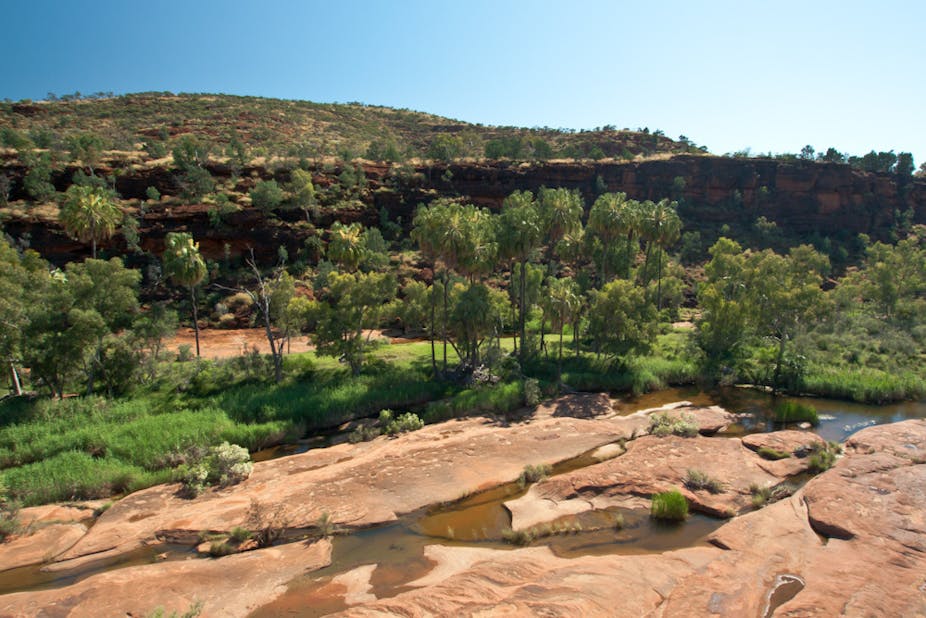
New molecular techniques show that an iconic palm only grows in central Australia because humans moved it there thousands of years ago. It poses the question: should we still regard this as a native species? And if it’s not native, what implications does this have for species conservation and management?
The red cabbage palm, Livistona mariae, has long been thought to be a survivor from a wetter climate, hanging on in a damp micro-habitat in Palm Valley (Finke River) near Alice Springs. That story was demolished earlier this year, when it was found that the palm is a relative new-comer, having arrived a mere 15,000-30,000 years ago.
The overwhelming evidence points to Aboriginal people bringing the red cabbage palm to Palm Valley. This palm is only found in the Finke River region, although it is very closely related to another palm over 1000km to the north, with whom it shares a common ancestor.
Most species are native somewhere, so it is populations instead of species that get the native or non-native tag. Unfortunately, there is no globally agreed scientific definition of these terms. Most people understand the term native to mean occurring in a place naturally, without human intervention. Some definitions currently used in policy and management tag all individuals moved by humans as non-native, while others include a cut-off date; all populations in a place before that date are considered to be native.
Many of these arbitrary dates relate to the arrival of Europeans in the country, as if human dispersal of plants and animals before this time was somehow different. In Australia, each state, territory and the Commonwealth has its own definition; 1400 AD is used at the national level. Northern Territory legislation uses 1788 AD, but only if the plants or animals were moved by Aboriginal people.
Using an arbitrary cut-off date is an unscientific approach with little relevance in the modern world. With rapid global climate change, many species are naturally entering new territory, as they track a suitable climate to meet their needs. Shouldn’t these populations be treated as native?
What about new populations of rare and threatened species, established by humans to conserve the species in a location predicted to meet the species' future climate and habitat needs? Should these populations be treated as native? Despite the obvious human intervention, most people regard these new populations as native, regardless of whether they are 1km or 1,000km from the original population. If the species becomes invasive in its new location, we might not be so accepting.
To move away from existing outdated and inappropriate definitions of native and non-native, we can apply the new concept of a projected dispersal envelope. The projected dispersal envelope defines the region where a species could establish new populations by natural means in a given period of time.
The projected dispersal envelope includes all possible information on the species (are seed carried by water? how long does it live?), its habitat (is there a river? what climate is suitable?) and its history (where does it come from? what is its genetic variation?) to establish the area in which any given population may move naturally, relative to a known native population. The projected dispersal envelope framework is a transparent and relevant method for determining and defining what is native.
Sophisticated ways to study how species have moved around, such as new molecular techniques, are being used to assess the relationships between species or populations. This information can be included in the projected dispersal envelope, which helps us assess if the population in question gets the native or non-native tag.
So now we understand what makes something native, we can simply conserve natives and control non-natives, right? But what about the red cabbage palm, an iconic species which gives its name to a treasured Australian location? What if it isn’t native at all?
A paper we recently published uses the projected dispersal envelope framework to assess the red cabbage palm. Because the projected dispersal envelope of the ancestral species doesn’t include the Finke River region, the palms there are non-native. Therefore, the red cabbage palm is a non-native species in its Finke River home, and has no native range.

The relevant Commonwealth and Northern Territory legislation for protecting individual species generally only applies to native species. If we adopt the projected dispersal envelope framework, the red cabbage palm would no longer be eligible for conservation under the current overly-simplistic war-cry of “conserve natives and control non-natives!”.
It is time to move away from this simplistic way of deciding which species to conserve and which to control. There is no doubt that we still need to care if a species is native or not, as this can “raise the red flag” on likely problems and help us develop better management strategies. But using this tag as the sole decision tool prevents us from incorporating other important information.
The red cabbage palm helps maintain ecological functionality in its natural habitat. Returning the ecosystem to what it was before the palm arrived is an unrealistic option. We should recognise that the species has important cultural heritage values, as it is used as bush tucker by Aboriginal people. It also has heritage value to many other Australians and car loads of international tourists, for whom Palm Valley is a memorable part of the unique Australian outback experience.
These factors, and others, should be taken into account when we make management decisions and set conservation goals.
Native species are an integral part of the Australian landscape, and credit is due to all those who work hard to protect and conserve our unique natural heritage. The methods we currently use for defining native species are inadequate, and fail to engage with the realities of change in our ecosystems in a world experiencing rapid climate change.
Russell Walton
Russell Walton is a Friend of The Conversation.
Retired
Interesting article. "Restoration" of native flora and flora isn't as simple as it first appears--- we should consider a different model from an arbitrary native/exotic classification. I've often wondered, for example, whether dingoes are indeed, native species.
Australia is often cited as the only continent where the indigenous people didn't practice agriculture, perhaps some reassessment is required.
Peter Ormonde
Peter Ormonde is a Friend of The Conversation.
Farmer
Precisely Russell.
I'd suggest it also has big ramifications for this notion of "untouched pristine wilderness". Untouched?
What we are usually looking at is the result of many centuries of management and human intervention - mostly through fire.
It is a conceit - a quasi-scientific sort of terra nullius - to remove the influence of Aboriginal people from the landscape. It fosters the delusion that we can maintain the existing landscape just be leaving it alone.
My view is that we are obliged to learn to manage this place if we want it to keep it and protect those ecosystems that have had adapted and indeed been created by the influence of fire over many millenia. Just sticking a do not touch label on it and leaving it alone won't do it.
Moving palms into Palm Valley - now that's serious gardening. Nice bit of work folks.
Mike Swinbourne
logged in via Facebook
Restoration of native flora and fauna is impossible, because the obvious questions that it raises are - restoration to what point? and for what purpose?
We oftern speak about 'restoring' the ecosystem to the state it was at when Europeans arrived - but that is a very eurocentric view of the environment and one which is totally devoid of both common sense and practical purpose.
I would also like to suggest that it is a racist view, and suggests that Europeans are alien invaders and the Aboriginals…
Read moreGreg Boyles
Lanscaper and former medical scientist
Your throwing around the racist slur in this context is utterly rediculous Mike. Clearly you have no comprehension of what 'racism' even is!
"Restoration of native flora and fauna is impossible"
What evidence or experience do you bring to the table to back a statement like this. I postulate zero, zilch, none!
Having been employed for the past several years restoring a remnant native grassland in Deer Park on the northern outskirts of Melbourne I can tell you that it IS possible.
But…
Read moreBernie Masters
environmental consultant at FIA Technology Pty Ltd, B K Masters and Associates
Russell, I'd always believed that Australian Aborigines didn't do farming. However, it's clear from the records of some early WA European explorers that Aborigines in fact farmed several species of native plant. For example, a fringed lily which produced an edible tuber was harvested at the most productive time of the year and a proportion of the tubers were replanted for next year's crop. This was recorded happening south of Geraldton. I'm sure that other species would have been equally well managed to allow sustainable harvesting.
Greg Boyles
Lanscaper and former medical scientist
I will also add that aborigines largely lived in harmony with the landscape for tens of thousands of years.
Something that we europeans are clearly not doing given the Murray-Darling basin and dry land salinity etc.
Aborgines have introduced perhaps a few hundred new species over 40,000 years. In contrats Europeans have introduced several thosand new species in 200 years.
Ian Donald Lowe
Seeker of Truth
Russel, there are dogs in indonesia and Bali that are very close to the dingo, if not the same. I would suggest that the dingo arrived with the people and it did have an impact on native fauna in it's new home but the past is the past and we can't change it, even if we wanted to.
Greg Boyles
Lanscaper and former medical scientist
"Throwing millions of dollars and years of effort at trying to preserve species which will not survive once that support is withdrawn is futile - and we need to be smart about what we are doing."
So what are you saying Mike?
The Tasmanina Devil and the Koala are not worth saving.
Few Australians nor many people around the globe would agree with you on that.
Certainly more worth while spending money on these conservation measures than on 'parties' like the Olympics and Grand Prix etc.
Peter Ormonde
Peter Ormonde is a Friend of The Conversation.
Farmer
Bernie,
There's a rather interesting description contained in Watkin Tench's journal of riding at full gallop out to Parramatta through knee high grass all the way and there are repeated descrptions of the park-like nature encountered by early settlers and explorers. Lots of grass and mature timber but little undergrowth and scrub.
Patch burning - low temperature fast fires - done seasonally were designed - yep designed - to reduce undergrowth and foster grass - all to boost the populations of roos, wallabies and emus. "Cleaning the place up". Farming but not as we know it.
Greg Boyles
Lanscaper and former medical scientist
Aborigines clearly signficantly altered and managed the landscape during their tenure.
But they learned to do so in a way that enhanced biodiversity and ecological productivity.
Europeans have signficantly modified the landscapes and have managed it in a way that reduces biodiversity and is reduing ecological productivy despite the initial spike due to fertilisers etc.
I.E. Soil erosion, dry land salinity and weed invasian.
Russell Walton
Russell Walton is a Friend of The Conversation.
Retired
Peter,
Yes, the phrase "Aboriginal Australians lived in harmony with the environment" is particularly annoying and ignorant. Indigenous people, like humans anywhere, modified their environment to suit themselves.
Peter Ormonde
Peter Ormonde is a Friend of The Conversation.
Farmer
Not just during their tenure I suspect. They altered the density and distribution of species - they "made" our vegetation communities and the life they support. In short built themselves into the place.
We're slowly getting the hang of it - about maintaining diversity and specific communities and species - but gee there's a long way to go isn't there?
I'm surrounded by some spectacular National Parks here but there is clear unequivocal evidence that without any management intervention we will lose the very things we try to protect as they succumb to regrowth, age and lack of basic essentials like pollinators and germination triggers. The ground orchids - which once characterised the place - have virtually disappeared.
Greg Boyles
Lanscaper and former medical scientist
In his book "The Future Eaters" Tim Flannery present anecdotal evidence that the ancestors of aborigines, like most humans, did not live in harmony with the landscape and may have played a major role in its wholesale alteration to what it is today from something quite different.
However they were forced to learn to live in harmony with this altered landscape and responded remarkably well given the level of biodiversity that Europeans found when they arrived here.
So relative to what we are doing, yes, modern aborigines lived in harmony with their landscape. Their society lasted, relatively unchanged, for tens of thousands of years.
Our society will clearly not last for any where for this length of time in its current form.
Bernie Masters
environmental consultant at FIA Technology Pty Ltd, B K Masters and Associates
"Enhanced biodiversity"? Actually, no, since hunting and changed fire regimes when Aborigines first colonised Australia 50,000 years ago led to the extinction of the mega-fauna. "Ecological productivity"? Again, no, they enhanced parts of the environment that best met their needs, which by definition implies that other parts of the environment suffered.
And, as peter has pointed out, there has been no "wilderness" in Australia for 50,000 years.
Having made these points, however, I have to say that the important issue facing all Australians right now is how to protect existing biodiversity and ecosystem functions and services in the face of climate change and human disturbances such as clearing and altered fire regimes, etc.
Bernie Masters
environmental consultant at FIA Technology Pty Ltd, B K Masters and Associates
Thanks for the comment, Peter. Here in WA, Sylvia Hallam in 1975 and David Ward and others in more recent times have written about what the WA bush was like 200+ years ago. The descriptions of many early explorers and settlers include grass, majestic tree-scapes over grassland and similar. Most of these grassed areas have now been lost due to the removal of Aboriginal people from management and the imposition of new (alien!) fire regimes.
Russell Walton
Russell Walton is a Friend of The Conversation.
Retired
Bernie,
I can remember an article in "Australasian Science" that suggests that Aboriginal Australians did, in some areas, practise a limited form of agriculture, however I don't know what's the latest archaeological consensus in regard to pre-European agriculture.
Peter Ormonde
Peter Ormonde is a Friend of The Conversation.
Farmer
Russell,
There's a heap of very detailed work on fishing and eel "farming" ... these range big timber fish traps on beaches that were rebuilt each year in time for the tailor run down the east coast through to inland freshwater systems using rocks to create fish traps - some of these structures remain. Eels seemed particularly significant in Victoria where there are the remains of stone foundations of semi-permanent seasonal camps.
One of the interesting things about the NSW beach visits was that inland Aboriginals groups would assess the value of making the wander over to the beach and rebuilding the tidal pens by the strength of the wattle bloom that spring. That's pretty sophisticated and professional observation I reckon. Talk about science! Indigenous empiricism.
Russell Walton
Russell Walton is a Friend of The Conversation.
Retired
Greg Boyles,
I think that the phrase "living in harmony" originally meant that Aboriginal Australians always had a negligible environmental impact, not that they adapted to a transformed situation. The notion seemed more 'deep green' ideology than science and contrary to the evidence-- it's highly probable that the first settlers exterminated the megafauna for example.
Russell Walton
Russell Walton is a Friend of The Conversation.
Retired
Peter,
I remember learning about the extensive eel "farming" complex at Lake Conda when I attended a weekend lecture by the Victorian Archaeological Survey(?) in the 70s. Quite a revelation.
Greg Wood
Energy Consultant
If Aboriginals are not an intrinsic part of nature, what then are they a part of?
Indeed Europeans are also an intrinsic part of nature. The difference is that this modern cultural form is utterly unable to restrain itself from constant and severe interference upon the ambient ecological balances underway around us all.
A metastic tumour is an intrinsic part of nature, nonetheless the host finds it an unsustainable condition to bear.
The fundamental measure of 'native', human or non-human…
Read moreGreg Wood
Energy Consultant
Sheeting the loss of Australia's megafauna to the aboriginals is a speculation not a fact.
Mike Swinbourne
logged in via Facebook
Wow Greg - so many ad homs and baseless assertions in only a few short posts. So let me reply if I may.
You have already answered your own assertion about the restoration of native flora and fauna with your own statements - but you also cherry picked my position and ignored the most important aspects.
When I said restoration etc is impossible, note that I said - to what state and why? You must first define this - restoration means that you are returning it to some pre-existing condition. To…
Read moreMike Swinbourne
logged in via Facebook
Your point is taken Greg (Wood)). Aboriginal people are an intrinsic part of nature, just as Europeans are. And that is a very important thing to remember.
My point was that Europeans are often considered as separate to nature, while Aboriginal people are considered somehow different. They and their actions are considered 'natural', while Europeans are artificial.
It is a false distinction.
Greg Wood
Energy Consultant
I accept that distinction. 'Consummately suicidal' is a much more accurate and practically useful descriptor than is 'artificial'.
This somewhat parallel to the OP which deals with 'nativeness'. Species that behave so have muich greater trouble acquiring 'nativeness'.
Greg Wood
Energy Consultant
Sorry. "I accept that distinction" should have been written otherwise. Perhaps, 'I accept that observation' (upon it being a false distinction).
Greg Wood
Energy Consultant
It is not posisble to accept your view that:
"Despite how we like to romanticise the lives of indigenous humans, they did not live in harmony with the land any more than Europeans did - who are also indigenous to part of the world as well."
After an inevitably necessary process of adjustment Aboringinals were able to attenuate a new landscape equilibrium and have since existed within this new balance for many thousands of years.
In just over 200 years we have wrought abominable destruction upon every facet of the resource base and, whilst continuing to assault the expiring remnants of these values, are now engaged in shipping the continent's entrails to China as fast and as furiously as we possibly can.
The respective performances of the two cultures simply cannot be credibly equated.
Mike Swinbourne
logged in via Facebook
Oh, and when you 'restored' your remnant grassland, how much did you actually restore?
Did you return the soil to its pre-existing state? Did you restore the invertebrate populations? Did you restore the other species of flora and fauna, or only the 'grassland'? Is the water supply (stream flows, water table) the same as it used to be? Did you destroy the seedbanks of invasive species?
If you can't answer these questions - and many more - then you have really restored anything, have you?
Mike Swinbourne
logged in via Facebook
So why it is not possible to accept that view? Let's look at what you have said shall we?
"...After an inevitably necessary process of adjustment Aboringinals were able to attenuate a new landscape equilibrium and have since existed within this new balance for many thousands of years. ..."
Why do you allow a 'necessary process of adjustment' before Aboriginal people were able to live in a 'new landscape equilibrium', but not allow the same for Europeans? We have only been here for 200 years…
Read moreGreg Boyles
Lanscaper and former medical scientist
"Sheeting the loss of Australia's megafauna to the aboriginals is a speculation not a fact."
Yes. Tim does stress that there is no direct evidence that the ancestors of aborigines caused the extinction of the megfauna. He merely states that it is a distinct possibility given that megafauna on other continents also became extinct soon after the arrival of humans.
And even if the ancestors of aborigines did cause the extinction of the Australian megafauna, the response of their descendants since that time increased and maintained the diversity of small to medium marsupials in the place of megafauna.
Greg Boyles
Lanscaper and former medical scientist
The definition of wilderness is subjective.
But if you compare biodiversity poor european agricultural landscapes to aborigine maintained landscapes then the latter is clearly wilderness relative to the former.
Russell Walton
Russell Walton is a Friend of The Conversation.
Retired
Ian,
Agreed. I was using the dingo example as a way of indicating how slippery the dividing line between "native" and "exotic" might be.
Interesting times ahead.
Greg Boyles
Lanscaper and former medical scientist
I hope you don't mean the first European settlers!
The megafauna had been extinct for several thousand years by the time the first European arrived.
Greg Wood
Energy Consultant
The equalibrium is a dynamic one, oscillating between a complex range of landscape parameters. These system bounds do shift over time but very slowly. The rate and range of change now being imposed by our socio-economic efforts is nothing like a trend that can be withstood by the natural order of things. We may be a part of nature but that does not prevent us from altering it to a form that no longer has room for us within it, a likely outcome which is the ultimate irony of our conceit.
Urban…
Read moreGreg Wood
Energy Consultant
Maybe you have an overly saccharine view of 'harmony'.
The fact is the changes wrought by the arriving aboriginal settlers eventually settled and enable a new form of system 'harmony' to prevail.
That is something our current system will never allow to occur. A new balance will only be struck beyond the reach of its cold dead hand.
Greg Boyles
Lanscaper and former medical scientist
I don't think anyone in the industry believes that any landscapes can be returned in totallity to a pre-European state. But they can certainly be returned to a state close to pre-European with respect to flora.
In the grassland I work on that pre-European state would be minus the major introduced weeds like Nassella, Phalaris, Bromus, Brassica and thistles etc.
And some areas in the grassland, that were dominated by these weeds, have indeed been successfully returned to a state where the native grasses now dominate and they are now quite resistance to re-invasion by former weeds.
With some introduced weeds like Romulea, it is a case of learning to live with them.
I am merely pointing out that you assertion that it is impossible and not worth the effort is false.
Russell Walton
Russell Walton is a Friend of The Conversation.
Retired
Regardless of the eventual scientific consensus, the idea is not just speculation, it's a plausible hypothesis. The evidence is accumulating that the extinction of Australia's megafauna was caused directly or indirectly by humans---refer to research (since Flannery's book appeared) published in New Scientist, Australasian Science and Cosmos.
Mike Swinbourne
logged in via Facebook
"....But they can certainly be returned to a state close to pre-European with respect to flora...."
Again I ask Greg - to what purpose? And why is it worth the effort? What is going to happen when the money runs out and you are no longer actively managing this site? How much did it cost to change this area to a previously unknown state (it's not restoration), and can you do that on a larger and more worthwhile site - one that can be used for conservation of species.
When you say that you are…
Read moreNeil Gibson
Retired Electronics Engineer
Aboriginal maintained landscapes? This idea may appeal to those who subscribe to the "noble savage" view of the original settlers in Australia but exactly what "maintaining" did they do apart from starting the odd forest fire to barbecue some slow kangaroos and unfortunate koalas. A stone-age people living at subsistence levels with a short life-span were not "living in harmony" but surviving any way they could . Of course they did have a minimal effect on the environment due to this lifestyle but to paint them as the original greenies is ridiculous.
Bernie Masters
environmental consultant at FIA Technology Pty Ltd, B K Masters and Associates
Neil, I think you are under-estimating the impact that pre-European Aborigines had on the Australian landscape. While they probably had no goal of maintaining the landscape, they clearly understood the management actions needed to provide food, allow seasonal access, protect water sources, etc. If you read the reviews by people such as Sylvia Hallam and Bill Gammage, Aboriginal fires were extremely frequent and carefully managed. There's absolutely no doubt that the resulting ecosystem modifications…
Read moreGreg Wood
Energy Consultant
What evidence do you have indicating that the average life span of aboringinals was short?
Peter Ormonde
Peter Ormonde is a Friend of The Conversation.
Farmer
Spot on Bernie.
I remember traveling with a group of old fellas up north for a few days and how the endless chatting and joking ground to a halt driving through some hundred miles of lush looking regrowth... everyone got very serious and sad.
Later on it was explained by one bloke that they were upset because the place had been let go and that no one was cleaning it up any more with the odd bit of burning, how the tucker would be gone and the place was turning into rubbish country.
They knew the country very well from their childhoods and recognised that the folks who were responsible for it, for walking around and keeping the place in good nick had all gone and that a timeless tradition had died.
They were all very deeply affected and sad. "It's just dead," he said.
Greg Boyles
Lanscaper and former medical scientist
All that has been proven here Mike Swinbourne is that you are just another one of those ignorant urbanites who is divorced from your own 'country' (in the aboriginal sense).
Suffice it to say that there are many Australians, including myself and council officers, who are not yet ready to give up on our 'country' and will keep plugging away to the best of our ability and spending a good deal of your money in order to do so!
Given that I have had a fair amount of praise heaped on me by more than one council officer and that 'my' reserve has become a bit of a show piece for assorted university researchers concerning with ecological restoration, I must be doing something right regardless of your assertions that all efforts are futile.
Lucky for us you are not in a position where your opinion particularly matters!
Greg Boyles
Lanscaper and former medical scientist
'Primitive or not Bernie, those aborigines could thrive in what you would regard as a hostile landscapes. Without your supermarkets and your running water, you would have no hope of surviving.
Aboriginal society lasted for 40,000 years at least. Ours will be lucky to last another 200 years at the rate we are going.
So one could legitimately question who is really the superior race here!
Greg Boyles
Lanscaper and former medical scientist
If for no other reason than grassland restoration being a more worthy cause to spend money on, for prosterity, than the crap you would have councils etc spend money on.
Russell Walton
Russell Walton is a Friend of The Conversation.
Retired
Greg Wood,
You really should read my other posts, or are you building a straw man?
I think "harmony" is a meaningless term.
Russell Walton
Russell Walton is a Friend of The Conversation.
Retired
Greg Boyles,
Really? The "first settlers" were literally, the first settlers.
How could you possibly think I was referring to Europeans, it's not the 1950s.
Jonathan Maddox
Software Engineer
The first Europeans to move to Australia consisted of three distinct classes : convicts, military and "free settlers". The settlers were those who came here, very explicitly, to take the land and become gentry. Much as Israeli "settlers" in the period 1967-present are precisely and explicitly those who explicitly set out to take possession of land acquired by that country in the Six-Day War.
So yes, it is the 1950s and it has been since 1788.
Jonathan Maddox
Software Engineer
explicitly explicitly explicitly of course.
Greg Boyles
Lanscaper and former medical scientist
I think it is you guys that are ignorant here. You are ignorant of ecological balance which is what living in harmony is about.
ALL species modify the landscape they live you damn fools and aborigines are no exception. But regardless of any modification most species live in harmonay or ecological balance with their environment regardless of any modification.
Do silly old fools honestly believe that the modern African megafauna do not massively alter their environment. What is that you think…
Read moreGreg Boyles
Lanscaper and former medical scientist
For starters they maintained 'story places', effectively national parks, where hunting was prohibitted in order to allow prey species places where they could breed unhindered.
So aborigines knew about conservation measures long before it dawned on our Europoean ancestors that such management tools were required.
Maybe you silly old fools are true racists who refuse to concede that aborigines got some things right despite being 'primitive in our eyes.
Neil Gibson
Retired Electronics Engineer
More of the "noble savage"mythology about a people with no written records and stories passed down from generation to generation. A typical business training device is to give one person verbal information and for them to pass it serially to other people. Usually the message is indecipherable by the time it has passed across the room in a few minutes.
Silly old fools are just not as gullible as those who make such ageist remarks and who are stupid enough to have to resort to name-calling to make a point.
Mike Swinbourne
logged in via Facebook
Thanks for your rational, reasoned comments there Greg. When it comes to what had been 'proven' here, I can say with some confidence that the greatest 'proof' that has been offered is that you are someone who is unwilling to address the issue with anything approaching substantial argument other than to offer ad homs. 'Ignorant urbanite' huh? Well, you sure showed me!
You keep 'plugging away' with your weed removal programs - they probably achieve something. You are obviously taking 'wasteground…
Read moreGreg Boyles
Lanscaper and former medical scientist
It is not a matter of you SILLY OLD FOOLS not being gullable.
It is a matter of your thinking being mired in the discredited mind set of a bygone era!
Greg Boyles
Lanscaper and former medical scientist
I.E. Aborigines being primitive stoneage people that will never amount to anything
Greg Boyles
Lanscaper and former medical scientist
The presence of snakes does not bother me at all Mike, and I enjoy seeing them from time to time while I work.
Snakes are an issue for the likes of you who don't 'get' the bush.
Greg Boyles
Lanscaper and former medical scientist
If there weren't people like us 'wasting' your money on bush regeneration then inevitably urban cretins like you start complaining to the council about the fire risk of the weedscape over your back fence, and of snakes and rabbits coming into your backyard.
Unfortunately removal of snake habitat close to back fences is part of what we must do due to the irrational fear of people like you.
But never mind, the regeneration over the broader area encourages the return of many small native grassland birds e.g. red breasted robbins and grass parrots etc even if the constant clearing of weeds makes it less suitable for snakes and bluetongues in the short term.
Greg Boyles
Lanscaper and former medical scientist
If I am guilty of blatant ageism then you old fools are guilty of thinly veiled racism towards aborigines.
Just as we have both commendable and attrocious aspects to our culture, aboriginal culture was the same.
If you were not racist and had not spent the bulk of your life behind a desk then you would be capable of acknowledging the commendable (noble savage) aspects of aboriginal culture.
Russell Walton
Russell Walton is a Friend of The Conversation.
Retired
I agree. Snakes are not statistically dangerous at all, some Australians seem rather paranoid in regard to snakes. I lived for 21 years in a "snake infested" area in West Gippsland and managed to survive and apart from an alarming encounter with an Eastern Brown(?) there were no problems. Constant vigilance is still recommended, despite what novices in the bush are told, snakes do not "get out of the way".
Bruce Webber
Research Scientist at CSIRO
Greg,
Thanks for your interest in our article. I would be interested to know where you came about that ‘measure’ of nativeness. No working definition I am aware of allows a non-native to become native after being resident for a given period of time. Are you saying that if a non-native introduction resulted in extinctions on a grand scale in the recipient environment, then as long as these extinctions stabilised then the introduced species would become native? In my opinion this line of thinking is a very slippery slope that should be (and is currently) avoided at all costs.
Bruce Webber
Research Scientist at CSIRO
Russell,
It is quite clear that the dingo is a non-native species in Australia based on the best available evidence showing that it arrived with humans c. 5000 years ago (http://www.pnas.org/content/101/33/12387). At that time this journey would have required a boat to cross a large expanse of sea, meaning this arrival would not have been possible without humans. Given this evidence, the dingo is not a good example of a 'slippery' dividing line between native and non-native, but rather a clear-cut case using the dispersal envelope framework.
Another matter, however, is how we choose to manage the dingo in Australia. This is an area in which many people have passionate views, because ultimately they view 'impact' from their own point of view (subjectively). We strongly suggest the choice of how we manage our flora and fauna should not only be based on native or non-native status.
Greg Boyles
Lanscaper and former medical scientist
"snakes do not "get out of the way"."
I disagree. I have encountered them (eastern browns and tigers) on numerous occasions doing this sort of work and they have never shown any particular aggression. Unless you deliberately or inadvertenly corner them.
They certainly do get out of the way, particularly if you have a brush cutter.
Greg Boyles
Lanscaper and former medical scientist
Subjective or not those in the industry generally regard native plants as those that have have been present since before European settlement.
All other species are regarded as weeds to be eliminated as far as possible.
You certainly do notice the stark difference between the biological behaviour of most of the weeds compared to the native species.
I will also add that a signficant part of the fire risk of bushland in urban areas is the result of uncontrolled weeds and less so the native plants.
You notice that in prolonged dry spells that, most of the native plants remain largely dormant and produce relatively little new biomass.
Many of the weeds on the other hand bloom quite signficantly even in transient wet spells. The biomass then dries out and adds a considerable amount of fuel for fires.
Greg Boyles
Lanscaper and former medical scientist
I can't entirely agree with that Bruce.
What you are effetively saying is that we should not bother making any and all efforts to preserve that native flora that makes Australia unique.
In essence you are condining loss of plant biodiversity due to weed invasion. This will have some effects on bird and insect biodiverity for example by excluding specific native food sources that some native birds and insects rely on.
I think the over arching management strategy should be to eliminate or…
Read moreGreg Boyles
Lanscaper and former medical scientist
You should also bare in mind that in the last 200 years or so, several thousand exotic species have been unleashed on our ecosystems which have suffered severely as a result.
If we don't make some attempts to restore native vegetation and eliminate weeds then our ecosystems in the future will bare little resemblance to those of the past.
And at the end of the day, I don't think many Australians will be prepared to tolerate that if it also means the loss of iconic species like Koalas etc.
Russell Walton
Russell Walton is a Friend of The Conversation.
Retired
That's your experience, mine's different. Where did I write that the snakes that I encountered were aggressive--apart from the Eastern Brown which certainly lived up to its "nervous description".
It wasn't my practice to go about the farm armed with an operating brush cutter. I had to keep a look out for red bellied blacks warming up in the sun around dams and fence lines.
Russell Walton
Russell Walton is a Friend of The Conversation.
Retired
Bruce,
I should have been more explicit, I understand that dingoes arrived through human agency very recently. The term "slippery" was in reference to the inevitable debates as to "native/non-native" by various vested interests, as indicated in your last paragraph. Ultimately it's a political problem, I doubt that it will be left to scientists.
I also understand that it's too late to "turn the clock back" for much of the environment.
Timely article on a very important subject--some of the comments have been instructive as well.
Greg Boyles
Lanscaper and former medical scientist
Yeah well accidently stepping on one and it biting you as a result is very different to what you have apparently said about them being aggressive. That sort of thing is clearly an instinctual deffensive action and not an act of agression.
You also need to consider that the fact that they were suning themselves in the morning means that they were/are cold and sluggish and may simply not be capable of getting out of your way quickly if you failed to spot them.
Again it does not mean they are aggressive or nervous merely that the person concerned was unlucky not to see them or simply careless.
Russell Walton
Russell Walton is a Friend of The Conversation.
Retired
Jeeeeeeez,
I never said that snakes are generally aggressive.
Greg Boyles
Lanscaper and former medical scientist
"snakes do not "get out of the way"."
Well what exactly did you mean by that then?
Greg Boyles
Lanscaper and former medical scientist
At a creek in Melton once I had a rather large Eastern Brown slither across my path about a metre in front of me. I minded my business and he minded his business.
Also one of our crew's dog flushed out a big tiger snake out of some long weedy grass adjacent to the area we were hand weeding.
After we got rid of the dog and the snake settled down I was able to get within 2 metres of it and take a close up photo of him. He just laid there and did not seem particularly alarmed at my approach.
Melinda Trudgen
PhD Candidate at University of WA and at CSIRO
Dear Greg,
Thanks for your comments. I have worked closely with Bruce on this article (and another which came out on ABC online this week), and have had many discussions with him on the issues surrounding how we define native/non-native populations.
We are both strong supporters of conserving Australian native flora and fauna, and the ecosystems they are part of. In addition, we are both highly aware of the threat that some (i.e. invasive) non-native species pose to ecosystems, and dedicate…
Read moreGreg Boyles
Lanscaper and former medical scientist
Relieved to hear that you are still adovcates of making all practical efforts to eliminate weeds.
What is the PDE framework briefly?
Surely there would be no plants introduced since European settlement that this framework would define as native?
It might however define that they are a low priority with respect to eliminating them.
Melinda Trudgen
PhD Candidate at University of WA and at CSIRO
Dear Greg,
My apologies, abbreviations can be a nasty habit. I was referring to the Projected Dispersal Envelope (PDE) framework, which is described in the article.
The projected dispersal envelope defines any plant (or animal) population that has arrived in an area it could establish in naturally as native. No cut-off date is used, so European settlement of Australia becomes irrelevant. Human involvement is also irrelevant, as long as the new population is within the projected dispersal envelope of existing native populations.
No recent Australian examples spring to mind, but I expect there are some and more will arrive in the future. Natural colonisation of volcanic islands, such as Krakatoa, provides a great example of how plants are able to establish new populations without human intervention.
Regards,
Melinda
Bruce Webber
Research Scientist at CSIRO
Greg,
As Melinda has pointed out, not making any effort to control non-native species that are having negative impacts is the last thing I would want to suggest! Much of our current work focuses on trying to come up with better ways for managing non-native populations. Many solutions that we explore involve control of non-natives to reduce impacts on natives. Our work on a new definitions framework is driven by the need to make this task more efficient and effective.
Bruce Webber
Research Scientist at CSIRO
Greg,
Our reason for questioning existing definitions is precisely to explore how relevant these arbitrarily defined dates are that have no real ecological relevance. I would like to think that we are both in industries that are progressive enough to recognise when something is not working and embrace change to a more efficient or effective model.
Just to clarify, weeds are not the opposite to natives, non-natives are. Weeds are merely plants that are not wanted where they are found. Weeds can be native or non-native, and they can be having terrible impacts or no impacts. Weeds is an entirely subjective term.
Often non-native plants can behave differently to native plant, but with community reassembly due to rapid climate change these boundaries are blurring. I'm sure many of the examples you provide are valid in your area, but we need to come up with definitions that work locally as well as globally.
Greg Boyles
Lanscaper and former medical scientist
Melinda, I cant help feeling that what happened at Krakatoa and what has happened in Australia are fundamentally different phenomena.
On Krakatoa the vegetation was obliterated by a non-human process and the island was gradually re-colonised by plants and animals over decades and entirely new ecosystems gradually built up.
And many of new plants and animals were from neighbouring land masses and would have had a great deal in common with the vegetation and ecosystems that were wiped out…
Read moreGreg Boyles
Lanscaper and former medical scientist
Again I return you to the issue of the huge volume of new introductions in a very short time span in Australia.
Environmental weeds are a natural phenomenum via the wings and gullets of migratory birds etc.
But what would be the average rate of introduction......perhaps 1 species every few thousand years or something like that.
I think you need to be very careful about removing the label of weed in the context of the last 200 years in Australia.
Deforestation is a natural process too, particularly on the african savanahs under the hooves and teeth of the megafauna. So some argue that deforestation by humans via the chainsaw is equally natural and not worthy of concern.
But in the context of CO2 emissions and reduction of the Earth's carbon sequestration capacity?
Greg Boyles
Lanscaper and former medical scientist
By all means apply a scientific approach to determine which weed species we should focus our efforts on.
But perhaps not eliminate the label of 'weed' from species introduced since European settlement because if nothing else it acts as an motivation management tool for workers in the field. Human perceptions of a task at hand is everything really.
Greg Boyles
Lanscaper and former medical scientist
Human perceptions of a task at hand is even more critical when it comes to ignorant politicians and funding.
Greg Boyles
Lanscaper and former medical scientist
Weeds being only about aesthetics is not quite right on reflection because some of their ecological effects can have economic impacts on us.
One might be the effect of many weeds species on fuel loads and bushfire intensity, e.g. Gamba grass.
Another example might be boxthorn and gorse infestations acting as havens for rabbits with all the flow on impacts they have - crop destruction, ground cover destruction leading to major erosion and top soil loss etc.
So weeds impose signficant additional costs on agricultural production and therefore there is signficant economic insentive to erradicate them as far as possible. Including from bushlad so that they don't re-infest agricultural land.
Murray Webster
Forestry-Ecology Consultant/Contractor
Hi Bruce, what about bats which are thought to have arrived about 15 million yrs ago, or rodents, eg rattus fuscipes, that are thought to have arrived 5 - 10 million yrs ago? Natives?
I agree with your statement "how we manage our flora and fauna should not only be based on native or non-native status". But what should it be based on?
Greg Wood
Energy Consultant
Hi Bruce
The ‘measure’ you’ve queried is an understanding I’ve drawn logically from what I know relevant to the question.
If none of your ‘working definitions’ allow for transition over time from ‘non-native’ to ‘native’, how then might these definitions categorise Aboriginal Australians? It is likely that many species have arrived here over the course of time by transit from elsewhere rather by in-situ evolution. How do you categorise these, especially considering you will not know what most…
Read moreGreg Boyles
Lanscaper and former medical scientist
Clearly we already have one other criteria other than native or non-native.
I.E.Economic impact / loss of agricultural production re declared noxious weeds and Weeds Of National Signficance.
These directly cause obvious economic loss.
Some how we have to impartially assess the indirect economic loss that the thousands of other weeds will cause over time by becoming future noxious weeds or that they are causing through biodiversity loss and loss of ecosystem services.
Bruce Webber
Research Scientist at CSIRO
Hi Greg,
Our new definitions framework was primarily designed for helping with managing non-human species. However, since you asked, the framework would classify all Homo sapiens as native to the world, as we have moved there of our own accord. A true cosmopolitan species if you like.
The framework explicitly recognises that native status doesn’t only apply to the area of origin. That is why we needed to explore issues relating to dispersal distance and the time period under consideration…
Read moreBruce Webber
Research Scientist at CSIRO
Greg,
I never meant to imply that we should abandon using the term 'weed', I merely pointed out that it has different meaning to the term 'non-native'. The two terms should not be confused or used interchangeably - weed can be used as a qualifier to the terms native or non-native. As you point out in your posts above, the 'not wanted' component of weeds can be complex and can be due to many different reasons (all subjective).
Bruce Webber
Research Scientist at CSIRO
Murray,
I am not familiar with the specific historical biogeography of bats and rodents in Australia, and I haven't assessed them with our new definitions framework. However, if the time periods you give are reasonable, then I can only assume they got here of their own accord (i.e. without human assistance) and wouldn't have had any barriers to spreading throughout the continent. If this is the case, then they would be native to Australia.
As Greg points out, other considerations that might be worth including in an assessment of how to manage species are impacts. For example, negative impacts on native species would suggest to me that control would be the most appropriate management response.
Bruce Webber
Research Scientist at CSIRO
Greg,
Melinda certainly was not drawing similarities between Krakatoa and Australia, we agree with you that they are fundamentally different. We are also extremely concerned by the impacts that non-native plants are having on native species here in Australia. We hope that a new definitions framework, that is based on transparent determinations using the wide range of scientific tools and insight we have available these days, will help in this process.
Greg Boyles
Lanscaper and former medical scientist
"As you point out in your posts above, the 'not wanted' component of weeds can be complex and can be due to many different reasons (all subjective)."
'Well I disagree that all 'weeds' are subjective constructs.
Nassella trichotoma, Nassella nesiana and Boxthorn, for example, have quantifiable agricultural impacts and therefore economic impacts well beyond subjective human aesthetics.
Surely one clear criteria for deciding whether a plant is native or non-native is the genetic profile. If it is indentical to the source population, e.g. in Europe, then it can hardly be regarded as native to Australia. If the genetic profile has some unique attributes from that of the source population then it could be regarded as native to Australia.
That inevitably involves a time frame for the transition from exotic to native.
Bruce Webber
Research Scientist at CSIRO
Greg,
One person's negative agricultural impact is another's positive pollination service. One person's negative environmental impact is another's positive frugivore food source. One person's beautiful shade tree is another's next invasive threat. As these examples illustrate, some impacts of non-natives may be easy to measure, but deciding which impacts to base your management choice on can be hard. That said, two obvious ones that I think are worth considering are negative impacts on native…
Read moreGreg Boyles
Lanscaper and former medical scientist
Well perhaps Bruce, but in the end we live in a democracy and the majority decision carries regardless of any scientific subtlties.
If a 'weed' in question has an economic impact on the majority and an economic benefit for a minority then it remains a 'weed' to be erradicated.
And I guess your new scientific assessment process will have to take this into consideration.
Greg Boyles
Lanscaper and former medical scientist
I agree with the article to a point but there are some clear distinctions between what aborigines have done and what Europeans have done and are still doing.
If you were to add up all the species that aborigines had introduced during their entire 40,000 plus year occupation, then would would it be......perhaps a few hundred species at the outside.
What ever the figure is it is a very small number spread of tens of thousnads of years.
There has been ample time for each new species to be integrated…
Read moreGreg Boyles
Lanscaper and former medical scientist
What story will the fossil record tell paleontologists tens of thousands of years in the future about the current period in Australia's long geological history?
Allan Lees
Surviver
It is appropriate that the term "native" is reserved for those species that were present before the arrival of Homo sapiens.
But to lump everything else into a single category, "introduced", is mistaken. There is a continuum between "native" and "absent" that needs to be addressed. From "caged" through to "domestic", "escaped", "feral" and "naturalised" there is a range of conditions with a range of management options. Significantly, there is the real possibility of a given species moving from…
Read moreBruce Webber
Research Scientist at CSIRO
Allen,
Thanks for your interest in our article. A bit of extra information might help with your post above.
Read moreIn our definitions framework it is actually possible and appropriate for the term native to refer to certain things that arrived in an area after Homo sapiens. As we note in the article, arbitrary cut-off dates (relating to human arrivals/settlements) are an unscientific approach with little relevance in the modern world. The relationship between non-native status and humans relates…
Jack Arnold
Director
Bruce, you may gain some insight into the origins of the Australian flora by reading Emeritous Professor N C W Beadle's publications, especially his major work on the Origin of the Australian Flora. Beadle was Foundation Professor of Botany at the University of New England and about 20 years of undergraduates were lectured at length on this topic.
Sadly,your paper reminds me of Bloom's Taxonomy of Education that mindless Education lecturers regaled Dip Ed students about ... without reading the paper.
Jonathan Maddox
Software Engineer
Funny that this article doesn't appear prominently in the sidebar.
https://theconversation.edu.au/ask-the-locals-a-new-way-to-tell-if-dingoes-are-native-5433
Alice Gorman
Lecturer in Archaeology at Flinders University
Very interested in the timing of the introduction - there are certainly pre-LGM dates for the Aboriginal occupation of Central Australia, but the abstract of the published article suggests that this might be related more to post-LGM movements?
Cultural values are important to consider in effective environmental management, and even more recent introduced species like camels and rabbits have cultural significance for many Indigenous groups.
Greg Boyles
Lanscaper and former medical scientist
I wonder if releasing Tasmanian devils on the mainland and breeding up existing populations of quolls etc could help with the rabbit problem?
Jack Arnold
Director
A heated discussion about semantic but arbitrary definitions, mention of "overwhelming evidence" without evidence or cross referencing, middle class navel prognostication of the relevance European invasion ... sounds like a suitable way to promote a minor scientific discovery of doubtful worth in any debate.
Bruce Webber
Research Scientist at CSIRO
Jack. I suggest that if you were to read more widely on the issue you would understand why definitions matter in this area and why the problem we have highlighted needs attention. As for the lack of 'evidence or cross-referencing’, perhaps if you had actually read our article (i.e. the previous sentence), you would have found the link to the relevant paper. Another comment here suggested that reading more widely on the issue might be appropriate – wait, wasn’t it yours?