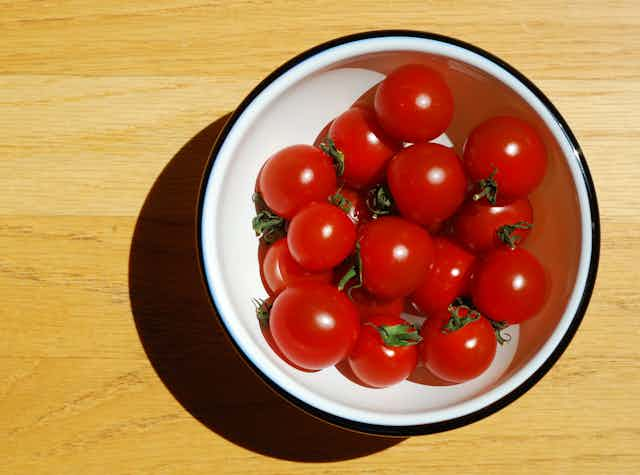

What my tomatoes taught me about quantum mechanics

Most people outside the esoteric worlds of little-science physics (aka quantum mechanics) and big-science physics (aka cosmology) will at some point realise both worlds fly in the face of intuition. Why does the little-science world of atoms obey rules of physics that seem to confound every-day common…

Jn6g5bqr-1355706039
Sometimes the juiciest treats come in small packages. Dylan Parker

Most people outside the esoteric worlds of little-science physics (aka quantum mechanics) and big-science physics (aka cosmology) will at some point realise both worlds fly in the face of intuition.

Why does the little-science world of atoms obey rules of physics that seem to confound every-day common sense notions of position, space, time, cause and effect? And why does the big-science world of cosmology posit that time and space are warped near a black hole?

I can’t talk for cosmology but, if you step into my garden, I’ll try to talk for quantum mechanics.

Planting an idea

Suppose I plant a tomato seed. In the first month the plant may grow a metre. But that doesn’t mean if I left it a million months, it would grow a million metres, even if it were to be fed regularly with my home-made liquid fertiliser.

The “million metres in a million months” conclusion would be an absurd, unwarranted extrapolation of a quotidian observation; it would also be absurd to apply such logic to quantum mechanics, in which we’re dealing with atoms, and their building blocks, that are a million times smaller than a speck of dust.

There’s an implicit arrogance in assuming a world view built up using our synthesis of observations directly gathered by our five senses should be applicable to objects much smaller than the smallest object we can see, or indeed to objects and distances much larger than those we can directly apprehend.

Where intuition meets method

The scientific method allows us to refine our flawed intuition, using reason to make sense of the data obtained by physicists using instruments that are thousands or millions of times more sensitive than our human senses.

We thereby build up a new intuition that’s counter-intuitive but leads to a successful description.

Many examples can be drawn from history:

  • we once thought the Earth was flat because it appeared flat to our eyes
  • we believed the mountains and continents were static because (earthquakes aside) they appeared to not move during our lifetimes
  • we assumed there was such a thing as universal time (“the time”) because of the fact that we can all meet for dinner at 7pm today or have a meeting at 10am tomorrow

Common sense and science frequently clash – and that’s not a bad thing.

Beans and bombs

Suppose I put a dried broad bean in a glass jar, screw on the lid and shake. Common sense tells us that the bean will just rattle around inside the glass jar. Quantum mechanics predicts there is a small chance the bean will escape from its prison by passing through the walls of the jar.

For beans trapped in glass jars, the chances of this happening are almost non-existent – but not quite zero. For really small beans (protons and neutrons, two of the building blocks of atoms) in really small jars (the nucleus of the atom), the chances of escape can become significant.

Protons and neutrons escaping from atoms are a form of radioactivity, the little-science equivalent of magic beans escaping from sealed glass jars.

These quantum magic beans underpin the power of the atom bomb, nuclear reactors and certain forms of radiation poisoning.

That’s because an immense amount of energy is released when protons and neutrons escape from certain nuclei, such as plutonium.

Now imagine that I have two different beans, say a broad bean and a borlotti bean, and a jar. Here are four possibilities:

A) Both beans are in the sealed jar
B) The broad bean is in the sealed jar, and the borlotti bean outside
C) The borlotti bean is in the sealed jar, and the broad bean outside
D) Both beans are outside the sealed jar

Common sense says you can have A, B, C or D.

Quantum mechanics says you can have A, B, C and D all at the same time. Let’s call this quantum state of two beans “ABCD”.

geishaboy500

In quantum state ABCD we can no longer speak of “the state” of an individual bean. We cannot speak of the borlotti bean as being inside the jar or outside; it is both at once. The same goes for the broad bean.

Such quantum states are “entangled” because the concept of the state of any individual part of the system loses meaning. The state of the whole system is ABCD, but don’t ask me what the state of the borlotti bean is, because this concept has broken down in the weird quantum world.

What use is this second piece of counter-intuitive quantum weirdness? It lies at the heart of current work to build a quantum computer, which may one day replace the computers at the heart of your laptop or phone, with computing machines vastly more powerful than any available today.

When the going gets weird …

Quantum mechanics is certainly weird, with beans jumping through walls, and being both inside and outside jars at the same time. It’s disorienting for so much big-world common sense to fly out the window when looking at the small world of atoms.

Should we be put off by what Erwin Schrödinger, of Schrödinger’s cat fame, called “damned quantum jumping”?

In a word, no: rather than being intimidated or surprised by the weirdness of quantum mechanics and other counter-intuitive ideas of physics, one should expect such physics to be weird. Indeed, one should wholly embrace this weirdness.

We should take solace from the fact that scientific method allows us to use our minds to see beyond the limitations of our intuition, thereby refining that intuition to see the hitherto unseen.

Through that process, scientific enquiry yields fruits (and legumes) that both enrich human culture and increase our power to better the human condition.

Sign in to Favourite

Want to follow The Conversation?

Sign up to our free newsletter to get the day's top stories in your inbox each morning, with a special wrap on Saturday.

Spinner
Donate and become a friend of The Conversation

Join the conversation

17 Comments sorted by

  1. Comment removed by moderator.

  2. Peter Ormonde

    Peter Ormonde is a Friend of The Conversation.

    Farmer

    Good try! I almost understood some of that. I think.

    I am gradually coming to realise that an understanding of matters quantum involves a state of permanent and irredeemable confusion. Now that is real entanglement.

    What a wonderfully strange and curious place we live. Thanks for the reminder.

    Now I am off to find some lead lined cannisters for my chick peas.

    report
    1. David Paganin

      Associate Professor (Physics) & Associate Dean Education (Science) at Monash University

      In reply to Peter Ormonde

      Thanks for your comment! One point I didn't mention in my article is that entanglement is also deeply connected with why the world appears classical, rather than quantum mechanical, to us. The permanent and irredeemable confusion you mention is very close to the idea that entanglement, of quantum systems with their environment, leads to their appearance as being classical. Cheers and thanks from David

      report
  3. Baron Pike

    logged in via Facebook

    "For beans trapped in glass jars, the chances of this happening are almost non-existent – but not quite zero. For really small beans (protons and neutrons, two of the building blocks of atoms) in really small jars (the nucleus of the atom), the chances of escape can become significant."

    The chances that the thing that we have determined fits the definition of a bean will ever escape from a closed glass jar, without either of them having become less than what can be defined as a bean or jar, are nil.
    Playing with words is a fine way to make a point, but the point made to be inferred here is simply wrong.
    Physicists should perhaps take a course in drawing the most correct inferences, rather than assuming that since nothing is theoretically certain, nothing is also theoretically uncertain.

    report
  4. Bruce Tabor

    Research Scientist at CSIRO

    I've found I've learned a lot about quantum physics by studying socks. Have you ever wondered why you often end up with an odd sock after washing your clothes? Well the sock exclusion principle explains it: once socks are off your feet and in the washing machine, they risk becoming indistinguishable & one must vanish or be transformed into something else:
    http://www.janko.at/Humor/Wissenschaft/Quantentheorie%20der%20Socken.htm
    For a more detailed explanation:
    http://blogs.scienceforums.net/swansont/archives/3411

    report
  5. Comment removed by moderator.

  6. Fred Pribac

    logged in via email @internode.on.net

    But wait there's more: lets assume that for some reason your tomatoes have withered.

    No problemo in the quantum mechanical analogy world - just collide some borlotti beans with some broad beans at sufficiently high energies and hey pesto - tomotoes!

    Oh ... and for goodness sake don't mix pasta with antipasto!

    report
    1. David Paganin

      Associate Professor (Physics) & Associate Dean Education (Science) at Monash University

      In reply to Fred Pribac

      Thanks for the post -- I like the idea of quantum cooking!! cheers and thanks from David

      report
  7. Trevor S

    Jack of all Trades

    I find and will probably forever find QM baffling which is probably what keep drawing me back to it.

    The articles timing was good, I just tried to finish "Absolutely Small" by Michael Fayer and felt embarrassed as I struggled with this beginners guide and gave up 3/4 of the way through.

    http://www.amazon.com/Absolutely-Small-Quantum-Explains-Everyday/dp/0814414885

    I started to struggle with the Interferometer example of a photon in two places at once and it went down from there !

    I still don't understand :)

    report
    1. Peter Ormonde

      Peter Ormonde is a Friend of The Conversation.

      Farmer

      In reply to Trevor S

      Excellent Trevor - you're obviously well on the way to a QM lecturing position (with tenure).

      Just as I think I've actually grasped something, some bugger turns up with a new parallel or metaphor and my fragile grasp disappears faster than a Higgs Boson in a salad.

      I've spent the whole day brushing away these accursed tiny bean bits that are hurtling about all over the place - at once, and at the same time elsewhere. I'll never get the place cleaned up.

      report
    2. David Paganin

      Associate Professor (Physics) & Associate Dean Education (Science) at Monash University

      In reply to Trevor S

      Hi Trevor, I too am continually drawn back to quantum mechanics by how baffling it is to everyday common sense! So many of our instincts, picked up from everyday experience, go out the window -- inspiringly baffling and always a challenge to understand! Cheers and thanks from David

      report
  8. Yoron Hamber

    Thinking

    Nice :)

    (Hmm, the comment was to short so I will write this too)

    report