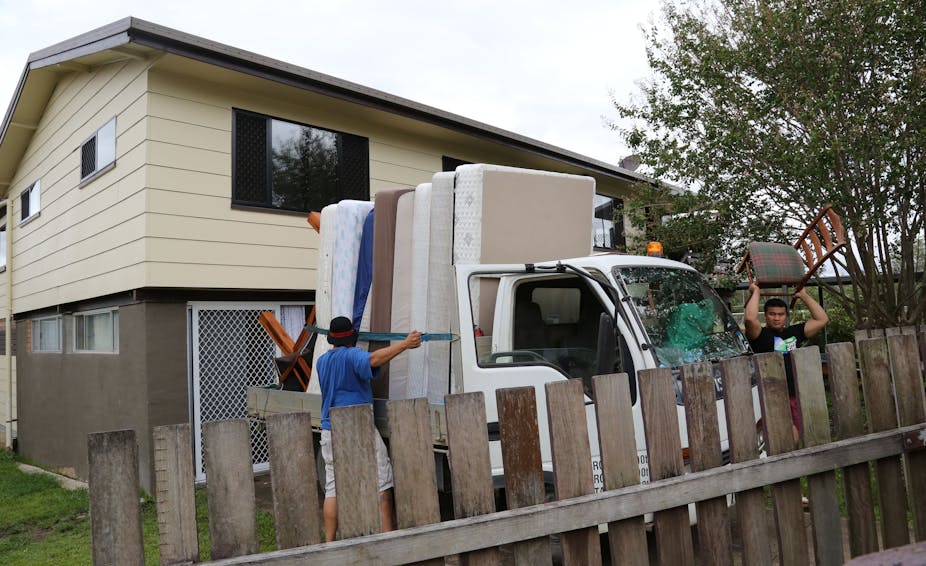
Queensland towns and suburbs have been hit by floods again. Flooding is not a rare event here and most residents are not surprised by the recurrence of floods.
But the memory of the 2011 floods is still fresh. Inevitably some homes will be damaged by the floodwaters. Some enduring problems regarding flood insurance threaten to explode as homeowners come back to clean up the mess.
When it comes to property damage, some of these affected households will eventually find that insurance companies are not going to recover their economic losses. Some are not even offered flood cover, whereas some policyholders elected to opt-out. Non-insurance or under-insurance remains an issue.
Why are they left uninsured? Because of their location, risk awareness, or economic reasons? Or ultimately all come down to some kind of policy failures?
After the 2011 Queensland floods, the Federal Government looked into the issue and commissioned the Natural Disaster Insurance Review (NDIR). They have identified a range of supply-side problems to fix. Some of these pertain to the practice of the insurance industry, and some entail legislative efforts.
Quite reasonably, the Review does not recommend mandatory purchase of insurance. Thus, on the demand side, households are left to exercise their freedom of choice. It is up to them if they elect to bear the risks.
But some households really never sign up to a flood insurance package, even if it is available at affordable costs, and even if they knowingly stay in a flood-prone site.
Isn’t it true that people would opt to get insured if they know they are at risk and can afford it? This is our standard assumption – people say no (or under-insure) if they think the floods won’t affect them or the insurance premiums too expensive, and vice versa. The NDIR and the industry share this view.
This is only part of the picture. Research shows that non-insurance is related to factors other than perceived risk and affordability.
In a research project funded by Griffith University, about 500 residents of South East Queensland, including Brisbane, were telephone-interviewed in 2012. They were asked if they have flood cover on current policies. More than 40% of respondents did not have it, or did not have home insurance at all.

True, those respondents who know their homes are at high risk of flooding are more likely to have flood cover on current policies. Also, those who had experienced property damage in the 2011 severe flooding event tend to have such cover. However, this is not a strong positive relationship. Statistically, it is not conclusive to suggest that perceived risk and damage experience explain the tendency for non-insurance.
Likewise, those who have higher incomes and find flood insurance affordable to them tend to insure. But no strong statistical relationship is observed. Household income and affordability are not a good explanation either. The standard assumption does not always hold.
What is the motive then?
Social influences. The findings suggest that if the respondents believe that their family or friends would want them to insure, they tend to do so. Also if they believe that other people like them would buy flood cover, they tend to follow suit. The decision is predominantly socially motivated.
Interestingly, such social factors are precisely what the Productivity Commission has identified but recommended not to deal with through government policy.
Certainly there is something the market cannot do, for which the government should at least facilitate. Although it might not be appropriate for them to mobilise social influence directly, they should try to make sure the community has the capacity to spread the message. There is no excuse for the government to avoid addressing behavioural drivers. Governments have been using all sort of measures to encourage good behaviours and punish the bad ones.
Local community organisations may help increase the voluntary adoption of flood insurance through word-of-mouth. Governments and the industry should support (financially) their efforts and harness the social forces they help to create.
(*Findings will be reported in an article due to publish in the March edition of Area journal.)
Chris Aitchison
logged in via Twitter
Insurance is gambling, and has a negative expected value (http://en.wikipedia.org/wiki/Expected_value) to the householder if the insurance company is making a profit. So there's that.
Chris Aitchison
logged in via Twitter
I should mention that it is still rational and sensible for someone to make a -EV bet on insurance to reduce their variance if the variance is such that they face a risk of ruin.
So it is not rational to get the extended warranty on your electrical goods, as your finances can swallow the variance on that bet. If your finances can't swallow losing a house when the long shot (insured event) comes in, it is rational to give up some EV to transfer that risk to another party.
Mind you, I know some of the insurance premiums in Far North Queensland (eg. Port Douglas) are >$10k/yr for a $100-150k Unit. I don't know what the insurance company's margin is there, but it wouldn't be silly for someone with sufficient capital to forgo paying those premiums.
I wonder if houses on hills are going up in value? Maybe hills will be the new coast...
Chris O'Neill
Telecommunications Engineer
"So it is not rational to get the extended warranty on your electrical goods, as your finances can swallow the variance on that bet."
Indeed. Extended warranties are a scam. I was persuaded into getting an extended warranty on a TV once by being offered a lower price on the TV if I bought the extended warranty. The next day I returned the extended warranty and had its full cost refunded. So I got the lower offer price on the TV without having to pay for an extended warranty. Perhaps I scammed them :-)
Alex Lo
Lecturer, Griffith School of Environment at Griffith University
Chris you may be right.
Here is the link to another report (page 29) indicating that Qld has the highest percentage of households without flood cover on contents policies.
http://www.pc.gov.au/__data/assets/pdf_file/0019/117460/subdr110.pdf
Gary Myers
logged in via LinkedIn
It would also be worth throwing into the mix the percentage and value of the mortgages on those properties. If a locality has a high risk of flooding, then I can see the banks insisting on a minimum level of cover. Plus they'd be interested in a mechanism to confirm that the cover continues for the full term of the mortgage.
Colin MacGillivray
Retired architect
As Chris said an insurance premium payment is a bet. The bookmaker, the insurance company, has administration costs, unpredictable future conditions, fraudulent claims, and needs to show a profit. So it's not a good bet for the honest. Insurance is based often on illogical fear and uncalculated odds.
My late father, a careful driver for over 60 years with no crashes, had comprehensive insurance all his life and reckoned he'd paid for two new cars. With health insurance you have to be sick to "win" so it's a lose lose situation. There are sound reasons why people don't insure.
Julie Leslie
GIS Coordinator
What you say is true. But most people don't really think about it. At all.
If they did, they would do something productive with the money they saved from not purchasing insurance - not piffle it away on whatever. I bet you those people who don't purchase insurance also don't do anything with the money either.
Andrew Pengilley
Doctor
This has the makings of another massive socialise the cost/privatise the profit moment for Australia. We have governments in NSW and Queensland who have dismantled planning restrictions and environmental assessment capacity on where developments are constructed and frankly deny 'politically correct' impacts of climate change. At the same time the insurance industry is saying that the risk of climate related disasters has increased so much they cannot afford the exposure, or the price of taking that…
Read moreFelix MacNeill
Environmental Manager
Thanks Andrew - couldn't agree more.
Surely step one would be for governments to begin defining zones where any new development will simply not be in any way supported by government should the predictable disaster occure: I mean no rescue service, no SES, no government assistance because WE WARNED YOU (and we actually meant it so it's no good coming crying when you lose the gamble).
Sorry, I know that sounds grumpy, but I'm sick of everyone bagging preventative 'interference' by government but then screeching to be rescued when the risks don't pan out.
Andrew Auzins
Retired
Insurance has nothing to do with gambling. The rational person will assess how much risk he is able to cover himself and how much he will be unable to cover. By insuring he transfers the risk to the insurer.
I know this is a generalization but - the average person who owns or is purchasing a home will be unable to rebuild unless they have transferred the risk of loss to an insurer. Worse still - a mortgagee unless insured - will not only lose whatever equity they have in their home but will still be liable for the balance of the mortgage. A situation from which it will be hard to recover.
People who fail to offset a risk they know they cannot cover themselves should be left to handle the consequences of their decision and not be bailed out by the taxpayer.
There is however the possible liability of planning authorities who allow development on known flood plains.
John Phillip
John Phillip is a Friend of The Conversation.
Grumpy Old Man
Alex, things must have changed some. I used to live in Kingston, Logan on land that had the low corner of the back yard enchroached on during the '74 floods (about 3sq metres). It was impossible for us to get flood coverage on that property - ie there was no choice involved, the insurance companies simply wouldnt cover us.
Alex Lo
Lecturer, Griffith School of Environment at Griffith University
sure, some homeowners are not offered a flood cover at all. But the data I collected (details are reported elsewhere) also show that, if we only look at those who currently don't have flood insurance, their willingness to pay for such cover also increases with perceived social expectations. This is about their intention, not actual decision which may be constrained by the industry's policy.
Emma Anderson
Artist and Science Junkie
Ok, so not all of it is denial-of-coverage and awareness of actual (rather than percieved) value of coverage is part of the decision making process.
So, for argument's sake, let's assume (big if) that we live in a situation where all people who would benefit from coverage are aware and have the resources to pay for it, but, the variable "denial of coverage" still exists. What are those reasons? Largely the same as why these people need coverage, they live in a high risk environment, which…
Read moreGeorge Michaelson
Person
Paul Pisale's comment that with a hilltop house at next to no inundation risk, he faced a $3000 flood premium says it all about the industry. I think Insurance is trying to have it both ways: claim that the premium has a societal outcome which reduces costs, but extremely high premiums on people with no risk exposure beg for under-insurance, and therefore a % reduction in the Insurers liability.
Personally, I think 'underinsured' defence has been over-engineered. Insurance companies probably have…
Read moreChris O'Neill
Telecommunications Engineer
"Paul Pisale's comment that with a hilltop house at next to no inundation risk, he faced a $3000 flood premium says it all about the industry."
This and John Phillip's comment about the impossibility of getting insurance on land that actually gets flooded suggests that some sort of scam may be in operation here, i.e. insurance companies justify a premium increase based on someone, somewhere getting flooded but then they don't actually insure that someone, somewhere who gets flooded.
Chris O'Neill
Telecommunications Engineer
Insurance is not a charity. A lot of people act as if it is. It is a negative sum game for policy holders. So people should ask themselves why they should get insurance.
The only justification I can find is that it takes care of genuinely awkward and unusual financial circumstances that could make a difference to your entire life such as your house burning down. If it's for flood insurance where you make a claim every 10 years then sooner or later the insurance company is not going to make you any better off for having insurance. They (the insurance company) are not a net source of money.
Michelle Prior
Researcher
Thanks Gary, for an interesting and topical article. Social influences is not a factor I had thought about. The failure of the standard assumption (income and affordability) is surprising.
It is not just Queenslanders who don't insure. When the Canberra bushfires occurred, many property owners were uninsured or under-insured. Do you know the comparsions between uninsured Queenslanders affected by floods and ininsured Victorians affected by bushfires?
Also surprising is the inconclusiveness…
Read moreAlex Lo
Lecturer, Griffith School of Environment at Griffith University
Income and risk perception are still in the equation but we should look beyond that. The data leading to this article also shows that both risk perception and experience of property damange due to 2011 floods are related to social expectations. Thus it is possible that these factors influence (perceived) social expectations which then influence insurance decision. The opposite direction may also be true though, i.e. social norms affect how we perceive flood risk (and the ways we approach the issue).
Bernie Masters
environmental consultant at FIA Technology Pty Ltd, B K Masters and Associates
There are some key principles missing from this article. The first is why should someone whose property is located in a known flood-prone area be able to buy flood insurance? I believe it is morally indefensible to offer insurance when the only responsible thing to do is to have these vulnerable properties bought back by government and turned over to public open space or similar or the landowner must build flood-proof buildings.
Read moreThe second issue is that, in general terms, the way insurance works…
Rachel Anne Carter
Associate Lecturer and PhD Candidate at the School of Law at La Trobe University
One of the starting queries that I would have in assessing this article would be what exactly where the parametres around which the questioning of the respondents was conducted. Was there mechanisms for screening out participants etc. Furthermore when results were collated how did you go about doing this. These questions are essential to determine the validity of your findings in light of the broader issue. I note that you have mentioned these will be covered in an article.
The second question…
Read moreAlex Lo
Lecturer, Griffith School of Environment at Griffith University
Thanks for your comments/questions.
Quota sampling was used and quotas were set based on household size in proportion to ABS census data. Screening procedures include requests to speak to household heads likely to be responsible for insurance decisions.
The government can still do something. They can sponsor community campaigns, offer grants to NGOs, etc. Not sure social change is something government cannot do, it is the extent in which they should do and how (directly or indirectly).
Agreed that insurance is a multifaced issue, but what I found in the literature and some official reports is that social dimensions have attacted little attention.
Chris Aitchison
logged in via Twitter
I think the best thing that Government can do is try to increase competition between insurance companies so that they are forced to get better a measuring risk.
Other commenters in this thread have mentioned silly situations where they are classed as being flood-prone despite being on a hill, no doubt because the insurance company's risk calculation method is not sophisticated enough to care. They just see a lat/long in a flood prone polygon on their map of Australia, not necessarily a lat/long…
Read moreChris O'Neill
Telecommunications Engineer
"There is no excuse for the government to avoid addressing behavioural drivers. Governments have been using all sort of measures to encourage good behaviours and punish the bad ones."
Your article is about evidence for what drives particular behaviours (social influence drives interest in flood insurance). Whether flood insurance is good behaviour is something you just assumed to be true. Your research was not about evidence for, or analysis of, that.
By the way, the insurance companies stopped taking new flood insurance policies a few days before the 2011 flood. They are not fools.
Michelle Prior
Researcher
Many apologies Alex for calling you by the wrong name - rushing due to power outage & internet problems.
Iain Brown
Retiree
Queensland was one the first States to remove the burden of the Fire Services Levy from Insurance policies. The hope was to encourage more people to insure their homes. Under insurance or no insurance is still a a major issue in QLD. Insurance policies require the Insured to pay for the first $20,000 in the event of an earthquake. I am telling you this because no one reads their insurance policy.Besides earthquakes never happen in OZ, then again it would never flood in Katherine. Sorry I am being cynical.Flood insurance should also have a $20K excess.Flood is a catastrophic event like an earthquake.In time Insurers could build up a pool of flood premium (during a drought) and reduce the $20K excess. In the interim,householders and business could cobble together the $20K through donations to get going again.Living in a flood affected area means in time your property values are flat lining.