Why we will make mistakes managing the Murray-Darling, and why that’s OK

The proposed Murray-Darling Basin Plan has been one of the most controversial pieces of public policy in Australia’s recent history. There has been the predictable divide between irrigators calling for more water to be extracted from the river, and environmentalists, who say too much is coming out already…

W6drrpwy-1335931877

The proposed Murray-Darling Basin Plan has been one of the most controversial pieces of public policy in Australia’s recent history. There has been the predictable divide between irrigators calling for more water to be extracted from the river, and environmentalists, who say too much is coming out already. But between the two, many experts are looking at the nuances of the plan and saying it’s a lot more complex than farming versus nature.

This week, researchers around the Basin will give us their view of how their local area has fared in recent years and tell us whether the proposed plan will make things better or worse. Today, Paul Humphries, Lecturer in Ecology at Charles Sturt University, says we will definitely make mistakes managing the Basin, but that it’s OK to be wrong.

It could be testament to our creativity and ingenuity that we can make an attempt at managing water in such a hugely complex ecosystem like the Murray-Darling Basin. But perhaps it’s also a demonstration of our arrogance that we actually think we can do it. Or perhaps it’s just sheer desperation that we have to do something, anything, to attempt to rectify all the poor decisions of the past. In the end, I reckon it is probably a combination of all three.

But one thing is very clear: as with most things that humans do when we attempt to predict or manage vastly complex systems, whatever happens, we will be flying by the seat of our pants. And we will almost certainly produce a less-than-perfect outcome. But that’s OK, despite the angst it might cause.

Why will we make mistakes and why is it OK to do so?

The Murray-Darling is made up of so many pieces, it’s no wonder we can’t make reliable predictions. John Carney

We cannot help make mistakes, because of the very complexity and size of the Murray-Darling Basin and because we don’t know how factors like climate and river flow influence water quality, individual animals and plants, populations, communities and ecosystem function (such as the movement of energy from the floodplain to the main channel of rivers).

Plans can be based on rough guesses, conceptual models or even mathematical models. But they are all built on data, and interpretation of the biological or ecological meaning of that data. Collecting, interpreting and forecasting data on rainfall and river flows, despite their complexity, is like a walk in the park compared to collecting, interpreting and forecasting data on even the simplest of ecological levels – the individual – let alone whole communities.

This is because the existence of particular physical conditions (like a flood) or chemical conditions (say, high salinity) will only tell you about what ecological outcomes are possible, not what actually will happen.

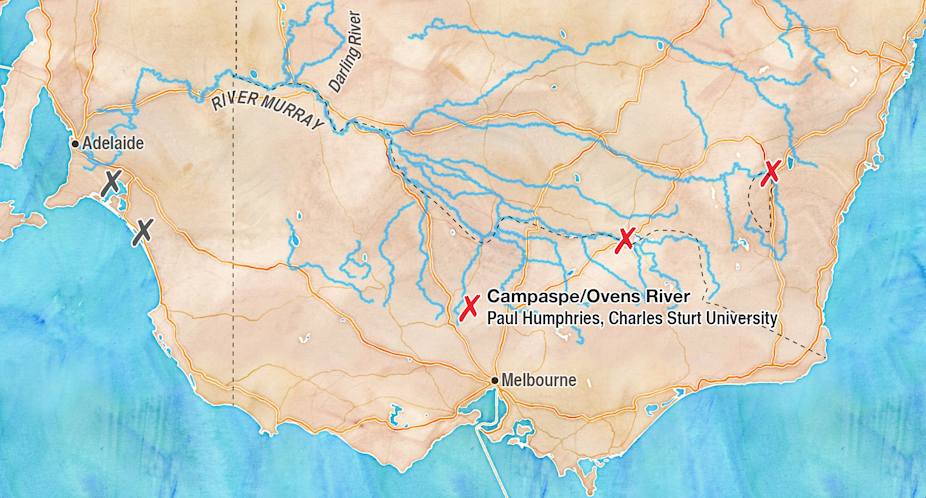
The Ovens River in 2007, when this mostly unregulated river dried to a series of pools. Paul Humphries

If we were only interested in bacteria or algae, perhaps, predictions could be made about outcomes based on specific physical and chemical conditions, because there is a close connection between inputs and outputs. But even with these relatively simple organisms, there is competition between individuals and species for space, nutrients and light, and so even there outcomes can be uncertain.

But when it comes to the complex behaviour of, say, fish, all bets are off. Sure, you can predict with a reasonable level of certainty that if you provide the right ranges of temperature and flow, a species will breed. But translating that simply to survival of the eggs is hard enough. Translating breeding to survival, growth, movement, the outcomes of competition and predation, maturation, attainment of breeding territories and successful mating, is nigh impossible.

There are approaches to help us realise our goals of obtaining improved outcomes. They include Adaptive Management and Bayesian Modelling. In both cases, there is inbuilt flexibility and potential to include improved understanding in subsequent iterations of predictions and on-ground actions. Progress will still be very slow, even with these approaches, because they still rely on data, and data collection on river ecosystems is costly and time-consuming. So, patience and persistence are important commodities with all of this.

Campaspe River at Strathallen during summer low flow period. Paul Humpries

Secondly, why is it OK to make mistakes in management? The answer to this relates to the first part of the discussion.

It is OK, because we can often learn more from mistakes than from successes. But, and it’s a big BUT, the only way to learn from mistakes is to set up the management decisions as experiments.

It is certainly a start to have good, sound, ecological bases – not to mention hypotheses – for giving more water back to the environment, such as flooding a wetland that has previously been dry. But it is absolutely critical to do this in a way that tells us something meaningful and allows us to improve – or rectify mistakes – next time.

This requires not only an appreciation of how experiments are done, but also intestinal fortitude on the part of natural resource management agencies involved. Intestinal fortitude is needed because a good experiment must include control or reference systems (that is, systems that are not manipulated). It must have a period prior to the intervention to gather baseline data to compare with after the intervention.

The heavily regulated Campaspe River at Campaspe Weir in 2002, releasing a small amount of water for downstream and environmental use. Paul Humprhies

In most cases, this may mean not intervening with some systems because you need them to act as references, and delaying remedial action to collect “before” data, both of which can incur the wrath or at the very least, antipathy and scepticism of stakeholders. Most natural resource management agencies find this approach unpalatable, because:

  • they understandably want to fix things as soon as possible, and

  • discontented stakeholders typically blame politicians and politicians don’t want to be seen in a bad light.

Sure, making mistakes is not something we strive for, and clearly it can cause financial suffering as well as poor environmental outcomes. I am not advocating that we deliberately make poor decisions. What I am saying is that we should recognise our profound ignorance of how ecosystems, like the Murray-Darling Basin, function. We need to accept that we are largely flying by the seat of our pants when making decisions and invest heavily in targeted data-gathering to improve our models. But most importantly, when making decisions, we have to conduct large-scale, ecological experiments to learn from the mistakes that we do make. Not to do so, risks making the same mistakes over and over again.

To paraphrase Oscar Wilde: to make one mistake may be regarded as a misfortune, to make the same mistake twice looks like carelessness.

Previous articles in this series

Join the conversation

19 Comments sorted by

  1. Susan Myers

    Project Manager

    The MDBA is making the same mistake, as did the early pioneers back in 1930 by not examining the ecological problems caused by the barrages.

    The barrages have diminished the Murray Estuary to just 11% of what the estuary used to be. This is habitat loss at a massive scale and it's been that way for 70 years. Habitat loss that has destroyed the mulloway fishery that used to thrive there.

    Examining what it would take to restore the estuary, to as much of it's previous historical boundaries as possible, would go a long way to making the riverine environment more sustainable.

    And I'm sorry, but the MDBA and all these government funded scientists get paid too much to be making such big fat mistakes.

    report
    1. John Nicol

      logged in via Facebook

      In reply to Susan Myers

      This article by Paul Humphries is one of the best if not the best, I have seen in discussions on the Murray Basin. He is being realistic.

      To suggest that one can consider the whole system, with its many tributaries, and the unknown fluctuations in future rainfall from massiv e floods such as those in the 1950s and more recently to the long droughts such as in the mid 19th century and the later federation drought, and come up with a theoretical solution, is just silly.

      The flexible, experimental…

      Read more
    2. David Arthur

      n/a

      In reply to John Nicol

      Good points made about the barrages on Lake Alexandrina, Mr Nicol.

      The same points hold for all upstream instream infrastructure, plus all diversions and extractions from the waterways of the MDB.

      Until and unless substantial upstream restoration and rehabilitation is carried out, it's a bit premature to just decommission the Lake Alexindrina barrage.

      report
    3. Susan Myers

      Project Manager

      In reply to David Arthur

      It would nice if there was just one independent scientific report by estuarine scientists that did model how much water is required to operate the Lower Lakes as the very large estuary they once were.

      It was quite common for Lake Alexandrina to 'go salty' during times of low river, and not until farming was encouraged around the Lakes did this become a problem. You will notice that many of the comments of the Lakes going salty back in the early 1900's are from the newly established dairy farmers at Narrung and Lake Albert.

      In 1844 the Lakes were mapped and areas of fresh, brackish and salty have been clearly marked by the South Australian Company. This is long before there were any significant diversions.

      report
    4. Gil Hardwick

      Anthropologist

      In reply to Susan Myers

      Susan, I disagree with you entirely. The purported problems of the Murray Estuary are short-term and short sighted, derivative and symptomatic rather than substantive. They are not even historically significant.

      To resolve them the tributaries and upper catchment must be sorted out first, as suggested, progressively and in carefully thought-out stages, then their effects monitored in the upper mid-catchment, and fine-tuned on that basis. It follows that once the remedial effects flow-on (pun intended…

      Read more
    5. John Nicol

      logged in via Facebook

      In reply to David Arthur

      That is true David although there seems to be some sense in keeping the upstream ones in palce since as many point out, they allow for a regulated flow down the river to feed the areas as necessary. Otherwise, whenther is a big flood as for 2011, 2012 and other years, all of the water is soon lost down stream and out to sea.

      Come a drought, and the same areas suffer. Of course, if one is trying to be totally natural, then yes, all structures should be removed for that to occur. I am not…

      Read more
  2. John Troughton

    ANU Alumni

    Do I take it that it is acceptable that the 4000 scientists over 7 years that produced a model of world carbon and world temperatures may have made a mistake? Or do we accept theirs as a state of the art?
    The basin is only 100m hectares so it is child's play to model compared with the world and it's dynamics!! Even if it is a model of the water which obeys natural laws, or the chemicals that obey natural laws, surely there are good models for that. Can the public use a water model if the CSIRO have…

    Read more
  3. Michael Burrows

    Mr

    Euastacus armatus where does thou swim?

    “In the ‘bloody’ Murray where I, always ‘bin’”

    What say you on this river debate?

    “We bury in the mud and river bank we hide;
    mis-managers above, our seasonal flows; as if in chide.
    Now the cod and yellow-belly gobble some of us up; but our
    Jennies in berry keep all the numbers up
    Jenny’s protected, most the year round
    Poor old male; on the plate, he is found
    Cooked with lemon and salt, I here his sweet flesh; is delicious to eat
    We want to breed, but males; are increasingly difficult to meet
    We’re tough little buggers and like a good fight
    But with your poisons and politics; hamper our plight
    So please be kind to the waterways, it is our land; may the ebb and flow of time and water, allow our species; with friends: be forever grand.”

    report
  4. Shane Perryman

    logged in via email @gmail.com

    Hi Paul,

    It's interesting isn't it that nobody questions the need for insurance when we take our cars out into the less complicated road network populated with a finite number of vehicles. IE we understand that (even in a system of our own creation) accidents and chance can produce unforeseen consequences.

    A river network is far far more complicated and yet the public debate is often interrupted by calls for deterministic answers (or worse allegations of incompetence when such can not be provided) ... from a system where we barely have the crudest map of the individual components and subsequent connections/interactions.
    Never mind including the errors involved in taking measurements!

    At least one of the comments before me made me think of The Dilbert Principles of Management.
    http://www.ifsociety.org/voxmagister/dilbert_principle.htm
    Especially principle #1

    report
    1. Gil Hardwick

      Anthropologist

      In reply to Shane Perryman

      No, Shane, I disagree with you as well.

      It is not complicated. We have very finely detailed knowledge of the Murray-Darling system, living on it for over 200 years now.

      The far bigger problem we face in addressing the issues is the flood of immigrants from Europe and all sorts of places over the past 50 years and more.

      That is not a racist or nationalist remark, merely pragmatic recognition that all those people come here carrying knowledge and other cultural baggage from other landscapes…

      Read more
    2. Shane Perryman

      logged in via email @gmail.com

      In reply to Shane Perryman

      First, my article should not be at the top of the page. When I posted there were already several posts. Since I'm in a different time zone I'm curious how The Conversation time stamps posts?

      In answer to Gil, what fine grained information do we really have? Before "we" even got to know the river we started to change it by cutting down the trees in the catchment, putting in structures, planting willows, pulling the wood out of the channel, placing embankments and in some places diverting or straightening…

      Read more
    3. Gil Hardwick

      Anthropologist

      In reply to Shane Perryman

      I'm not sure that I stated anywhere that we have been "studying the river systematically over 200 years", have I? Please point me there.

      What I said was that we, by which I mean we who have been living on the Murray-Darling system for over 200 years, as distinct from those arriving recently from other countries, know how the system works, its history, and best practice in its remediation. We even have the logs and diaries of the first explorers up the Murray, with precise accounts of their experience…

      Read more
    4. Shane Perryman

      logged in via email @gmail.com

      In reply to Gil Hardwick

      [I'm not sure that I stated anywhere that we have been "studying the river systematically over 200 years", have I? Please point me there.]

      I did not mean to state that you did. My observation. But I'm glad you agree.

      Until your emotions, assumptions and innuendo come out in your long reply there is some interesting information. I don't know if its "fine scaled" though.

      Why not write this information the first time instead of the vague reply you gave. That is why I asked those two questions…

      Read more
    5. Gil Hardwick

      Anthropologist

      In reply to Shane Perryman

      It is a telling indictment that people working in these fields do not know each other and the work they've been doing all these years. That's a large part of my complaint, that so many different people are doing the same work over and over again, fragmented I argue through capricious funding cuts and constant challenge to our integrity ad absurdem.

      Yes, we understand uncertainty. It has been applied here ad nauseam, until as I have suggested elsewhere if it were applied to itself it would disappear…

      Read more
    6. Gil Hardwick

      Anthropologist

      In reply to Shane Perryman

      OK, yes, while I'm thinking about it, if we are to have a conversation let's have a conversation.

      The context to me suggests intelligent, well-informed conversation not bullshit over a few beers at the pub, a bit of six o'clock or even ten o'clock swill before he have to be out of there, no worries mate, she'll be right.

      Yes, I understand The Conversation is new, but Netiquette has been around for 20 years, as much to do with context and appropriateness of setting as interpersonal regard…

      Read more
  5. Debbie Hoad

    student at University of Canberra

    I just wish people would have more sense than to try to grow water-hungry crops like rice in areas of water shortage. They are even more of a drain on resources, because they are growing a crop that is ill-suited to the environment.

    report
  6. Anthony Farrugia

    Builder

    Has anyone ever come up with the idea that the big cities that we build could perhaps be served with Desalination? any excess could be redirected to the Murray. This could apply all over Australia, or is this too simple an idea for the big thinkers.
    Ciao,

    report
  7. Peter R. Smith OAM

    Retired

    Hi Anthony Farrugia, desalination to expensive and it would be un-practicable to pump from major cities back into the Basin rivers.
    Hi Debbie Hoad, Rice and Cotton are not a problem in the Basin.
    Hi all, the Barrages must be retained and listening to all the clap trap by people wanting the estuary restored is just an environmental smoke screen and this is certainly not about fishing.
    Remove the Barrages and TOTALLY destroy the Lower River Murray Lock 1 to the Southern Ocean.

    report