Why work with Big Tobacco?

Big Tobacco’s desperate efforts to oppose the introduction of tobacco plain packaging have been supported by a potpourri of consulting, legal, advertising, public relations and lobbying organisations. Consulting groups, lawyers and lobbyists are free to choose their clients, and it is still legal to…

Wysr8239-1335237804
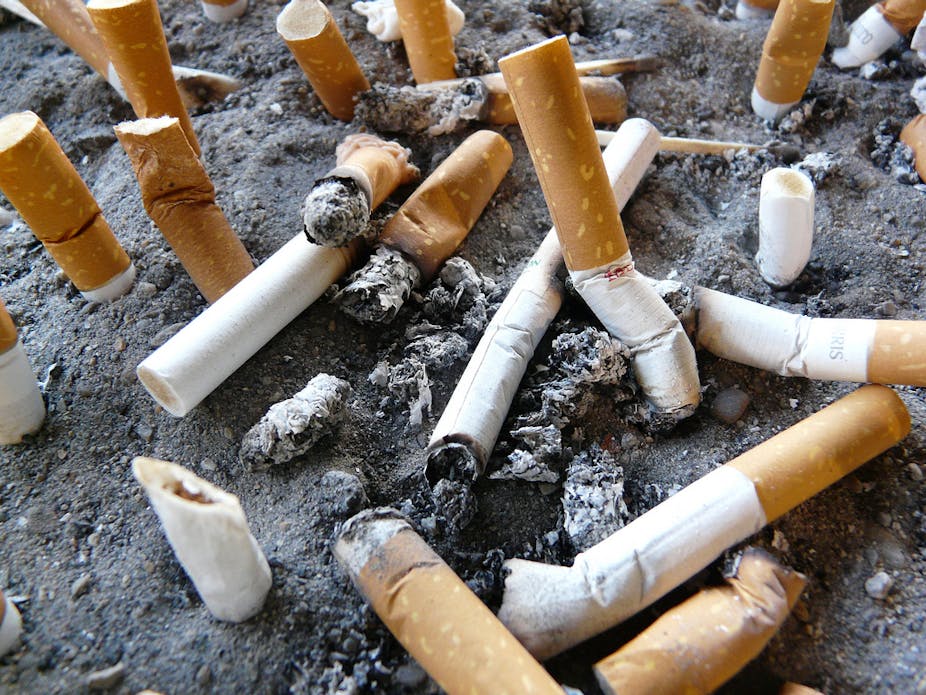
Cigarettes are the only commercial product that kills one in two of its regular users when consumed as intended. Jayaprakash R/Flickr

Big Tobacco’s desperate efforts to oppose the introduction of tobacco plain packaging have been supported by a potpourri of consulting, legal, advertising, public relations and lobbying organisations.

Consulting groups, lawyers and lobbyists are free to choose their clients, and it is still legal to sell tobacco products to adults (even though many retailers knowingly break the law prohibiting sales to children). But legal or not, the question remains: why, in 2012, would anybody want to work for or with the tobacco industry?

When I was first involved in tobacco control 40 years ago, the people leading tobacco companies had started their careers long before the dangers of smoking were identified or publicised. They took some wrong decisions early, setting the industry off on a long road of denying evidence, opposing effective action, promoting their lethal products wherever they could, and in my case offering to set me up handsomely to work on some other campaign. At least one could understand their approach, however misguided.

2012 is different. The overwhelming evidence about the dangers of smoking has been known and widely publicised for more than sixty years, confirmed over and again by evidence of the role cigarettes play in a galaxy of lethal and painful conditions. We know – as does anyone working for and with the industry – that cigarettes are the only commercial product that kills one in two of its regular users when consumed precisely as intended, and that passive smoking is a major cause of death and disease.

As long ago as 1967 the late Senator Robert Kennedy said, “the tobacco industry is peddling a deadly weapon. They are dealing in people’s lives for financial gain”.

The tobacco industry is more than lethal. It has been exposed over the years as dishonest and manipulative. Once-confidential industry internal documents show in fine detail that the major companies have been guilty of everything their most cynical critics suspect – and more.

They have lied and deceived. They have been found guilty in the United States of racketeering. In Australia, the main tobacco industry association even paid for people to go through the garbage of anti-smoking organizations.
Marionzetta/Flickr

Not surprisingly, Big Tobacco finishes rock bottom in global surveys of industry credibility.

Tobacco companies still market their products in developing countries in ways that would be unthinkable now in countries such as Australia. They promote to the vulnerable, just as once they targeted the youth market here.

In developed countries, they are mainly reduced to working in the shadowy half-light of lobbying and public relations. When they surface, as in their current desperate and misleading campaigns against plain packaging, they open themselves up to yet more cynicism and ridicule.

They cannot resist “dirty tricks” campaigns. They establish and fund front organisations. They pay consulting groups to produce substandard or one-sided reports that they then use for lobbying purposes. They use loopholes in the tobacco advertising ban legislation to run “political” media campaigns.

So why would anybody want to work with companies where success will result in more lung cancers, more heart disease, more respiratory disease, more suffering, more premature deaths? Who would want to work for a disreputable industry where even the suggestion of a “dirty tricks” campaign has instant plausibility?

Why would spokespeople and lobbyists for the companies want to expose themselves publicly as peddlers of Australia’s most lethal drug? How do people whose job is to ensure maximum possible cigarette sales sleep at night, knowing that so many of their consumers are suffering and dying? How do they tell their children and families that they work for companies long described as “merchants of death”?

Even if tobacco industry executives can close their eyes to the deaths for which they are responsible, why would large and respectable consulting groups, advertising agencies, legal firms, or even public relations and lobbying companies, which presumably can choose their clients, agree to act as hired guns for this pariah industry? Why do they not take the approach recommended by the World Health Organization and adopted by universities and other research groups and have nothing to do with the tobacco industry – no matter how much money is offered?
aaedf faa b/Flickr

It is true that cigarettes are a legally sold product – albeit so harmful that parliaments around the country have decreed that they may not be sold to minors. But that is a historical accident: if they were a new product, they would not be would be allowed on the market.

There is a long-standing and worthy legal tradition that any client – no matter how evil – is entitled to a defence. There is no such noble tradition or rationale for consulting firms, advertising, public relations and lobbying companies, or even lawyers who advise on means of circumventing legislation and putting pressure on health groups.

Anyone who now works for and with the tobacco industry knows beyond a shadow of doubt that their work will result in unnecessary death and disease.

That is clearly not a concern for tobacco company executives, who know that they are in the business of peddling a lethal drug. But the outcomes of the work done by otherwise respectable consulting, advertising, public relations, lobbying and legal companies that work for Big Tobacco are no different. They should take policy decisions to eschew this evil business.

Failing such a decision, when their executives go to sleep at night they should spare a thought for the suffering, death and disease they are helping to promote. They too are, in Robert Kennedy’s words, dealing in people’s lives for financial gain. Is it really worth the money?

Join the conversation

10 Comments sorted by

  1. Margo Saunders

    Public Health Policy Researcher

    "How do they tell their children and families that they work for companies long described as “merchants of death”?" In the 1980s, my sister worked for a PR company in Washington DC whose client was the US Tobacco Institute. (In a quirk of fate, while she was working for them trying to combat moves towards smoke-free workplaces, I was at ASH UK promoting smoke-free workplaces.) When I challenged her about how she could rationalise working for an industry that caused so much disease and death, she…

    Read more
    1. Glen Daly

      Retired

      In reply to Margo Saunders

      It is difficult to convince someone of the error of their actions if their livelihood depends on performing those actions.And there is virtually no limit to the ways in which those actions will be rationalized - human nature.

      I just hope that the federal government sticks to their guns in the case of packaging despite the peddlers of the poison invoking the WTO and other outside bodies.What Australia does on the doemestic front is our own business. That principle needs to be applied in other areas as well.

      report
  2. Jon Krueger

    engineer

    There is exactly one reason to work for Big Tobacco: money. They have a lot of it.

    The business model of this industry is to get 14 year olds addicted to slow poison. To further that cause, this industry has lied, misled, intimidated, covered up, engineered its product for addiction, and engaged in the largest, longest-running PR campaign every mounted, to "keep doubt alive". This industry has known for 50 years that its product, used exactly as intended, kills half its best customers; its response to that fact has been to push up smoking as much as possible. If that's OK with you, take the money.

    report
  3. Mark Chambers

    Business & Marketing Consultant

    Given that medical research has also proven that smoking is not only an addiction, but one which is even more difficult to overcome than heroin, that in itself is a compelling enough argument not to take up the habit.

    Given, however, that psychiatrist's tell us the treatment for a patient who has just quit smoking is exactly the same as the treatment for someone who has just lost their best friend, what exactly does our author think would happen if the tobacco industry shut down overnight ??

    Arguing for and with ideals is always a safe haven, it's otherwise known as 'taking the moral high ground'. Who of us though, including the author, would be prepared to have those same ideals applied to 'everything' in our day to day lives ??


    report
  4. Daryl Deal

    retired

    Hmmm, WHO, indicates the annual world death toll from all tobacco related products, is approximately 3,500,000.

    Perhaps, it is time to stop beating around the bush and apply a $100-00 death tax, for each and every packet of cancer sticks, sold world wide. Such a high price, will remove the product out of reach for 99.9985% of the end users.

    Since, we have the technology, GM re-engineer the evil broad leaf tobacco plant, remove the nicotine genes, to make it beneficial. That is, the plant can absorb certain environmental water toxins and/or produce biofuels to replace the rapidly depleting toxic crude oils we consume.

    report
    1. Mark Chambers

      Business & Marketing Consultant

      In reply to Daryl Deal

      Nicotine ... there's still no evidence that it is harmful, hence patches etc, it's all the other rubbish in cigarettes that's the problem. (ie; tar, salt peter, etc) I like your thoughts on GM though, you'd think they could have done something along those lines by now ... wonder why they haven't ?????

      Crude Oils ... rapidly depleting ?? We're being conned a bit on that one, the world, as such, is tripping over it, ie; Gulf of Mexico, etc. The USA alone has an estimated untapped reserve of more than 2 Trillion barrels (which is more than the Middle East) and then there's China, Argentina, Germany, and not to mention the one which probably tops the lot ... Russia.

      $100.00 per packet sold death tax ?? $36K per year for the average smoker. I think the WHO might be your biggest ally on that one. Let me know how you go with the WTO and a few other interested parties. Good luck though :)

      report
    2. Daryl Deal

      retired

      In reply to Mark Chambers

      Ah, "The Sky is Pink", the standard Hill & Knowlton, of question one hundred years of solid basic science on the subject, using fallacy logic.

      The adverse health effects of both direct and indirect inhalation of tobacco smoke and the addictive properties of nicotine, are well documented and the science is rock solid. There can be no debate on the science, the only debate left, is how harsh the mitigation and tax laws, that are required to curb a lethal public health menace.

      There exists an…

      Read more
    3. Evert Rauwendaal

      logged in via Facebook

      In reply to Daryl Deal

      I think he was referring to nicotine. He acknowledges that smoking tobacco is dangerous and addictive. According to a leading researcher in the field[1], nicotine on its own is relatively weak reinforcer and there is simply no evidence for the abuse of pure nicotine.

      1. http://goo.gl/Fpg4a

      report
  5. Evert Rauwendaal

    logged in via Facebook

    It is Australian government policy [1] that prohibits tobacco companies from selling safer tobacco products (such as Swedish 'snus'[2]).

    Surely that makes the government at least partly responsible for smoking related illness?

    1. http://goo.gl/FEktN

    2. http://goo.gl/X0zF8

    report