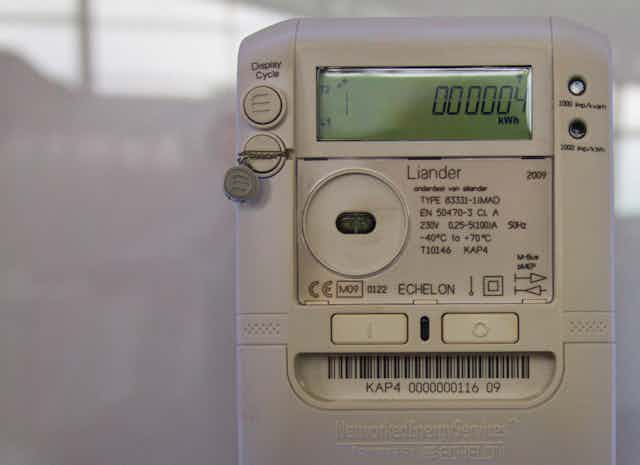

Smart meters are in the news again with much discussion about what Prime Minister Julia Gillard is expected to propose to the COAG meeting on Friday.
Smart meters can perform various functions, from remote meter-reading to facilitating time-of-use tariffs to the consumer. Some of the main smart-meter capabilities are to:
- measure electricity consumed – how much and when (on a time interval basis)
- help the customer and their supplier communicate with one another
- store interval-data and transfer it remotely to a data collector or utility
- display consumption, tariff and other information.
Smart meters are not an end in themselves. But they can be a way to develop a more effective “demand side” in the electricity system; right now, most of the control of electricity delivery comes from the “supply side”.
At the moment, most power users get a flat tariff, whatever time they’re using power and however much demand there is for it. Smart meters can be used by power companies to introduce time of use tariffs – that is, to charge based on how much demand there is for power at a particular time. If accompanied by good feedback (such as an in-home display), they can allow consumers to control when they use their power, thus controlling what they spend.
Smart meters can also improve billing systems and bring other benefits.
Costs in the electricity system (and hence impacts on customers’ electricity bills) are driven both by overall demand (the total amount of electricity consumed) and peak demand (the maximum amount consumed at any one time).
Peak demand is a particularly important driver of costs. Energy companies have to build power stations and networks to serve demand for only a small number of hours of peak demand each year, which means that this infrastructure is effectively unused for much of the time. Yet the companies who have built it will still need to recover the high fixed costs. The Australian Government estimates that 25% of retail electricity costs are derived from peak events – such as hot weather – that occur over a period of less than 40 hours per year.
The rapid growth of peak demand relative to overall (or average) demand has been a major factor influencing costs in the Australian electricity system. Between 2005 and 2011, peak demand increased at a rate of approximately 1.8% a year, while total electricity usage grew at 0.5% a year.
Although peak demand has fallen more recently this may just be due to cooler summers (and hence less use of air-conditioning). It is rather soon to say whether this drop off is a trend.
Tackling peak demand could help reduce the growth in costs. However, that there are many factors to consider in assessing whether reducing peak demand will in fact reduce costs – notably whether there is scope to defer or avoid investment. In some areas, where much investment has been made in recent years, the scope for savings may be limited.
Smart meters can deliver information, technology solutions and price signals, such as time of use and critical peak tariffs or rebates. They could therefore enable consumers to provide demand response in the electricity market. They could do this by electing to use less power when power is expensive.
Many time of use trials have found that the biggest reduction in peak demand comes from a combination of price signals, automated control (so consumers don’t have to do all the work to benefit from reducing demand at peak times) and clear, simple information.
Some sources say the Prime Minister is likely to propose the AEMC recommendation that smaller consumers be allowed to stay on a flat tariff when they get a smart meter, rather than being charged based on the time they are using power. This would help protect low income and vulnerable consumers from the risk of a bill shock.
It would be good practice for consumers to have a smart meter for some time before being offered a time-of-use tariff, so that they can build up a picture of their consumption (load) profile and then work out whether a time-of-use tariff would be the right choice for them.
Consumers also need ways of accessing information on their usage. A meter on its own will not do this; customers also need in home displays or web portals and these should be provided at the same time or soon after the meter has been installed. In the UK, the Government requires the energy retailers (who are responsible for the roll-out) to provide every consumer with a free in-home display at the same time as their smart meter is installed – and the installer will also show the consumer how to use it.
Smart meter roll-outs can be costly however and costs may escalate beyond original estimates – as was the experience in Victoria. It certainly makes sense to undertake robust cost and benefit assessments for any major change in energy markets – including smart meter roll-outs.
There are pros and cons of all forms of roll-outs. Network led geographic roll-outs may offer economies of scale but retailer led roll-outs may allow for more effective targeting of smart meters (for example, large users could get meters first).
Whoever rolls out smart meters however, it is the consumer who will pay the costs. Consumers, therefore, should see some benefits.
John Newlands
tree changer
This sounds like the pay-more-get-less plan or perhaps a tool for rationing. I think a success criterion is that say 70% of households can hold their bills steady for the first year. If that doesn't happen it looks unsporting and a rigged game.
We already know that certain groups will scream loudly. Those who consider themselves physically frail will want to be exempted from extreme weather pricing. As with medical marijuana in the US a lot of people will suddenly become fragile. PV owners who were getting 44c per kwh for grid export on cool days won't like getting paid 4c.
I believe there are many people who have cut their energy use to the bone so the smart meters won't help. If these people end up paying more short term we'll know the meters don't actually achieve what is claimed. I think all of us will want to know if power bills keep going up who is getting the dollars. We want power bills steady, retailer profits steady and emissions down. Is that likely?.
Felix MacNeill
Environmental Manager
John, it's not just about cutting energy usage overall, but timing it better so you can get the same bang for less bucks.
Michael Shand
Michael Shand is a Friend of The Conversation.
Software Tester
If you were really concerned about the money you would be against privatisation as oversea's companies buy majority and all profits goes swiftly and quickly out of the country.
Smart Meters are not meant to save individuals money, thats a misnomer and a strawman. iE. it is your mis-understanding of the situation.
If you really want low power bills then you want liquad thorium reactors built, you actually do want this, Thorium Reactors - look it up
Tony Xiao
retired teacher
The primary function and only consideration by utility providers to install Smart Metering is for remote data acquistion to fully automate their billing systems and eliminate manual data collection thus reducing overheads.
Smart Metering of electricity, gas and water is just another inevitable advancement in technology that is/has been occuring globally for years.
For governments and utility providers to suggest it has benefits for the general consumer is nothing more than sales-pitch considering that the general public have no idea of what is a kWhr..
Felix MacNeill
Environmental Manager
Tony, I'm not so sure it's that negative.
I manage energy for a large organisation and one of the endlessly annoying things is the way we can't get all our bills operating on a calendar month basis, simply because retailers have to stagger billing periods to allow a small cohort of meter readers to actually get around and read the meters. It sounds petty, but it actually causes a lot of nuisance in trying to manage mandatory internal and external anergy usage and the whole financial side as well…
Read moreIan Donald Lowe
Seeker of Truth
For many Australian families, the time they spend in their own homes is limited by other activities such as work or school or commuting and when they are at home, they will spend a certain number of hours sleeping, so the amount of time that they will be awake and able to "shift" their power usage is actually very limited and suprise, suprise - the usual peak periods are those same early-evening hours that most families are at home and awake.
"Many time of use trials have found that the biggest…
Read moreByron Smith
PhD candidate in Christian Ethics at University of Edinburgh
Automated control means things like Peter Campbell's example of a timer on a washing machine or dishwasher so that it does its cycle during off-peak time.
It is the unnecessary use of such devices during peak time that lifts everyone's electricity costs (as explained well in the article).
David Boxall
logged in via Facebook
Solution 1 to maximise the incentive to save power: abolish standing charges. For me at least, the cost of my actual consumption is such a minuscule part of my bill that there's no real incentive to economise. Cutting usage won't save me enough to be worth the bother.
Peter Campbell
Scientist (researcherid B-7232-2008)
None of this is new or scary for me. Since it was installed along with a PV system in 2008, I have had a time-of-use-capable meter. After a little monitoring I worked out our family could benefit from the time of use tariff available in the ACT from ACTEWAGL. From mid-2009 till now we have saved about $40/quarter from our electricity bill. The only two things we do specially are 1) we have a delay option on our dishwasher so it can be set to automatically start a few hours later when it is shoulder…
Read moreComment removed by moderator.
SmartMeterDangers
logged in via Twitter
Smart Meters: Correcting the Gross Misinformation - a position statement signed by over 57
researchers and physicians with peer-reviewed studies on RF exposure, criticizing the industry-fed
lies about smart meter "safety". These scientists are often attacked by industry shills.
Smart meters
"Wireless smart meters typically produce atypical, relatively potent and very short pulsed
RF/microwaves whose biological effects have never been fully tested. They emit these millisecond…
Read morePeter Campbell
Scientist (researcherid B-7232-2008)
I'm new to the Conversation so still learning what is allowed and what is not but I notice everyone else except "Smartmeterdangers" has used their real names.
Michael Shand
Michael Shand is a Friend of The Conversation.
Software Tester
Having worked on these projects in victoria I can say that this technology is essential for the states infrastructure. From Outage Management systems to balancing load. With these meters we can remotely turn off and on peoples power which is a huge advantage.
Power cannot be stored in our current system it has to be used as it is generated.
The more information the distributors and generators have the more effecient they can be and this leads to less wastage.
For consumer benefits I agree…
Read moreRuth Davies
logged in via LinkedIn
The biggest problem with so-called time-shifting of energy use is the fact that you can't time-shift your life. Should we all go to bed at 7.00 pm and then get up at 3.00 am so we can cook our food and watch telly when the electricity is cheaper?
A secondary issue is that very few electrical appliances actually have time-shifting capability. I've never seen a clothes washing machine or dryer which can be set to start at a specific time for example. Until such appliances become readily available…
Read moreMark Amey
logged in via Facebook
Most modern dishwashers and washing machines have a time delay of up to ten hours. As for driers, we use a specially constructed solar clothes drier, which sits outside!
Peter Campbell
Scientist (researcherid B-7232-2008)
Our washing machine is old but it could be set up to start with a simple timer in the power point.
Felix MacNeill
Environmental Manager
Ruth, if people have better things to do than obsess over the cost of electricity (and good luck to them) then nobody is forcing them to do so - smart meters merely facilitate the option for those who actually want to make a rational effort to reduce their costs and emissions, rather than just whinge on talkback radio about cost of living.
And i think you've got a good point about most appliances not yet having timers, but that's probably pretty basic technology that would soon be made available if there was a demand. Again, smart meters would facilitate and encourage such a development.
Margo Saunders
Public Health Policy Researcher
Consumers would benefit from increased 'energy literacy' so that, where there is some flexibility, they could make the right choices. I am having a running argument with my husband about whether it is more cost-effective to leave appliances such as a colour tv on when you are away from the room (his belief) or to turn it off when you're not watching it (my belief). As for incentives for reducing energy use, Thaler & Sunstein, in their book Nudge, have plenty to say about this - and it involves more than just feedback about pricing: experiments have been conducted which show the power of 'social nudges' (letting people know what the social norms are and how their behaviour fits with those, including their energy use). Part of the problem is that Australians have grown quite cynical: they believe that, rather than being rewarded for decreasing their use of electricity (and water), reduced use throughout the community simply results in price increases.
Stephen Pritchard
Researcher, cognitive science
I think smart meters are a good idea. I've been living with a time of use meter for almost 3 years now, with the following conditions:
peak time = 2-8pm weekdays, shoulder = 7am-2pm and 8pm-10pm weekdays, 7am-10pm weekends, off-peak = 10pm-7am all days.
pricing (excl GST, since July 1 2012):
peak = 47.77 c/kWh
shoulder = 19.40
offpeak = 11.90
It *does* change our behaviour. Yes, there are loads that we wont shift (e.g., if the oven is needed for dinner, we aren't going to wait til after…
Read moreChris O'Neill
Telecommunications Engineer
"pricing (excl GST, since July 1 2012):
peak = 47.77 c/kWh
shoulder = 19.40
offpeak = 11.90"
The obvious shortcoming with this is that the same set of rates apply every working day of the year or every weekend day of the year. i.e. there is no variation based on whether the peak period is occurring during record high consumption in a heat wave (which determines the cost of the "poles and wires") or whether it is occurring during a day of average consumption.
I expect that smart meters could be used to vary the rates between these times but I haven't seen any talk of this.
Stephen Pritchard
Researcher, cognitive science
Chris, I wouldn't be surprised if its been considered, but can you imagine if there were pricing variations not just by time of day, but by time of year, with really high prices for consumers on the true heat wave summer peak?
Consumers would need to stay constantly vigilant about the price of power, or else set up automatic systems to turn off appliances if the price got too high etc. I think it would be a challenge even for very informed and alert consumers. Consider the controversy about extremely high bills due to accidental over-use in the mobile phone market, and imagine that in power consumption. All fun and games til a hapless central a/c owner gets their quarterly bill for $5,000 because they didn't think to moderate their a/c use when they really wanted it on those hot days.
Chris O'Neill
Telecommunications Engineer
"Consider the controversy about extremely high bills due to accidental over-use in the mobile phone market, and imagine that in power consumption."
You're not suggesting that other phone users should share the payment of extremely high bills of some users, are you, because that's the logical conclusion of what you're saying.
It's certainly just to ask people to pay for the costs they impose on the system and not expect other people to subsidise them. Whether it's simple to make this happen is another matter.
Stephen Pritchard
Researcher, cognitive science
"You're not suggesting that other phone users should share the payment of extremely high bills of some users, are you"
That's exactly what I'm suggesting, and that is exactly what typically happens in the mobile phone market: most people are on capped plans, rather than pay-per-minute plans, you don't pay less if you use less than your cap, and you don't pay more if you go over. Those who make less calls on such plans effectively subsidise those who make more, and everyone is happy because their bills are predictable.... (unless you fail to read the fine print and exceed what your cap allows).
David Boxall
logged in via Facebook
Stephen Pritchard: "... can you imagine if there were pricing variations not just by time of day, but by time of year, ...". As I understand it, spot electricity prices vary according to conditions, moment to moment. That is, real electricity prices are not as predictable as you imagine.
So, what if consumer prices varied on the same basis? Given sufficiently smart meters and appliances, we could prioritise our usage. For example, the air conditioner might be programmed to turn off if the meter reported that the price of electricity had risen above a certain level.
SmartMeterDangers
logged in via Twitter
My name is Susan B. I live in La Mesa, CA, where I had two smart meters on my property for two years, and finally was able to opt-out after fighting a legal battle with the state regulatory agency. The smart meters ruined my health and now am left with increasing sensitivity to RF radiation and electromagnetic fields, which impacts my ability to be in public and live a normal life. It includes headaches, sleeping problems, dizziness, skin problems, skin cancers, heart arrythmias, ringing and pain…
Read moreEric Ireland
logged in via Facebook
I don't understand the hysteria over smart meters in Victoria. It seems some people are under the false impression that they're the cause of high electricity prices. I've had one since I moved to Melbourne two years ago, and it has made no difference to my life whatsoever. I haven't been offered a time of use tariff, but it seems like it might be a good idea.
Annie Nava
logged in via email @yahoo.co.nz
You can have your say about Smart Meters with the nsw government here - http://haveyoursay.nsw.gov.au/smartmetertaskforce