
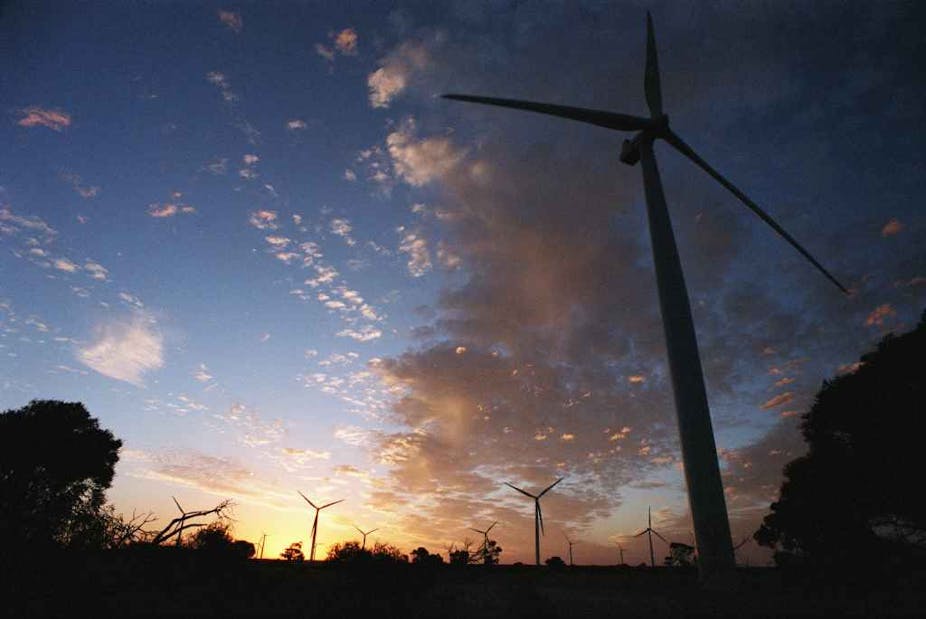
The integration of wind energy generation into the electricity grid in South Australia is a success story.
The gross statistic often quoted is the total electricity produced as a percentage of the supply. In the year to June 2012, the electricity generated by wind farms in SA amounted to 3,349 GWh, or 26% of the total supply. This was behind the 50% supplied by natural gas and ahead of coal’s 24%.
Possibly more significantly, the Australian Energy Market Operator (AEMO) has revised upwards the fraction of installed wind generation capacity “firmly available” to meet maximum demand; that is, the amount that can be counted on to be available globally at any time regardless of local intermittency. This amount is up from 5.0% to 8.3% for the summer period and from 3.5% to 7.5% for winter demand.
The reasons given for this upward revision are twofold. There are more wind farms operating in the state, bringing with that greater geographical diversity. As well, the accuracy of the analysis of this characteristic has been improved (calculations are now based on five minute dispatch intervals rather than a 30-minute time scale. The previous method wasn’t as accurate in measuring the firmly available output).
The final significant statistic is publicly announced projects for potential new electricity generation plants. Eighteen out of 24 are wind farms, with a total installed capacity of at least 2,215 MW and perhaps greater than 2,607 MW. This compares with three projects with a total capacity of 695 MW for gas plants, the next highest.

Despite the apparent success of wind energy in South Australia, it is not all beer and skittles. There is, as elsewhere, some opposition to wind among some communities.
According to Chris Judd, REpower Australia Chief Executive, “Opposition to wind farm development in South Australia is driven by political ideology dressed up as a grassroots movement”.
I believe it is not quite as clear cut as that. I would suggest that in SA, and most likely elsewhere, there is a mixture of what is expressed above plus some genuine environmental concerns. At times, there is also a sense of being left out of the process.
Mr Judd goes on to give an example of the Ceres wind farm project on Yorke Peninsula. Construction there is set to begin at the end of 2013, and to be completed by 2015. It will have 180 turbines with installed capacity of 600 MW.
The crucial point about this development is that it was originally devised by a local farmer, John McFarlane. After talks with a business partner, he brought the idea to the attention of the South Australian Government, and the company Suzlon, which merged last year with Repower. The farm will be connected via undersea cable with Adelaide. The key feature is that this project was “brought to us by the community”, says Chris Judd.
I suggest that one would find a significant difference in attitudes towards wind farms in communities where genuine consultation and involvement has happened versus where it hasn’t. This is an obvious point, but one that still must be emphasised. Don’t forget that this was the original way wind farms developed in Europe – community ownership – and that model has been taken up with the Hepburn wind farm in Victoria. It extends to most development activities – truly involve the community and it is a lot easier; ignore it at your peril.

One point to make, in keeping with the community theme, relates to the demographics in South Australia and the way the SA Government has viewed the whole question of wind farms. South Australia is in some ways almost a city state. Of the approximately 1.5 million people in SA, about 1.1 million live in Adelaide. As such, the regions are even more vulnerable than in most other states or territories. As Chris Judd points out, South Australia has been quite “entrepreneurial in understanding the opportunity that wind brings to the regional communities”.
The picture is enhanced if one extends the discussion to other renewable sources. In SA there has been a reduction in electricity demand in the last couple of years and indeed a reduction in future forecasts. Some of this is due to reduced industrial activity but some is due to the high penetration of rooftop solar.
In 2011-2012, according to AEMO, rooftop solar is estimated to have generated about “2.4% of South Australia’s annual energy” – I presume they mean electrical energy. More importantly, “AEMO estimates that 38% of rooftop PV capacity installed in South Australia can be considered to be producing at times of summer maximum demand.”
This is an area where there has been a mismatch between wind and demand at times. There is a projected increase in rooftop solar, even with falling feed-in tariffs, but hopefully there will be the initiation of solar farms, such as the one being lobbied for at Port Augusta. Different types of generators, with differing temporal patterns, and generators spread across geographically diverse locations, will continue to increase the reliability of renewable energy.
Alex Cannara
logged in via LinkedIn
Indeed there are environmental concerns. But, there are engineering realities. Wind in SA gives or 26% of the total supply, but only about 8% can be counted on over the year.
"18" wind farms "totalling 2.2GW" peak are planned? That's 1, 100-acre nuclear plant. How many square miles do 18 wind 'farms' occupy? How many species are interfered with or killed? How much noise produced? How much fossil-fuelled maintenance? What about the initial debit of 700tons, per peak MW installed, of resources…
Read moreMike Hansen
Mr
A pro-nuke gish gallop.
Alex Cannara
logged in via LinkedIn
Really? A "gish gallop"? What regular words does that stand for?
;]
Michael J. I. Brown
ARC Future Fellow and Senior Lecturer at Monash University
It isn't hard to look up "Gish Gallop"
The following is from http://en.wikipedia.org/wiki/Duane_Gish
Gish has been characterized as using a rapid-fire approach during a debate, presenting arguments and changing topics very quickly. Eugenie Scott, executive director of the National Center for Science Education, has dubbed this approach the "Gish Gallop," describing it as "where the creationist is allowed to run on for 45 minutes or an hour, spewing forth torrents of error that the evolutionist hasn't a prayer of refuting in the format of a debate"[7] and criticized Gish for failing to answer objections raised by his opponents.[8] The phrase "Gish Gallop" has come to be used as a pejorative to describe similar debate styles employed by proponents of other, usually fringe beliefs, such as homeopathy or the moon landing hoax.[9][10]
Geoff Russell
Computer Programmer, Author
Gish Gallop is an ad hominem attack sometimes justified in a stand-up debate. But this is a written forum. If someone makes 10 points, you have plenty of time to make a considered rebuttal. If the 10 points are worthless, then you can usually show this with a solid rebuttal of 3 or 4 points and, in the words of many text books, leave the rest as an exercise for the reader.
Gary Murphy
Independent Thinker
If wind is so absolutely terrible why does it have one of the lowest LCOEs?
Figures from US DOE:
Wind 96.8; Nuclear 112.7; PV 156.9
http://en.wikipedia.org/wiki/Cost_of_electricity_by_source
"How many square miles do 18 wind 'farms' occupy?" - Not many at all, given that the only land that is used up is the diameter of the shaft.
"How many species are interfered with or killed?" - very few if you are not stupid enough to put them in a migration path.
"How much noise produced…
Read moreBlair Donaldson
logged in via Twitter
Spot on Gary, I am always amazed at the idiocy of comments questioning the area a windfarm may take up - as though the existence of wind turbines preclude previous farming practices.
Your answers to the other questions are also correct judging by the results here with two windfarms nearby.
One other point, most of the turbine and foundations can be recycled at the end of its life, whereas the majority of the components and structure of a clapped-out nuclear power station have to be entombed at great expense.
Geoff Russell
Computer Programmer, Author
LCOE isn't much of a measure.
Suppose I have two cars, one costs me 98 cents per kilometer but only runs some of the time and sometimes just slows to a crawl for hours at a time. The other costs 112 cents per kilometer but runs reliably 24x7. Which is cheaper? The LCOE doesn't factor in the fact that I might very well need twice as many of the unreliable cars as the reliable ones. Nor does it factor in the idea that the unreliable car sometimes buggers up the road so I need to find more money for road repairs. Etc, Etc.
Blair Donaldson
logged in via Twitter
Geoff, "Gish gallop" is not an ad hominem attack, it's a method of confusing the issue during a debate, primarily, but also employed in print. It's the favoured tactic of creationists because they lack any genuine understanding of the topic they frequently criticise, namely, evolution. Instead they repeat factually false statements, even when they have been corrected time and again.
It's also a tactic employed by the landscape guardians when attempting to diminish the value of wind energy.
Check out a few YouTube videos featuring Ken Ham, Kent Hovind, Wendy Wright or Duane Gish. Warning: watching any of the above will likely make your head bleed.
Zvyozdochka
logged in via Twitter
Your analogies are eye-wateringly bad.
LCOE is an industry agreed method of calculating the cost of delivered energy.
Alex Cannara
logged in via LinkedIn
A subsidized industry's "agreed method". Sort of like the combustion industry's agreed subsidized methods that include things like depletion credits, regulatory exclusions...?
;]
Fortunately, scientific & engineering facts are independent of any industry's "agreed methods". Unfortunately, politics & greed are always ready to hide facts.
Alex Cannara
logged in via LinkedIn
Aha, so when you say something, despite not being a scientist ior engineer, it's not a "gish gallop", but when someone states facts about something that you don't fully understand but are biased toward, like windmills, it's a "gish gallop".
Got it! Thanks Blair.
;]
Alex Cannara
logged in via LinkedIn
So Gary, why is EROI better for one thing than another? Well: a) complete economics, science & engineering in the estimate, or b) incomplete, fudged economics, science & engineering.
And, "10mx10mx10m" is indeed 1000 cubic meters, which is more than 1000 tons of concrete per tower. Remember how concrete is made?
Remember what the 400-ton steel tower (from Korea or China) is made from -- 1000 tons of coal hundreds of tons of ore, tons of transport fuel, etc?
And remember how much land…
Read morePeter Lang
Retired geologist and engineer
On that basis 'gish gallop' is an excellent description of the Mark Lynas article you called "great".
http://www.bishop-hill.net/blog/2012/9/26/missing-the-point.html
William Raper
Mr.
Perhaps this is off topic, but it seems to me that the elephant in the room is the cost of "reticulation" of electricity. At present I have to pay some 10 times the generated cost of electricity and the added cost (approx 90%) SHOULD be constant. Thus even a doubling the generated cost would scarcely be noticed!
What we need is any form of safe electricity generation. Let's get on with it!
Peter Lang
Retired geologist and engineer
William Raper,
Do you want the safest electricity?
Guess what it is: http://nextbigfuture.com/2012/06/deaths-by-energy-source-in-forbes.html
John Newlands
tree changer
I note the practice of quoting large nameplate capacity for wind farms which makes them sound quite impressive compared to gas fired power stations. However wind farms may average just 30% of that output whereas combined cycle gas plant typically runs at 65%. More than that in heatwaves when wind farms are largely becalmed and gas underpins the network.
Another omitted factoid is that a couple of months back it was thought SA had the world's third highest electricity prices. However the biggest question of all is what happens to windpower when gas from the Cooper and Otway basins gets seriously expensive? Santos have said they will send Cooper gas to the LNG plant at Gladstone Qld. Since the Japanese have shown a willingness to pay very high prices for LNG then SA will have to match that price.
High energy prices appear to have put the kibosh on SA's biggest project, the Olympic Dam expansion. Wind power is a lovely way to create a green glow but not to power heavy industry.
Mike Hansen
Mr
Bovine excrement.
Wholesale electricity prices in SA have dropped from $56.39/MWh in 2000/01 to $24.45/MWh in 2010/11.
http://www.climatespectator.com.au/commentary/should-sa-fear-closure-coal-power
John Coochey
Mr
I agree your statement is correctly labelled bovine excrement because it is retail costs that matter particularly when they have been pushed up be the costs of extensive grid networks to give some continuity of supply. Electricity is not a cash and carry product.
Mark Duffett
logged in via Twitter
A tech that can only be relied on for 8% of supply strikes me as a fairly low bar for 'success', in the context of the decarbonisation that is actually required. I would have like to have seen Prof. Boland address the issue of whether expansion of wind in South Australia can continue indefinitely. There have been suggestions that, beyond a 'sweet spot' of about 20-25% average contribution, additional wind capacity begins to descend a curve of diminishing returns quite rapidly.
Tony Simons
Accountant
How about exporting more SA power to NSW and Victoria. How about putting more wind turbines in Spencer Gulf and Gulf St Vincent 15 Km offshore to minimise visual impact as is happening in Europe. Shallow water. Windpower is one of the few areas of SA comparative advantage.
Alex Cannara
logged in via LinkedIn
Losses, costs and dangers are even higher for offshore wind. Here's the assessment of our first major project that we hope will never happen...
www.mms.gov/offshore/AlternativeEnergy/PDFs/FEIS/Section5.0EnvironmentalandSocioeconomicConsequences.pdf
Mike Hansen
Mr
On the subject of losses, costs and dangers ...
"None of Japan's commercial wind turbines, totaling over 2300 MW in nameplate capacity, failed as a result of the 2011 Tōhoku earthquake and tsunami, including the Kamisu offshore wind farm directly hit by the tsunami"
http://en.wikipedia.org/wiki/Wind_power_in_Japan
Alex Cannara
logged in via LinkedIn
Right, Mike. So that 2.3GW peak, = <1GWe average, is less than the reactor at Fukushima that's still old but good (#6).
So all the Japanese windmills, equalling less than an old GE reactor there that's generated power for decades, are better? How?
Reactor #6 displays the TEPCO, NISA & Japanese govt. cupidity for all to see -- it was the only one with emergency generation above the tsunami line -- the line documented years before by geologists and ignored by authorities.
Even the Japanese…
Read moreDavid Arthur
n/a
Of course wind power in South Australia cannot expand indefinitely - there is, after all, only a finite amount of wind blowing at any given moment, and only a finite amount of available land (and shallow enough ocean!) on which to install wind farms.
What would be of use is an expansion of wind utilisation across the rest of Australia.
Meanwhile, Mark, would you be so good as to read and comment on Marvel et al, "Geophysical limits to global wind power". Nature Climate Change, 2012; DOI…
Read moreAlex Cannara
logged in via LinkedIn
Thanks for the links, David.
You may be interested in the present understanding of the Carbon Cycle, which makes talk about wind.wave... even more absurd -- we're now emitting about 100x the amount (10Gt) of Carbon the cycle can move back to deep storage in rock (limestone...) via subduction (e.g., the Tohoku quake). You can probably get Don's relevant paper...
http://eps.berkeley.edu/development/view_person.php?uid=6449
The implications are clear -- we've committed the planet to about 10,000 years of far warmer & challenging climate, even if all emissions stopped today.
Mark Duffett
logged in via Twitter
David Arthur, my point was not regarding the theoretical total amount of wind energy. My take on Marvel et al 2012 was 'yeah, nice calculation, but not really helpful'. The last line of the abstract says it all: "It is likely that wind power growth will be limited by economic or environmental factors, not global geophysical limits." As the saying goes, no sh_t, Sherlock! Limits are no less limiting for being economic (which I'd say incorporates grid penetration issues, see below) rather than geophysical.
Rather, the most critical limits are on effective (in terms of decarbonisation) grid penetration. http://decarbonisesa.com/2011/09/14/the-good-the-hard-and-the-windy/ is a good discussion of the issue.
Robert Tony Brklje
retired
That tech can be readily expanded by the use of vertical axis wind turbines and adding it to the suburban environment. There is a lot of focus on vertical axis because of the low noise and reduced visual impact this is a good example of what is being achieved already http://www.flickr.com/photos/carbonfreeenergy/3957479225/. So rather than focal point of wind generated power and more distributed network.
Alex Cannara
logged in via LinkedIn
Thanks for the link, Tony. And, Caltech research has also given data on verticals...
http://cleantechnica.com/2011/07/14/caltech-vertical-axis-wind-turbines-boost-wind-farm-power-efficiency-10x/
http://media.caltech.edu/press_releases/13430
However, even with these more efficient designs, the power density remains low and the land use high.
This is why solar PV on structures, with no land use, and growing power yield per sq meter, is making most wind power irrelevant, especially as EVs & storage improve.
John Newton
Author Journalist
Excellent piece - a good companion to the Media Watch comment on The Australian's Graham Lloyd's attack on wind farms - he's a serial attack dog.
But there is one giant problem with all renewable energy sources: wind, solar and wave.
No one owns the resource so there's no stacks of cash for the big end of town. No uranium to pull out and sell, no coal....
Damn.
Alex Cannara
logged in via LinkedIn
Actually, here, the juice is 'owned;' by the lease holder for a home installation. They sell the utility what the homeowner doesn't use.
But yes, the combustion folks love their "depletion allowances" for the part of the energy they "own". They neither own or pay for the Oxygen their business couldn't operate without -- oops, another subsidy!
Dr Graham Lovell
logged in via Twitter
SA is leading Australia in the building of wind-farms, and as John Boland noted, the geographic spread of these in the state provides an important offset for wind variability, with farms being established in both the mid-north and in the south-east of the state.
Connection to the National Electricity Market (NEM) provides an outlet for wind energy, when more is produced than can be effectively used in the state. In this regard upgrades to the interconnectors between SA and Vic need to be considered…
Read moreRobert Tony Brklje
retired
More likely the bulk of regional SA is a sucky place to live. Unlike the eastern sea board, where many regional areas represent ideal retirement and hobby farms. SA lacks those opportunities over much of it's area but try and set up a wind farm in Mclaren Vale, Barossa Valley, Mount Gambier and see how far you'll get.
A great spot for a wind farm, The Nullabor National Park in parallel to the Eyre Highway, a hundred mile odd long wind farm.
With energy creating a new regional town becomes a real possibility.
Alex Cannara
logged in via LinkedIn
As a Yank, I simply comment that lif SA ia anything like Calif & other dryish parts of the US, local solar on structures is far more productive and predictable than wind. And,, solar PV technology has at least one doubling of power per sq meter to go. Wind doesn't, apart from the other typically unaccounted-for costs of wind farming.
As to pumped storage, it's efficiency is at best 75% and such installations are not only weather dependent (having something to pump), they cannot follow the rapid fluctuations windmills produce. Solar compensation is better for them. However, pumped storage has many environmental defects, so expansion of it is unlikely in most places with such concerns.
Any region wanting low-impact, good efficiency 'renewable' power can simply copy efforts like the Calif. "million solar homes" initiative -- >30GWe hours/day with no land or transmission losses..
Dr Graham Lovell
logged in via Twitter
The above article is primarily about wind power, with a passing comment on solar. These renewable sources of electricity should not be seen as competitors, but rather as meeting different parts of the demand equation. In fact, solar PV is likely to do little for the summer peak demand (at 5-6pm), and absolutely nothing for the winter peak demand, so alternative capacity has to be provided to meet those peaks.
Nevertheless, solar PV is a power source with a lot of potential. I would hope and expect…
Read moreAlex Cannara
logged in via LinkedIn
Your comments are indeed interesting, Graham -- such as: "in fact, solar PV is likely to do little for the summer peak demand (at 5-6pm), and absolutely nothing for the winter peak demand," -- that assumes no storage locally, either via EVs, recharge stations, or on the local grid. Wind does nothing as reliably as that.
As to pumper storage, not only is capacity severely limited by appropriate sites and the inevitable environmental damage via repeated drawdown/refill cycles, but hydro generators…
Read moreGary Murphy
Independent Thinker
I read somewhere that if you face the panels West instead of North the generation does match the summer peaks. (But obviously nothing in the mornings)
Mike Hansen
Mr
Alex - I have read MacKay's book. It does not say what you keep implying it says. Have you read it? It appears not.
Read moreIt inspired a local version "AUSTRALIAN SUSTAINABLE ENERGY - BY THE NUMBERS"
Here is the last paragraph
"Whether we use pumped hydro, molten salt or hydrogen storage and which mix of wind, solar, wave and geothermal power we use, the conclusion is the same. Given the will, we could supply all our energy needs in a sustainable and mostly renewable way. We could do this at a price…
Alex Cannara
logged in via LinkedIn
Sure, and one can deploy 2-sided panels, and new designs, which use microlensing to gather light better from different angles. Then there are tracking systems, but not likley for homes.
The key now is to aim for the 3.1MW/acre maximum, via PV designs that convert the full bandwidth of the solar spectrum (IR to UV) to electrical output. All these things are in the works and the present record of NREL PV systems getting well over 40% efficiency (0.4kW/sq meter) without even using much of the spectrum.
Alex Cannara
logged in via LinkedIn
Yes, Mike, I like to read things I recommend. I've even discussed issues with him personally.
MacKay's book is referenced to indicate that 'renewables' as advertized don't do the whole job, which everyone here seems to agree on already. It's also an older look at sources, so his appreciation of nuclear costs isn't necessarily up to date. And, the statement: "higher nuclear, less energy efficiency" is obviously silly, since the two are independent and efficiency is always an agreed-upon goal. MacKay understand this is obvious.
The issues are with "efficiency" at both the generation and use ends. One can't just pick one side. That' why wind, being less efficient than present solar PV, and guaranteed to fall further behind, is a logical source to drop from massive power-generation deployments, even apart from its serious environmental impacts.
That;s the point. Now please read the other books, as you asked me to read MacKay's.
Dr Graham Lovell
logged in via Twitter
One of my relatives, in the 1880s, had a wheat farm at Pt. Germein, just outside of Goyder's line. It was too hard, and he had to give it up. Co-incidentally, my great-great grandfather had land in the same region. This is near the beginning of a harsh region, and difficult to use for cropping. They were right to give up.
You can travel north from here, along the side of the Flinders Ranges. Here you can also see the tragic remains of the hopes of those who sought to farm this region as well…
Read moreAlex Cannara
logged in via LinkedIn
Nice thoughts, Graham. But, making "vigorous efforts to try to ameliorate the effects of putting too much CO2 into the atmosphere." means vigorous thought about scientific realities, and wind, compared to present alternatives fails.
Any indigenous folks there might also think windmills sticking up, transmission lines & towers sticking up, birds being killed, etc. is not a "magnificent sight".
We've made similar, greater mistakes up here, perhaps over longer periods and more land area.
The facts don't change about the inefficiency of prop-generators, the losses in transmission, the maintenance emissions on top of fabrication & construction emissions, etc.
Politics always rumps facts. That will be one facet of how our descendents do think of us, when they see our mountaintop removals, or decrepit wind farms, and they read documents from our time and before showing clearly how to avoid the problems we now will indeed leave them with.
Mike Hansen
Mr
No Alex - I did not ask you to read MacKay's book. It was your sneering and arrogant comment.
"It would be interesting to hear that any of the wind uber alles advocates here actually read real results of wind studies, such as in Allison's, Hargraves' or MacKay's books."
The choice of the "higher nuclear, less energy efficiency" pathway to model was MacKays not mine. As was it MacKay's choice to model the 55% wind pathway - why would he do that if as you claim wind is useless.
I admit I have not read the "The Wind Farm Scam" - I do not intend to. Any book with that title should stay in the dumper where it belongs.
Mark Duffett
logged in via Twitter
"Environmental issues can hardly be compelling" with both top and bottom dams required for pumped storage?! Dr Lovell, have you noticed what's happened (i.e. nothing) for the last 40 years every time a dam has been proposed for energy purposes (and most others), supposedly for environmental reasons?
Alex Cannara
logged in via LinkedIn
"Have you read it? It appears not." -- a famous quote of Mike Hansen!
"The choice of the "higher nuclear, less energy efficiency" pathway to model was MacKays not mine" -- never said it was yours. You just seemed to like it enough to quote it here, Mike.
"MacKay's choice to model the 55% wind pathway - why would he do that if as you claim wind is useless" -- MacKay was writing that at an earlier time, as an example. It doesn't mean he thinks wind now is better than other choices that have…
Read moreMike Hansen
Mr
"MacKay was writing that at an earlier time, as an example. It doesn't mean he thinks wind now is better than other choices ..."
earlier - like December 2011
http://www.guardian.co.uk/environment/2011/dec/28/uk-switch-low-carbon-energy
That argument is so sad, it does need responding to - I will allow readers here form their own judgments.
Mike Hansen
Mr
That argument is so sad, it does **not** need responding to - I will allow readers here form their own judgments
Alex Cannara
logged in via LinkedIn
Yes, Mike, anyone who reads your link can see your fudge: "David MacKay told the Guardian in 2009, was why he wrote a book" -- David wrote his book before that 2009 interview. I know, because I corresponded with him then about his book.
But again, no one's against truly carbon-free power. Wind is simply the least efficient and least "carbon-free" of our choices. If you don't like that reality, sorry.
;]
By the way, the British Energy Dept. is now endorsing advanced nuclear R&D, including thorium-salt systems. And, MacKay himself has long understood the value & importance of nuclear power.
Jonathan Maddox
Software Engineer
Since the vast majority of South Australia's non-intermittent electricity is produced by urban combined-cycle gas-fired power stations that have no difficulty ramping their power output up and down to compensate with large, rapid changes both in demand and in intermittent renewables, wind energy is trivially easy to integrate.
PV is cheap and getting cheaper. It isn't yet cheaper than wind and it definitely produces electricity only while the sun is shining. It's useful, it's wonderful, it's…
Read moreJonathan Maddox
Software Engineer
http://au.news.yahoo.com/thewest/lifestyle/a/-/article/15022145/chanel-invokes-renewable-energy-of-fashion/
Zvyozdochka
logged in via Twitter
The SA wind example is the one the fossil-nuke boosters hate the most.
Alex Cannara
logged in via LinkedIn
Really? Why? Our fossil fuellers love to 'invest' in wind & solar 'famrs' because they get tax credits, subsidies... and they know those sources will never cmpete with them.
They've always known nukes could put them out of business and so they support anti-nukes.
So, keep up the good work for combustion, Z, they love it and they love selling the fossil fuels used to process the 700 tons of materials needed per 300kW of installed windmill.power. Facts are wind's biggest enemies.
;]
Gary Murphy
Independent Thinker
See - this is what you don't get about the situation down here Alex.
We don't have nuclear power and are extremely unlikely to get it. For both technical and economic but mostly political reasons. The current debate down here is between renewables and fossil fuels. And by denigrating the cheapest leading renewable it is you that is playing into the hands of the fossil fuel industry.
Alex Cannara
logged in via LinkedIn
Gary, you say the choices are "mostly political". then you say I don't understand your situation there. Of course I don't.
But, the scientific & engineering facts don't support your assertion that wind is "the cheapest leading renewable", unless there's some odd political subsidy or penalty relating wind & local solar.
Again, that's nothing to do with long-term reality, true costs, or emissions reduction, since politics changes, as do subsidies/penalties. The physics, chemistry & international economics for wind make it more costly long term than local solar PV.
Your politics can change, however.
Gary Murphy
Independent Thinker
Wind has the most installed capacity and the lowest LCOE of all renewables except hydro. That is what I mean by 'cheapest leading renewable'.
Alex Cannara
logged in via LinkedIn
Keep repeating that, Gary!
;]
Gary Murphy
Independent Thinker
Good to see you've got the last word again Alex. Oh s*** - sorry!
Alex Cannara
logged in via LinkedIn
Here, Gary, you can have the last word again, if that's so important to you.
;]
Blair Donaldson
logged in via Twitter
John, thanks for the great article. I particularly like your reference to community owned wind farms and agree that community acceptance is likely to be greater where community ownership exists. Something I have tried to push for ages in this area.
However, based on local experience I can categorically state that opposition to wind is not so much based on any supposed environmental concerns, rather it's misinformation promulgated by groups like the so-called landscape guardians.
Here in South…
Read moreAlex Cannara
logged in via LinkedIn
Blair: " I can categorically state that opposition to wind is not so much based on any supposed environmental concerns" -- which means that: a) you don't understand the issues, or b) you've $ in the wind biz and don't want ny offending facts.
Got it. And what you wrote indeed fits the description of a "gish gallop"!
;]
Mike Hansen
Mr
Alex - your comment is offensive ("you've $ in the wind biz") not your facts which are largely irrelevant or made up.
And again - look up "gish gallop". If you understand what it is, you may stop firing your "link buckshot" at the thread.
Blair Donaldson
logged in via Twitter
Mike, it's true that I do own a small number of shares in Australia's only community owned wind farm, wish I could afford much more actually.
I don't bother reading or responding to the droppings of the resident psittacine and wonderful example of Christian hypocrisy. I'm happy knowing his words condemn him while highlighting his lack of objectivity and honesty.
Alex Cannara
logged in via LinkedIn
Facts are tough, eh Mike? So Blair does admit to having $ in wind. So, what's "offensive", again?
;]
Alex Cannara
logged in via LinkedIn
" I don't bother reading or responding to the droppings of the resident psittacine and wonderful example of Christian hypocrisy. I'm happy knowing his words condemn him while highlighting his lack of objectivity and honesty." -- wow, that;s an impressive gish gallop of gushing parroting!
;]
See how long it took to get the facts of where your $ is, and its effect on your avoidance of engineering facts?
Does this style of immature, grade-school-playground attempts at insults ever work for you Blair? Or do folks just get to laughing too hard to be offended as you hope?
David Arthur
n/a
Blair, good on you for participating in the Hepburn wind farm, and good comments about community engagement.
Don't be too hard on Alex. He's viewing the situation from the perspective of the US, with similar land area to Australia and much higher power demand.
As a matter of fact, there is another nation with one quarter the population of the US, and one sixth the land area - so if the case for nuclear power in the US is as strong as Alex states, it is even more so for Iran. I assume Alex makes that argument in fora as and when the opportunity arises.
Alex Cannara
logged in via LinkedIn
You do "assume" a lot there David. Does that count as discussion?
;]
Mike Hansen
Mr
Still offensive. Blair is not going to get rich on shares in Hepburn Wind which uses its profits to support community projects. I have a house at Hepburn Springs - most people who have invested are treating it as a donation. You questioned his integrity - he has demonstrated it consistently in his behaviour in discussions here.
Mike Hansen
Mr
correction - "many" people that I know, not most. When I spend time reading the compulsive BS'ing of the nuclear spruiker, I find that I need to be doubly careful not get sucked into that vortex of hubris and exaggeration.
Blair Donaldson
logged in via Twitter
David, thank you. I found out as much as I could about various German and Danish community owned projects. I like the idea of communities benefiting from public infrastructure. It seems to work well in those countries so I was happy to give it a go and participate here in Oz. There are at least two more community owned projects in the pipeline around the country but legislative handicaps introduced by the LNP are making these popular projects difficult.
Funny you should mention Iran, can't help…
Read moreBlair Donaldson
logged in via Twitter
Mike, I appreciate your defence, thank you. The disappointing thing is that Alex has never bothered to ask me why I got involved with the Hepburn community windfarm, as you correctly say, it wasn't to get wealthy, far from it, it was because I like the idea of community owned and controlled projects rather than governments imposing things from on high.
The bonus was that this project also involved clean, renewable energy. There was also an element of altruism involved, there is reward far more valuable than any monetary gain knowing my small support is helping the push towards a sustainable future.
I'm bemused that he should think I'd be embarrassed about others knowing of my interest in the Hepburn project. Far from being ashamed, I consider it a badge of honour to be a member of Australia's first community owned wind farm.
Alex Cannara
logged in via LinkedIn
Nice try to invert your final release of your $ interest in a windfarm, Blair. You should help the Romney team reformulate truths!
Obviously, I'd no knowledge of you involvement until you mentioned it. And, why do you think anyone would care? Your words show you don't get the science, engineering and environmental flaws of it, and don't care.
Remember, convincing you of anything is not my interest. My only interest is that misinformation doesn't pollute others' minds that might be open to facts.
Alex Cannara
logged in via LinkedIn
Glad again that you're reading our firnd MArtin's book, Blair!
However, you don't quite get the Danish wind situation. The woman who heads Danish govt.renewables efforts was here speaking a few months back and shared details, like: a) they use pig/cow poop composting for heating gas, and b) the Danes don't want any more land-based, noisy, ugly windmills, so offshore is where they now concentrate.
Also, your reading of Martin is a bit off, with: "the ease with which domestic nuclear can be…
Read moreAlex Cannara
logged in via LinkedIn
If you want to show all here that you condescend to read what;'s written, Mike, reread what I wrote and show me where I "questioned his integrity". His words lead to questioning his knowledge, just as your words above lead to questioning your maturity & objectivity.
;]
.
Geoff Russell
Computer Programmer, Author
The blue whale in the renewable room is whether they will enable us to reach our climate change goals? Prof. Boland's article ignores the goals and whether we can reach them.
Suppose you want to climb a really big mountain. You are at altitude zero and you know the peak is at altitude 100 units. Suppose you look around and find a little track that will get you 1 unit up in 1 day. Great. Off you go. When you get there you look around to find another track that will get you 1 unit up. You see…
Read moreBlair Donaldson
logged in via Twitter
Geoff, installed wind energy capacity in Australia in the last six years, 2+ gigawatts, in the UK, 7+ gigawatts. In the US: http://en.wikipedia.org/wiki/Wind_power_in_the_United_States
Nuclear zero.
Your "shaky grid" concern is something of a beat up, nobody is saying "don't worry, something will turn up". There have been numerous unplanned, emergency generator shutdowns in the last couple of years in the Latrobe valley courtesy of flooded mines, plant failure and earthquakes? They didn't do much for grid stability but you didn't mention that.
In any case, the interconnecters linking the eastern states greatly reduce any grid instability.
David Jones
Engineer
Geoff,
I suggest you have a look at a radiation map for the Chernobyl region.
The contaminated area (not the exclusion zone) is roughly the same area as the whole of South Korea. This is reason enough for most people to reject that "pathway".
Geoff Russell
Computer Programmer, Author
Nuclear power installed in South Korea in the last decade 7 GW and these are real gigawatts, not divide by 3 or 4 gigawatts.
Geoff Russell
Computer Programmer, Author
Nobody is suggesting building reactors without containment buildings.
But what's the big deal about the levels of radiation in the region? Russia/Belarus/Ukraine had 14 million cancers during the past 25 years with about 6000 due to Chernobyl with very few fatalities. Had those countries had Australian cancer rates during the past 25 years, then instead of 6,000 extra cancers, they would have had 6 million extra cancers, ie., about 20 million in total. Radiation is pretty much a cancer wimp…
Read moreGlenn Tamblyn
Mechanical Engineer, Director
Geoff
Your right about the relatively low death rate due to Chernobyl. However big dramatic events that lead to deaths always have a much bigger pull on the human psyche than low key slow events that have the same result - a house fire vs cigarettes for example.
But some considerations. The area of the exclusion zone might be needed, but they don't all have to be in one location. They could all be mounted along road sides for example, conveniently connecting to the power lines that run over…
Read moreGeoff Russell
Computer Programmer, Author
South Korea is building their current nukes in under 5 years.
I would have agreed with much of what you say about nuclear until recently, but the more I find out, the more obvious it becomes how the risks of nuclear have been overstated not just a little but massively and consistently. Consider, please. Studies of atomic bomb survivors lump people into groups depending on their radiation dose. The top group is typically above 2 Sieverts. The LD50 is about 5 Sieverts. So 2 is a huge dose. The…
Read moreGlenn Tamblyn
Mechanical Engineer, Director
Geoff
I think you have missed my point somewhat. The risks of Nuclear aren't simply a static, intrinsic risk. Rather thay are a risk derived from the circumstances that each country finds itself in, based on the capcity of it's engineering infrastructure. If Korea is building reactors in 5 years - is that build time from turning the first sod or time from the first stage in the planning and approvals process. And if Korea has been progressively building Nuclear Reactors for years then their domestic…
Read moreMike Hansen
Mr
Glenn.
Why did Fukushima fail?
According to The Fukushima Nuclear Accident Independent Investigation Commission, because the regulators were in bed with the company. This report is scathing of the nuclear industry in Japan.
It refutes the idea that it was the reactors location that was the problem - although obviously that did not help.
"The TEPCO Fukushima Nuclear Power Plant accident was the result of collusion between the government, the regulators and TEPCO, and the lack of governance…
Read moreAlex Cannara
logged in via LinkedIn
"who is going to watch the regulators?" -- us.
Who watched the banking regulators?
As Pogo Possum said: "I've seen the enemy and he is us."
In the US, that's hy the NRC was split out of the AEC (which went into DoE), and NRC only reports to Congress. Guess who elects those dudes?
If anything, Fukushima and the entire Sendai tragedy is the responsibility of the Japanese govt. and the Japanese traditions that allow top-down, unquestioned control by a few. TEPCO was known for decades…
Read moreAlex Cannara
logged in via LinkedIn
Glenn, you're quite right that local capabilities determine how quickly & safely any technically complex systems can be implemented. This includes things like giant dams, as well as modest nuclear plants. The nice thing about nuclear designs in mush of the world is their modularity. So, wehn most anyone in the western world build a new LWR, they get the main containment vessel from just one place that makes them: S. Korea.
And, when one staffs a nuclear plant, anyone getting a job in it takes…
Read moreAlex Cannara
logged in via LinkedIn
Good points, Geoff. And, there's a new study from U. of N. Carolina regarding the surprisingly broad array of inherited tendencies for various cancers, meaning that our parentage is far more dangerous to us than most any modest chemical or radiological threats.
There's also a recent report published by the AAAS that illustrates the very dangerous consequence of our moving to 7 billion folks in such a short time -- multiplication of bad genes.
Alex Cannara
logged in via LinkedIn
Just FYI, when talking about the actual output of a plant to the transmission system, GWe (GW electric) is used. That keeps clear what a plant actually delivers regardless of its input energy.
Alex Cannara
logged in via LinkedIn
Yes, David, you're right to "reject that pathway" -- the reactor designs in Chernobyl are illegal everywhere in the world but the former CCCP. They've already been rejected for you by people who care.
Alex Cannara
logged in via LinkedIn
So Blair, how much energy has that wind installation in UK or here delivered per sq km per day? When you figure that out, you may then realize why we're doing more productive things, like the "million solar homes" initiative in Calif. (>5GWe) that use no land, kill no species, increase reliability and predictability, etc. So the "gish gallop" is actually a gait of the windies.
;]
Take a gander...
www.caiso.com/outlook/SystemStatus.html
Alex Cannara
logged in via LinkedIn
Right Gei=off. the problem is that folks with 'green' biases, just like the deniers, don't get the significance of the industrial revolution's combustion output.
A Berkeley geologist just presented up-to-date Carbon-Cycle knowledge yesterday to a symposium, and the issue we must get our minds around is that we're moving 10 billion tons of Carbon from geologic storage into the air each year now. The pre-industrial rate was less than 1/10 that.
The only return path is subduction of sequestered…
Read moreMike Hansen
Mr
"TEPCO was known for decades to be corrupt -- even Yakuza involvement...'
Read the report from The Fukushima Nuclear Accident Independent Investigation Commission.
http://naiic.go.jp/wp-content/uploads/2012/07/NAIIC_report_lo_res4.pdf
Why did the Investigation Commission miss that? You are a BS'er. The fact is you cannot face the fact that it was the nuclear industry in Japan that was the problem - there is no need to go looking for Yakuza.
"...caused by Japanese policy on land use" - not according to the Accident Commission who slated the blame home to the cosy collusion between the industry and the regulators.
"...despite clearest warnings possible, form geologists "
So why are you not screaming about the restart of Ohi reactor No. 4.
"...seismologists said there were potentially active faults under Ohi and the nearby Shika station, operated by Hokuriku Electric Power Co."
http://www.reuters.com/article/2012/07/18/us-japan-nuclear-restart-idUSBRE86H0CO20120718
Mike Hansen
Mr
You and Geoff should get together and write the marketing material for the nuclear industry.
"People of Australia. Your bad genes and your addiction to Macca's hamburgers means that you are going to fall off the perch anyway. So we have decided to put a new Chinese modular reactor down the end of your street".
Peter Lang
Retired geologist and engineer
Glenn Tamblyn,
Your argument seems to be to do nothing, because as we know, renewable energy is not a viable option.
By trying to block nuclear development - as the anti-nukes have been doing for 50 years - you are not only blocking the capacity for the world to cut GHG emissions, you are also causing higher levels of fatalities per MWh of electricity generated. Nuclear is the safest way to generate electricity: http://nextbigfuture.com/2012/06/deaths-by-energy-source-in-forbes.html . The…
Read moreBlair Donaldson
logged in via Twitter
Geoff, I said the last 6 years, not the last decade. And you didn't specify whether that included planing, construction and commissioning or just the construction phase. I'm sure, if the will was there, just about anybody could build a large nuclear power station in a hurry - but I wouldn't want to be living near it and I suspect, you wouldn't either.
Blair Donaldson
logged in via Twitter
Geoff, here is another wonderful example of the inherent problems linked with nuclear energy and plant construction:
http://in.reuters.com/article/2012/09/18/us-india-nuclear-idINBRE88H1B020120918
The combination of an energy hungry country, poor regulatory laws, real nuclear plaint failures courtesy of natural events have companies like GE being tangled up. Again, if nuclear was so safe and reliable, why do you think GE is being "hamstrung by liability laws that oblige the firms rather than the Indian state to pay for the damage from an industrial accident…"?
Note, the project mentioned in this article has been in the pipeline since 1988
Alex Cannara
logged in via LinkedIn
Good example of misinformation, Blair! "villagers say waste from the nuclear plant will flow into the sea and kill the fish" -- nukes don't emit anything that "flows into the sea" except perhaps some cooling water, if the plant is a conventional LWR and designed to do that, as our 2 Calif plants have long done.
So how sincere are you about learning of how a given technology works before passing on misinformation to others who deserve better?
Why not post the articles about Dow Chemical finally…
Read moreAlex Cannara
logged in via LinkedIn
MikeH, any personal issues with hyperbole?
;]
David Arthur
n/a
Geoff, my problem with top-down planning of such a huge endeavour as eliminating fossil fuel use from our economy is that it cannot possibly predict all technological and methodological improvements several decades in advance.
In terms you would understand, the problem would be better addressed through a genetic algorithm that can adapt and alter responses as time and technology progress. Better still would be a horde of semi-independent genetic algorithms that co-operate and compete with each other; this would better mimic the real world with its multitude of people.
Alex Cannara
logged in via LinkedIn
You know, Mike, it's always good to talk with people before you malign publicly what they know.
A close friend was a nuclear safety engineer with GE when TEPCO was building Fukushima. He and others were amazed at what the managers at TEPCO did to avoid costs & safety recommendations GE engineers made at every meeting.
You can also look up for yourself things like "TEPCO executives dismissed for fraud", or NISA's negligent collusion with government and TEPCO managers. Or you can read the…
Read moreDavid Arthur
n/a
Thanks Alex.
While you're here, would you be so good as to comment on the story out of Mark Jacobson's Stanford University lab to the effect that offshore (I assume off the US's Atlantic coast) wind power could meet one third of the US's peak power demand?
The Stanford news release is at http://news.stanford.edu/news/2012/september/offshore-wind-energy-091412.html, and it's summarised for us here at "The Conversation" at http://theconversation.edu.au/enough-wind-off-east-coast-to-power-one-third-of-us-9674
pdf's of Jacobson's reports are accessible from http://www.stanford.edu/group/efmh/jacobson/Articles/I/Offshore/offshore.html
Alex Cannara
logged in via LinkedIn
Man, Mark gets his stuff all around! Yes, I know Jacobson and his work has been critiqued often because he's viewed as a wind promoter rather than a wind expert. He even tried to say how many people in the world would die from Fukushima emissions, and got shot down for not understanding radiobiology, both here and in Japan! He's a Civil engineer, apparently looking to publish his way to Full Prof.
Here's one critique of his published statements...
Read morehttp://bravenewclimate.com/2009/11/03/wws…
Mike Hansen
Mr
Another "gish gallop" of links. What is the objective here Alex - to prevent anyone checking your claims without having an afternoon free?
I have checked a few and they are actually saying the same things as the Accident Report which I linked to.
For example the NY Times link
"In Japan, the web of connections between the nuclear industry and government officials is now popularly referred to as the “nuclear power village.”
From the Accident Report which I quoted above
Read more"With such a powerful…
Glenn Tamblyn
Mechanical Engineer, Director
Peter
"Your argument seems to be to do nothing, because as we know, renewable energy is not a viable option."
We know nothing of the sort Peter. Solar & Wind are rapidly approaching cost competitiveness with Fossil Fuels now, particularly with the way PV Solar costs are crashing due to China ramping up production. We have already seen here in Victoria that uptake of Solar PV in new home construction has been the equivalent of avoiding the need for a new power station.
The argument is often…
Read morePeter Lang
Retired geologist and engineer
Glenn Tambling,
"We know nothing of the sort Peter. Solar & Wind are rapidly approaching cost competitiveness with Fossil Fuels now,"
Rubbish. The renewable advocates have been saying that for over two decades. They are not close to being cost competitive or economically viable and probably never will be.
You have to compare on the basis of cost of electricity.
"Simulations of Scenarios with 100% Renewable Electricity in the Australian National Electricity Market” by Elliston et al…
Read moreGary Murphy
Independent Thinker
Yes - let's compare on the basis of cost of electricity:
Latest LCOE figures from the US DOE:
Nuclear 112.7; Wind 96.8; Solar PV 156.9; Biomass 120.2.
http://en.wikipedia.org/wiki/Cost_of_electricity_by_source
I see you have linked to your own paper again. Where you costed a modelled scenario with a lot of solar thermal (which is still quite expensive). Although the Saudis have just invested $100 billion in it so it will probably get cheaper.
http://cleantechnica.com/2012/05/11/109-billion-increase-for-solar-in-saudi-arabia/
But you don't really need solar thermal anyway. With a geographical distribution of wind and PV and some on-call backup like hydro/gas and some energy storage.
In short: more wind; more PV; less solar thermal and less biogas than your costed scenario.
And here's another idea for storage:
http://cleantechnica.com/2012/09/26/greenpeace-energy-turns-wind-power-in-to-gas-power/
Peter Lang
Retired geologist and engineer
Gary Murphy,
The costs you quoted are not comparable in the way you are suggesting because fossil fuel, nuclear and hydro are dispatchable, but non-hydro renewables are not. So you need to calculate the cost of electricity when they are included in the system. You need to properly attribute the costs of back up, transmission and other costs to the non-dispatchable technologies. I gave a link in my previous comment. It explains it all. My previous comment shows how far renewable energy is from being viable.
Peter Lang
Retired geologist and engineer
Gary Murphy,
For substantiation for my comment above, see p24 here: http://bree.gov.au/documents/publications/aeta/Australian_Energy_Technology_Assessment.pdf
"Projected LCOE does not necessarily provide a reliable indicator of the relative market value of generation technologies because of differences in the role of technologies in a wholesale electricity market. The value of variable (or intermittent) power plants (such as wind, and solar) will depend upon the extent to which such plants…
Read moreGary Murphy
Independent Thinker
Oh - I see the problem. The largest generation sites are in SA which means the transmission network is hugely expensive. A 2.6GW transmission line from the nullarbor to Adelaide?
Basically - the scenario you have costed is a ridiculously, unnecessarily expensive one.
Mark Duffett
logged in via Twitter
All 100% renewables scenarios for Australia incorporate either multiple transmission lines of similar dimensions or dozens of multimillion tonne/year biomass burners. That the Greens oppose the latter tells you all you need to know about the likelihood of that getting up.
Peter Lang
Retired geologist and engineer
Gary Murphy,
"Basically - the scenario you have costed is a ridiculously, unnecessarily expensive one."
This is not my scenario. This is the scenario analysed by Elliston et al. They assumed the locations for the solar thermal plants for high insulation, wide dispersion (SA, NSW, Qld) to minimise the effects of large areas of cloud cover which can cover the whole area.
Why don't you redo their analysis with your preferred locations if you think you can come up with a much cheaper option.
By the way, the BZE "zero carbon Australia by 2020" is a far worse analysis and many times more expensive.
Face it, non-hydro renewables are not viable and unlikely to be in the foreseeable future. I'd suggest you challenge your beliefs.
Zvyozdochka
logged in via Twitter
The Greens do not oppose biomass.
Gary Murphy
Independent Thinker
I know it is not your scenario. That scenario was created merely to demonstrate that it is technically feasible to have a 100% renewable system. There has been no attempt to optimise the costs.
Of course sourcing 40% of your energy from Solar Thermal plants a long way from the trunk lines is hideously expensive.
"Why don't you redo their analysis with your preferred locations if you think you can come up with a much cheaper option." - Well I might give that a go. One question though - where did the $1500/MWkm come from? The transmission capacity / cost relationship seems unusually linear.
Gary Murphy
Independent Thinker
Yes - obviously you need generation in dispersed geographic areas (but not too far from the trunk lines) so that less backup is required less of the time.
Alex Cannara
logged in via LinkedIn
Thanks for those numbers, Peter. What are the xCGTs?
The lost sales opportunity for wind below mimum, or above maximum, operating speeds -- are they included in the wind values?
Any numbers for local (home/business) PV?
Glad to see the nuclear figures so superior.
Alex Cannara
logged in via LinkedIn
Depends on whether they know what 'green' means.
;]
Biomass is as inefficient and environmentally damaging as any biofuel. It's not only photosynthetically inefficient, thermodynamically inefficient, it's damaging both to land and air. Plenty of reports available. And,Massachusetts has recently wised up and placed stringent requirements on it.
But, hey, if it's subsidized, burn it & collect the check!
;]
Alex Cannara
logged in via LinkedIn
Mike, how about actually reading the links that don't fit your bias? You know, like the one about the TEPCO fraud, or the one about the national grid problems, or...
You know, the ones that cover the simple facts -- Japanese govt + Japanese business causes problems. The Yakuza is an interesting thing for you to latch onto, but that was only one example of how the govt. itself has been the prime source of troubles for Japanese suffering loss. Remember the Japanese banking collapses? Was that "nuclear industry"?
For example, the huge LNG terminal that exploded in the quake and killed people -- was that the "nuclear industry"? Was ignoring of tsumnami warnings from geologists as well as dead ancestors the "nuclear industry"?
We all know the answers, so all your selective wimpering does is show your dedication to the truth appears lacking.
Perhaps if you ever had experience in or with Japanese corporations, you'd understand the reality ordinary Japanese face.
Alex Cannara
logged in via LinkedIn
Peter is quite right. The effect of unwise anti-nuclear groups has been to increase the global emissions problem.
The need to prevent thousands of future years of extreme hardships worldwide was know in the 1960s to be 1GWe per month of new, emissions free power. Nothing but nuclear could meet that.
The US faltered in its funding toward that goal in the '70s. Now the debt is 1GWe/day, just to prevent absolute climate & ocean catastrophe.
The anti-nuclear movements are as responsible…
Read moreMike Hansen
Mr
"Mike, how about actually reading the links that don't fit your bias?"
OK Alex. You are now making a complete fool of yourself.
Here is your comment
https://theconversation.edu.au/wind-power-why-is-south-australia-so-successful-9706#comment_77054
Why don't you count the links. How am I supposed to know which one to read?
And again - this is all misdirection anyway. The NAIIC report said it best.
"Only by grasping this mindset can one understand how Japan’s nuclear industry managed to avoid absorbing the critical lessons learned from Three Mile Island and Chernobyl"
In your case, you simply refuse to acknowledge the Fukishima report - it has to be Yakuza - you exhibit the same arrogance and hubris.
Mike Hansen
Mr
Read the BREE report.
"It should be noted that the LCOE analysis for nuclear technologies does not include disposal/storage of spent fuel or provision for decommissioning of plant."
Or the costs of setting up the regulatory environments.
Mike Hansen
Mr
"The anti-nuclear movements are as responsible for this state as are the combustion folks"
Crap.
Nuclear has never been on the agenda in Australia because of a plentiful supply of cheap coal. It is not on the agenda now - from commercial interests or from government because of cost.
Nuclear has never competed against renewables - it has competed against coal.
The BREE report that Peter Lang quoted shows a LCOE that is based on a carbon price. See Figure 2.2
It will be a carbon price that will make nuclear cost competitive against coal.
Who supported a carbon price - the Australian Greens. Who has been one of its most vitriolic opponents - Peter Lang.
Gary Murphy
Independent Thinker
"China...and is addressing that via far more nuclear GW than it could via wind/solar." - actually no. They are installing renewables faster than they can install nuclear.
China installed 20GW of wind power in 2011. That extrapolates linearly(?) to 200GW (60GWe) in a decade.
http://en.wikipedia.org/wiki/Wind_power_in_China
They plan to have 40GW of PV by 2015 (Up from 3GW in 2011). That extrapolates to 100GW (20-30GWe) in a decade.
http://en.wikipedia.org/wiki/Solar_power_in_China
As for nuclear:
"The official target of a capacity of 40 GW by 2020 is unchanged but earlier plans to increase this to 86 GW has been reduced to 70-75 GW due shortages of equipment and qualified personnel as well as safety concerns."
http://en.wikipedia.org/wiki/Nuclear_power_in_china
Mark Duffett
logged in via Twitter
Carefully chosen words, Zvy. They might not oppose as an abstract concept, but look what happens when a proposal is actually put forward to progress electricity generation (as opposed to transport fuels) from biomass:
http://www.tfga.com.au/in-the-news/from-the-ceo/biomass-rejection-is-flawed-policy/
http://tasmaniantimes.com/index.php/article/forests-agreement-clear-logging-must-stop
http://lee-rhiannon.greensmps.org.au/sites/default/files/Pages%2048-49%20-%20PoliticalTrends%20Feb%202012%20%28low%20res%29.pdf
Hope you can see how I got the impression they opposed it.
Zvyozdochka
logged in via Twitter
Oh yes, how very 'careful' of The Greens to spot that burning native forest waste in a multimillion dollar plant, thus making the original practice more profitable, locks in native forest destruction.
Alex Cannara
logged in via LinkedIn
Interesting ploy Mike -- you complain there's no information to refute your misinformation, then when information is provided you complain it's too much.
Every one here can see the silliness of your avoidance of facts by playing the victim. Man up.
;]
Alex Cannara
logged in via LinkedIn
So, Gary, the math is simple: 20GW wind = ~6GWe (24/7). That's 2, nuke plants.
Your extrapolation unfortunately also misses the climate realities China is planning for as well...
http://spectrum.ieee.org/green-tech/wind/a-less-mighty-wind
www.nytimes.com/2011/01/21/us/21tttransmission.html?_r=1&hpw
Now, when the winds over existing 100s of square km of wind farms change undesirably, will the cost of abandonment, or mass migration. of windmills be in the EROI?
70 GWe of nuclear is 24/7 greater than 210GWe wind, and 300 GWe solar.
But, in any case, the work China is doing with on-structure solar is exceedingly important & valuable, as it is most anywhere. And, as it's efficiency regularly increases & cost decreases it makes wind irrelevant.
But, anyone can have their personal windmill.
;]
.
Mike Hansen
Mr
So you refuse to count the links - here you go - 35 links in a single comment.
https://theconversation.edu.au/wind-power-why-is-south-australia-so-successful-9706#comment_77054
Then you state "Mike, how about actually reading the links that don't fit your bias?"
Apparently I was wrong - you don't mind making a fool of yourself
(BTW, I am aware of the OCD that requires you always to have the last comment - fair enough - no harm, but don't you think the ";]" affectation is a bit "off")
Gary Murphy
Independent Thinker
Yes - forget about solar thermal for now - it is still too expensive.
Do it all with Wind/PV and backup natural gas (for now) and hydro for smoothing smaller fluctuations.
The trunk lines should be about $30 Billion (3000km*10GW*$1000/MWkm).
Maybe another $20 Billion for connecting generators to the trunk line.
That's $50 Billion for transmission (about the cost of the NBN). If the govt could pay for the transmission lines then the energy retailers could pay the generators about 15c/kwH. That's an increase of about 10c/kwH on current wholesale prices and an increase of 5c/kwH over nuclear.
Mike Hansen
Mr
In an earlier post Alex states while attacking wind farms.
"But, it is interesting how some folks who advertize themselves as 'green' and environmentally concerned, don't want to hear others who complain that a particular choice hurts their environment."
https://theconversation.edu.au/wind-power-why-is-south-australia-so-successful-9706#comment_77419
But he now rails against people who oppose nuclear power in their environment - in his words they are "ignorant".
Welcome to the world of the nuclear zealot - hypocrisy - no worries.
Peter Lang
Retired geologist and engineer
Mike Hansen,
Your advocacy for Greens policies reveals all. What a joke.
Others my be interested in this:
http://jennifermarohasy.com/2012/06/what-the-carbon-tax-and-ets-will-really-cost-peter-lang/
Carbon pricing will never work in the real world. This has even been acknowledged by US Senator John Kerry (one of the strongest advocates of the US Cap and trade legislation) and Professor Richard Tol "The cost of tackling and not tackling AGW" http://judithcurry.com/2012/09/12/the-costs-of-tackling-or-not-tackling-anthropogenic-global-warming/#comment-239101
Peter Lang
Retired geologist and engineer
Gary Murphy,
You said: "Do it all with Wind/PV and backup natural gas (for now) and hydro for smoothing smaller fluctuations."
You can do that yourself in the spread sheet you can download from the site here:
http://bravenewclimate.com/2012/02/09/100-renewable-electricity-for-australia-the-cost/
It turns out to be a system with about 54% of electricity generated by gas generators.
Read moreLCOE = $207/MWh
CO2 abatement cost = $161/t CO2
[lower if we use CCGT instead of OCGT, but this is good…
Peter Lang
Retired geologist and engineer
Mike Hansen,
The cost of decomissioning and disposal is not included for any plant. However, the cost of decomissioning and disposal for the back end of the nuclear fuel cycle is included in the cost of nuclear generated electricity in USA, UK, EU. It is adds a small cost to the cost of electricity (look it up for yourself if interested).. However, importantly while this cost is internalised for nuclear it is an externality for all other electricity generation technologies. It would be much…
Read moreMike Hansen
Mr
But you are happy to quote from the BREE report which includes a carbon price to improve the LCOE of nuclear vs coal - what's up with that?
What about the other points?
You can make the claim that nuclear's failure is due to environmental groups and not economics - I do not accept it. Look at the US where there is substantial environmental opposition to fracking - it has not stopped the drillers and now relatively cheap gas is pushing out coal and probably nuclear as well.
Alex Cannara
logged in via LinkedIn
Good points, Peter. I'll just add a lobbied US externality for all non-nuclear generations, especially combustion power and the systems that depend heavily on combustion of coal, etc., such as wind -- it's called NORM Exemptions.
Geothermal, coal, gas & oil extraction, steel & concrete production, etc. are exempted from worry about emitting Normally Occurring Radioactive Materials, at all stages of their extraction through delivery, whether of power or materials.
On other words, they can emit…
Read moreAlex Cannara
logged in via LinkedIn
Still not reading, but complaining about either to litt;le or too much given to you, eh Mike?
Sorry, you asked for more info and I gave you some relevant links from a paper that discusses the events and causes at Fukushima, beginning on day 1.
You apparently read enough to label the whole batch unacceptable to your mindset. Did you notice how many professional organizations are represented by those pieces? Did you bother to note that they're in chronological order? Did you bother to note…
Read moreGary Murphy
Independent Thinker
"It turns out to be a system with about 54% of electricity generated by gas generators." - I meant more wind and PV than the original scenario (I was thinking double the wind; triple the PV). Not just replacing the solar thermal with gas.
The $1000/MWkm was not a guess. I went to the same source you did but I took the average of the 3GW capacity lines in it. The 2GW capacity lines varied from 1360-2120 $/MWkm but both of the 3GW lines were around 1050 $/MWkm.
The 3000km is probably a bit…
Read moreGary Murphy
Independent Thinker
"So, Gary, the math is simple: 20GW wind = ~6GWe (24/7). That's 2, nuke plants." - In one year Alex.
Wind + Solar installed in a decade = 90 GWe
Nuclear power installed in a decade = 70GWe
"..the work China is doing with on-structure solar is exceedingly important & valuable" - Indeed. We can agree on something. Doesn't make wind irrelevent though. Because the wind blows when the sun don't shine. (Unless storage becomes very cheap)
Peter Lang
Retired geologist and engineer
Mike Hansen,
Are you being intentionally misleading? The AETA report includes shows prices with and without a carbon price. I used without a carbon price for all the figures I quoted.
Peter Lang
Retired geologist and engineer
Gary Murphy,
I have to say, you haven't the slightest understanding of the subject and not the slightest idea of what you are doing. You can't just pick the numbers that suit you. The discussion is pointless.
But it sure is revealing to see how the Greens think. It also explains why they believe they understand economics but there understanding is about the same as that of a taxi driver, or the guy you happen to strike up a conversation with at the pub.
Alex Cannara
logged in via LinkedIn
Gary, the wind "may blow" when the sun don't shine, and it may blow less & less where the towers & foundations were expensively installed, as climate changes -- that's what the Chinese already see.
So indeed, avoiding honest appraisals of power density & reliability will make wind irrelevant, and do that expensively.
The Chinese now expend a significant fraction of thei GDP on healthcare due to combustion emissions. They know this can't go on. That's why local solar and advanced nuclear are important to meeting their goals.
Gary Murphy
Independent Thinker
"The discussion is pointless." - Is that because you think I am an anti-nuclear zealot who will never change my mind? That's not true. I would much rather avoid nuclear because it is dirty and dangerous, but if renewables truly can't do the job then I will change my mind.
BTW I am not affiliated with the Greens. I just know we have to stop emitting greenhouse gases and I don't trust nuclear energy.
"You can't just pick the numbers that suit you."
Read moreDo you mean the $/MWkm figure? I chose…
Robert Tony Brklje
retired
Actually the reality in a modern society is far more complex than that. For example when they talk water shortages, there is not shortage of water, there is a shortage of 'CHEAP' potable water, cheap as in low energy cost.
Read moreThe more accessible and the lower the cost of energy the more accessible water becomes, even condensate water becomes usable with cheap energy.
There is also a balance between energy and raw minerals, the lower the cost of energy the more recoverable and recyclable materials…
Alex Cannara
logged in via LinkedIn
Indeed, the world and its populations have serious, complex needs. For water, China is essentially out of potable groundwater, largely by their own creations, so are facing expensive remediations...
www.sciencemag.org AAAS Science VOL 334 11 NOV 2011
Peter Lang
Retired geologist and engineer
Gary Murphy,
OK, you’ve got my attention with this:
“”The discussion is pointless." - Is that because you think I am an anti-nuclear zealot who will never change my mind? That's not true. I would much rather avoid nuclear because it is dirty and dangerous, but if renewables truly can't do the job then I will change my mind.”
Let’s see if there is any room for progress.
Q1. Why do you say nuclear is dirty and dangerous?
I’d argue and objective analysis demonstrates the opposite is…
Read moreAlex Cannara
logged in via LinkedIn
Truth hurts, eh Mike?
Notice I didn't say "Australia" or any particular place. Fellow Sierra Club members live around the world. What my fellow Aussie members support or don't isn't restricted to Australia. So, indeed, some Aussie anti-nukes ahve mildly affected worldwide club policies, not just on things Aussies have on continent.
Of course you folks do sell Uranium to the rest of us, so again your "crap" is in fact crap.
"Nuclear has never competed against renewables" -- it doesn't have to, because only local solar has any potential to supply significantly dense power. And, remember, Mike, it's also what I advocate, along with EVs, etc. So you simply want wind to have properties it never can. That's your mistake.
Alex Cannara
logged in via LinkedIn
As Peter says, Mike, you don't understand nuclear-power costs.
Mike Hansen
Mr
Misleading - how is that? I said the "the BREE report which includes a carbon price to improve the LCOE of nuclear vs coal "
You referred Glenn to table 4:38 for Nuclear (SMR), LCOE, NSW
Region - NSW (including ACT) 2012 2020 2025 2030 2040 2050
With a Carbon Price n/a 113 115 116 121 123
Without a Carbon Price n/a 113 115 116 121 123
So if we look at coal BAU or some of the cheaper coal (or gas for that matter) technology options, then your nuclear option would not be competitive without…
Read moreGary Murphy
Independent Thinker
"So I do not agree you can just make up some other scenario to improve it without modelling. Your scenario would not meet the reliability requirements."
I am aware that it would have to be backed up with gas and/or storage.
30GW of gas generation has a capital cost of about $30 Billion? And obviously a fair bit of that would be recouped at a Wholesale price of $150/MWh when the LCOE of natural gas is well below that.
"Cost projections for renewable energy have been highly optimistic…
Read morePeter Lang
Retired geologist and engineer
Gary Murphy,
You ask lots of questions. But they cannot all be answered on a blog site like this. I urge you to read the papers I referred you to. I cannot write them in bits and pieces here in such a way that you will be able to follow them. Your questions are answered, IMO, in the papers I referred you to and the references contained in them. If you have specific questions relating to the papers, then feel free to ask, and I’ll do my best to answer them. But there is no way I can explain…
Read moreGary Murphy
Independent Thinker
"Q1. Why do you say nuclear is dirty and dangerous?" - Another discussion for another time.
"Q2. Can renewables to the job (provide the power the world will need this century, with acceptable reliability, cost competitive with fossil fuels)."
I'm not talking about the whole world - other countries can make their own decisions. I am talking about Australia.
My calculations seem to indicate that they can do the job in Australia. And not at a prohibitive cost.
Your costings are of a system…
Read moreAlex Cannara
logged in via LinkedIn
Gas is more than pipelines -- it's a limited resource and unless substituting for coal, it's a significant emitter, not just of CO2, but of wasted/leaked methane, which is >25 times worse than CO2.
Gas, presently cheap up here, is estimated to last onlt another few decades at reasonable extraction costs. By then, it will be far too late to deal with the climate consequences.
For Australia, with bountiful Uranium, etc., nuclear power makes great sense, with immediate emissions reductions.
Large, immediate reductions are needed at once because we've already committed to thousands of years of very unpleasant, very expensive climate. See this fellow's publications......
http://eps.berkeley.edu/development/view_person.php?uid=6449&page=72
--
Alex
Peter Lang
Retired geologist and engineer
Gary Murphy,
Q1. Needs to be addressed. You made the statement that "nuclear is dirty and dangerous". But that is an emotional response. It is not objective. It is paranoia. Your paranoia is preventing you thinking objectively. It causes you to make ridiculous cost estimates to try to back up your beliefs. For as long as you are not prepared to challenge your beliefs about nuclear being ‘dirty and dangerous’, you will not be able to get past your paranoia. You will not be able tackle any…
Read morePeter Lang
Retired geologist and engineer
Gary Murphy,
I am not sure where you got the $1,000/MW.km from.
You cannot use the $1000/MW.km figure, for a number of reasons. Firstly, it is for a augmentation of existing capacity. That is obvious from the table heading. So it is clear you just make stuff up to suit your agenda. More below.
I used the figures from Table 6 http://www.electranet.com.au/assets/Uploads/interconnectorfeasibilitystudyfinalnetworkmodellingreport.pdf as the basis for unit cost estimate of $1,500/MW.km…
Read morePeter Lang
Retired geologist and engineer
Gary Murphy,
Just to summarise, your proposal to cost optimise does no such thing. Andy amount of renewable increases the capital cost and cost of electricity. Nuclear is far cheaper option to get the same emissions reductions.
With existing hydro capacity, 14.6 GW PV, 23.2 GW wind and 35 GW natural gas, the bal park cost estimates are: capital cost $221 billion of which $54 billion is for transmission; LCOE $225 billion and CO2 abatement costs $279/t.
Any increase in renewable energy capacity increases the costs.
Importantly, the average emissions are about 0.36 t/MWh, or about four times higher than from the nuclear scenario which would also cost far less.
Sure, we can optimise, but you need to demonstrate a system than meets the reliability requirements, with emissions intensity similar to or better than nuclear and competitive cost.
Gary Murphy
Independent Thinker
"Cost optimisations will improve the costings of all options, but not by enough to close the 3:1 gap between renewables and nuclear and not by enough to make renewables a viable option."
I disagree. If you get rid of the large amounts of currently expensive solar thermal and substitute more Wind/PV and gas backup; and put the energy generators closer to the trunk lines and closer to where the demand is; the costs could be reduced dramatically.
"The amount of roof space on commercial buildings…
Read moreGary Murphy
Independent Thinker
"Gas is more than pipelines -- it's a limited resource and unless substituting for coal, it's a significant emitter..."
I know Alex. In the short term they will be substituting for coal. And the renewables will be reducing the amount of time they need to be running (and hence the emissions). In the longer term the idea is to reduce the amount of time they need to be running further as different renewables and/or large scale storage become viable and eventually switch the last of it to biogas.
Politicians in this country aren't going to commit suicide by going nuclear Alex. All they will do if we don't get renewables working is stick their heads in the sand and say 'we are only a very small part of the problem - it doesn't really matter if we keep emitting'.
Peter Lang
Retired geologist and engineer
Gary Murphy,
<blockquote> I disagree. If you get rid of the large amounts of currently expensive solar thermal and substitute more Wind/PV and gas backup; and put the energy generators closer to the trunk lines and closer to where the demand is; the costs could be reduced dramatically.</blockquote>
What does “dramatically” mean? You need to provide the numbers and show your basis of estimate. I can tell you now your are wrong and just making stuff up.
Peter Lang
Retired geologist and engineer
Gary Murphy,
You’ve provided three arguments to justify your strident opposition to even considering the nuclear option::
1. Nuclear is ‘dirty and dangerous’
2. It’s too expensive compared with renewables (or however it is you are trying to that point)
3. “Politicians in this country aren't going to commit suicide by going nuclear”
You were not prepared to substantiate your first point
You are clearly wrong on the second (by a large margin)
The third is silly. If we need to reduce emissions, we’ll go with the least cost option. The public will buy that (not right now, but over time). However, progress is being delayed, and has been for 50 years, by Greens/Progressives/Left ideologues who continue to spread the sort of anti-nuclear disinformation and nonsense you’ve been arguing in the comments here.
Alex Cannara
logged in via LinkedIn
Just saw a nice documentary on SA and the Aussie pelicans that migrate from around your inland rivers and southern coast to Lake Eyre (I think), when it receives flood waters & fish from your inland rivers. Those rivers are supposedly yet to be dammed or otherwise messed with.
The doc was impressive about your scientists working to preserve the natural populations of birds, etc. in SA, along with the rivers.
Would politicians there go with ruining that rather than build a safe reactor or two on 100 acres somewhere close to demand? You know what a "safe reactor" is, right -- any of the 100+ we have, or the others UK, Sweden, France, Germany, etc. have, totalling >400. Or, even the 100+ more in our nuclear navy -- one of which we gave you to scare the Chinese with.
Alex Cannara
logged in via LinkedIn
Gary, there's >2% of earth's land covered by our structures. Businesses have varying areas for large to small, depending on floors, obviously. But, as reported here earlier, even NYC has enough rooftop space for 50% of its peak, hot summer day load, just from local rooftop PV that's 20% efficient..
Residential areas are even better. Walmarts are great. There's no need for wind, even if it weren't inefficient and cursed by transmission & conversion losses.
Let's both watch this several-year-old PV installation on a church up here go through the day... http://tinyurl.com/3znad4b
Peter Lang
Retired geologist and engineer
Alex,
You may find this of interest: http://bravenewclimate.com/2009/08/16/solar-power-realities-supply-demand-storage-and-costs/
Peter Lang
Retired geologist and engineer
Gary Murphy,
I’ll have another try to address what I think is your main point.
Your main point is, I think, that solar thermal is expensive so we should dispense with that and substitute gas and more PV and wind.
Let’s simplify this. Consider as a first step that we dispense with the solar thermal and replace it with gas, while keeping the amount of wind and PV constant.
In that case we have:
Existing hydro capacity, PV = 14.6 GW, Wind = 23.2 GW, Natural Gas = 35 GW.
Ball park cost…
Read moreGary Murphy
Independent Thinker
The system I envisage has 3 ~10GW trunk lines connecting Sydney to the other 3 mainland capitals. ~40GW of wind generation and ~40GW of PV generation. With 30GW of additional natural gas backup (NEM already has ~4GW).
I estimate the trunk lines to cost ~$30 Billion.
(3000km*4 2.5GW(500kV) Transmission Lines @ $2.5Million/km).
I estimate the cost of connecting the wind generation to the trunk lines at ~$20 Billion (I just doubled the number you used in your paper for 23GW of Wind)
I estimate…
Read moreGary Murphy
Independent Thinker
Yes - lake Eyre is a beautiful place when it floods.
It floods around once every 10 years and is slightly below sea level. There would be absolutely no point damming anything around it and I don't think anyone has ever proposed it.
This just in - you've just been elected King of the straw people. Congratulations! ;)
Gary Murphy
Independent Thinker
Strident opposition? I have hardly even mentioned nuclear. I am just trying to ascertain what the cost of a renewable energy system would be.
Alex Cannara
logged in via LinkedIn
Wow, Gary, an initially pleasant exchange I started on Lake Eyre triggers a brain fart about "straw people"?
;]
Alex Cannara
logged in via LinkedIn
Clearly, Gary, you're no power engineer or environmentalist grounded with enough science & engineering.
Alex Cannara
logged in via LinkedIn
Will read today, thx.
Peter Lang
Retired geologist and engineer
Yes you did. You said it is "dirty and dangerous". You then avoided substantiating your statement. This shows you are not objective. You suffer from radiation phobia, nuclear phobia and paranoia about nuclear. That is thanks to 50 years of brain washing by the irrational Greens and anti-nukes. For as long as you cannot challenge your beliefs on this, you will not be able to do any objective analyses. It is clear that the nuclear spring is 1/3 the cost or less, lower emissions, safer, cleaner, more reliable than renewables, but you are clearly not prepared to look at it objectively.
Peter Lang
Retired geologist and engineer
Gary Murphy,
You ask:
“What part am I making up?”
The question would be better asked as “what am I misunderstanding?”
The answer is you understand next to nothing about the issues. You clearly haven’t tried to understand. You haven’t read the EDM paper or the critique or the paper with the nuclear option added. And you continually ignore what I’ve been telling you on this thread. Your understanding is totally naïve.
There is no point going through all the points you make they…
Read morePeter Lang
Retired geologist and engineer
Woops, I forgot to add the extra cost for transmission and distribution. So all the cost figures stated above would be higher than stated.
Peter Lang
Retired geologist and engineer
Second woops, I forgot to include the line item for transmission capital cost ($54 billion) and contribution to LCOE ($32/MWh) in the list above, so the line items do not total to the stated total. The totals are correct, except that, the transmission cost is for 14.6 GW of PV and 23.2 GW of wind, not 40 GW of each. If I made the adjustment for the transmissions cost, all costs would be a bit higher.
Gary Murphy
Independent Thinker
You take the system as is and just say 'too much spillage'.
Obviously it is an extremely crude approximation and line capacities would have to be adjusted to suit generation siting and demand.
I strongly doubt your assumption that half of the renewable energy would have to be spilled. Obviously if that was happening it would be worth increasing some transmission capacity.
“I envisage a 15c/kWh wholesale electricity price”.
I understand the LCOE for the whole system would be higher than…
Read moreGary Murphy
Independent Thinker
"Clearly, Gary, you're no power engineer..."
Very true Alex - by background is in accounting.
Gary Murphy
Independent Thinker
Relax Alex - it was a joke :)
Your implication that opposition to nuclear power would lead to the damming of Lake Eyre was frankly bizarre and a giant strawman.
Gary Murphy
Independent Thinker
"Yes you did. You said it is "dirty and dangerous". You then avoided substantiating your statement. This shows you are not objective."
All that shows is that I don't want to get into that discussion here and now. I want to focus on the costs of a renewable system.
"...50 years of brain washing by the irrational Greens..." - Now that's objectivity!
Peter Lang
Retired geologist and engineer
Gary Murphy,
Admit it. Your mind is closed. You are not trying to understand anything. You just being devious, right?
I gave you the link to one of the transmission line studies. Read it and read the other reports. You can get them from AEMO.
You say: “I strongly doubt your assumption that half of the renewable energy would have to be spilled.”
You wouldn’t have a clue. You’ve done not calculations. You haven’t understood the EDM paper. You haven’t looked at the charts showing…
Read morePeter Lang
Retired geologist and engineer
Its a really pity you know nothing about estimating then. I guess that is not really what accounts do. But you'd think you'd be more open to the bleeding obvious when its put in front of you.
Peter Lang
Retired geologist and engineer
You said: ""...50 years of brain washing by the irrational Greens..." - Now that's objectivity!"
Clearly, you do not realise how you got brain washed.
"I want to focus on the costs of a renewable system."
You don't give me the impression you are making an honest attempt to do that. You are continually making up rubbish. If you were making an honest attempt, you'd:
1. genuinely try to understand the basis of the estimates I've given you (including the calculations in the spreadsheet); and
2. you'd prepare your own estimate, properly laid out with all the assumptions clearly presented so it can be discussed.
Alex Cannara
logged in via LinkedIn
Excellent job, Peter! May I use it up here?
All I'd add is some analysis of the relative benefit of DG (structure solar PV/hot-water). This is what Calif. and various local govts. are supporting, now that PV at 20% eff. is <$1/W and per-pane; inverters (e.g., Enpower) are inexpensive and >90% efficient.
..
Alex Cannara
logged in via LinkedIn
As Geoff & others suggest -- time for you to learn what "nuclear power" means, David.
What it means to the world is the safest form of mass power production ever deployed by mankind: http://tinyurl.com/3nwjboz
.
Gary Murphy
Independent Thinker
Wow - you get very upset when people question your assumptions. I am sorry but I can't just take one person's word for it that a blanket $1500/MWkm is the correct figure - especially when that person clearly has his own idealogical barrow to push.
Yes - I've found it on the AEMO website:
http://www.aemo.com.au/~/media/Files/Other/planning/0179-0176%20pdf.ashx
page 20 Comparison of Costs of Providing a 1200km 3000MW transmission link.
Looks like the cost varies from 1.5B to about 3B depending…
Read moreGary Murphy
Independent Thinker
I always get 3 quotes Peter.
Gary Murphy
Independent Thinker
1. I have looked at your estimates.
2. I have prepared my own scenario and (very rough) cost estimates. And I thought we were now discussing it. (If you think just calling me a 'stupid-head' and saying it's all wrong constitutes a 'discussion').
Peter Lang
Retired geologist and engineer
Gary Murphy,
“Wow - you get very upset when people question your assumptions.”
I get annoyed when someone is devious. That’s what I think you are. You don’t even bother to read or understand the material I’ve urged you to read. You pull figures out that suit your position without the slightest attempt to understand. I could explain further that you are using when you quote 3000 MW for trunk lines. I could explain that up itil the recent estimates they previous estimates were far too low…
Read morePeter Lang
Retired geologist and engineer
Gary Murphy,
This is going nowhere. Your mind is locked shut. You're clearly a renewable energy zealot, whether you recognise it or not.
Peter Lang
Retired geologist and engineer
I haven't seen you provide an estimate I can follow. You'd need to document the assumptions and the basis of estimate so it is all present and can be followed and reproduced by someone else. You haven't done any of that, s owe cannot discuss it. You need to show the totals for Capital Cost, LCOE, CO2 emissions and CO2 abatement cost. If you don't do this there is not point because you'll say it's cheaper and I'll say the CO2 emissions and abatement cost is high. So you need to lay it out properly…
Read morePeter Lang
Retired geologist and engineer
Gary Murphy,
You say: "1. I have looked at your estimates."
Can you state that you accept the assumptions, the figures and the totals for the scenarios covered?
If not, can you say which figures you disagree with, why you disagree, what you'd suggest be substituted instead of my figures, and the basis for your recommended figure/ Then we can discuss the discrepancies and get them agreed before we proceed to looking at your proposed scenarios.
It is pointless moving on to discuss your scenario if there are outstanding points of disagreement on my 'ball park estimate'.
If you don't agree with this approach, say so and suggest an alternative approach.
I repeat, there is no point proceeding to discuss your scenarios while there may be unresolved issues with my estimates.
Peter Lang
Retired geologist and engineer
Gary Murphy,
Further to the above, before we move on to looking at your proposed scenarios, we need to agree the following are correct for the scenarios I've covered. For each technology: generating capacity, average capacity factor, capital cost per kW, annual generation, the inputs to LCOE calculation, emissions factor for gas generation. For transmission we need to agree the line length and line capacity (MW) for each line, and the capital cost unit rate per MW.km.
Do you disagree with any of my assumptions? Which? Why? What do you propose to substitute? Why? What is the basis of estimate for your revised figures?
Gary Murphy
Independent Thinker
Yes - it is rather devious of me to try to devise a cost-effective renewable energy scenario. I guess I should just take Peter Lang's word that it can't be done.
The problem with the EDM scenario (which they admit themselves) is this:
"Currently, NEM wind farms are predominantly sited in South Australia and Victoria in the same wind regime."
http://www.ies.unsw.edu.au/docs/diesendorf-simulations.pdf pg20
(See: I have read it)
Situating all of the Wind power in one geographical area…
Read moreJonathan Maddox
Software Engineer
Gas-fired peaker plants in existing power systems are sometimes built with a projected 5% capacity factor and end up being used even less ... they're fired up only when the spot price soars in near-emergency conditions, and earn their keep well enough that way.
All the same economic concerns apply no matter who owns the plants : if it isn't potentially profitable, it's clearly not a least-cost approach to the problem.
But I don't necessarily agree that we need any new gas generation at all…
Read morePeter Lang
Retired geologist and engineer
Why do you advocate renewables given that nuclear would be 1/3 the price at current costs, safer (less fatalities per TWh), more reliable and fit for purpose?
http://oznucforum.customer.netspace.net.au/TP4PLang.pdf.
Peter Lang
Retired geologist and engineer
Gary Murphy,
Your thought processes are a mess. Your thinking is disorganised. You don’t understand the issues. You don’t understand how to estimate. You pick numbers for no other reason than they give you a low cost for renewables. Your thought bubbles are a meaningless soup.
You have found no error in the ‘ball park’ estimate I gave, so I’ll take it you accept it.
On the other hand I’ve shown that everything you’ve thrown up is wrong.
You repeat the same misunderstandings over and…
Read moreJonathan Maddox
Software Engineer
Nuclear power is not available in Australia today at *any* cost. Its "current cost" is therefore effectively infinite in this country. In one or two countries, China and South Korea perhaps, it is currently cheaper to add nuclear power than renewables. Everywhere else, even in France and the largest user of nuclear power the USA, renewables are demonstrably cheaper.
The biggest difference between nuclear power and renewables is that renewable generators come in small, mass-produced pieces. Since production has really ramped up in the last decade, producers of renewable generators have been able to do learning and development that the piecemeal development of nuclear power has been unable to do.
The opportunity cost of NOT advocating renewables is huge. Nuclear has a long, long lead-time, on the order of a decade, with a cost of capital to match. Wind has a lead time of two years or less; solar PV has a lead time of weeks.
Peter Lang
Retired geologist and engineer
Jonathon,
That response is wrong on costs and illogical on argument. You didn't read the link did you?
The comparison is on costs, not on the basis of ideology and politics. Laws can be changed any time. If it is clearly cheaper by a large margin to go nuclear to make the emissions cuts being advocated, then clearly is is better to go nuclear. Saying it is not available because it is blocked by politics is not relevant to the cost comparison. The costs are clearly much cheaper at current prices for build in Australia. You didn't read the link, did you?
Jonathan Maddox
Software Engineer
I read your paper some months ago when you posted the same link in another thread on The Conversation and when you posted links to the same arguments as comments on Brave New Climate threads. I've responded to the arguments in it before, elsewhere.
I believe your estimates of costs for the renewable energy scenarios to be overstated because:
* capital costs have always fallen and will no doubt continue to fall for energy conversion technologies as they mature.
Read more* the vast majority of the cost…
Peter Lang
Retired geologist and engineer
Jonathon,
A long list of your beliefs - all text and no numbers - is no basis for a constructive debate. The figures I used are from the most authoritative source available for the purpose. So I am not persuaded by your beliefs.
You said: "I believe your estimates of costs for the renewable energy scenarios to be overstated"
Which figures do you disagree with? Please state which figures and which tables in the Appendices here: http://bravenewclimate.files.wordpress.com/2012/02/lang_renewable_energy_australia_cost.pdf
What numbers do you suggest should be substituted and why? What is the basis for your revised number?
Alex Cannara
logged in via LinkedIn
Jonathan, your statements indicate clearly you're not an engineer or economist.
And, you seem unaware that the very countries wishing to buy Aussie Uranium (China, S. Korea...), stand ready to build nukes in your country as soon as you sign contracts, just as they're now doing with the Saudis, etc.
The Saudis, etc.,despite overabundant sun, know they can replace their combustion power far faster with nukes than any other way. They also know you and we will buy their oil, so they don't waste it themselves.
;]
Alex Cannara
logged in via LinkedIn
Gary, you snark: "devious of me to try to devise a cost-effective renewable energy scenario" -- yet, you've read (maybe not) many times here that local solar PV/hot-water on existing structures (DG) is now not only a "a cost-effective renewable", it's policy in major utility markets, such as Calif. and it's "million solar home" initiative, plus many local governmental projects.
Perhaps what you don't like is the elimination of wind as needed at all?.
Jonathan Maddox
Software Engineer
I'm nodding sagely here. Eyes on the prize in Saudi Arabia. Don't hold your breath.
Alex Cannara
logged in via LinkedIn
Jonathan, good to have confirmation of your sageness, even if it comes from you.
;]
Jonathan Maddox
Software Engineer
I suggest the removal of "24GW of gas turbines running on biofuels" altogether. Existing fossil-based infrastructure (with dramatically reduced capacity factor) and overbuilt intermittent generation are likely to be far more cost-effective in the long run than collection of chaff for burning.
I suggest spreading wind farms out across all regional areas accessible to the NEM instead of concentrating them in SA and Victoria, and doubling or quadrupling the stated capacity to 55GW or more.
I…
Read morePeter Lang
Retired geologist and engineer
Jonathon,
You say: “I'm not going to suggest actual numbers. Give me a raise and I'll go and study accounting.”
Anyone can make up thought bubbles unless you test them and see if they make sense, it’s pointless. You add nothing constructive, just your beliefs, wishes and hopes. That’s what renewable energy advocacy have been running on for 30 years.
No constructive debate can be held if you just make up stuff as you are doing.
You clearly have not read the paper I linked to. Only…
Read moreJonathan Maddox
Software Engineer
I refrained from making up numbers except for suggesting that far more inexpensive, intermittent generation can be accommodated than typically accounted for; and that the cost of dispatchable backup should correspondingly be discounted and/or deferred until we have enough intermittent generation that curtailment becomes a significant drag on the system.
Better-trained economic minds than mine are running numbers, including experts from and/or hired by the NEMMCO itself. I eagerly await their numbers. I have given you my reasons for not accepting yours.
Jonathan Maddox
Software Engineer
Of course I mean AEMO, not its predecessor NEMMCO.
http://www.climatechange.gov.au/en/government/initiatives/aemo-100-per-cent-renewables.aspx
Peter Lang
Retired geologist and engineer
Jonathan Maddox,
You say:
"I refrained from making up numbers except for suggesting that far more inexpensive, intermittent generation can be accommodated than typically accounted for"
But this is just an unsubstantiated assertion. It is wrong, as I have shown.
Peter Lang
Retired geologist and engineer
Jonathan Maddox,
You said:
"I have given you my reasons for not accepting yours."
No you haven't. Which figures are wrong? What do you suggest they be replaced with and why? It's meaningless to just say I want more wind capacity, without saying what other numbers have to be changed (like capacity factor, transmission costs, etc) and putting it together that add up. Therefore your assertions are nothing more than ideological drivel. The AEMO study will be of little use because they have excluded nuclear and have no baseline for comparison.
Jonathan Maddox
Software Engineer
You (and the EDM model you work from) assume the absence of any power storage technology bar existing pumped hydro in the Snowy, and likewise assume curtailment (spilling) and therefore inevitable low capacity factors for intermittent generation at high penetration.
Large dispatchable loads, making good use of off-peak renewable power when and where it is available, and high-volume, low-cost power storage which is not tied to geography, are in active development. My hope and assumption is that…
Read moreJonathan Maddox
Software Engineer
Peter Lang, you leap back and forth between requesting intelligent dialogue and dismissing your opponents' contributions to that dialogue as "ideological drivel" and worse.
It's not that I think your figures are especially inaccurate. I think they're probably much better than anything I, personally, could come up with.
Rather than dismissing those numbers outright or suggesting *specific* adjustments, I merely assert that your figures fail to take into account certain realities, such as politics…
Read morePeter Lang
Retired geologist and engineer
Jonathan Maddox,
You say: “Peter Lang, you leap back and forth between requesting intelligent dialogue and dismissing your opponents' contributions to that dialogue as "ideological drivel" and worse.”
Point taken. But I suggest you jump back and forth between one unsubstantiated assertion after another. You say you don’t accept my figures but you wont say which or why or say what you want them changed to an why. So an intelligent discussion cannot even begin.
This is the process that…
Read morePeter Lang
Retired geologist and engineer
Jonnathon Maddox,
You say: "This is no less likely than a rapid political turnaround on nuclear power in Australia."
Sorry but that is just silly. Your beliefs about nuclear are based on ideology and paranoia. But energy storage is limited by physics and cost. The cost of renewables with storage is so far off being economic it's not worth me wasting time discussing. Put up a properly prepared estimate as a basis for discussion, not just random assertions wishes and hopes.
Jonathan Maddox
Software Engineer
I don't recall mentioning any strong beliefs about nuclear energy here. Nor has anyone else on this page. You must have me mixed up with another poster on another site.
Peter Lang
Retired geologist and engineer
John Boland,
Can you say how much CO2 is avoided by wind generation and what is the CO2 abatement cost (t CO2/MWh of electricity supplied by wind)?
Zvyozdochka
logged in via Twitter
How's your pushing of Inhaber Syndrome* going? Nothing turned up from your anti-Irish windpower crusade either?
http://www.guardian.co.uk/environment/blog/2012/sep/26/myth-wind-turbines-carbon-emissions
* Failure in analysis of complex systems
Blair Donaldson
logged in via Twitter
Great link! Thanks for posting.
Alex Cannara
logged in via LinkedIn
Yes, thanks Z, it demonstrates what folks who don't actually understand wind power, physics, engineering, or the environment do when misinforming. I appreciate your giving me the chance to comment there, along with otehrs who do understand wind myths.
To save anyone going back to the link, this is what I posted to it...
-----
Whoever wrote this, doesn't seem to get the physics or environmental realities of inefficient windmill power.
To paraphrase, "It's a myth that it's a myth that wind…
Read morePeter Lang
Retired geologist and engineer
Do you think it is justifiable to commit to spend about $24 billion on subsides to renewable energy, mostly for wind power, without knowing whether or not they are reducing emissions by the amount claimed by their advocates and without knowing the CO2 abatement cost?
See here (and three preceding comments): http://www.wattclarity.com.au/2012/09/high-wind-production-in-south-australia/#comment-4745
Blair Donaldson
logged in via Twitter
Peter:
http://www.energymatters.com.au/index.php?main_page=news_article&article_id=3396
Peter Lang
Retired geologist and engineer
Why do you keep linking to all these renewable energy advocacy sites? Do you really believe they are authoritative or balanced? Don't you question what your reading? The opening sentence says:
"How much more solar power could we have installed if we had gotten rid of subsidies for fossil fuels, and pushed them towards a new technology?"
Doesn't that question raise the sensitivity of you BS meter? The obvious response is:
"How much more solar power could we have installed if we had gotten rid of subsidies for renewable energy?"
The answer of course is "None".
Blair Donaldson
logged in via Twitter
Peter, but that's the thing. You don't seem to mind the obscene subsidies being paid to the fossil fuel industry to prop up outdated, polluting processes but you get a bit huffy when anybody has the temerity to suggest we should be developing clean, renewable technologies? You don't see the hypocrisy apparently?
Out of curiosity, can you name any new industry that kicked off entirely free of subsidies at some stage?
PS I'm fully aware of the fact that renewable energy advocacy sites are not entirely objective but you seem to be ignoring the fact that those opposed to renewables are equally guilty of the same lack of objectivity. You fossil fuel fundies really do double standards very well.
Alex Cannara
logged in via LinkedIn
Facts are such problems for you, Blair!
;]
Mike Hansen
Mr
Yes. Very good. Both nuke spruikers immediately responded by linking to their **own** blog comments as authoritative sources of information.
Cannara links to anti-wind sites that quote noted crank Nina Pierpont.
"Dr. Pierpont also reported that some people feel disturbing pulsations in their chests and ears even when they can't see or hear the wind turbines."
This is the guy who says "Facts are such problems for you, Blair!" Hilarious.
Here is some data for South Australia.
http://www.climatespectator.com.au/commentary/wind-power-nice-theory-better-practice
Alex Cannara
logged in via LinkedIn
Yep, Mike, "hilarious" -- you can't seem to write without the crutch of wimpy epithets, like "spruiker".
And, since I've no "blog", is this also fabricated in your desperation?
As to sites I linked -- the US MMS site, the NC site, the Maine site... are all "cranks"?
C'mon, you can do better than play that weak joker.
;]
But you just don't seem to get it -- I don't care what you think or why. I only care that misinformation doesn't propagate to folks who deserve better.
Mike Hansen
Mr
fabricated? You have forgotten your post already? Although in your case you reproduced the "blog comment".
"To save anyone going back to the link, this is what I posted to it."
Losing the plot Alex?
"I only care that misinformation doesn't propagate to folks who deserve better."
Well in that case why don't you provide links to Nina Pierpont's peer reviewed medical research on "wind turbine syndrome?
Here is a start for you - a link to the PubMed site http://www.ncbi.nlm.nih.gov/pubmed
"PubMed comprises more than 22 million citations for biomedical literature from MEDLINE, life science journals, and online books. Citations may include links to full-text content from PubMed Central and publisher web sites"
Alex Cannara
logged in via LinkedIn
You're propping up the "wind turbine syndrome" as your scientific justification of why windmills are efficient & the way to go, Mike?
That's desperate even for you!
Whether people feel/hear wind farms or not, the performance of the systems is clearly inefficient and consumptive of resources. Why can't you address that?
Oh, I did forget the "plot" -- you can't. So you find some straw man. Wow. Impressive, Mike.
;]
But, it is interesting how some folks who advertize themselves as 'green' and environmentally concerned, don't want to hear others who complain that a particular choice hurts their environment. You ignore many, Mike, but expect your preferences to be accepted by all.
Mike Hansen
Mr
You claim
"But, it is interesting how some folks who advertize themselves as 'green' and environmentally concerned, don't want to hear others who complain that a particular choice hurts their environment."
Well funny you should say that. Here is a quote from Professor Boland's article
Read more"I suggest that one would find a significant difference in attitudes towards wind farms in communities where genuine consultation and involvement has happened versus where it hasn’t. This is an obvious point, but…
Zvyozdochka
logged in via Twitter
Your post reminds me of the misinformation 'sponsored' (by General Motors mainly) that the $30k Toyota Prius somehow contains $150k of embedded energy and materials.
"Expensive elements required for efficient generation (rare-earths, etc.) that are expensive and now a world monopoly controlled by China."
Seeing as you're the expert in data sheets and manufacturing inputs; tell me how much rare-earth is in a Vestas DFIG turbine? (You can pick another manufacturer if you like).
Zvyozdochka
logged in via Twitter
"without knowing whether or not they are reducing emissions by the amount claimed by their advocates"
You must believe that on the design, purchasing and operating side of large power utilities (like AGL, Windlab for example, one of our clients) sit a bunch of morons.
It's beyond tedious Peter Lang.
Peter Lang
Retired geologist and engineer
Blair,
You are being misleading. The subsidies for fossil fuels electricity generation are negligible compared with the subsidies for renewable energy. The current government has committed Australians to subsidise renewable energy to the tune of $24 billion - that's equivalent to 10% of the total Australian federal government debt that it has run up in just 5 years. Get some perspective!
Peter Lang
Retired geologist and engineer
Blair Donaldson,
You say:
"Great link! Thanks for posting"
Did you look at it? Did you read it? Did you think critically about what it says? Or does it just say what you wanted to hear before saying "great link"? Did you look for any critiques? Try this: http://www.bishop-hill.net/blog/2012/9/26/missing-the-point.html and be sure to see my two comments on p3 and my rough calculations of the CO2 abatement cost with wind in South Australia and in UK (Note the calculations are intended…
Read morePeter Lang
Retired geologist and engineer
Since John Boland has not responded to this question, I'll suggest how he might go about making a rough estimate. But note, it would be a rough estimate because we have no CO2 emissions measurements and the estimates contain large uncertainties and errors.
How much emissions are avoided by wind generation and what is the abatement cost?
Joe Wheatley (2011) analysed the estimated emissions from the EirGrid and showed that the emissions avoided by wind generation decrease as the wind penetration…
Read morePeter Lang
Retired geologist and engineer
Its not the managers and investors who are morons. Its the people who advocate policies like subsidies and mandating renewable energy who are the morons. They advocate economically irrational policies and the incompetent and opportunistic governments implement the policies. It takes decades fort the population to get to realise what they've done.
Alex Cannara
logged in via LinkedIn
Mike, Mike, Mike -- "we never got an opportunity to discuss the article because a pro-nuke troll decided to attack the comments with his anti-wind vitriol" -- really? Does your 'argument' really need support by childishness like "troll"?
We've indeed been discussing the article, and the realities of the various technologies involved. Now anyone who's already invested in a particular technology and doesn't understand or like the scientific or engineering facts impinging on it can either accept…
Read moreMike Hansen
Mr
Alex says "Nina may well be right about the effects of windmill noises on some people. Certainly, if true, they don't deserve your thinking they are irrlevant and your opinion of windmill noise counts above all others, do you?"
So Alex - you have not met the challenge of finding the scientific research behind Pierpont's "wind turbine syndrome".
Let us just reword your statement a little - we will even leave in your typo.
The critics of nuclear may well be right about the effects of radiation on people. Certainly, if true, they don't deserve your thinking they are irrlevant and your opinion of radiation counts above all others, do you?
Do you see how that works?
Alex Cannara
logged in via LinkedIn
Oh Mike, you are just so wickedly perceptive! How long did this verbal arrow take you to sharpen?
So windmill noise, well documented and perceived, is somehow equivalent to nuclear radiation, which is well documented but not perceived (until seriously sick)?
Radiation has always been taken seriously, except by combustion folks. That's why nukes aren't allowed to emit Radon, vaporized Uranium/Thorium/Polonium, etc., but combustion plants can, via their industry-lobbied NORM Exemptions…
Read moreMike Hansen
Mr
You say "It's not your straw man Pierpont, whoever that is..."
Alex - when you are put under pressure, you go to water.
For a virulent wind energy hater such as yourself to claim that you do not know who Pierpont, the inventor of the fake "wind turbine syndrome" is, is really laughable.
Do you seriously believe that those people still following this thread are convinced?
This is what happens Alex when you become a zealot - objectivity and integrity goes out the window.
You may think…
Read moreBlair Donaldson
logged in via Twitter
Mike, I've given up paying any attention to any of the pro-nuclear propaganda spewed by Alex. His biases are there for everyone to see. Let his snarky little posts and double standards speak for themselves and reflect on him.
Blair Donaldson
logged in via Twitter
Peter, get over yourself. You haven't got a clue what advocates of renewable energy know about the costs of changing from fossil fuels to clean energy. You go right on believing we don't have any insight into the various benefits and downsides of changing to clean energy. It might help you sleep nights.
FWIW I have a number of very enlightening, qualified contacts in both the fossil fuel industry and the wind industry. Unlike you, these people are realists and can see where the future lies, yes…
Read moreBlair Donaldson
logged in via Twitter
Mike, go easy on poor old Alex.
If I read your comments correctly, it's hilarious that Alex thinks Pierpont is some wind industry creation rather than an unqualified quack promoting a non-existent health condition. I'm starting to think Alex is here for comic relief, he's certainly not writing anything that could be considered enlightening or enlightened.
Alex Cannara
logged in via LinkedIn
Mike, you and apparent handmaiden Blair, just can't seem to understand either engineering or argumentation. So, you've no factual supports and sink to simpering epithets...
"a virulent wind energy hater such as yourself " -- never said I "hated" wind, remember? I said anyone could have a windmill, but they couldn't then make an environmental/engineering/economic case for us all to subsidize and depend on masses of them.
Yes, folks here are indeed bored with your desperate mischaracterizations…
Read moreAlex Cannara
logged in via LinkedIn
Ooooh! Back atcha Blair.
;]
Alex Cannara
logged in via LinkedIn
Z -- "Your post reminds me of the misinformation 'sponsored' (by General Motors mainly) that the $30k Toyota Prius somehow contains $150k of embedded energy and materials"
Actually, it's your 'post' that reminds us all how willing some are to make snarky statement despite full ingnorance of othwers and facts. -- What if I said we have a Prius and are looking at a Tesla, Z?
Now to your obvious lack of engineering & science knowledge: " tell me how much rare-earth is in a Vestas DFIG" -- how…
Read moreZvyozdochka
logged in via Twitter
Come on Alex, engineering/data-sheet expert that you are, tell me how much rare earth material is used in the production of a doubly-fed induction generator (DFIG)? You know, the kind used in most wind turbines (Vestas, Suzlon etc).
Alex Cannara
logged in via LinkedIn
Likely none, Z, which is part of their inefficiency and stability problems....
"In practice, the classical wound-rotor doubly fed induction electric...generator (WRDFIG) system has known issues of instability, high maintenance and inefficiency of an integral multiphase slip-ring assembly, and discontinuity about synchronous speed where induction ceases to exist. A practical WRDF electric machine system that does not rely exclusively on asynchronous induction principles while symmetrically motoring…
Read moreZvyozdochka
logged in via Twitter
Well you nearly got it. There are no rare-earths used in wind turbines common in commercial wind farms. It is not a limiting factor.
The rest of your post is 'motivated reasoning' nonsense.
Alex Cannara
logged in via LinkedIn
Thanks Z! And since direct drive depends on far higher magnetic fields, from rare-earth magnets, what you're talking about is a generation (excuse the pun) behind, which simply adds to both the inefficiency of present windmills and their future need for expensive refurbishment.
Ever been up on a 300ft windmill doing repairs/upgrades, Z?
That's how we lose people pretty regularly up here -- getting as bad as cell-tower maintenance.
You also don't seem to get the position of rare earths in the various control systems used even for the current/older systems you see around you.
In any case, your words aren't those of a knowledgeable electrical engineer. Wind 'farms', as built today, are inefficient and wasteful of space and power loss, Sad facts, but true.
Alex Cannara
logged in via LinkedIn
What's "hilarious" Blair, is that you have no respect for the fact that you've ignored all the other links of data that show wind's deficiencies and you pick some odd Pierpont character to wrap an even more odd, losing argument around.
As I said before, and you desperately ignore, I've no concern for him or the syndrome you have re wind.
The physics and engineering are my concern and are clearly what you've no basis to discuss honestly.
Doug Payne
Controller of power System NSW
HydrogenFuel Cells, Cars, Smart Meters, Solar, Wind,
Fuel cell technology is on the move and this will change the game completely.
1...By 2050 wind and solar intergrated with hydrogen fuel cell/ electrolysis technology in Australia could provide all energy. This includes transport.
Read more2..The requirement for high cost interconnection of large electricity transmission systems will be in rapid decline.
3..Homes will be largely disconnected from the network most of the time. Energy will come from…