







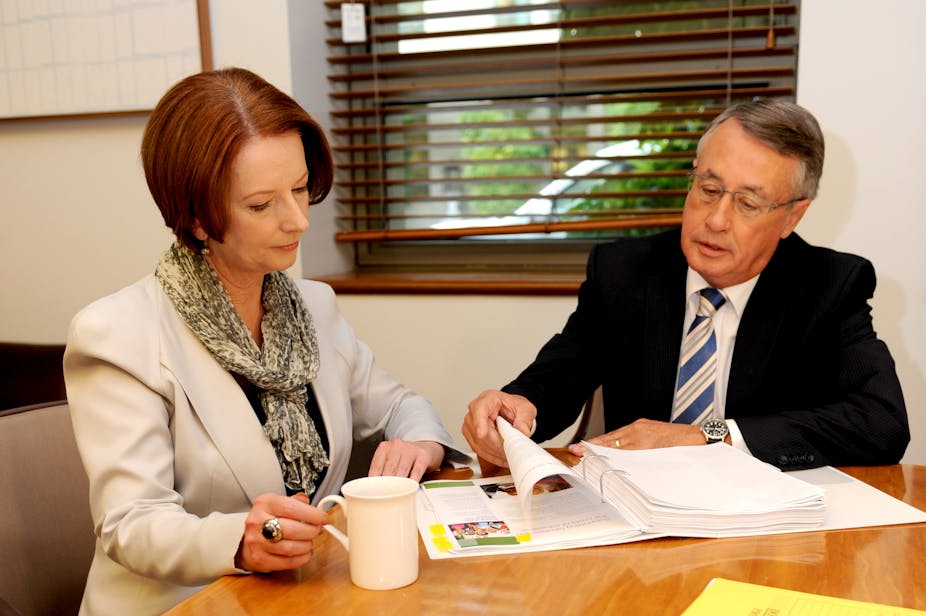
Federal Treasurer Wayne Swan will be busy tonight handing down the Federal Budget with all the policy settings we’ll need to ensure Australia’s future prosperity (and not simply as a re-election platform). Right?
Anyway, we thought we’d ask five experts for their last minute “wish list” of what they believe should be in tonight’s budget.
Simon Marginson, Professor of Higher Education, University of Melbourne: Two things I would like to see in the budget are for higher education and innovation.
First, a modest increase in program, fellowship and project funding for both the Australian Research Council (ARC) and the National Health and Medical Research Council (NHMRC). The Howard Government doubled these two schemes – the core of our national research effort – in 2001 but since then there has not been a substantial increase in either the ARC or NHMRC funding while many other countries, especially in East Asia, have substantially expanded their public research budgets. Second, with university class sizes growing ever larger, it is essential we shore up the level of public support for the teaching of undergraduate domestic students.
Last December’s report of the government’s own Base Funding Review showed that the majority of students are studying in programs where the funding rate (fixed government subsidy plus fixed student contribution) is either definitely below average teaching costs or suspected of being so. The Base Funding Review recommended the rationalisation and shoring up of funding across the range of disciplines.
If Australian higher education is to both augment future workforce productivity and provide meaningful opportunities to more students – the twin rationale for expanding the size of the graduate population - and also continue to attract large numbers of international students, its quality must be maintained and enhanced. Simple as that.
Mike Rafferty, Senior research analyst, Workplace Research Centre, University of Sydney: Budgets are largely symbolic statements. Most expenditure and revenue is already locked in from one year to the next. Budgets are about tweaking those numbers, but mostly also about symbolism – the message is as important as the content. I don’t have any problem with symbolism per se, but with the quality of political commentary at such an all time low, symbolism is everything - and nothing. What symbolism is there in targeting an accounting residual like the deficit?
I’d like to see some debate about how we can spend $30 billion on superannuation tax concessions and only $30 billion on the age pension. I’d like see some debate about why a society that is so much wealthier than even 20 years ago yet is making access to rights to basic sustenance conditional on presenting oneself in the labour market.
I’d also to see people, corporations and institutions with so much economic power asked about their obvious interests in political positions and about the obvious materiality of their interests.
So I’d like to see different questions asked by different people. That would make a great change to current budget symbolism with real economic potential.
John Vaz, Department of Accounting and Finance, Monash University: What I would like to see in the budget is incentives that will act to stimulate the slow part of the two-speed economy.
We have previously seen squandering of billions in poorly thought-out stimulus such as cash give-aways and home insulation, which were a waste from a long-term benefit point of view. The government is now trying to recover this waste (that is embedded in the deficit) with a view to achieving a politically driven surplus. This deficit reduction and debt pay-down will be achieved by reducing our fiscal outlays. This strategy runs the risk of stagnating the non-resources driven services sector, such as tourism and residential construction, which are already suffering.
I have two inclusions in the budget. I would like to see the government allow full tax deductions for capital-related items, such as home improvements of a capital nature above say $1000 and up to say $50,000 for the prime residence and that can be subject to a combined income threshold. This will only be offered to prime residences of taxpayers. This will provide benefits to both the services sector and to households, who will spend their own money wisely and will be properly accounted for in their tax returns for the cost and the value received. It will also capture a lot of the cash economy in this sector.
To those who cannot afford a home and are renting, the government could provide a home savings scheme that matches dollar for dollar or some proportion of any savings made for this purpose and any interest earned could be tax-free. This could be means-tested to a maximum threshold. This means that instead of a fixed first home buyers grant, which is typically inflationary with the benefit capture by vendors, individuals as buyers can benefit from a savings scheme that will provide the ability of potential home buyers to capture most of the surplus from, such as scheme.
Paula Lorgelly, Associate Professor, Centre for Health Economics, Monash University: One thing I’d like to see in the budget is less “budgeting” and more spending. However, this is unlikely given the government’s steadfast stance on returning the economy to a surplus. With this budgeting in mind, the one item on top of my wish list is no cuts to health research, or in an ideal world more funding for health research. Such research is important for both the health and education sector - it helps us build capacity and be globally competitive - but it also means that we can contribute to the often limited evidence base.
Many of the areas that may receive more funding will not have been well evaluated, and we will not know if such services are a good use of our limited resources and offer value-for-money. Senator Wong recently argued that “you don’t come back to surplus simply through accounting. You come back to surplus because you make hard decisions”. With limited evidence, they really are hard decisions, made even harder when you get it wrong. Investment in health research would help inform these decisions, and take some of the guesswork out of where we should be spending money (or indeed making savings if the government insists on returning a surplus in the future).
Graham White, Senior Lecturer, School of Economics, University of Sydney: My wish for tomorrow night’s budget is that the government backpedals on the goal of delivering a surplus and defers until the signs of softening in the economy are past.
But failing that – and I’m not naive enough to believe that they will backpedal – the attempt to bring in a surplus should be focused more on the revenue side than on the expenditure side and should be targeted away from low to middle-income earners towards high-income earners.
Both of these objectives could be justified on economic grounds, although targeting the higher income earners can obviously be justified on equity grounds.
If the government seeks to bring in a surplus, it will be less depressing on overall aggregate demand if done through taxes, rather than curtailing expenditures. And if we are to have a surplus, we need it to be done in a way that minimises the depressing effect on overall spending.
There is a similar justification for having less pain for lower-middle income earners than high-income earners to the extent that the latter spend a smaller proportion of their income. Cuts to higher income earners will likely have less of a depressing effect on consumer demand.
The qualification to all of this is that bringing in a surplus will likely require expenditure cuts – and cuts which will affect low to middle-income earners at least indirectly. Hence it would be best if the achievement of the surplus at this time was put on hold.