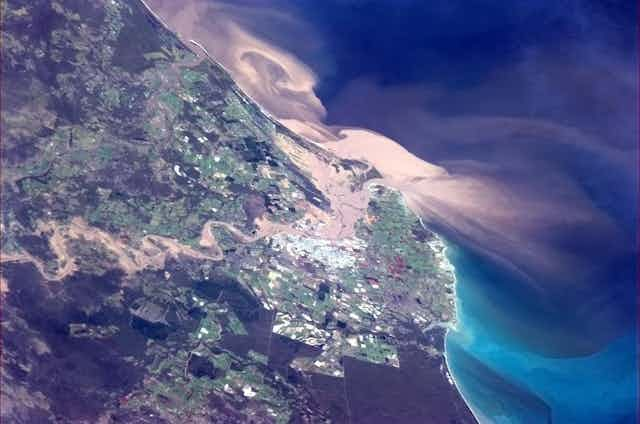
The Great Barrier Reef (GBR) is both a national marine park and a World Heritage Area. But next to the reef, a catchment of 400,000km2 is almost completely developed for agriculture, predominantly beef grazing and sugarcane, horticulture, cotton and grains cropping. How does this development affect the integrity of the reef?
It is well recognised that pollutant runoff (particularly sediment, nutrients and pesticides) from agriculture to the GBR is causing serious widespread damage to the reef’s ecosystems, including coral reefs and seagrass meadows.
The degradation is compounded by climate change impacts. Coral cover on the GBR in the central and southern parts has fallen from near 50% in the 1960s to 14% currently. In the 1980s it was recognised that degradation due to agricultural pollution was an issue for the GBR.
After decades of research and monitoring, a joint Federal and Queensland “Reef Plan” was developed in 2003 to address the issue. Reef Plan was finally implemented through an Australian Government initiative, Reef Rescue, in 2008 (with $200 million of Australian Government funding from the Caring for Our Country initiative). The scheme paid incentives to farmers, with matching farmer funding, to improve farm management practices.
Reef Rescue has been an outstanding success for this type of catchment management program. In 2009 the Queensland State Government introduced legislation to improve farm management; this was implemented from 2010. With the change of government in Queensland in early 2012, emphasis has shifted to a farm-industry-led Best Management Practice approach, with organisations like CANEGROWERS signing agreements with the Queensland Government to develop and implement best practice.
The combination of these initiatives has led to a small improvement in quality of water being discharged from rivers in the GBR catchment. This was first detected through modelling in 2011. Water quality in the GBR should keep improving – as funding is expected to continue – albeit slowly. The long process to improve the water quality of river discharge to the GBR has been a success, if a belated one.
As well as agricultural development, though, there are a number of major ports along the GBR coast, with the largest of these exporting coal. These include Gladstone, Hay Point (probably the largest coal export port in the world) and Abbot Point. More general cargo ports include Townsville (sugar, mineral products and general cargo) and Cairns (sugar, tourism and general cargo).
All the coal ports are in the process of major expansion for increased coal and/or coal seam gas exports. Expansion involves huge dredging operations and dumping of the dredge spoil at sea. In Gladstone, where expansion began in 2010, dredging is taking place in sediments that are known to be contaminated with heavy metals, Tributyltin anti-foulant residues and petroleum hydrocarbons (from long periods as a port and major industrial centre). In some areas the sediments overlie acid sulphate soils.
The environmental management regime for this development is deficient in both planning and execution and it is claimed (see below) that serious environmental impacts are now occurring. However the monitoring programs in place are so poorly designed and weak in execution it is difficult to draw conclusions as to what exactly is causing the observed effects, including fish disease. Major expansions planned for the other ports are unlikely to be managed any better, given the deficiencies in both the Australian and Queensland environmental assessment and protection system for large projects.
In response to the port expansion process and the fish disease episodes in Gladstone, UNESCO sent a team to examine the state of the GBR World Heritage Area (GBRWHA) in March 2012. They suggested the GBR may be placed on the “World Heritage in Danger” list.
The Australian and Queensland Governments responded by beginning a Strategic Assessment process. Each government is preparing its own assessment; the terms of reference are different, but the assessments are meant to be complementary.
The assessments are under way, with the Australian Government releasing its report last week. It is difficult to comment on the assessments' scientific robustness and credibility at this stage. It’s not clear the final assessments will have gone through any rigorous and independent scientific review.
In the meantime, permits for major expansions of the Abbot Point coal terminal are progressing. As for Gladstone, there will be very major dredging and spoil dumping in the GBRWHA. The environmental impact assessment process here appears to be no more scientifically robust than that which occurred in Gladstone, although the sediments in the area are less contaminated than those in Gladstone.
So although runoff from agriculture is still a major issue for the GBR, at least it is now being managed with some success. This is in contrast to major port development. There are multiple stages and proponents where management is uncoordinated, lacks transparency and appears to have no hope of reform in the near future, despite what may come out of the Strategic Assessments.
David Jones
Engineer
One major difference being that in the near future the port developments will stop but the agriculture will continue.
Robert McDougall
Small Business Owner
And your point is?
Jon Brodie
Research scientist
While port development may stop one day it won't be any time soon with plans in the pipeline for continuing major expansions in Cairns, Townsville, Abbott Point, Hay Point, Gladstone as well as the possible Fitzroy River mouth projects. I think this takes us another 10 years at least. During this period we hope, given further Reef Rescue funding (?), to continue to slowly improve water quality by reducing agricultural pollutants.
Felix MacNeill
Environmental Manager
David, I suppose that the more acute damage from the development stage will ease once construction is 'complete' (if that ever really happens!) but won't thre be serious, ongoing problems arising from the heavier maritime traffic and all its resultant dangers and damages?
Robert McDougall
Small Business Owner
I suppose the other complication is flood events overflowing tailings and holding ponds etc as well as government approval to release contiminated water into natural waterways
Jon Brodie
Research scientist
Aerial photos of the Fitzroy river mouth potential sites for the 2 coal terminals planned for there in the recent high tide conditions and the very recent Fitzroy flood show the sites completely under water. The wisdom of building there with coal piles and infrastructure instead of expansion within Gladstone proper is highly dubious.
David Arthur
n/a
Not only are the port developments going to cease, but so is the entire export coal industry.
1) China's only been importing Australian coal while it develops its domestic mining industry,
2) every other banana republic is developing its own coal mines to compete with Australia, and
3) global warming means the world is going to cease using coal altogether in a couple of decades' time.
It may be that further port development will be a waste of capital investment anyway.
David Jones
Engineer
The point being that it is a meaningless comparison.
By all means examine and criticise the environmental impact of the port development. Please do suggest improved management ideas. Better still look at the ongoing impact of the mines themselves and tell us if they are matching the improvement efforts of agriculture.
Comparing a one off event (or several) with an effectively endless process is not sensible. What will the cumulative effect of the port development be in 100 years time or 1000 years?
David Jones
Engineer
Felix,
There would be effects which might make sense to compare (invasive species, oil spill risk and so on) but the article is talking about dredging impact.
Felix MacNeill
Environmental Manager
Just because the article didn't overtly address these kinds of issues, does that mean that they are not relevant and shouldn't be discussed?
You said 'the port developments will stop but the agriculture will continue.' All I suggested was that, even when development was completed, there would be impacts from increased traffic - just the kinds of things you mentioned.
Felix MacNeill
Environmental Manager
And there is is a (manufactured) clamour to reduce 'green tape'...what can you say?
Robert McDougall
Small Business Owner
the clamour generally comes from those who dont want to be held accountable for the damage they cause or view the environment not as something essential to support life, but as an impediment on the way to profit.
Felix MacNeill
Environmental Manager
What really gets up my nose is that they're making the profit largely by flogging off OUR resources anyway!
David Arthur
n/a
To reduce 'green tape', get State governments out of environmental approval altogether, and leave all environmental approval in the hands of the Feds
1) at least the Feds are bound by treaty obligations
2) State governments are often project proponents, so their environmental assessments are 'conflicted' - maybe not at the draft stage, to which the relevant professionals have contributed, but certainly at release of the Final version, after Senior Executives and Ministerial have had a crack at it.
3) State governments are generally desperate to get royalty income.
Felix MacNeill
Environmental Manager
Now there's a thought!
Of course the subsidiarity argument would probably get used...and the 'What would distant bureaucrats in Canberra know?' argument could take its place in the pages of the Daily Telegraph or Australian. As far as I can see, far too often the 'you need local understanding' argument amounts to little more than we want our mates to do the assessment...
David Arthur
n/a
Distant bureaucrats in Brisbane are as clueless as their peers in Canberra. The difference is, the masters of the Canberra bureaucrats are less likely to be wined and dined by a contentious project's proponents.
Don't for a moment imagine that the powers-that-be in Brisvegas are any less rapacious than their counterparts in Sydney. Gunnedah, on the Liverpool Plains, is ~480 km from Sydney.
Gladstone is ~530 km from Brisbane.
Felix MacNeill
Environmental Manager
Good point David - I've been one of those Canberra bureaucrats for many years, and no bugger has even once offered me a bribe!
Geoffrey Harold Sherrington
Boss
Felix, what a nasty comment. You can get yourself a slice of mining action any time you like, but there's no need to snark about "YOUR" minerals because they are worth next to nothing until discovered. That discovery can be very expensive. If you want to change the direction of mining, get yourself on a Board and help set policy. I'm sorry if it takes funds and effort, but nobody in theory is stopping you.
Geoffrey Harold Sherrington
Boss
Oh sorry, I misunderstood. You are environmental manager for a company making green tape. That's useful.
Geoffrey Harold Sherrington
Boss
Sorry, you guys lack the experience to contribute here. few slogans is too light a touch. What you need is reams of measurements, calculations, quantitative material. Like mining companies have to produce at their cost before they are given permission to mine.
David Arthur
n/a
Yeah. like the reams of data provided to the Bligh government?
Claims former Qld government put pressure on gas approvals
By Emma Pollard, http://www.abc.net.au/news/2013-02-11/claims-former-qld-government-put-pressure-on-gas-approvals/4511904
An industry group has dismissed claims two to Queensland's largest resources projects were approved because of pressure by the former Bligh Labor government.
The Courier Mail newspaper says a Right to Information investigation has revealed the Bligh…
Read morePat Moore
gardener
Thanks for the national flagging of this travesty Jon. These massive coal port developments are an atrocity of destruction of delicate ecosystems for short term profits that mostly go offshore & further heat the planet. Yet another case of privatized profits at the expense of social/environmental losses to contribute to the hoover up effect of deeply polarized multinational corporate wealth. Because Queensland's been economically screwed by the GFC debt-making schemes, IBM Health Dept payroll…
Read moreRobert McDougall
Small Business Owner
in the case of CSG, it's all about quick, put in the infrastructure that costs billions, locking in a requirement for a return on the investment BEFORE all the smoke and mirrors dissipate and science can prove it's a bad idea. Then its a case of "oh well, the damage has been done so we might as well continue to make money out of it" then through hiding behind a corporate structure, run away with the profits with no accountability and when the sh!t@ hits the fan say "we had no idea, we relied on the reports, it's not our fault".
Dale Bloom
Analyst
The top photo in this article is of discharge from the Burnet River in Bundaberg after the recent floods.
Here are more pictures
http://www.abc.net.au/local/photos/2013/02/03/3682078.htm
There is extensive agriculture in the catchment area of the Burnet River, but no coal mines, and there are no coal ports.
I think this should have been stated in the article.
David Arthur
n/a
I think mining will be commencing around Monto in 2014, from which Three Moon Creek runs south to join the Burnett (near Munduberra?).
While there is no coal port at Bundaberg as yet, John-Paul Langbroek was quite keen to see a coal port on the Burnett, which would facilitate re-opening of the Burrum coal measures.
It also needs to be pointed out that, although the line on the map marking the southern end of the GBR for administrative purposes near the Burnett, the physically real GBR extends past the Burnett to Hervey Bay.
Up until the last couple of flood events, Hervey Bay corals were recovering quite well from being smashed apart in the 1970's by tugs towing balls and chains (same technique as brigalow clearing), so that trawl nets wouldn't snag on the corals.
Hervey Bay's inshore reef fishing industry finished up within a couple of years.
Dale Bloom
Analyst
Maybe the coal mines will go ahead. There are a number of coal mines now being cancelled. I am uncertain whether coal mines cause much damage to the GBR.
Tourism, population growth and foreshore real estate development would probably represent the biggest threats to the foreshore areas and marine environments at Bundaberg and Harvey Bay, as they do in most other places.
I can remember being involved in having Mon Repose turtle rookery declared a conservation area. Originally it was a cattle farm, and the owner wanted to convert it into housing development with quite a lot of backing from members of council. Now, it is one of the most important turtle rookeries in the world for research, but it was a very close call that it would become housing development. That is the power of the real estate industry in this country.
David Arthur
n/a
Excellent points, Dale, thanks for that, and huge gratitude for getting Mon Repos protected.
I think these three processes associated with coal mining could affect the GBR
1) dredging associated with port construction and maintenance
2) coal dust emissions from handling and loading
3) pump-out of flooded pits
Further to the point about the GBR extending to the waters of Hervey Bay, have you a thought regarding New Hope's proposal to re-open the Burrum measures to mining?
I understand there was an underground mine many years ago near Howard that was exceptionally wet due to groundwater seepage.
This time, the proposal is to have an open-cut pit within 10 km from Maryborough, ~25 km upstream of the (Ramsar-listed) wetlands of Great Sandy Strait on the Susan River, and yet the Federal Government chose to not require assessment under the EPBC Act.
Colin Hunt
Honorary Fellow in Economics at University of Queensland
The article contends that the Reef Rescue programme has been an “outstanding success” in tackling water quality to the GBR. This conclusion is based on a small improvement achieved in the quality of water discharged into the Reef’s catchment in 2011.
Read moreThe extent of the challenge is illustrated by the fact that dissolved nitrogen and phosphorus loads are 5 to 10 times natural loads. The “small improvement” in water quality achieved in 2011, mentioned in the article, is likely to have been negated…
Jon Brodie
Research scientist
Yes Colin that's all true but at least we are making some small progress there. I'm afraid I don't see we're making any progress anywhere else wrt the GBR including in the zoning of the Coral Sea (as described in your recent paper - great paper), climate change, ports, Torres Strait shipping issues in the forgotten part of the GBR, micropollutant management in the GBR coastal zone, ....