
There’s been plenty of commentary recently on the “numeracy crisis” threatening the economies of many developed nations, including Australia.
A 2009 report by the National Academies in the US was not the first to highlight the desperate need to improve mathematical education, particularly at the K-12 level, where so many otherwise talented students either fall behind or lose interest. The report’s summary concluded:
“The new demands of international competition in the 21st century require a workforce that is competent in and comfortable with mathematics.
“There is particular concern about the chronically low mathematics and science performance of economically disadvantaged students and the lack of diversity in the science and technical workforce. Particularly alarming is that such disparities exist in the earliest years of schooling and even before school entry …”
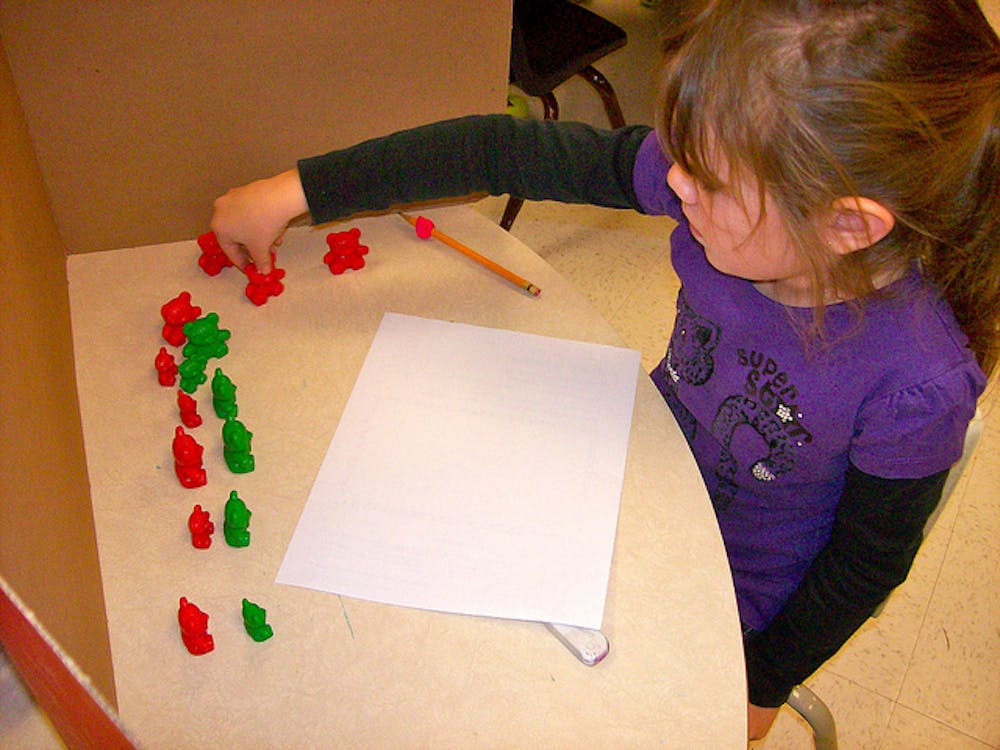
The committee found that, although virtually all young children have the capability to learn and become competent in mathematics, the potential to learn mathematics in the early years of school is not currently realised for most.
This stems from a lack of opportunities to learn mathematics either in early childhood settings or through everyday experiences at home and in communities. And this is especially the case for the economically disadvantaged.
A UK report released last month found that millions of British adults have numerical skills at a level more commonly expected of an 11-year-old. The report also found that young people with poor numeracy skills were twice as likely to drop out of school and twice as likely to be unemployed.
The report’s authors called for a change in society’s attitude to mathematics, so that being bad at maths should no longer be seen as a “badge of honour”.
According to the same UK report, one in five of business members questioned last year said they had to teach remedial mathematics to their employees. As James Fothergill, head of education and skills at the employers’ group CSI, explained:
“It’s really important that [employees] are helped to apply maths skills and concepts in practical situations, such as being able to work out what a 30% discount is without doing it on the till.”
Many business leaders also pointed to the fact few of their employees were able to spot “rogue figures” – data that is likely to be in error.
In February this year, speaking at a forum of national educators in Canberra, Australia’s Nobel Prize-winning astronomer Brian Schmidt went so far as to warn that Australia’s resource boom was threatened by a lack of highly-trained engineers, saying:
“Too many kids who are willing and able to excel at maths are taught by teachers without the competency required to teach the subjects they are teaching.”
At the same forum, Australia’s Chief Scientist Ian Chubb said part of the problem was that mathematics and science courses were considered “boring”.
“We need to think about how to deliver the science and mathematics to a generation of students that have many more options available to them,” he said.
The situation is better elsewhere. Finland and Canada, for example, rated an “A” in an international ranking of 17 developed nations in education and skills. Finland has ranked at (or near) the top of the OECD nations in educational performance for more than ten straight years.
Canada’s strength derives in part from the system’s primary focus on K-12 education. On the other hand, Canada faces the challenge of educating and training the three million adults, in a country of under 35m people, who have only “Level 1” literacy. This would seem to show that you do get what you pay for.
Of course other countries, such as Japan, Taiwan, China, Korea and Singapore are not standing still, with impressive gains in educational performance.
So what can be done, for the good of everyone? Perhaps all nations can examine the educational programs of highly successful nations such as Finland.
The Finnish educational system eschews standards tests, preferring instead custom tests devised by highly-qualified teachers. (Several decades ago the government required all teachers to have master’s degrees).
Another is Finland’s focus on basic education from age seven until 16, at which point 95% of the population continues in either vocational or academic high schools. According to Pasi Sahlberg, a Finnish educator and author:
“The primary aim of education is to serve as an equalising instrument for society.”
It’s a nice thought, and one we’d all do well to take note of.
A version of this article appeared on Math Drudge.


Dale Bloom
Analyst
And the Finish system requires all teachers to have a Masters degree in education, and interestingly their rates of pay and hours of work are about average or even below average for OECD countries. Class sizes are about normal for class sizes in Australia.
Seamus
logged in via Twitter
"“It’s really important that [employees] are helped to apply maths skills and concepts in practical situations, such as being able to work out what a 30% discount is without doing it on the till.”"
Oh noes!
Maths and Science courses are considered boring because they ARE boring. The way Maths is taught in schools (highschool in particular) has not changed in the last 100 years. It's obscure formulas, minimal real world application and a lot of rote learning. Not only that it is extremely hard for many children, and those who struggle are stigmatised from day dot.
Unfortunately, with the increasing value placed upon TER and NAPLAN results, we are likely to see an ever increasing focus on teaching to the textbook and to hell with any innovation that might make Maths, and other areas of the curriculum, half way enjoyable to those who don't excel at it.
Joseph Bernard
Director
please watch this RSA Animate presentation by Sir Ken Robinson..
http://www.youtube.com/watch?v=zDZFcDGpL4U
says it all... we need to change
Our education model is outdated..
Our teachers should be all skilled with NLP methodology which will make education a science rather than a 'Hit or Miss' change learning experience
Rob Crowther
Architectural Draftsman
I though NLP did not live up to its expectataions.
That aside, I want to draw like the dude in the video.
Joseph Bernard
Director
NLP is a term that covers a broad spectrum of techniques and knowledge.
At its core is TOTE .. Test-Operate-Test-Environment used to verify modelled systems. These systems are part of an evolving processes that starts with the "meta model" of the language we use and the representational models used by our mind. As such it is a work in progress that is continuing to evolve.
As for effective? Have you ever watched any of Derren’s Browns work on youtube?
Like .. a) BBC presenter that is convinced that the present in the box behind him was the present he had always wanted.. http://www.youtube.com/watch?v=befugtgikMg
b) Shopping malls are laid out in a way that we are open to suggestion and hands up all that agree? http://www.youtube.com/watch?v=IOEKdaXIEHc
Alice Gorman
Lecturer in Archaeology at Flinders University
I didn't find out until my 20s just how fascinating maths can be. I don't recall being taught any of the social and historical background to the theories and equations we had to learn how to use at school. Now I read popular books about maths for pleasure (and there are many wonderful ones - Marcus du Sautoy being a stand-out). As I came to understand what was really going on behind all the rote learning, I would think about how I would teach maths to school children to inspire them rather than filling them with dread. Not something I'm ever going to do but I hope someone will!
Peter Ormonde
Peter Ormonde is a Friend of The Conversation.
Farmer
Not a numeracy crisis ... it's an education crisis and it's across the board. Maths is just easy to measure. The others - like reason, curiosity and enthusiasm aren't.
I reckon one really only learns a couple of Big Things at school... and the biggest is enthusiasm. Nothing is more contagious, more inspirational than an enthusiastic teacher. And nothing is more stultifying and disheartening than a teacher who just grinds relentlessly through the approved (and no doubt totally excellent) curriculum like an angle grinder.
We need to teach teachers, to create them, to keep them enthusiastic. Especially at universities where actual teaching seems to be often regarded as a drudge ...but we need it all the way down to the youngest kids ... to inspire, encourage and instill wonder and curiosity.
I'm not sure that the most elaborate bureaucratic techniques of monitoring, measuring and evaluating are much help there at all.
Mark Chambers
Business & Marketing Consultant
Someone once told me that there are only 3 kinds of people in this world ... those who can add up , and those who can't. On several occasions I have passed this comment on (for its humorous value) including to one university graduate who responded with 'what's the 3rd kind??'
There appears to be an increasing number of adults who consider that maths at school should be fun. Surely , school is meant to teach our children a lot more than the subjects of their classes . If numeracy is suffering…
Read moreAnthony Muscio
Systems Analysist and Designer
and there are two type of people in the world. One that can extrapolate from missing data.
Mark Chambers
Business & Marketing Consultant
actually there's only one type of person in the world ... but I like them equally.
Dave Smith
Energy Consultant
It is pretty unbelievable that in this era of smart phone apps, the internet, electronic whiteboards and video games, my primary school-age kids are still being given homework that entails laboriously writing out times tables by hand. If one set a competition to find the most boring way to teach maths, that would have to be in with a good shot at the trophy.
Pathetic.
Rob Crowther
Architectural Draftsman
Oh that’s easy.
When I used to walk my children to school we used to play a question game. That was fun.
Before the question game could start I needed a proper rendition of at least 3 times tables. Always picking on 7 or 8 and always including 2, 5 or 10. One hard set and finishing with an easy set with a moderate set in the middle.
The tables were over and done with before we reached the end of the street and the street is about 20 houses long.