
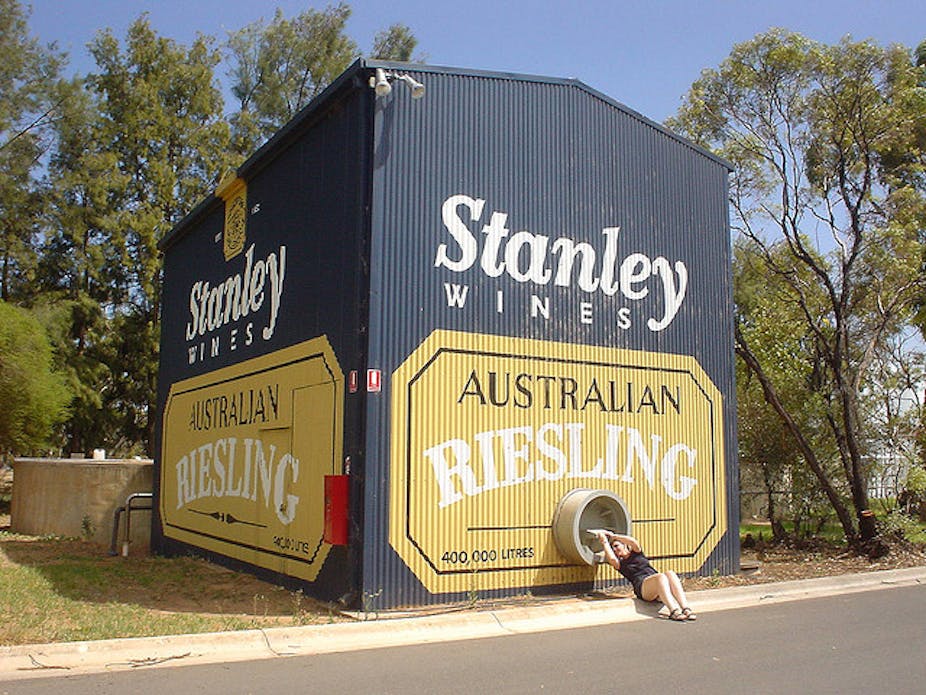
Although most Australians would probably say we’ve always been a heavy-drinking nation, the consumption of alcohol has followed a roller coaster curve since European invasion.
Alcohol consumption in Australia began at an annual high point of 13.6 litres of pure alcohol per head in the 1830s. It declined to 5.8 litres a year during the economic downturn in the 1890s, then to a nadir of 2.5 litres during the Great Depression.
After World War II, there was a long rise in per capita consumption to another high point of 13.1 litres in 1974-75. It then dropped again and rose slowly to the 2008-09 levels of ten litres.
There’s little doubt that alcohol is an important part of Australian culture. According to the author of The Rum State, Milton Lewis, heavy drinking was an established cultural norm transported to Australia at the time of colonisation.

It was the norm in Britain to drink heavily and gin epidemics were devastating entire communities at the time. Lewis says that alcohol in Europe had long served as a food and source of nutrition as the diets of the time were very restricted and there wasn’t a lot else to choose from.
Two drinking practices were established that still exist today. One is “shouting” in which each person in turn buys a round of drinks for the whole group; and the other, “work and bust”, is a prolonged drunken spree following a long period of hard work in the bush. This is basically an earlier term for the contemporary notion of binge drinking, and can be seen in the “Mad Monday” celebrations at the end of a football season.
But other factors were also at play. For a time, spirits were used in barter and convicts were part-paid in rum. In this way, rum became a currency of the colony – hence the term “a rum state”. The control of alcohol gave enormous political power. And alcohol was reportedly involved in the only military coup in Australia – the Rum rebellion in 1808.
Over the years, there have been many different social meanings of alcohol. In Australia and elsewhere, wine, brandy, beer and stout have been seen as good dietary supplements for invalids. Alcohol was once seen as a good, healthy food Lewis notes that it has been consumed as a sacrament, a toast, a fortifier, a sedative, a thirst-quencher, and a symbol of sophistication.

Temperance organisations sprang up in the early 19th century, and became active in Australian colonies from 1830s. They initially advocated moderation and would eventually demand prohibition. They were affiliated with Christian churches, and seen as a middle-class reaction to an upsurge in lower-class drinking of spirits, which was due to more industrialised production of distilled spirits, and the fear of the working class being more dangerous when drunk.
The highpoint of the temperance movement came during World War I and the Depression, when consumption went down dramatically across the English-speaking world. But after World War II, there was a backlash against the anti-alcohol movement. Drinking rates began to climb again along with growing prosperity and cultural shifts such as the changing role of women, and European immigration shaped the way we drank.
“Civilised” drinking – drinking with food and in moderation – became the norm. Wine became a much more popular drink by the 1960s and Australia invented the wine cask. A significant change occurred in Victoria in the 1980s with the Niewenhausen report, which promoted the liberalisation of licencing in Victoria. This was taken so keenly by successive Victorian governments that, on average, two new liquor licences were granted every day from 20 years from 1986.

But as large alcohol manufacturers increased their range of products, ramped up the amount they were producing, upped the sophistication and diversification of their advertising and allied themselves with major sports and the major media outlets, civilised drinking has not remained the norm for a sizeable proportion of the population. In the last two decades, binge drinking has again become fashionable.
And the harm these drinkers inflict on themselves and on a large proportion of the community is preventable.
It doesn’t have to be this way. History shows us that overall average rates of alcohol consumption in Australia can change quite dramatically over time, and that drinking practices are highly modifiable.
This is the first part of our series looking at alcohol and the drinking culture in Australia. Click on the links below to read the other articles:
Part Two: Social acceptance of alcohol allows us to ignore its harms
Part Three: My drinking, your problem: alcohol hurts non-drinkers too
Part Four: Alcohol-fuelled violence on the rise despite falling consumption
Part Five: ‘As a matter of fact, I’ve got it now’: alcohol advertising and sport
Part Six: Advertising’s role in how young people interact with alcohol
Part Seven: Big Alcohol and Big Tobacco – boozem buddies?
Part Eight: Explainer: foetal alcohol spectrum disorders
Part Nine: ‘Valuable label real estate’ and alcohol warning labels
Part Ten: Forbidden fruit: are children tricked into wanting alcohol?
Giles Pickford
Giles Pickford is a Friend of The Conversation.
Retired, Wollongong
Language is both our greatest achievement and a serious problem when it is used to lie anf deceive.
That is why Art and Music are so important as they communicate without words across all classes and races.
It is a big concern that modern political wisdom sees Art and Music as an expensive luxury which the tax payer cannot afford. This is a tragedy and a corruption of what Jeremy Bentham meant when he asked "What is the use ot it?"
Giles Pickford
Giles Pickford is a Friend of The Conversation.
Retired, Wollongong
My apologies. The above comment was meant to be attached to the next article on Language making us different from the animals.
Tim Traynor
Rocket Surgeon
You were drinking too much when you mistakenly posted that here, Giles? :-)
Reema Rattan
Editor at The Conversation
Would you like me to remove your comments from here, Giles?
Nick Stafford
writer
I look forward to this series on alcohol and thank you for starting it Rob Moodie.
What is binge drinking please? I hear the term all the time but dont know what it means. When does a "big night" become a "binge"?
I would like a lot more precision with this term because it does seem, at least a bit, that binge drinking is the negative name older people have come up with to demonise young people's drinking.
Teaki Page
logged in via Twitter
Hi Nick,
I believe 5 or more drinks for men, or 4 or more for women is considered binge drinking.
And I disagree that it's used to demonise drinking, I think the reverse is true - we use terms like 'big night' and 'having a few' to normalise binge drinking and to become complacent about what we are actually doing - binge drinking.
Nick Stafford
writer
Hi Teaki
thanks for responding
I just totally disagree with and reject the moral judgement (It has no scientific or rational basis) that more than 4-5 drinks of alcohol can be labelled a pathology or disorder called binge drinking.
This is straight out moral and medical pathologisation.
The drugs area of life is so full of moralistic assumptions and judgements hiding behind scientific language. Binge drinking along with "epidemics" of drug use are two of the most common.
RJ Lohan
Software Engineer and Father
I don't think the term 'binge drinking' needs a numerical classification. I think you can consider the term to simply mean 'drinking to get drunk'. And this behaviour can be taken to extremes to become 'drinking LOTS to get drunk QUICKLY'.
Stephen Riden
Research and Information Manager, DSICA
"Binge drinking" in the research literature used to refer to an all-weekend or longer drinking session, primarily in terms of alcoholism.
It has since been redefined downwards by the public health advocacy movement to a binge being much less alcohol consumed on a single drinking occasion.
http://shm.oxfordjournals.org/content/22/3/597.full
don davey
retired
I guess i could regarded as biased in my statement however for me who lost both his wife and daughter to the actions of a drunken driver this whole issue is a law and order one.
The person whom killed my family had before been charged with the offense several times and then when convicted spent only 12 months incarcerated as as back driving in 24 months.
The liquor lobby are far to powerful and the courts far to lily-livered and weak.
Anthony W Collins
Lawyer
Binge drinking is not about the level of consumption but rather the behaviour and consequences of that behaviour. Unfortunately the demon is in the person not in the bottle. There is no point in setting a per volume scale to define binge drinking. No one can know where the tipping point is. As for "older people demonising young people's drinking", I suspect the classic excuse for street violence, drink driving, and vandalism,is "I'm sorry I was pissed". it is behaviour and the consequences of that behaviour that is the issue..
Jason Thompson
logged in via Facebook
That sounds a bit too much like a 'guns don't kill people, people kill people' argument to me?
I live in inner Melbourne and the promotion of alcohol and drinking is almost blanket. I can step outside my door at any time of day or night and see it sold / advertised / being consumed / being picked-up after by the police / Salvo's or Councils. Then I can go inside and be bombarded with promotion through sport, TV or radio (which strangely looks nothing like the reality of how people are using it....) It's endless.
There seems to be no shame at all from the alcohol lobby as to the negative consequences of the endless promotion of drinking and binging culture.
It pains me to say it because one of the reasons I live in Melbourne is because of its great pubs, but at some point, alcohol producers will need to be held to account for the cost of their product on consumers or society more generally. If any other product did the harm that alcohol did, we'd be up in arms about it.
Andrew Muratore
logged in via email @gmail.com
Sorry, first you demand 'a lot more precision' with the term 'binge drinking', and then you complain about 'moralistic assumptions and judgements hiding behind scientific language', when it was you who requested the scientific language in the first place?
Sounds like you're setting yourself up to be outraged.
Nick Stafford
writer
Hi Don
I am really sorry to hear about the death of your daughter and wife, that must have been horrific.
yours
Nick
Nick Stafford
writer
Andrew,
I don't see any problem with wanting a more precise definition while recognising that a lot of discourse about legal, illegal, and precription drugs contain moral judgements hidden within neutral scientific sounding language.
And I don't understand your point about me setting myself up for moral outrage.
You wrote that I "demanded" a more precise definition. I did nothing of ther sort Andrew, I "asked" for a more precise definition.
Finally, given that your response had nothing to actually say about the issues raised by the article or myself, you have not really contributed anything other than your own sense of moral outrage.
So it is not me setting myself up to be morally otraged at all Andrew. It is you who has done so by seeing some imaginary contradiction that actually exist.
Joanne Butler
logged in via Facebook
Greetings from Ontario, Canada.
It is fascinating how we tiptoe around alcohol and the problems it causes. In Canada, we have pretty much given over the job of defining "responsible drinking" to beer and spirit manufacturers, and the definition is: As long as you are not committing vehicular homicide, then you are drinking responsibly.
These parties even ran a campaign that was, as I understand it, meant to be tongue-in-cheek. It showed young drunk men passed out in various humorous positions and settings (slides in playgrounds; statues in parks) with the message being that thank goodness they were so responsible in their (over) drinking that they just crawled away to sleep it off, rather than getting behind the wheel.
Whatever.
Malcolm Gladwell has some interesting observations on culture and drinking: http://www.gladwell.com/2010/2010_02_15_a_drinking.html
Reema Rattan
Editor at The Conversation
Is there much of a problem of people freezing to death?
Tim Traynor
Rocket Surgeon
Aboot 50/50 with being eaten by a bear I suspect.
Rosalie Higson
Freelance journalist
Joanne, hello to Ontario, and thanks for the link to the M. Gladwell piece, really interesting.
Peter Ormonde
Peter Ormonde is a Friend of The Conversation.
Farmer
Interesting link Joanne... helps explain something I as a non-drinker have been mystified by on occasion - the ritualistic elements of it all and the vastly different outcomes of intoxication depending on context, culture and circumstance.
Welcome aboard.
I remember watching a long queue outside a Belgrade supermarket waiting for it to open in the freezing dark. Many wore hard-hats, overalls and carried the tell-tale bag of construction workers.
They poured in, they poured out - each clutching a 2 litre bottle of what I assumed was vodka. Off to work over the road on a large construction site. Only to return at about 11 for a refill.
Don't ever go above the second floor in Belgrade. Ever.
Tobin Richard
Software Development Manager
Attitudes to drinking can and should change but it's vital that more people recognize that the desire to use mind altering substances such as alcohol for recreational reasons will never go away. It has been a part of human culture for all of history.
Some people forget that, usually while promoting an abstinence and punishment approach that does more harm than good.
Merrilyn Wasson
Policy Analyst
Living and working in Darwin for eight years, and now living and working in Singapore, I have been following the discussion on alcohol consumption and related issues in Australia with great interest.
There is no debate in Singapore, where all forms of alcohol are available in all the Supermarkets, with no restrictions at all.
Prima facie, there are two main concerns in Australia. The most pressing relates to death and injury to others caused by alcohol, from drink driving, alcohol inflamed…
Read moreTerry Mills
lawyer retired
Merrilyn, I know what you mean. I lived in Singapore for some years and there was no evidence of the type of binge drinking we see here, even among the expats at Boat Quay on a Friday night. The difference may be cost as alcohol is very expensive in Singapore and there are no wine flagons/ cartons.
Bob Trussler
writer
I was confused then horrified recently at the supermarket.
I had not spent enough to get a petrol discount voucher, but I had a voucher on my receipt.
It was for a two-for-the-price-of-one deal on wine.
This is pervasive alcohol advertising gone mad.
John R. Sabine
Scholar-at-Large
If this is to be a week-long conversation, then I hope that all participants will take note of two important relevant factors.
First, be careful in your use of the word "drug". After many years lecturing to university students on this topic, I have yet to find a satisfactory definition for "drug", that is one that decribes this both adequately and exclusively. Maybe the conversation will turn up a useful definition.
The second key factor is what I have previously described as the Universal Law of Nutrition, namely "a little will do you good, a lot will kill you". There is no food nor drug (whether they can be distinguished is another matter) to which this law does not apply. Ignore it at your (logical) peril.
Narelle Matheson
logged in via Facebook
I appreciate what you are saying regarding the word "drug". I do hope that in the course of the conversation a suitable definition can be sourced to best describe the use of substances which produce effects that can be both pleasurable in moderation and dangerous when used to extremes. Perhaps this also fits your second point as well.
Evert Rauwendaal
logged in via Facebook
Here you go:
"The truth is that no single uniform feature is found in all the substances called drugs that differentiates them from all the substances called nondrugs, except that all drugs have been called drugs by somebody." http://knowledge.sagepub.com/view/the-relativity-of-deviance-2e/n9.xml
Narelle Matheson
logged in via Facebook
Okay. Binge drinking in my part of the world means drinking as much as possible in order to become totally legless. My father was a violent alcoholic, very partial to secretive binge drinking, which coloured my take on alcohol somewhat. However, I enjoy my alcholic beverages in moderation as do the other members of my family.
The question is, why is binge drinking attractive to the 18-25 age group? It is associated with violent behavior, irresponsible behavior, injury, medical difficulties…
Read moreStephen Riden
Research and Information Manager, DSICA
People abuse alcohol in that way for lots of reasons: to conquer boredom, to gain self-confidence, to loosen their inhibitions and to liberate themselves from their everyday experience.
Drinking is pleasureable and intoxication is fun - until the hangover. But these people you are referring to (and it is by no means all 18-25 years old, or in fact only 18-25 years old) find the fun and enjoyment while intoxicated are worth the risks they run and the pain they feel the next day.
The impact of hangovers worsens as people get older - it is one of the reasons most people cut back as they age. Older people are also more sensitive to those risks you listed.
And excessive alcohol affects young people's physical co-ordination less than it does older people. So they can drink more without showing it or noticing it.
Tobin Richard
Software Development Manager
Alcohol is used for the same reasons as any other drug. For social reasons, for relaxation, for (self) medication, for recreation, boredom, etc. Young people will always push boundaries and test their own limits and nearly everyone is going to binge at least once or twice. The specifics of the culture around it can be controlled to a certain extent but for some factors, such as boredom, the effort required is large and difficult.
As an aside, you should be careful about suggesting alcohol is being used "as an alternative to drugs" which implies it isn't a drug itself. Not that I'm saying you necessarily meant to imply that.
The arbitrary line many people draw between alcohol and other drugs regardless of whether they are objectively more or less harmful makes clear discussion very difficult. It leads to the bizarre situations such as where control approaches that might work well for many different drugs are only ever applied to alcohol or are never applied to alcohol.
Peter Ormonde
Peter Ormonde is a Friend of The Conversation.
Farmer
"Alcohol is used for the same reasons as any other drug."
See I'm not sure that's true. Other drugs are used to get smashed - to have an altered mindstate. There's a bit of social interaction (perhaps anti-social) but the fundamental driver is to get wasted.
Some kids - let's call them binge-drinkers - drink for the same reason.
But not all alcohol consumption is aimed at getting wasted. It has social functions - a bottle of wine or a beer over a meal, celebrations, social events and the…
Read moreNick Stafford
writer
Hi Peter
You suggest it is not true that alcohol is used for the same reasons as other drugs because in your words:
"Other drugs are used to get smashed - to have an altered mindstate. There's a bit of social interaction (perhaps anti-social) but the fundamental driver is to get wasted."
Sorry but this is just not true. This is simply the dishonest line alcohol users use to imply that their drug is a social activity while other drugs, as you say are simply tools to get wasted.
Last weekend…
Read moreNarelle Matheson
logged in via Facebook
You are quite right, poor choice of words on my part, of course alcohol is a drug.
Narelle Matheson
logged in via Facebook
Some Irish people may be heavy drinkers, but that is a generalisation, and probably mythical!
I share your concern, but it still doesn't explain why.
Peter Ormonde
Peter Ormonde is a Friend of The Conversation.
Farmer
You seem to suggest I'm adopting a "moralistic" criterion betwen alcohol and other drugs. I should point out that I am far more tolerant of most other drugs than I am of alcohol.
But the point is that the use of illicit drugs is solely driven by the desire to achieve an altered mindstate ... one doesn't sit around with one's mates having half a toke and shooting the breeze. The whole point is to get ripped even a little bit.
But with alcohol we ceremonialise it - it is interwoven with our…
Read moreStephen John Ralph
carer
Hi
There is a large number of citizens (mainly young men I'd surmise), who by nature have a belligerent and anti-social personality. Their pleasure is to head for drinking establishments to create as much trouble as they can. Alcohol is their drug because it fuels them on to greater deeds of hooliganism (to use an old word).
These are the people who bash others and start fights - because they like to, and because they can.
But they will be aggressive with or without alcohol.They are spoiling…
Read moreNick Stafford
writer
Sorry Peter
but you are just dead wrong. ALL drug use is ritualised and cermonialised in its own way. You wrote:
"one doesn't sit around with one's mates having half a toke and shooting the breeze"
Clearly you have never spent any time around pot smokers. They regularly sit around and chat.
People who use exctasy, amphetamines and heroin also often ceremonalise their drug use and sit around "shooting the breeze".
I am sorry this notion you have that alcohol is entwined in our social fabric while other drugs are not is just bizarre.
ALL drugs, inlcuding alcohol, are used to alter consciousness and ALL drugs, including alcohol, are ALWAYS embedded within a social context with a wide range of social meanings and purposes.
Peter Ormonde
Peter Ormonde is a Friend of The Conversation.
Farmer
I defer to your expertise Nick - I've just never seen anyone have half a toke and pass it on. Sounds like your mates are sooky dilettantes to me. Most of my distant pot-smoking acqaintances wanted to stare at the wallpaper.
It is rather disturbing that a sociologist would have such a shallow notion of ritual and social bonding behaviour.
It's a bit like watching what grog does in indigenous communities where there is no social framework for consumption beyond the shared grog and shared intoxication…
Read moreNick Stafford
writer
Alright Peter you have really pissed me off with your slimy innudendo.
Cannabis was first used in Australia in the 19th century Peter, as were opiates. Heroin was put on the market in 1898.
How much years do you think it takes for a drug to become enculturered?
Your pathetic attempt to imply I dont understand sociological concepts simply because you are incapable to recognising the social context around other drugs is sad.
And just because your brain dead mates stared at the wall after smoking pot doesn't say anything about the rest of humanity are as dumb as you and your friends.
I am not going to bother addressing your childish questioning of my 30 years as a sociologist. Just because someone disagrees with you Peter doesn't mean you need to go into childish attacks against the person. It is a sure sign of ignorance, cowardise and stupidity.
Peter Ormonde
Peter Ormonde is a Friend of The Conversation.
Farmer
Don't take offence Nick.
I've known plenty of economists who, after 30 or 40 years plying the trade - don't know their arses from the elbows. Why should sociologists be any different?
Here: http://www.sirc.org/publik/drinking6.html Pretty stock standard social analysis of the role of alcohol, its social and symbolic significance. All rubbish I guess.
I still don't believe you are or ever were a sociologist - you don't understand even the most basic concepts of the art.
Come back if you have something other than anecdotes of days spent staring at walls.
Tobin Richard
Software Development Manager
Peter, it clearly isn't the case that there is no social aspect in the use of other drugs or that they are only consumed "to get smashed". Or at least that isn't true of all other drugs.
It was a pretty common sight back when I was a university student to see groups of kids on the campus lawns or in the campus bar's balcony passing around a joint. Anyone watching these groups would pretty quickly have realised that a lot of people socializing in those circles would never take a drag or would only…
Read morePeter Ormonde
Peter Ormonde is a Friend of The Conversation.
Farmer
Have a read of the link I posted above Richard.
Drug use of any sort - is heavily ritualised and structured - from kava through to mescalin. It takes many many years for such a role to become stablished - not 100, 200 or anything like it. Alcohol and its social significance (as opposed to just getting smashed) is as perfect illustration. Literally sacramental. Same with hashish.
What is different today is that we have new substances - without ritual and context - in which the purpose and…
Read moreVenise Alstergren
Venise Alstergren is a Friend of The Conversation.
photographer, blogger.
ROB MOODIE: Thank you for a very interesting article. Although, I notice you didn't mention the infamous Australian 'six o'clock swill.' Surely this must have accounted, in large proportion, to generations of bombed youngsters.
Has anyone done a survey of alcohol by type? I.E. Does beer plus testosterone produce a particularly odious soused youth? Or, does it bring out the animal in young women? Does too much wine have the same effect as too much beer?
Peter Ormonde
Peter Ormonde is a Friend of The Conversation.
Farmer
Not sure about bringing out the animal Venise but those sugary coloured fizzy things - breezers and coolers and the like - certainly seem to bring something up. A hideous combination of sugar, food colouring and wine. And probably responsible for a decent chunk of another generation.
Narelle Matheson
logged in via Facebook
Alcohol is alcohol - the mix only makes it more or less palatable! The individual alcoholic strength of each drink may have different effects, and it sure takes less over-proof rum to become drunk than mid- strength beer, measure for measure. But, the overall effect on the human system will be similar, bar the need to go to the bathroom more frequently.
Peter Ormonde
Peter Ormonde is a Friend of The Conversation.
Farmer
Not too certain of that Narelle.
I've seen quiet and passive beer intoxicated persons become slavvering red-faced aggressive drunks after a few belts of rum. I've seen merry tipsy ladies dissolve into tears over their fifth gin.
Obviously not the alcohol - since that is homogenous, but I wouldn't mind betting that the mixers and the additives also have psychoactive properties, or at least affect how or possibly where the alcohol is absorbed.
Even more curious every night for almost a year I've watched a bloke with a routine drinking habit - (5pm = beer) become twitchy and aggressive without it and - after only half a stubby, is relaxed happy and slurring his words... giving every indication of being turpsed.
Despite its prevalence and social acceptance, we actually seem to know very little about it.
Venise Alstergren
Venise Alstergren is a Friend of The Conversation.
photographer, blogger.
Those sugary things are unbearable even without the alcohol! But, seriously, has anyone ever done a survey of beer behaviour compared to wine behaviour? I think they should.
I'd rather legalise drugs, outlaw beer, but give the big beer companies the right to produce quality drugs. ( No matter how vile the taste of Oz beer, I'm sure they produce a quality product.)
Venise Alstergren
Venise Alstergren is a Friend of The Conversation.
photographer, blogger.
Points taken. It's just that I'm suspicious about beer. Surely it can't be just rotten parenting which causes teen aged binge drinking? Peter has a definite point on the alcoholic fizz the kids drink but ninety percent of them would prefer to have a beer; wouldn't they?
Venise Alstergren
Venise Alstergren is a Friend of The Conversation.
photographer, blogger.
That's my whole point!
Peter Ormonde
Peter Ormonde is a Friend of The Conversation.
Farmer
The fizzy things are not designed for "young people" Ms A - just young girls. No Orstrayan bloke would be caught dead knocking back a breezer. No one would ever talk to you again. Not even girls. Drinking is extremely gendered.
The spark for this spectular display of invention came from brewing company research showing that you women had somehow got the daft idea that beer was fattening, they didn't like the smell or the bloated feeling .... Gotta admire that sort of inventiveness.
Incidentally speaking of blaoted feelings - when I was in Dublin far too long ago I found myself staying in a doss house with a mob of young country lads who worked on the busses. Every weeknight these under 20's would hit the pub, downing 8 pints of Guinness each. That was also dinner and I suspect breakfast and lunch as well.
A feat of Olympic magnitude.
Hey - why isn't that part of the Olympics??? Watch this space.
Venise Alstergren
Venise Alstergren is a Friend of The Conversation.
photographer, blogger.
I sit corrected. Do these young heroes refuse to touch wine as well?
I foresee a troubled future for Oz. The majority of new arrivals seem to be Muslim to whom alcohol is forbidden. What happens when their children reach teenage; confronted by generations of Oz born hoons whose idea of heaven is to get smashed........Something has got to give?
Peter Ormonde
Peter Ormonde is a Friend of The Conversation.
Farmer
I imagine that the cirrhosis industry would be most concerned by such unAustralian demographic changes Ms V ... I am anticipating ads at the footy campaigning against such threats to "our Orstrayan culcha"...
Venise Alstergren
Venise Alstergren is a Friend of The Conversation.
photographer, blogger.
You bet! :)
Kate Newton
logged in via email @ymail.com
People ingest psychoactive substances, including alcohol, to make them feel good. Boosts the endorphins. What's the mystery?
Narelle Matheson
logged in via Facebook
Kate, I think that the phrase "to feel good" is the mystery. It is a mystery to me that if over- indulging in alcohol results in injury, hospitalisation, or humiliating circumstances, that this can be termed as "feeling good"! Drinking alcohol may boost endorphins, but it is also a depressant, and excessive intake does not make one feel good.
Kate Newton
logged in via email @ymail.com
If there is a mystery it is not specific to alcohol. Humans notoriously tend to preference short-term versus long-term consequences of behaviour. If only we were all rational and long-sighted!
Stephen Riden
Research and Information Manager, DSICA
the odds of a single incidence of intoxication leading to injury, hospitalisation or humiliation are quite low. Most pissed people reach thier own bed without suffering any of those things.
Venise Alstergren
Venise Alstergren is a Friend of The Conversation.
photographer, blogger.
People who are smoking dope don't form beer sodden groups of witless youths who are busy looking for the next person to beat the shit out of.
Jenny Mountford
Community Nurse
I expected a comment from Nick. As a chronic illness self-management nurse I work with mainly older people who are suffering chronic illness largely due to lifestyle issues. Therefore I am not "demonizing' the young.
I agree the shout system is one culture we need to change. It is very difficult for men [I usually work with men with this problem] to say to their mates "I will buy my own", and they end up failing in their commitment to keep at 2-3 standard drinks in a session. If we [the individual] are to control obesity, heart disease and diabetes, we must restrict our alcohol consumption.
Unfortunately this is not the only issue, advertising, sport sponsorship, peer pressure, role models, to name a few are other issues that need to be addressed. When I read the history above I wonder if we will ever address them. Not to say we can't have a go.
Nick Stafford
writer
Sorry Jenny,
you expected a comment from me on what? I have contributed to this discussion a few times so I am at a loss to understand your comment about me. Care to explain?
Manuel Montes
logged in via Facebook
“Binge drinking” became irrelevant to me since I was more or less in a permanent inebriated state for a number of years. Personal graces saving me from this behaviour were regular eating, regular sleep, regular exercise as I was very fit, plus the fact that I drank only wine (no spirits) – I also didn’t drive.
Read morePrior to reaching this pathological state, ‘Binge drinking’ had meant going on a 4 or 5 day rampage and at the height of dependency, I went on a trip to Europe during which I flew there drunk…
Narelle Matheson
logged in via Facebook
Manuel, I thoroughly enjoyed reading your post. Pleased you found your feet before you did too much damage to your mind and body. Certainly there is no evidence of damage in your ability to write!
I agree with you that social activity of any kind is associated with alcohol consumption, and have also been accused of being boring for not joining in. However, my choice. Thanks for an interesting read!
John Ahearne
logged in via Facebook
The prevalence of binge drinking today is in large part due to the change in alcohol advertising. Alcohol has to compete with other recreational drugs for the consumer dollar and so is now being marketed as a mind-altering (and in many advertisements, halucinogenic) substance. The amount of alcohol required to reach this level of intoxication is not easily ingested as beer; there is consequently a move to more concentrated forms of alcohol - cocktails, shots, and such delights for the beer-drinker as "Jaeger-bombs" - to get really drunk really quickly. The long-term health implications of this trend are worrying.
Stephen Riden
Research and Information Manager, DSICA
"Alcohol ....is now being marketed as a mind-altering (and in many advertisements, halucinogenic) substance."
Rubbish. Got any evidence for that?
Please give an example - if you can - of alcohol being marketed as having a mind-altering or halucinogenic effect, anytime in the last decade.
Jason Thompson
logged in via Facebook
Serious? How about the Strongbow ad or the 5-Seeds ad for hallucinogenic or any other ad that shows people drinking and consequently becoming more attractive, happier, celebratory, whatever.
Drink and you'll suddenly be happy, carefree, funnier and more interesting. How is that not mind altering? In fact, it's even personality altering!
"Live, share, laugh - Yalumba". "True character - Jacob's creek" "Hello Beer (with hilarious pictures of pranks)..." "VB - You can tell a lot about a man by his hands".
Apparently if I drank all those I could be simultaneously happy, generous, funny, tough, and upstanding. No mention of 'pissed'.
Now, I'm trying to think of a single ad in the last 10 years that shows people drinking and getting aggressive, abusive, uncoordinated, rude, violent, destructive, or gets in their car and kills themselves or someone else.....
Still thinking....
Still thinking....
Nup - drawn a blank.
Stephen John Ralph
carer
Hi Jason
if we believed everything we hear and see in advertising we'd be a lot of things - naive, gullible, just plain stupid.
We do have the TAC and similar "ads" - they are broadcast very frequently on our screens.
The advertising world is paid a lot of money to make a product attractive - whether its alcohol, tampons, breakfast cereal etc.
So is it the advertising agencies fault?
Give us some credit for believing the reality from the hype. And if you're worried about the kids, then make them take note of the TAC ads....or better still TALK to them.
Jason Thompson
logged in via Facebook
Thanks, Stephen,
If you are saying that advertising doesn't work or only works on naive, gullible / stupid people (which of course none of us are), does that apply to alcohol advertising, health advertising, or both?
If advertising doesn't work, why would anyone pay huge sums of money to do it?? It doesn't make sense.
As for TAC road safety ads - they are paid for through insurance premiums collected in Victorian car / transport registrations. TAC is motivated to keep the road toll down…
Read moreStephen John Ralph
carer
Hi Jason
My point is we are bombarded with many messages from advertising. Many ads try to sell us a product that is less desirable or less advantageous than the ad portrays. Breakfast cereals, soft drinks, junk food etc.
And to that end we need to value judge an ad for the image and information that it promulgates.
Those info channels that sell stuff 24 hours a day are a perfect example. Everything they advertise sounds wonderful and fabulous and, golly we NEED it now.
Onto alcohol - it is not illegal in this country. The government readily accepts the excise/tax from the sale of the product. It is not illegal to advertise alcohol, therefore any artistic licence used to sell alcohol is up for grabs.
Again my point is we do not have to swallow hook, line and sinker the image, idea, information etc that is there on our screen. If we have intelligence, we need to use it to screen the relevant from the absurd.
Venise Alstergren
Venise Alstergren is a Friend of The Conversation.
photographer, blogger.
You should thank your god you were not born a woman. Continually this sort of advertising is used to make women unsure of themselves. Everything from fashion to tampons, from honey to home hunting, from nappies to nibbles. E V E R Y T H I N G. So when a woman sees an ad for drink to make her sexier, funnier, and more interesting, it's just one more tile on the roof or brick in the fowl-yard.
Stephen John Ralph
carer
Hi Venise
Before I make my comment, can I say that in a previous job (a while ago) I was the Equal Employment Officer for a large Victorian district of the Education Dept. Seeking to expand womens higher job-level opportunities.
WE may be digressing from the original topic,
but as we have ventured into advertising and beyond ???
If we look at advertising in total (partic TV) it seems to me that the majority of it is pitched to women.
Read moreSupermarkets, fashion, cosmetics, household products…
Venise Alstergren
Venise Alstergren is a Friend of The Conversation.
photographer, blogger.
My comment was, strictly speaking, meant as irony along the lines of 'so what else is news?' (Nothing personal, I can assure you.) I'm far from being an unreconstructed feminist.However, you bring up an interesting point.
""But with ads for alcohol, I think the emphasis is on men, with women on the margin. I think they are aiming for the "macho/maleness' image (subtle as tho it sometimes may be)..""
The following is a personal hypothesis, so you can shoot me down if you wish....
I wonder…
Read moreStephen John Ralph
carer
Hi again
shooting people,down is not part of my game plan....this is about spirited discussion!
Firstly - always room for improvement.
I guess the alcohol industry is run by men.......I dont know the %, but i guess it would high. But then again they employ ad agencies to do their marketing.
I dont think women are as gullible as to envy men as a reason to turn to alcohol, but certainly peer group pressure is a large reason for both sexes.
Men are (overall) physically stronger than men…
Read moreVenise Alstergren
Venise Alstergren is a Friend of The Conversation.
photographer, blogger.
Hi to you too.
I still think you haven't quite got my point. Not for a moment do I imagine alcohol ads making women to become one of the blokes by drinking like the advertisers portray men. BUT, BUT, my thinking was along the lines of "Gee, this is where all the action is....therefore by becoming a part of the scene I'll probably get a bloke, or at least meet a man."
Forgive me for being a very female female; but I do know how a lot of women think. (I'm not talking about well educated females- I hope.)
Stephen John Ralph
carer
Hi again
yep - I'm with you mow......finally.
There is definitely something in what you say.
I can see where some women must see the "drinking" scene as an opportunity to get a man. But they can't set their sights too high.
There is a show on teev about teenage kids& young adults (english) going on holidays, and their parents going along incognito...its called "sex something".
Its so awful , it can be fascinating for a while. All these young people want to do is drink to the stage of complete inebriation, and then the guys want to latch onto women...but are so drunk they wouldnt know which way was up. I guess the women are looking for a bloke, but they seem to relish camaraderie as much as a shag.
In the gay world of the 60s & 70s, these men and women would be called Dolly Desperates.
Peter Ormonde
Peter Ormonde is a Friend of The Conversation.
Farmer
Venise - how do you look in stubbies and a tee shirt?
Have you seen the appalling ads for Fourex ... some sort of island teeming with yobbo blokes - not a woman in sight - that apparently is part of the "appeal". You'd have to sneak in with a fake beard and a strap on gut. And leave your brain on the boat.
Nothing social about this message whatsoever... certainly nothing to do with boy meets girl ... on this island us blokes are safe from all of that.
Venise Alstergren
Venise Alstergren is a Friend of The Conversation.
photographer, blogger.
Hi,
Glad you agree! Terrifying isn't it? Cheers :) V
Peter Dawson
Gap Decade
The original article seems to be saying that drinking practices are highly modifiable, but that it takes widespread economic hardship for drinking rates to reach low levels. Economic hardship may well be just around the corner, but we have such a well developed alcohol industry (and productive capacity) in Australia, it's hard to see the habit withering away, unless we en masse discover something better to do with our time.
Alcohol and tobacco (edit: and caffeine!) are our main legalised drugs…
Read more