
A land of (more extreme) droughts and flooding rains?

While most people now understand that the enhanced greenhouse effect means a much warmer planet, communicating regional shifts in weather remains a significant challenge. As with most complex science, nuance is everything. But how do you communicate complexity and nuance in a world increasingly geared…

6jv8wzq9-1335234537
Rain’s coming: does that mean there’s no such thing as climate change? Georgie Sharp

While most people now understand that the enhanced greenhouse effect means a much warmer planet, communicating regional shifts in weather remains a significant challenge.

As with most complex science, nuance is everything. But how do you communicate complexity and nuance in a world increasingly geared to a 140-character limit? Over the next few days, we’ll be looking at the relationship between climate change and rainfall.

Changing the chemistry of the Earth’s atmosphere is an uncontrolled experiment. By definition, providing a perfect picture of the outcome is a difficult task.

Nevertheless, our understanding of physics and chemistry has allowed us to determine with a high degree of confidence the likely impact of these changes on the planet as a whole. In the long term — but rapidly by geological timescales — the Earth will continue to warm.

Projected changes to regional weather patterns are much more uncertain. On the balance of evidence this uncertainty — including the possibility of abrupt shifts in regional climate — actually underscores the dangers of future climate change.

However that is not quite the interpretation of some in the broader community, who interpret uncertainty in regional projections as serving to only reduce the risks of climate change.

While this is a very strange framework for assessing risk, it has been pervasive enough to confuse efforts to communicate future changes, and distorts our assessment of certainty, uncertainty, risk and consequence.

Recent heavy rainfall over most parts of Australia, and some of the conversation that has followed, has highlighted many of these difficulties.

You can’t look out your window to gauge future climate change

It is clear from the public discourse that there is both a general lack of understanding of the relationship between global warming and rainfall, as well as confusion around how future rainfall projections may or may not relate to current and recent rainfall variability in Australia.

It is important to broadly understand that future projections, say for 2050, are not dependent on our experience of recent local weather events. This is because climate projections are not an extrapolation of observed data — they are based on what will physically happen if carbon dioxide in the atmosphere keeps rising.

People understand this intuitively when it comes to their own health. When a doctor warns a young drinker in their twenties about the risks associated with heavy alcohol consumption over the next 40 years, that person tends not to respond that they feel fine now and hence the doctor is an alarmist.

This is because there are very sensible things you can say about risk, that are independent of the immediate perceptions of the individual.

This is analogous to climate projections based on fundamental physics and chemistry alone. In this context, it should be very concerning to all that the climate system is already showing clear evidence of change due to increasing greenhouse gases. That is, the first symptoms are already clear.

How will rainfall change under global warming?

We need to set the scene before tackling this topic.

Firstly, climatologically, there is a large difference between rainfall and temperature — and a large difference in our ability to provide future projections for rainfall compared with temperature.

Temperature and rainfall are different. Dean Ayres

To understand this issue, we can use a bit of a thought experiment.

If the Earth had a twin, and you added greenhouse gases to its atmosphere, it would warm up. In fact, any planet that was remotely similar to Earth can be expected to behave the same way.

But could you use the Earth’s twin to understand how global warming will change rainfall on our home planet?

The answer is yes, but only to a point.

As greenhouse gases build up in the atmosphere, a general result would quickly become apparent. Our twin planet would have warmer oceans, and a warmer atmosphere — holding much more water vapour. Water vapour is itself a greenhouse gas, and is the key positive feedback of the enhanced greenhouse effect.

Across the entire twin planet as a whole, there would be more rainfall. The rainfall is likely to be heavier, and rainfall variability more extreme. The equatorial regions would most likely be wetter, and parts of the mid-latitudes drier. The drier regions of the planet are likely to experience more severe drought interspersed by rainfall that is heavier — when it does fall.

This result is known in the science as an intensification of the hydrological cycle. It has been a consistent feature of climate modelling over the last 30 years. It is the result that has been reported in every IPCC report published since 1990.

But what does that mean for where I live?

While an intensification of the hydrological cycle is a robust consequence of global warming, rainfall patterns over each region of the Earth are influenced by much more than just increasing greenhouse gases.

Returning to our twin Earth, we can begin to understand why projecting rainfall over individual regions is a much harder task than projecting temperature increases.

From space, the twin Earth would look almost that same as the planet we live on. However if you closely inspected the twin, even before you started increasing greenhouse gases, you might well find some strange things.

You might find that its cycle of El Niño and La Niña events — the ENSO cycle — wasn’t exactly the same as our Earth. You may also find that the location of tropical rainforests and deserts was similar, but not exactly the same, from one twin to the other.

This shows you how complex rainfall actually is. Weather patterns are a bit like personality; even the Earth’s twin will have slightly different weather and climate.

Returning to our analogy of the young alcoholic — if he or she had a twin, and they both drank heavily for 40 years, it is likely that both would suffer bad health, but not identical symptoms.

So while projecting that the Earth will warm up is relatively straightforward physics, predicting how rainfall will change over a single region requires a whole different level of scientific precision.

Southern Australia is expected to dry, on average. suburbanbloke/Flickr

Unfortunately, we don’t have a twin planet or a time machine. Fortunately, we do have Earth System Simulators and supercomputers. With these models, we can effectively create not just a twin Earth, but a whole family of Earth-like planets to experiment with. In this way, we can get an idea of how rainfall over Australia is likely to change by using many different climate models, and running simulations over and over again — to examine the mechanisms in the models driving the changes. These experiments have shown us a few things.

  • The models cannot agree on rainfall changes across northern Australia, with some models suggesting wetter conditions, and others drier conditions, on average. This actually tells us something about the physical predictability of future rainfall in this part of the world. The models show that a range of different, predominant atmosphere and ocean circulation patterns are equally plausible for this region as the planet warms.

  • The models are in much better agreement over southern Australia, which is expected to dry, on average, as the planet warms. This indicates that something more coherent happens to the atmospheric circulation in this part of the world, as you heat up the entire climate system.

  • The models also agree that individual rainfall events will be heavier over most of the continent. This includes over regions that are expected to dry.

Some of that sounds familiar. Isn’t this what we have been seeing in Australia?

The above rainfall projections are not the simplistic “warming=no rain” scenario that seems pervasive in some public conversations. In particular, there seems to be less of an appreciation in the local media that warming is likely to increase rainfall, when averaged across the planet, and increase heavy rainfall events.

In this context, the latest research indicates that we are already observing an increase in very heavy rainfall events around the world. Closer to home, observed increases in monsoonal rainfall and decreases in rainfall across southern Australia are consistent with a generalised wetter tropics and drier mid-latitudes scenario. The recent severe and prolonged drought (and by some measures a record drought), ended abruptly by record rainfall, is also consistent with projections for a warmer world.

But before we get ahead of ourselves, it’s important to recognise that climate scientists have stopped short of categorically linking recent drought and rainfall to climate change. This is because recent events are essentially an intensification of the normal pattern of variability in Australia. When both climate change and natural variability push in the same direction, we will tend to break climate records, but – with the amount of global warming observed so far – it is still difficult to disentangle the contribution of either when it comes to rainfall extremes.

Whether such disentanglement makes much sense is an open question. For climate scientists, it is more than enough to understand that every weather system and every ocean current operates in a climate system that is now almost 1 degree warmer than at the start of the 20th century. That is climate change.

Whenever we break records consistent with a warmer world, we are getting some help from the enhanced greenhouse effect. In that context, some of the characteristics of recent local rainfall extremes are likely to have been influenced, at least partially, by a warming planet.

It’s not as simple as drought or flood

The broader understanding of actual rainfall changes in Australia has also suffered from simplifications and misinformation in recent years. While many commentators have simply referred to droughts and floods, that description lacks nuances that are key to scientific investigations.

Notably, drought conditions can be realised in many different ways.

The most easily understood manifestation of drought is an absence of meaningful rainfall over long periods. However, in Australia — and particularly in those areas where rainfall is not high — many other changes in rainfall can lead to drought.

There are many different kinds of drought. AAP

One of the distinguishing features of Australia’s climate, in comparison to arid or semi-arid regions elsewhere on the globe, is the drenching that the entire continent receives on a semi-regular basis. For some parts of Australia, drought conditions can be caused by a prolonged lack of these very wet years alone, since those years are important to the normal hydrological cycle that ecosystems have adapted to. In a water-limited environment, a change in the frequency of future wet years, analogous to a change in the time between drinks, can have a profound impact.

Then again, in water-limited environments, drought conditions can also be caused by a consistent lack of rainfall just in a given season, with normal rainfall over the rest of the year.

In the recent drought that gripped southeastern Australia from 1995 to 2010, a number of different rainfall changes were apparent:

  • An absence of wet years altogether.

  • A systematic reduction in autumn and winter rainfall.

These two factors exacerbated one another, leading to prolonged and severe drought and water shortages. However it is the second factor above that has scientists most interested.

A 10-20% loss of autumn and winter rainfall has occurred over both the southwest and southeast corners of the Australian continent. This is most significant in the southwest of Western Australia, where the changes have occurred since around 1970. In the southeast, similar rainfall reductions have been apparent since the mid 1990s.
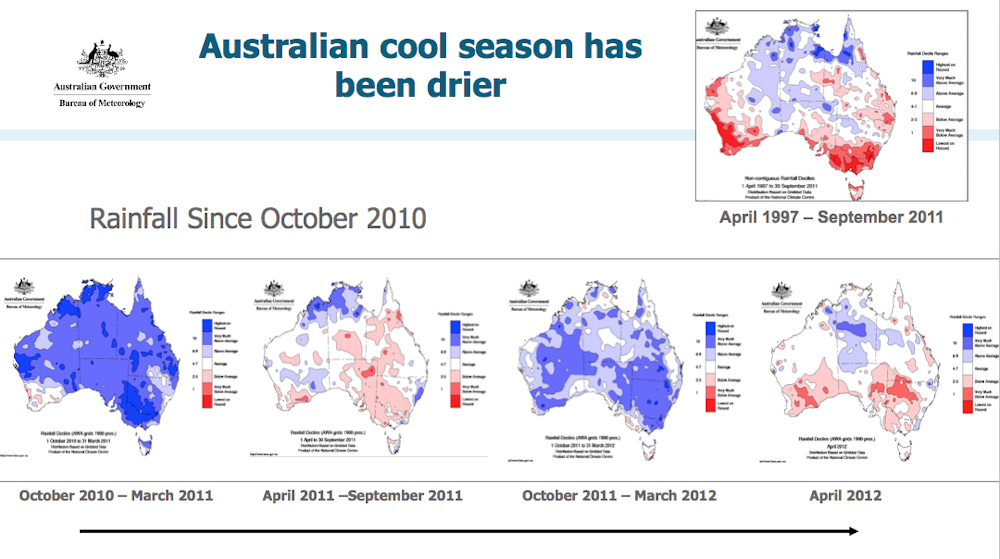
These changes are climatologically significant. Southern Australia shares a Mediterranean type climate. Most of the rainfall falls in the winter half of the year and summers, in general, are dry.

The 10-20% loss of autumn and winter rainfall has been amplified in the subsequent reductions in streamflow and water storages. There are many reasons for this, the simplest being that drier soils and vegetation soak up more moisture and therefore provide less surface runoff when rain does fall.

The reduction in autumn and winter rainfall has been the backdrop to a prolonged sequence without very wet years. Again, the situation is most starkly realised in southwest Western Australia, where the last decent wet year was in the mid 1960s. This has systematically reduced inflows to dams and led to progressive depletion of water storages.

For the southeast, rainfall over 2010 and 2011 has brought meaningful relief after 15 dry years. But it is important to realise that the recent rainfall was tropical in origin, and fell in spring and summer, while the long-term trend of reduced rainfall occurs during autumn and winter.

In other words, the big wet year finally arrived—but the more systematic seasonal drying potentially remains. In fact, for the period April through September, it was drier than average across southern Australia in both 2010 and 2011. Since the start of April this year, coinciding with the end of the 2011-2012 La Niña, it has been dry again across large parts of the southwest and southeast. Western Australia is heading for one of the driest April-May periods on record this year.

Tomorrow, Karl looks at the question of whether we can link specific drought or rain events, and drying over southern Australia, to climate change.

Join the conversation

43 Comments sorted by

Comments on this article are now closed.

  1. Comment removed by moderator.

  2. Fred Pribac

    logged in via email @internode.on.net

    I note that the very first comment on this article has been removed.

    In the interests of transparency and to avoid fanning the flames of conspiracy theorists would it be appropriate for the moderators of the conversation to have some criteria that they could report on when they make such deletions?

    Eg. "Abusive/libelous/ ..." comment removed by moderator.

    report
    1. Peter Lang

      Retired geologist and engineer

      In reply to Fred Pribac

      Fred Pribac,

      I support the present policy. Her's why.

      I'd prefer the Moderator just remove the comment and say no more than was done in this case (by the way it was not my comment, and I didn't see it). My reason for supporting the present policy is that I have been subject to deletion of many comments on other sites, and often editing of my comments to say what the Moderator would like my message to say. Often the Moderator writes and abusive message as well and often writes a misleading (IMO dishonest) statement as to what the content of my comment was. So, if you open the can of worms of the Moderator having to write a justification for removing or editing a comment, it raises a lot more angst than just removing the comment. I remain furious about the treatment of my comments on some other sites.

      report
  3. Peter Lang

    Retired geologist and engineer

    Karl Braganza,

    There is something I don’t get about the predictions of future climate, particularly the predictions of drying as the planet gets warmer.

    I understand that the geological record indicates:

    1. The planet is in a cold house phase [1], [2]

    2. The planet is well below its “normal operating temperature” [1], [2]. (For 75% of the time since animal life began to thrive, 550 million years ago, there has been no ice at the poles. So much warmer is normal operating temperature…

    Read more
    1. David Arthur

      n/a

      In reply to Peter Lang

      Gday Mr Lang,

      You mention the planet being warmer than at present for much of its history(~75%), so why don't we let it warm up a bit?

      You may as well argue, the planet had much lower levels of oxygen than present for half its history, so why don't we get rid of that?

      The planet has also gotten along quite nicely for most of its history without multicellular life, so why worry about that?

      The reason humanity would be wise to maintain climatic conditions pretty much as they have been for the since the advent of the Holocene is that human civilisation has grown and developed within that Epoch.

      report
    2. Mike Hansen

      Mr

      In reply to Peter Lang

      Peter - given that you are a bit of a deniarsaur, you would have done well in the hothouse world of the Triassic.

      For the remaining 7 billion of us, climate change is not so promising. We are concentrated on the world's coasts and in it's river valleys. Sea level rise, changing climatic zones, wetter becoming wetter, drier becoming drier is not going to be easy to adapt to particularly given the speed at which it will happen.

      report
    3. Marc Hendrickx

      Geologist

      In reply to David Arthur

      So David,
      Given the march of the ice ages that characterise earth's climate for the last million years will continue and we are near the termination of the current interglacial. What would you advise to slow down or counteract that long term process?

      report
    4. Lorna Jarrett

      PhD candidate, science education; Physics teacher

      In reply to Peter Lang

      Peter,

      "3. Life thrives when the planet is warmer, but struggles when colder"
      sounds a lot like "carbon dioxide is a plant fertilizer" to me.

      No sympathy for all the cold-adapted organisms and ecosystems eh?

      report
    5. Mike Hansen

      Mr

      In reply to Marc Hendrickx

      Here is a discussion on the next ice age at DotEarth by Andrew Revkin referencing this paper in Nature Geoscience.
      http://www.nature.com/ngeo/journal/vaop/ncurrent/full/ngeo1358.html

      As Revkin concludes
      "I’d suggest the growing body of research concluding that what was once seen as an inevitable descent into the next ice age has been put off for a very long time by the building blanket of greenhouse gases generated by humanity’s burst of fossil fuel combustion.

      And Richard Alley, Evan Pugh Professor of Geosciences at the Pennsylvania State University
      "So, overall, the idea that our CO2 is having a large impact on the climate that will last a long time, and exceed any natural trend to start a new ice age, is rather well established in the scientific literature "

      report
    6. David Arthur

      n/a

      In reply to Marc Hendrickx

      To answer your question, Dr Marc (related to Dr Karl? He's a funny chap):

      Keeping atmospheric CO2 above ~300 ppm will do fine for preventing reglaciation.

      By the same token, keeping atmospheric CO2 below ~350 ppm will be beneficial for sea level and climate stabilisation. This will also maintain permafrost stability, which is a Good Think in terms of limiting excess methane emissions.

      report
    7. Yoron Hamber

      Thinking

      In reply to Peter Lang

      There is no normal 'temperature' geologically, unless you're thinking statistics possibly?

      If you do have you considered all that time the Earth was a glowing ball of magma, as it first got created? If you take that into consideration your statistics will show you a earth where humans can't exist. All statistics need to be defined from what is, not what was, meaning that you need to make the relevant 'cut-off's' for where to start and end to make the series probable.

      Earth swings between different climates, and will continue to do so. This human made warming won't be for ever geologically, at least not if we won't pressure it a lot more. But a geological period is not really humanly possible to imagine. We live our lives considering possibly decades, although some older cultures built to last as the pyramids.

      But geologically those pyramids will be pebbles in 'no time' :)

      report
    8. In reply to Ian Ashman

      Comment removed by moderator.

  4. Tim Scanlon

    Author and Scientist

    Looking forward to this series.

    It is always good to see the explanations of climate and climate change made. Clears up a lot of the misinformation on both sides.

    report
  5. Marc Hendrickx

    Geologist

    Rainfall seems to be quite difficult to predict. Just ask Karl.
    "the odds aren't on for the type of flooding we saw in the summer just gone."

    Here's the BOM's Karl Braganza on The World Today in September 2011
    http://www.abc.net.au/worldtoday/content/2011/s3320553.htm
    SIMON LAUDER: The last La Nina was strong enough to push the rainfall south, drenching New South Wales and Victoria. Dr Braganza says it’s unlikely this summer's rainfall will be as heavy and there will be clearer signs about…

    Read more
    1. Marc Hendrickx

      Geologist

      In reply to Paul Gregory

      Here's Karl again:
      "you get an enhanced wet season in the tropics"

      And what happened?
      "below average for parts of northern central Australia and the tropical north".

      Here's Karl again:"big floods aren't expected on the same scale this year"

      And what happened?
      record breaking rainfall for central and northern Victoria, extending into southern New South Wales, causing flash flooding in some areas. The trough then brought particularly heavy falls in a wide band stretching from central Australia, through northern South Australia and western New South Wales to the Illawarra, causing further flooding and road closures.

      Looks like those models need some tweeking.

      report
    2. Marc Hendrickx

      Geologist

      In reply to Mike Hansen

      Read my request to Karl to provide more information. It seems that Regional climate models are proving less than useless in providing reliable information about future rainfall. In the example provided half the models indicate there will be more rain, and half say less. Karl yet to provide an answer.

      It seems that raising reasonable questions about legitimate issues to do with models that are clearly failing draws a hostile response from a group of true believers, hell bent on shutting down any debate.

      report
  6. Marc Hendrickx

    Geologist

    Seems those "Earth System Simulators" still need some work especially when it comes to rainfall....

    Results of climate modelling contained in the NSW Office of Water's Background document titled "Draft Water Sharing Plan Greater Metropolitan Region unregulated river water sources." dated May 2010. From page 11...
    http://www.water.nsw.gov.au/ArticleDocuments/34/wsp_metro_surface_water_background_draft.pdf.aspx

    Climate change and variability
    The NSW Office of Water has forecast rainfall and…

    Read more
    1. Mike Hansen

      Mr

      In reply to Marc Hendrickx

      From Dr Braganza's article above

      "Projected changes to regional weather patterns are much more uncertain. On the balance of evidence this uncertainty — including the possibility of abrupt shifts in regional climate — actually underscores the dangers of future climate change.

      "However that is not quite the interpretation of some in the broader community, who interpret uncertainty in regional projections as serving to only reduce the risks of climate change

      Dr Braganza anticipated the troll.

      report
    2. Karl Braganza

      Manager, Climate Monitoring Section at Australian Bureau of Meteorology

      In reply to Marc Hendrickx

      Hi All, I don't normally blog but the above posts demonstrate nicely how disinformation can distort the public messages on rainfall projections.

      1. The posts discuss recent seasonal (3 monthly) rainfall predictions. These are quite different to projections of changes to average rainfall under increasing greenhouse gases. This is essentially a variation on the "if you can't predict the weather than how can you predict climate" meme. This is well discussed on sites like Skeptical Science. This article…

      Read more
    3. Marc Hendrickx

      Geologist

      In reply to Karl Braganza

      Braganza neatly sidesteps criticism raised of regional climate modelling used to provide projections about regional rainfall. In comments above he seems to suggest any criticism is a side show (perhaps part of some sort of consiracy) rather than legitimate questions about the models. To recap NSW Office of Water has forecast rainfall and runoff across NSW using 15 global climate models for the IPCC SRES A1B climate scenario. 7 of 15 models predicted that mean annual rainfall would decrease by between 2 and 10 per cent, while 8/15 models predict that rainfall would increase by between 2 and 10 per cent by 2030.

      Perhaps Karl can tell me which model is correct, or should I just toss a coin? How is this information of any use to policy makers?

      report
    4. Marc Hendrickx

      Geologist

      In reply to Mike Hansen

      It underscores the fact that I could flip a coin to get the same result as 15 IPCC climate models-remember for NSW half of the models say more rain, half say less.

      For regional rainfall projections the models score an F.

      report
    5. Karl Braganza

      Manager, Climate Monitoring Section at Australian Bureau of Meteorology

      In reply to Marc Hendrickx

      Hi All,

      Someone asked me to post again, this is the last post from me, its difficult to find the time to keep blogging unfortunately.

      The whole article is about describing how one interprets climate model output when it comes to regional projections. The only way one could state that the article 'side-steps' the issue of uncertainty in regional rainfall modelling is if one doesn't actually read the article.

      So the answer is in the article but, more generally, asking which models one should…

      Read more
    6. Mike Hansen

      Mr

      In reply to Marc Hendrickx

      Sidesteps? He addresses it directly.

      From the article - you should try reading it Marc.

      "Projected changes to regional weather patterns are much more uncertain

      "The models cannot agree on rainfall changes across northern Australia, with some models suggesting wetter conditions, and others drier conditions, on average. This actually tells us something about the physical predictability of future rainfall in this part of the world. The models show that a range of different, predominant atmosphere and ocean circulation patterns are equally plausible for this region as the planet warms.

      and also in
      https://theconversation.edu.au/australia-expecting-an-active-cyclone-season-but-future-cyclones-still-hard-to-predict-4862

      "Predicting how temperatures will change due to increasing greenhouse gases is relatively straightforward physics. By way of contrast, predicting how regional rainfall will change, such as the future rainfall over South Australia, is a much harder task.

      report
    7. Marc Hendrickx

      Geologist

      In reply to Karl Braganza

      Karl says "But I am not a policy person" clearly this is the case. Given, as you admit, the models do not at this stage allow for reliable projections on a regional scale (as demonstrated by the NSW example I provided) they are no more than an academic excercise and do not (at this stage) offer anything solid in regard to assisting in making realisitic and sensible policy descisions.

      When they do Karl, let us know.

      report
    8. Ian Ashman

      Manager

      In reply to Karl Braganza

      Karl

      Keep up the good work.

      Try to ignore Marc - his job here is to deny.

      report
    9. Ian Ashman

      Manager

      In reply to Marc Hendrickx

      "When they do Karl, let us know."

      How about instead Marc, you just buzz off and let the grown-ups talk?

      report
    10. Yoron Hamber

      Thinking

      In reply to Marc Hendrickx

      You hit on a very important point there Marc. The simulations are limited, but they are on the other hand as good as we can make them, considering limitations in hardware/software and our current knowledge. To that we also must consider what bias we migh put into the scenarios, unknowingingly as we choose what we think are the most important factors for the computer to count on and project long range predictions. There is this guy in London that made simulations possible for Pc:s though, and using…

      Read more
    11. Ian Ashman

      Manager

      In reply to Marc Hendrickx

      snore...marc is denying....snore...

      report
    12. Ken Swanson

      Geologist

      In reply to Ian Ashman

      Ian
      Your comments are increasingly abusive and do not add to this discussion.
      Why don't you post something that adds to the discussion instead of writing a continual stream of slagging remarks

      report
  7. Marc Hendrickx

    Geologist

    BOM's Earth System Simulators and supercomputers also responsible for this failed forecast:
    2011-12 Australian tropical cyclone season outlook.
    For the 2011-2012 cyclone season Australia's premier meteorological institute predicted an 80% chance that cyclones would exceed the long term average (12) with a forecast they rated as "Very High". The actual number of cyclones (8) was 33% below the long term average.
    Missed it by that much!
    What went wrong there Karl? Earth System Simulators and supercomputers needed a fresh cup of tea perhaps?

    Outlook:http://www.bom.gov.au/climate/ahead/tc.2011-12.shtml
    Outcome:http://en.wikipedia.org/wiki/2011%E2%80%9312_Australian_region_cyclone_season

    report
    1. Marc Hendrickx

      Geologist

      In reply to Marc Hendrickx

      Here's BOM's article on this on The Conversation last year:
      "Australia expecting an active cyclone season, but future cyclones still hard to predict"

      "This cyclone season (November to April), cyclone activity in the Australian region (5°S-40°S, 90°E-160°E) is likely to be above average. Typically, 12 cyclones develop or move into the region during the tropical cyclone season. The outlook issued by the Bureau’s National Climate Centre suggests an 80% chance of having more than the long-term average number of cyclones in the Australian region during the 2011-12 season."

      And that outcome again: 8 cyclones = 33% below average.
      What does this say about the models used?

      report
    2. Mike Hansen

      Mr

      In reply to Marc Hendrickx

      Pathetic trolling. Is that all you have Marc? I assume that you have a file of BOM forecasts which if not 100% correct absolutely prove beyond a shadow of a doubt that climate science is wrong.

      You have not even bothered to read Dr Braganza' article.

      Infantile.

      report
    3. Mike Hansen

      Mr

      In reply to Marc Hendrickx

      Read the actual article. Marc is not interested in discussing the science - he is simply looking for a "gotcha" through selective quotation.

      https://theconversation.edu.au/australia-expecting-an-active-cyclone-season-but-future-cyclones-still-hard-to-predict-4862

      The article discusses the difficulties in forecasting tropical cyclones. Not quite the picture that Marc attempts to paint.

      "This cyclone season (November to April), cyclone activity in the Australian region (5°S-40°S, 90°E-160…

      Read more
    4. In reply to Mike Hansen

      Comment removed by moderator.

    5. In reply to Ian Ashman

      Comment removed by moderator.

  8. Felix MacNeill

    Environmental Manager

    Thanks Karl - a typically useful article...not least because, rather predictably, it brought out the customary Alpha Draconian counter-science arguments from Marc and allowed us to compare these with reality.

    I still maintain that, while the science may not be perfect, it certainly beats the fantasy alternative.

    Put more crudely, I'm scoring this as Science 1; intergalactic reptiles nil.

    report
  9. Marc Hendrickx

    Geologist

    Karl, the lack of predictive skill of models is summarized in this post by Roger Piekle Snr (perhaps the editors could invite Roger to make a comment on Karl's piece above)

    http://pielkeclimatesci.wordpress.com/2012/05/08/kevin-trenberth-is-correct-we-do-not-have-reliable-or-regional-predictions-of-climate/

    Also, in terms of rainfall reductions, such as in southwest Australia, you have failed to consider alternate effects; e.g. see

    Nair, U.S., Y. Wu, J. Kala, T. J. Lyons, R.A. Pielke Sr., and J.M. Hacker, 2011: The role of land use change on the development and evolution of the West Coast trough, convective clouds, and precipitation in Southwest Australia. J. Geophys. Res.-Atmos., 116, D07103, doi:10.1029/2010JD014950. Copyright (2011) American Geophysical Union.
    http://pielkeclimatesci.files.wordpress.com/2011/05/r-357.pdf

    report