
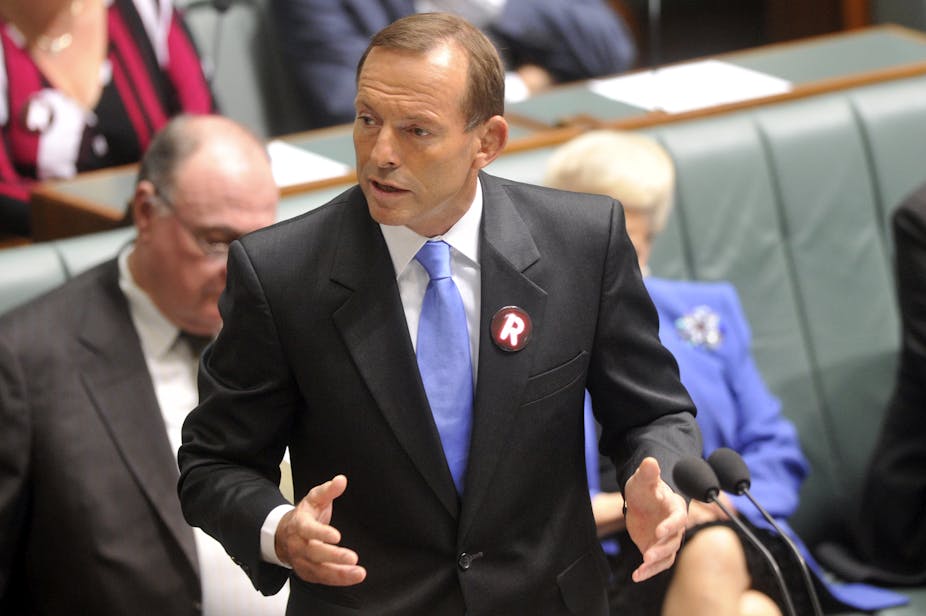
A Coalition government would reduce the regulatory burden on universities and encourage the growth of online learning, opposition leader Tony Abbott will tell a higher education conference this morning.
Abbott will say that outside officials should not be trying to micromanage universities “or bury them in reporting requirements.”
“We will help to foster the creative and economic potential in our education and research sector by reducing their regulatory and compliance burden.”
He will say that universities already have to report to the Tertiary Education Quality and Standards Agency set up in 2010, and should not also be subject to oversight from the new Australian Charities and Not-for-profits Commission.
“This is an unnecessary and intrusive bureaucracy and entity that was supposed to reduce red tape but which has already increased it.”
Addressing the Universities Australia Higher Education Conference in Canberra, Mr Abbott will place a lot of stress on online learning, saying the Coalition wants the universities to be able to take advantage of the growth in this area, such as the development of Massive Open Online Courses.
“These have obvious potential to make higher education widely available but, equally obviously, also pose a challenge to established methods and institutions.”
Abbott will announce a Coalition online higher education working group of MPs, chaired by Alan Tudge, from Victoria, to “explore how nimble and resourceful institutions might make the most of future opportunities while preserving their inheritance."
The group will report on;
- How online technology can improve existing campus-based teaching, with all the benefits of interaction, in the classroom and beyond.
- How online courses can expand access for people wanting to undertake university study.
- Whether online courses offered by Australian universities can be attractive to large numbers of students in Asia and beyond.
- What is needed to ensure the quality and integrity of online courses.
- What the government should do or undo to enable universities to make the most of new technologies.
“These are important questions, lest debate about online opportunities fall into the trap of ‘bricks and mortar versus virtual’,” Abbott says in his speech. The group will report by the end of April after consulting widely with the sector.
Abbott promises a Coalition government would be “stable and consultative”, carrying through policies it put in place.
It would encourage universities to protect their academic standing so students “can be confident that their degrees are taken seriously.”
It would also work with universities to expand their share of the international higher education market, and would establish a new Colombo Plan. The Menzies Research Centre, the Liberal party’s think tank, will soon host a round table to help shape this initiative.
The Coalition would encourage universities and institutes to “ensure that their research work is world class, effectively delivered and well targeted.”
Tony Lewis
Tony Lewis is a Friend of The Conversation.
Musician & Academic
All this without the NBN?
Philip Starkey
Physics PhD Student
Exactly what I was thinking. How can Australian Universities deliver decent content to students if they are downloading/streaming material through an aging copper network?
The coalitions Fibre to the Node (FTTN) plan still relies on the rotting copper that is in the ground to run the "last mile" to the home. The copper network is predicted to cost Telstra up to $1billion a year in maintenance alone ( http://www.computerworld.com.au/article/433877/fttp_could_save_700m_year_maintenance/ ). As the…
Read moreBrett Dawson
Journalist
Abbott is going to not have his cake while eating it.
Tony Grant
Student
TL,
Now we understand the rush to put a "NBNish" policy together!
Turnbull using all his powers of "double speak" and the like's of Alan Kohler (The Drum) ABC to support "any Abbott talk of policy"?
And Michelle Grattan easing the B/S s0-called policy via this blog...makes sense to me...all the major media and taking over the blog-o-sphere!
Tony Grant
Student
Nobody is coming out and calling "Abbott talk" for what it is...crap?
Neville Mattick
Grazier: Biodiversity is the key.
Why am I not surprised that the Leader of the Opposition plots a plan for 'cheaper' higher education via wire without a functional Broadband system in this Nation?
This must not happen!
Craig Minns
Self-employed
"How can Australian Universities deliver decent content to students if they are downloading/streaming material through an aging copper network?"
My ADSL connection is currently running at 10.6Mb/s.I can stream video on 3 separate computers at once.
How much crap can one person swallow?
Agoodopinion
logged in via Twitter
Good question... with his "NBN is a waste of money" puzzled?I am
Agoodopinion
logged in via Twitter
No matter what side of politics, you can see the disgraceful way journalists do not scrutinise a poor PM candidate with weak, inconsistent or no policies.
I thought they would put Australia interests first, instead they are offering Australia a poor PM candidate willing to create division in our society with "stop the boats" with sexist remarks and no credible policies.Shame Australians deserve better
Philip Starkey
Physics PhD Student
How much crap can someone swallow? You tell me.
You say you are 10.6mbps. Good for you. I'm on 4mbps, and the average in Australia is somewhere from 4-5mbps. That means many people are on less than 4mbps. I can barely stream 720p content from youtube. If i up the resolution to 1080p, my connection (the average australian speed) can't handle it.
But of course because your connection can handle what you need, we shouldn't embark on a national building program that will provide a ROI of 7% while…
Read moreCraig Minns
Self-employed
Hi Phillip, thanks for the considered response. I used to work as a technician for both Telstra and Optus at different times: I'm not just talking through my bum.
I've just changed my connection profile to the DSLAM (which I can do remotely via my modem) to a "high speed" QOS profile, which maximises bandwidth at the expense of latency and error correction. I could also choose to maximise quality by prioritising error correction over either of the other two factors.The 10.6Mb/s I quoted was for…
Read moreNeville Mattick
Grazier: Biodiversity is the key.
You kidding me - right? Fooling about with last centuries technology, patch on patch, crosstalk, FTTN all LNP speak for 'we can do it cheaper' was that about eight broadband plans in the Howard era.
Do it right, do it once install the Fibre to the Premises - yes it is rocket Science - and best practice at that.
Craig Minns
Self-employed
How much are you prepared to pay for a fibre connection to your home?
Gavin Moodie
logged in via LinkedIn
Our internet service provider iinet sent us its price list for accessing the NBN. It looked ok. Not cheap, but I don't expect cheap for an excellent service. We plan to transfer as soon as it is offered, which hopefully will be before 14 September.
Craig Minns
Self-employed
All great, but that's a subsidised price, paid for by the taxes of people who neither want nor need such a service.
If it was unsubsidised you would be paying perhaps 3-5 times as much. would you regard that as a good deal?
Neville Mattick
Grazier: Biodiversity is the key.
My "station" will never have fibre, however, satellite is the alternative with a mix of 3G wireless, when as remote as I am.
Paying for services in remote Australia is not new, my Dad had to find $2,500 to pay the electricity County Council in 1975 for a feasibility study of line building, the fee was not refundable and was a considerable cost for mains power which was finally connected in may '76.
Back to the point above; I am concerned that University Education may not be delivered satisfactorily by the LNP plan and it certainly has no hope without Labors NBN.
Craig Minns
Self-employed
You could have a satellite connection now, Neville. Do you?
Gavin Moodie
logged in via LinkedIn
Yes, I do think that's a good deal. My taxes subsidise roads, private health, private schooling, etc, most of which I neither want nor need.
Craig Minns
Self-employed
That's a copout, Gavin. You will be offered a service that has a maximum data rate of 100Mbps. The same service could be delivered by a FTTN network at significantly lower cost to the taxpayer.
If you were to send your kids to private school, you would pay. You could choose a Catholic school at reasonable cost, or you could send your kids to Shore at great cost. Your choice, your cost to evaluate as to value. If you wanted private health insurance, you would pay. You could choose a basic plan or a comprehensive one. your choice, your cost to evaluate as to value. In both cases, the subsidy is justified because the cost of the subsidy is less than the cost of providing a public service. Roads are a common asset that all benefit from, even if they don't have a car. Without roads, you don't eat.
Why should I subsidise your internet? What's in it for me, when there is a cheaper alternative?
Gavin Moodie
logged in via LinkedIn
I expect to pay for my NBN access according to the quality of the service and my use of it.
Everyone benefits from national telecommunications just as everyone benefits from roads.
Why should I subsidise other peoples' private health insurance and their children's private schooling, especially when there are excellent public services available to all for much lower costs? Not only do they not benefit to me, they undermine public health and education.
Craig Minns
Self-employed
"Everyone benefits from national telecommunications just as everyone benefits from roads."
How?
I've already explained the argument for subsidising private schooling. The public service costs more to provide than the subsidy provided. The only argument is whether the subsidy is too high. Personally I think it is, so we're in agreement there. Now, what about the huge subsidy I'm paying for your FTTP? What's the benefit to me?
Craig Minns
Self-employed
My apologies, managed to hit "post comment by mistake.
We already have a national telecommunications network. I agree that it is good. The question is why I should subsidise you to have a FTTP connection when there are cheaper alternativesthat will serve as well for your and my purposes. What benefit accrues?
Gavin Moodie
logged in via LinkedIn
The network effect: the benefit that everyone gets from a network being accessible to a large number of users
http://en.wikipedia.org/wiki/Network_effect
Craig Minns
Self-employed
A network is already available to a large number of users. What additional benefit accrues by having FTTP rather than a progressive replacement of POTS with FTTN?
Gavin Moodie
logged in via LinkedIn
The NBN is better than the current network and better than fibre to the node which would still rely on deteriorating copper from the node to the home.
Craig Minns
Self-employed
Why is it better, Gavin? What benefit accrues?
You keep dodging that question.
Gavin Moodie
logged in via LinkedIn
The NBN is faster, has more capacity and is more reliable because it doesn't rely on an ageing copper network which is deteriorating, starting to fail and is costing increasingly more to repair.
Craig Minns
Self-employed
Still dodging the question. I'm afraid you're looking increasingly out of your depth, Gavin. The issue of replacing deteriorated copper has been discussed above.
What benefit accrues compared to the alternative? Please avoid repeating the same irrelevancies, they're simply tiresome.
Gavin Moodie
logged in via LinkedIn
As Neville Mattick wrote:
'You kidding me - right? Fooling about with last centuries technology, patch on patch, crosstalk, FTTN all LNP speak for 'we can do it cheaper' was that about eight broadband plans in the Howard era.
'Do it right, do it once install the Fibre to the Premises - yes it is rocket Science - and best practice at that.'
Since it is best practice it is worth paying more than for fooling about with last century's technology, patch on patch, etc, as Mattick wrote.
Craig Minns
Self-employed
We agree it's wonderful, you still haven't addressed why it's needed.
My question is siimple: how much better? What benefit accrues?
What are you going to do with the NBN that you could not do with a FTTN network at much lower cost?
Gavin Moodie
logged in via LinkedIn
As you wrote, all this has been covered before in this string and many times before in many other articles. Some of us see the benefit of building a new network once and right and are willing to pay for it; others want to save money by patching up the existing network. In the end that is a judgement of what one values in the present and what one anticipates for the future. That disagreement can't be resolved by recapitulating old ground.
Craig Minns
Self-employed
Not even a single thing you can point to that can be done using the NBN that couldn't be done using a FTTN alternative? Not one?
I thought not.
The simple fact is that replacing perfectly serviceable existing networks with fibre is just not justified. On any grounds.
Henry Verberne
Former IT Professional
Yeah I'm allright Jack! I am stuck on 1.5mb/s. Many parts of the country are even worse off.
So you want to deny the rest of us an up-to-date, future-proof NBN because you can stream at 10+mb/s?
Henry Verberne
Former IT Professional
Unlike most Government expenditure the NBN is forecast to return all of the Government funds, plus interest, by 2034. So that knocks out your argument that you will be paying for the desires for faster speeds of others.
Australia has amongst the slowest available broadband speeds in the developed world. This is a huge impost to new technologies for business and education. Where FTTP is available, the cost is so high that only the largest businesses can afford it.Australia has amongst the slowest available broadband speeds in the developed world. This is a huge impost to new technologies for business and education. Where FTTP is available, the cost is so high that only the largest businesses can afford it.
BTW, the cost of all the node infrastructure needed (capital and maitenance) will result in a network that is not much less than the NBN, but a fraction of the potential of fibre. Do it right the first time, with fibre!
Neville Mattick
Grazier: Biodiversity is the key.
Personally I am not concerned for home users' and although they determine the 'outcome' by their vote, it is actually our Universities, Medicine, Security and perhaps Business sectors' (to name but a few) that I want to see have Gigabit+ FTTP.
Selfish, yes; I rarely if ever watch video, mostly look at boards such as this and the ABC, so no real need for bandwidth, however as voters' determine the success or failure of the awe inspiring NBN it is important for FTTH to put new media and medical services there; that ARE the FUTURE.
Gavin Moodie
logged in via LinkedIn
But the idea is that universities can offer on line learning to students and health providers can provide health services to their patients in their own home, for which bandwidth to peoples' homes will be needed.
John Bloomfield
Retired Engineer
Henry, I thoroughly agree.
A fibre broadband connection enables almost limitless future possibilities.
Who can predict what technological devices will be interconnected through it in future years?
Smart power grids, personal medical monitors, powerful remote CPU's, transport co-ordination networks to name but a few that come to my mind.
The fibre cable promises never to become obsolete technology infrastructure - the equipment that connects either end of the fibre is free to evolve as new technology develops.
It is the freedom of users to change and adapt to unforeseeable future applications that is its true value - the investment will be returned many times over - the risk of investment failure is minimal.
This quote from Michael Faraday sums it up:-
“I am busy just now again on electro-magnetism, and think I have got hold of a good thing, but can't say. It may be a weed instead of a fish that, after all my labour, I may at last pull up.”
Craig Minns
Self-employed
Henry, nobody is suggesting that the service you describe is adequate. A progressive upgrade of the exchange line with fibre to the node would fix it, at much lower cost than the NBN.
Craig Minns
Self-employed
That's just jingoism, Henry. Why is the maximum cost solution justified, is the question that needs to be answered, sloganeering doesn't do that, it just stops you thinking about it.
Craig Minns
Self-employed
Neville, this is more of the same sloganeering.
The medical service don't exist and may never exist. What exists and is likely to exist in the next 1 years or more is well served by a FTTN model at much lower cost, with a progressive upgrade reducing the cost further still.
Craig Minns
Self-employed
How much bandwidth, Gavin?
Craig Minns
Self-employed
This is all a lot of red herrings, John. When you were working, did you always specify the "best" solution, or did you specify a solution that fit the performance criteria for the problem presented?
To use a road analogy, you're suggesting that we should build a Hume Freeway to every door, while hoping that in future there will be a demand for trucks to every home, all the time and that the trucks will be bigger and faster than the ones that exist now or in the foreseeable future.
Would you…
Read moreCraig Minns
Self-employed
"lots of different modes", of course.
Craig Minns
Self-employed
"what is likely to exist in the next 10 years or more". I think my laptop's keyboard has had its chips.
Philip Starkey
Physics PhD Student
You've written a lot of comments in the last day, I'll just stick to addressing this one.
Yes I've played with the connection profiles, it doesn't make any difference. I live at least 3km from the exchange. Nothing is going to improve that. On my parent-in-laws connection, I actually had to forcibly reduce the syncing speed (by forcing the profile to ADSL2 rather than ADSL2+) to stop it from dropping out. It still drops out, but not quite as often. They now sync at around 7.5mbps.
You mention…
Read moreHenry Verberne
Former IT Professional
Jingoism? This country still suffers economically from the "tyranny of distance" and the NBN with FTTP with assist significantly in overcoming that competitive disatvantage. You have a strange concept of jingoism.
I also re-iterate the point that any comprehensive roll-out of FTTN will require a huge number of ugly street cabinets, very costly to install and maintain and we still end up with a "nobbled" network that will not cost much less than the the real thing.
Craig Minns
Self-employed
Phillip, I said it would involve replacing exchange lines with fibre, not building new exchanges. In other words, copper that is in those big bundles you referred to. The connection to the house from the node might be done in all sorts of ways.
On the concept of replacing cable with wireless you're overlooking two things. Firstly, the fact that it is trivial to create a directional beam that can be very narrow indeed between two points. Every telephone or streetlight pole could house a transponder…
Read moreCraig Minns
Self-employed
The "ugly street cabinets", if that's the way you want to define them, will still exist regardless, for all sorts of services. That's a pretty precious sort of argument. Have you noticed the Optus cabinets, by the way?
Why will it be more costly to install and maintain? You keep making this assertion, but you haven't backed it up. There will be no need to rollout cable to individual homes, it will already exist. It will enable advances in technology to be incorporated. It will be cheaper at every point in the process. It will still enable those who insist on fibre to have it, if they pay for the installation work from the node to their home, or perhaps that could be included in the contract cost over time as was done with cable.
Anyway, the point's moot, the NBN and all the boondoggle it implies is what we have.
Chris Reynolds
Education Consultant
Yes. I read this piece and wondered where the analysis was. For example, last October I seem to recall a reaction from universities to the affect that there is a limit to the effectiveness of anything but face-to-face teaching. Her failure to mention this suggests that many in the media currently Michelle as de facto become Abbott's mouthpiece. Perhaps when leaving Fairfax she should have made the honest step and joined his Press Secretaryship. But then now she can lead us all by the nose in this new age media area. Her position as a credible commentator becomes less and less credible by the day.
Philip Starkey
Physics PhD Student
Ok, maybe exchanges wasn't the right word. New nodes will need to be built, and a lot of them. They will need power, unlike the passive optical network nodes planned in the NBN. The only was to get faster speeds out of copper is to shorten the length of copper. This is the whole point of FTTN and FTTH just takes it further.
Using a wireless protocol for that very short distance you suggest is silly, especially if it is directional. You open yourself up to even more problems with the uncontrolled…
Read moreCraig Minns
Self-employed
power's trivial, Phillip. The Optus network reticulates power at 90V to power the CAU on the side of the house via a voltage carried with the coax already. Power could be easily reticulated along a power pair attached to the coax. If it was low voltage it wouldn't require the installers to be electricians, either.
The idea of someone scaling my house or flat to put a piece of paper over my transponder seems a bit faretched and the problem with trees already exists. A wireless transponder would give more flexibility of placement and not have any more issues with trucks than cable does. Less, because it doesn't sag, especially in summer.
Government estimate of the cost of the NBN is >$37B. The difference is double. What do we get for spending double right now, that we couldn't get by spending less on a FTTN system that could be upgraded when needed? Especially given that technology doesn't stand still.
Henry Verberne
Former IT Professional
In early 2009, a seven member panel of experts – including University of Adelaide Professor Emeritus of Communications, Reg Coutts – knocked back all bids in a tender process for the original NBN plan of FTTN because none were viable.
"Essentially to go down the FTTN road would mean something in the order of, greater than 50 per cent of the capital being put into digital cabinets in the suburbs,” he said. “They then become an obstacle to the final solution… fibre-to-the-premise. Fibre-to-the-node was not a stepping stone to fibre-to-the-premise. In fact, if anything it would put it backwards. The second reason, of course, is in no other market have people proceeded with fibre-to-the-node other than an incumbent. It is a solution that is the right solution for an incumbent that has a copper infrastructure.”
Source: http://nbnexplained.org/wordpress/technical-points/the-fttn-first-debate/
Neville Mattick
Grazier: Biodiversity is the key.
Yes I agree; "awe inspiring NBN it is important for FTTH to put new media and medical services there; that ARE the FUTURE"
Craig Minns
Self-employed
Thanks for that link, Henry, it's interesting. The thing is, there actually WAS an incumbent, with cable in the ground and it's being paid to take it out and for the use of its ducts and cable right of way.
Why not buy the cable as well and use it till it breaks. then replace it? Spread the cost over a longer time frame and take advantage of technological improvements into the bargain.
Peter Redshaw
Retired
You hit the spot with that question. You have to wonder if Tony Abbott even listened to the talk by Professor Glyn Davis, the Chair of Universities Australia, at the Press Club last Wednesday. If he had he might have understood Australian Universities have been doing online courses for some time. And if he had he may have understood two things. The first being going online costs money to set up and operate and two the NBN is essential.
But he would have also understood something about the…
Read moreHenry Verberne
Former IT Professional
FTTN uses more electricity than FTTH, produces more greenhouse gases than FTTH, features a bigger carbon footprint than FTTH, requires more maintenance in terms of changing batteries and collings fans than the simple splitter boxes used by FTTH hubs, requires larger fridge sized cabinets on every second street around Australia compared to postbox size FTTH hubs, yields slower download speeds than FTTH at the same time as using hardware that stifles competition. An FTTN cabinet is approximately ~(50x120x150)cm LxWxH. An FTTH Cabinet is approximately ~(47x37x68)cm LxWxH and eight times smaller in volume. Which one would you like in your street ?
Henry Verberne
Former IT Professional
Craig: have a good read at this link:
http://www.abc.net.au/technology/articles/2013/02/21/3695094.htm
Why would we want to be stuck with the second-rate (but marginally less expensive) broadband you are pushing for?
Philip Starkey
Physics PhD Student
Craig, the point with power is that you need more nodes than exist now. The power usage is predicted to be higher. Also, you were the one suggesting that optical transmitters could be used. Now you are switching back to wireless transmitters. Are you still suggesting using a directional wireless transmitter, one for every house? Or are we back to a shared wireless signal, that isn't directional.
Yes the cost of the NBN is predicted to be $37B, but the government contribution is only $27.5B. The…
Read moreJohn Bloomfield
Retired Engineer
Craig,
I think you are viewing this NBN project through ideologically tinted glasses.
To suggest that value gained from as yet unforeseen applications are but "red herrings" is to deny frenetic past history of technological advances and assume a similar pace of innovation will not continue.
My many years experience with matters technical has taught me to always design/buy to the latest technology -to do otherwise is false economy.
Read moreIn practice, it is not uncommon in electronic/computer design…
Craig Minns
Self-employed
I'm suggesting that technology is not static. Wireless modes are among the most heavily researched areas of tech there is at present, whatever frequency is used. Optical spectrum is simply one potential part of that for specific applications, not something conceptually different.different. Why do you struggle with that? The short range and directionality makes optical spectrum a potential candidate for the local connection, with or without an encasing fibre.
I have no knowledge of what the LNP…
Read moreCraig Minns
Self-employed
John, I think that by worrying about my motivation you're just trying to shoot the messenger instead of reading the message. Hardly the sort of thing that leads to good engineering solutions.
I say that future applications, which are not even considered yet, are red herrings when you don't want to consider technology to deliver those applications that is currently available or will be in the foreseeable future.
You're like the fellow who bought heavily into railways at the end of the 19th century…
Read morePhilip Starkey
Physics PhD Student
Craig, I don't know how to make it clearer than I already have. The medium of transfer is the important point I'm trying to make. Base load broadband needs to be robust and it needs to be fast. Wireless cannot compete with fibre in this regard, EVER (this is from a physical perspective).
I'm not suggesting no one ever use wireless, far from it. Wireless is a good complementary service, but it can't handle the base load any time soon. I've also outlined above reasons why a ubiquitous broadband…
Read moreCraig Minns
Self-employed
Phillip, what is important is the bandwidth needed and the bandwidth that is able to be delivered. The medium doesn't matter a bean.
If you need water available at the tap, you don't really care whether it is delivered in a pipe or by the truckload, what matters is the cost, quality and convenience. There are many homes that rely on water being trucked in at their own expense: would you be prepared to pay for them to have pipelines installed - hang the expense, or do you recognise that it is simply…
Read morePhilip Starkey
Physics PhD Student
I'll try one last time...
The medium matters because the medium ultimately limits the maximum achievable bandwidth. As I tried to make clear, wireless, fibre, and any of the other "new technologies" you are trying to talk up are just transmitting or manipulating certain frequencies in the electromagnetic spectrum. The medium thus defines which frequencies are going to be useful and also defines the type of technical noise that will impact the systems performance (when I use the term technical…
Read moreMarkie Linhart
Rouleur
…and given that Australia ranks a lowly 40th globally in the 'speed' tables I don't think any amount of obfuscation will alter the fact that we need the fastest NBN available right now.
Do it once. Do it right. Do it it fibre to the premise…
Craig Minns
Self-employed
Phillip, you're simply not addressing the topic.
I couldn't care less if fibre is "best", there are lots of other solutions that are near enough to best for the local link and an easily meet or exceed the capacity of the fibre backbone to deliver to the local point of distribution. All the stuff about medium deosn't matter a damn, because transmission distances are short and the signal can be directional. A short-range, low-power directional signal can be quite large in bandwidth and bandwidth…
Read moreCraig Minns
Self-employed
I would have liked to see an NBN arrangement that made best use of all the existing cabling. A sort of Super HFC. As was mentioned earlier, an incumbent has a good reason to do so and so it's a no-brainer for Australia, which has already spent $20 billion buying the cables back so they can be scrapped.
The only factor limiting bandwidth in existing HFC networks is contention at the node level. A fibre backbone that allowed local nodes to devolve to block size would enable much higher available…
Read moreCraig Minns
Self-employed
Sheesh, I really need to check harder before I click "post"...
"LTE or some other future broadcast wifi standard" might also be provided from some of the local transponders on poles. The possibilities of integration are immense, if the network is sufficiently flexible.
Philip Starkey
Physics PhD Student
A) I completely disagree with the suggestion that because the signal will be retransmitted using some other mode IN THE HOME that it is fine to do it outside of the home. I don't even see how that is an argument. Because someone does it in the home it is fine to do it before the home? In the home, the end user has the CHOICE of what transmission technology to use, for whatever purpose they need. You can provide arguments for short range wireless transmission all you like, but the technology an end…
Read moreCraig Minns
Self-employed
Phillip, you're getting quite hot under the collar. Take a chill pill, dude.
The simple fact is that fibre is NOT necessary for the local link. You still haven't told me what you think your own bandwidth demands might actually be, which means you have no idea of what the actual size of the pipe to the premises needs to be. Without that basic piece of data (I'd say 100Mbps would provide more than adequate bandwidth to the vast majority of homes and businesses for the next 5 years at least, until…
Read moreGiles Pickford
Giles Pickford is a Friend of The Conversation.
Retired, Wollongong
Phil Starkey has got it right about the Politics. The Chinese have a 50 year plan, and they stick to it. Our government can't even have a one year plan because the Leader of the Opposition has decided that the Governor General wa wrong when she gave power to the minority government cobbled together by Gillard. Abbot has been asking for an election for three years. Now he has been promised one he ha suddenly gone quiet.
You can't govern a country with such politicians. The only plan you can have is to survive the week.
Craig Minns
Self-employed
Oh, and yes, the user could happily align their own receiver. It's no harder than lining up a TV antenna and could be much easier, given that the device will be attached to a computer that can provide feedback in regard to field strength and other parameters.
However, I would suggest that it is pretty straightforward for a tech to climb a ladder and do it at the same time as the transponder on the pole is installed. A pair of techs, one at the house end and one at the pole end would do a whole street in a morning.
My record for installing cable broadband to a home was 35 minutes for a new installation, including premises cabling and a drop from the street, as well as provisioning and operational checks on the modem. With no cable to install and a simple piece of gear to screw to a wall I reckon 10 minutes - tops. Add another 20 if cable has to be run from the transponder to some other point, which need not be the case.
Craig Minns
Self-employed
Phillip, here's a real world application of a directional wireless (over LTE in this case) link.
We don't have TV or Radio out here (no reception) so the internet and phone are our only means of communication with the outside world. All Telstra, of course, we don't muck around with any other carriers. It's Telstra's network and they maintain it after the fires, floods, storms etc which play havoc with our lines.
"There's no chance of any fixed line internet out here. We tried the Government subsidised satellite and that was only marginally faster than dial-up so after a lot of trial and error and frustration with Telstra call centres, we found a fantastic solution – wireless internet via 4G modem and fixed booster (yagi) aerial on the roof. Briliant."
http://www.onlineopinion.com.au/view.asp?article=14767
Craig Minns
Self-employed
There should be quotes around the second paragraph as well...
I need new glasses or something.
Philip Starkey
Physics PhD Student
Craig, I am far from "hot under the collar" despite your comments such as:
Read more"A good scientist doesn't think that way, Philip" (Attempting to imply I'm a bad scientist?)
"you're very happy to throw other people's money around" (Attempting to imply that I have less ownership over government funding than someone else, despite the fact that the current NBN is projected to provide an ROI of 7%, a point you continue to conveniently ignore)
"Try to move down from your "this is the theoretical best performance…
Philip Starkey
Physics PhD Student
Thanks Giles, at least someone gets it!
That's one of the reasons I was so happy about the NBN. Finally a plan that looked more than an electoral cycle in advance. It was a plan to build something over 10 years, with the expectation that it would last for decades more.
Unfortunately it looks to become undone at the next election. I can only hope one day people wake up to the stupidity of short term gains. I just hope it doesn't take a world war to make it happen.
Craig Minns
Self-employed
Phillip,
Read moreThanks for that ABC link, it's interesting. I thought Dr Pepper's comments were a little confused though. Whilst he acknowledges basically all the points I have made, he then asserts that FTTN will be unable to keep up within the next 3 years, which is patently silly, seeing as much less capable technology already manages to do so. I suspect what he's really saying is that much of the routing/switching infrastructure is obsolete (certainly the HFC infrastructure is, it was obsolete when…
Jack Arnold
Director
A lucid report free from any criticism of the Gillard Labor government. Yet like all Abbott Liberal Party press releases, there is little substance in the content, no costings and no policies to replace the $1 BILLION removed from the tertiary sector by the Howard Liberal government.
So, Ms Gratton has reported another Abbott 'aspiration' ... words, words words. Why are we surprised at the lack of substance?
Ramon Erispe
Scientific Publishing
Indeed Jack. I am very surprised this piece did not come under editorial scrutiny. A subject I undertook many many years ago as an undergraduate was political PR - this piece is a classic textbook example campaign writing....high on aspiration and low on substantive argument with facts and costings.
Tony Grant
Student
Jack,
The media report the coalition at all times...in"glowing terms" if there are "issues" have you noticed how quiet...dare I say empty the "rags" are on the coalition?
How well was the "coup d'état" in Canberra over the weekend of sitting Liberal Gary Humphries (moderate) followed?
The extreme right-wing "Zed Seselja" who failed to lead the Liberals in the ACT election to victory only lets his supporters know the need for so many meeting per 6 months.
The ABC did a piece on Saturday evening, then it was lost in a hyperlink?
Stephen John Ralph
carer
My original comment re MGs article was deemed inappropriate by this forum's editor.
I don't think I included anything that hasn't already been said, and nothing that appeared to be defamatory.
Is there censorship abroad here when it comes to overt criticism of a contributor?
Jack Arnold
Director
Hi Tony ... did you notice that there was only one very short mention of this matter on ABC news coverage showing Julia Gillard making the same point as many here; namely how can you have an INternet led education revolution without having a high speed NBN.
It appears that Tony Abbott is the mouthpiece for any thought bubble hatched by the unelected hacks of the Liberal Notional Coalition.
Doubtless the Australian electorate is wise to reject a candidate for Prime Minister who is unwilling or unable to understand modern communication technology.
craig sambell
environment journalist (ret)
Get rid of the NBN?......increase on line learning???.....and this bloke aspires
to lead this country??????
Tony Grant
Student
Notice Abbott has had at least one of his daughters in the UK studying?
This from a man who recently borrowed $700K (mortgage) isn't this bloke "counting his chickens" oh, I did forget "the huge inheritance" ?
Louise Zarmati
PhD graduate at Deakin University
'Reduce the red tape' is the Coalition's euphemism for cutting jobs.
Craig Savage
Professor of Theoretical Physics at Australian National University
Job cuts are what universities desperately need.
My day to day experience teaching and researching at ANU tells me that we need to dramatically reduce the number of staff who neither teach nor research, nor directly support those activities - i.e. the bureaucracy.
I believe such cuts are needed in both universities and in the government agencies, such as the ARC and TEQSA, that are driving some of this unproductive growth. At least one recent study suggests that a typical Australian university…
Read moreCraig Minns
Self-employed
Ah Craig, I wish I could offer you a job. You'll obviously be in need of one soon...
Michael Shand
Michael Shand is a Friend of The Conversation.
Software Tester
Great so Michelle is just a mouth piece for politicians now, is any of this good or bad for students? is it realisticly going to happen?
Is there any journalism going on is repeating what the politicians say enough now a days
Kevin Bain
Teacher
I agree Michael, what a pathetic effort. Summarising a press release! Neither news, analysis or opinion.
Philip Starkey
Physics PhD Student
I made a comment about this on the last piece by Michelle Grattan. I was effectively told by another person working for "The Conversation", that because this article is under the "Research and news" section on the homepage, the author doesn't have to provide commentary or analysis.
It seems a bit of a cop-out to me.
Paul Pfluger
retired
Regurgitated press releases count as MG's best journalistic efforts. So much better unanalysed, I reckon.
Tony Grant
Student
Which politicians?
Peter Evans
Retired
From the limited detail available sounds as if the Coalition is catching up to what is already happening. See recent ANU announcement on electronic learning, Uni of New England on external courses, Monash and its electronic learning program. While not all are degree courses electronic education is happening now and without a lot a Govt involvement and its seems without a lot of concern with Govt constraints. Perhaps article could examine what is already happening and see if the announcement contributes much to that.
Michael Shand
Michael Shand is a Friend of The Conversation.
Software Tester
Great Comment
Gavin Moodie
logged in via LinkedIn
It is true that the Coalition seems to be catching up - partly - with what Australian universities are already doing in online education. It is also galling to hear politicians and other 'experts' lecture universities on the importance of Asia and the opportunities of international education.
It is particularly annoying that Robb, Tudge and before them Lindsay Tanner and many others claim with apparently unshakeable confidence that online learning will allow universities to offer higher education in Australia and Asia at a tenth of current funding levels.
Nonetheless, one may perhaps be able to lead them to a better understanding of the present and the possibilities of the future.
Craig Minns
Self-employed
Well done, Michael, your dog-whistle attracted a whole pack.
Jack Arnold
Director
Hi Craig, what a pointless comment. In contrast, what appears to have happened is that an unelected political hack in the Liberal Party started reading The Conversation after the series on MUOOCs was archived and came up with the "original idea" that on-line learning was going to be cheaper to provide and so more profitable for universities.
In the real world, UNE has over 60 years experience in providing both external studies to students and graduate training that has created the explosion of external delivery during that time.
Surely Abbott is the political (mis)leader you have when you want to have severe funding cuts for universities after 14 September 2013, just like the Howard policy.
Gavin Moodie
logged in via LinkedIn
Shadow finance minister Andrew Robb was quoted as boosting the potential of online education on 19 May 2012 (Trounson, 2012) and of course former finance minister Lindsay Tanner (2011) argued this in October 2011, well before moocs became prominent.
Tanner, Lindsay (2011) Uni 2.0: will the internet kill universities? Chancellor’s lecture series 25 October. Victoria University, Melbourne. Retrieved 1 November 2011 from
http://www.campusreview.com.au/wp-content/uploads/2011/10/Will-the-internet-kill-Universities.pdf
Trounson, Andrew (2012) Andrew Robb predicts 10 million international students within 10 years, Australian, 19 May, retrieved 31 January 2013 from
http://www.theaustralian.com.au/higher-education/lib-predicts-10-million-students/story-e6frgcjx-1226360648874
Sean Manning
Physicist
Or facts, you forgot facts.
Giles Pickford
Giles Pickford is a Friend of The Conversation.
Retired, Wollongong
Is this the "real Tony Abbott"? If so it is a refreshing change from the Abbott we have had for the last three years. I hope it is real and not a pose.
Reducing the regulatory burden is a good idea and is based in the concept that Universities actually know what is best for them. They need to be trusted rather than made to jump through unecessary hoops imposed by people who do not understand them and are therefore extremely suspicious of them.
The MOOC thing has started happening already…
Read moreTony Grant
Student
Still believe in heaven ?
Too, any Royal Commission into Roman Catholic child sex abuse will not be "heavy handed" by Abbott and his mentor Pell...you for real?
On ABC former priest and lawyer says that 6% of the clergy are child sex abusers...check it out the only Mediterranean Late Line female reporter Emma...a good catholic girl!
Noel Douglas Preece
Ecologist at Biome5 Pty Ltd
An uncritical promo from Michelle. How about some analysis?
Michael Lenehan
retired
One highly critical comment is embedded in the puff: the fact that there are already so many degrees from so man institutions that simply can't be taken seriously - and that many of these degrees are held by people who are currently working and lecturing at Universities.
And, worse, it's often very difficult to determine the serious from the unserious.
My daughter did some drama subjects as part of her degree and the surprisingly high level literary criticism involved was far more rigorous…
Read moreGiles Pickford
Giles Pickford is a Friend of The Conversation.
Retired, Wollongong
I am getting tired of the constant moaning about Michelle Grattan. Readers ought to attack the topic, not the messenger.
Grattan is one of the most senior journalists in Australia. If she chooses to summarise a press release, so be it.
Readers of The Conversation seem to have an opinion on everything. If Grattan does not have an opinion on something I am not worried about that. She is not opinionated and for me that is not a problem.
I once gave MIchelle a lift from Canberra to Wollongong. That is a 2.5 hour drive. We had a long conversation broken only by the hourly ABC News. I think she will make a great University teacher.
Giles Pickford
Paul Burton
Professor of Urban Management and Planning at Griffith University
If Michelle chooses to use the strapline 'Professorial Fellow' then we might reasonably expect a more critical approach. By all means use Abbott's speech as a starting point, but go somewhere further and more interesting with it. Even if this was written as The Conversation's Chief Political Correspondent we should expect more than a summary of a press release, which could be done by an unpaid intern.
As for readers of The Conversation having opinions on everything...well Giles, that is rather the point of the whole enterprise. More worrying is for its Chief Politicasl Correspondent not to have an opinion on something they write about.
Michael Lenehan
retired
I read the conversation and I don't have any opinions. I once drove from Canberra to Wollongong and all I did was listen to rehashed press releases on the radio. Fair go, Giles, this PR gumph was pretty bad and like totally way bad from someone supposed to be a real journo.
Jack Arnold
Director
Thank you Giles ... and there are fairies at the bottom of the garden, too.
Agoodopinion
logged in via Twitter
"If Grattan does not have an opinion on something...she is not opinionated" How wrong.
For MG anything that comes out of Abbott's mouth if is wrong is ignored and the rest is "analysed" with rose coloured glasses...
Just what Australia needs lack of scrutiny from a candidate to the highest office of the land right?
Craig Minns
Self-employed
Ah yes, shooting the messenger. That always works...
Agoodopinion
logged in via Twitter
As for readers of The Conversation having opinions on everything...Great the way it should be ...we are still a democracy.
The lack of reporting integrity and scrutiny in our media of all sides of politics hopefully will not undermine it or change it to a oligarchy or worst...
Sean Manning
Physicist
Senior does not equal good.
If you write crap you are obligated to hear the criticism. Just as if you write excellent articles you are entitled to the praise. It cuts both ways.
Alice Gorman
Lecturer in Archaeology at Flinders University
I would totally support any genuine move to reduce time-consuming and burdensome bureaucratic regulation. However, online learning has been fairly extensively researched and debated, so I'm not sure what this new group will add to that. And, as a frontline teacher, I am rather tired of people presuming that online teaching is a solution to everything. As any expert in this field will tell you, a classroom course cannot be simply transferred to an online environment - they must be completely redesigned…
Read moreComment removed by moderator.
Comment removed by moderator.
Terry Mills
lawyer retired
In the last few years I have been attending a regional university where a number of our lectures are provided online from a remote source (usually another Australian university). Throughout, the problem has been line quality and this manifests itself in poor audio, picture flickering and periodic line dropout. The only way that this can be overcome, we are told, is by NBN fibre to the premises.
Why is this not a priority of the coalition and why was Mr Abbott not questioned about his plans for delivering FTTP ?
Comment removed by moderator.
Gavin Moodie
logged in via LinkedIn
One should reserve judgement until reading Abbott's speech, but on the strength of the briefing reported here it seems that the Coalition's policy is relying heavily on contributions from shadow foreign minister and former minister responsible for education Julie Bishop, shadow finance minister Andrew Robb and Alan Tudge, the federal member for Aston and a member of the House of Representatives Education and Employment Committee.
Bishop is promoting a 'reverse Colombo plan' as she calls it. Robb…
Read moreMarkie Linhart
Rouleur
Without a fully functioning NBN as is currently being built by NBN Co, all this is just more hot air…
Ronald Ostrowski
logged in via Facebook
As someone who has been a casual lecturer in the past, and now, in the twilight of my career life, am teaching fulltime I agree with online learning, and am certainly using available technologies such as edutainment animations and the like to ensure student engagement with an online delivery mode. But there is also ample research demonstrating that online learning alone has limited potential to deliver optimum learning outcomes to the broader scope of the student base. Hence a blended learning approach, which would include interactive classrooms, would be more effective.
However, virtual classrooms would rely on reliable technologies both from the service provider end (the universities and TAFEs) and the client end (the students). The NBN would deliver that. Yet, Abbott, cuts his nose to spite his face in promising to DEMOLISH it. It is a pity the MSM don't pick up on this sad fact.
Comment removed by moderator.
Stephen Cook
Consultant at Clan Consultants
Perhaps we should consider how the “digital revolution” could be applied to parliament? Do the Members actually need to be in the Chamber to participate? By using the advantages of the “digital revolution” we could provide opportunities for a more participative democracy. Seems a bit like journalists who comment on how everyone else should be doing their job without ever looking at how they do their own work. Perhaps our leaders should be looking at how they could make improvements to their own industry before telling others what they need to do to be part of the “digital revolution”.
Gavin Moodie
logged in via LinkedIn
@Stephen Cook. You make a good point: we should indeed point out the potential of the digital revolution to revolutionise Parliament, and maybe even inject a bit of participatory democracy into deliberations.
When MPs were criticising universities for being 'on holidays' for half the year some of us pointed out that universities' terms were rather longer than parliamentary sessions. And during the Dawkins amalgamations some wag wrote a nice piece (for the Canberra Times?) arguing the benefits of amalgamating the national Parliament with the ACT legislature.
Agoodopinion
logged in via Twitter
"Seems a bit like journalists who comment on how everyone else should be doing their job without ever looking at how they do their own work" Well said
Jack Arnold
Director
HI Stephen ... didn't a Denzel Washington film expose this practice in the US Congress?
I do agree that the (mis)Leader of the Opposition without majority in his own party should be stopping his continuous dummy spit and step aside for an alternative candidate who is more acceptable to the Australian electorate. Having 2/3rds of the electorate preferring somebody else is an accurate judgment but hardly reflected in the writings of Ms Grattan or other mainstream media.
Comment removed by moderator.
Gavin Moodie
logged in via LinkedIn
Abbott's (2013) speech to Universities Australia has now been posted, remarkably promptly for an Australian political party. I found it sympathetic to universities, informed and intelligent. The phrase I highlighted in his speech is his reference to Mackintosh (2006) [1791]) -
'In an era of busy government and constant change, it’s insufficiently recognised how often masterly inactivity can be the best contribution that government can make to a particular sector. A period of relative policy…
Read moreGiles Pickford
Giles Pickford is a Friend of The Conversation.
Retired, Wollongong
Thank you Gavin for your comment full of useful information and devoid of invective against journaists andother commemtators who are not members of the Conversation jackal pack.
Agoodopinion
logged in via Twitter
“If you can't answer a man's arguments, all is not lost; you can still call him vile names.” ...
Jack Arnold
Director
HI Giles. I reject your spurious claim that The Conversation has a "jackal pack". This is an offensive comment that our Censor would erase immediately if it pertained to the Liberal Notional Coalition or the writings of the recently appointed Ms Gratton.
Rather, the readership of this blog are generally well educated intelligent, articulate, informed persons, many benefitting from the Whitlam Labor government free education policy of the seventies, who believe that Australian politics should work for the best interests of the Australian community not the best interests of foreign corporations or self made billionaires wanting to stop governments from impeding profit taking.
John Bloomfield
Retired Engineer
Well said Jack.
Many of "The Conversation" readers/contributors are refugees from MSM publications and immediately recognise when articles are presented in that 'superficial-repetition' style.
The difference at 'The Conversation' is that consumers of published articles may query and seek clarification on the views/facts presented.
Trolls aside, the vast majority of TC correspondents seek to improve the understanding of issues presented by examining the integrity of data and arguments presented, striving to reach a more rigorous conclusion.
The enemy of populist politics and MSM spin is examination of facts and a ready facility to correct propagated falsities.
Isn't this the basic method used to advance scientific knowledge?
Michael Lenehan
retired
I couldn't agree more. What I (and I suspect most people) want from The Conversation are long-form well-though-out and argued viewpoints on topics that are not usually covered by the mainstream media - or at least not covered in any depth by those publications. I can see little point in publishing mainstream commentators pumping out the same old same old. There are also probably far fewer trolls on this site - although some highly academic over-responders do tend to sometimes get carried away with their particular speciality or hobby horse. But that is often interesting in itself and usually produces responses which - though a little heated at times - are rarely at all troll-like in nature.
Stephen Cook
Consultant at Clan Consultants
While I believe that there is a lot to be gained in using technology in all its different forms for education we need to look at it as just another tool to help in the education process. The tool in its self should not be the focus.
Read moreAs an educator for more than 25 years with experience across schools, VET, industry and universities I have seen many different technologies introduced into the learning experience. My experiences range from the introduction of rolling chalkboards through to full online…
Kevin Bain
Teacher
Stephen, one of the great things about this forum is the inclusion of people with insights derived from broad experience, like yourself. As an aside, the opportunity to speak out by acas who feel a bit '"put upon" by their local management, is a welcome development. Universities are - or should be - defined firstly by free speech.
As a casual teacher, I was recently offered teaching work by my TAFE but halving the contact hours (yes 17 weeks down to 8) because numbers of students were low. These changes are cost-driven not educationally-driven: any teacher knows this is impossible. "Regulation" is a shameful disgrace.
Desmond Carroll
Retired journalist (chief sub-editor)
Thank you. This saved me the trouble of visiting the Liberal Party website.
Gavin Moodie
logged in via LinkedIn
These valuable points about the importance of the national broadband network to online education and other points about online education might be made to the Coalition's online higher education working group which invited submissions on 28 February to close on 30 March 2013
http://www.liberal.org.au/latest-news/2013/02/28/tony-abbott-press-release-coalitions-online-higher-education-working-group
Peter Kington
Raconteur, ideas man and food whore at Self Employed
"Michelle Grattan does not work for, consult to, own shares in or receive funding from any company or organisation that would benefit from this article, and has no relevant affiliations."
At last, a disclosure statement. But what is it worth?
It is not merely enough to declare an interest, but the declarant then has to honour the spirit of the declaration. As a Professorial Fellow at an Australian University which, presumably, would financially benefit from any further deregulation and development…
Read moreGavin Moodie
logged in via LinkedIn
Many argue that traditional universities such as the University of Calendar will be wiped out by on line education. Any institutional interest is too remote and uncertain to expect Grattan to declare it in this case.
Jack Arnold
Director
An excellent comment Peter.
I am reminded that The Conversation (TC) recently requested financial contributions from bloggers. Could this pecuniary request be to fund the writings of such right wing pundits as Ms Gratton? In such a case I would suggest that TC bloggers withhold any contributions until such time as credible political editors are appointed.
The number and intensity of response blogs on this matter since the unfortunate appointment show that the principals of TC are as deaf and inflexible as mainstream media outlet owners, defending their owner's right to make the decisions regardless of the audience they serve.
Helen Errington
logged in via email @iinet.net.au
Why no critical analysis Ms Grattan of this "aspiration". If this had been a Labor Party policy, holes would have been the focus, but no, not for anything the LNP puts out. Ms Grattan please come to your senses and take some responsibility for fair and equal treatment of each candidate. We the intelligent people know we will be sentenced to a life of misery under an Abbott government and the media will be held responsible. Your lack of critical analysis of Abbott and what he stands for is glaring.
Paul Pfluger
retired
Onya Helen!
Jack Arnold
Director
Hi Helen ... you seem to have picked the major flaw in this article, namely that critical analysis of the latest Liberal Party thought bubble squawked by Tony Abbott requires the installation of the high speed NBN to be effectively carried out.
As we have all heard repeatedly over the last two years, the Tony Abbott Liberals would stop the NBN roll-out and so make this 'innovation' unworkable.
So, this is just another "aspirational statement" for the (mis)Leader without majority in his own Liberal Notional Coalition who is rejected by about 2/3rds of the Australian electorate ... the daily news grab for mainstream media churnos complicit in vilification of the very effective Gillard Labor government.
Hardy Gosch
Hardy Gosch is a Friend of The Conversation.
Mr.
Well said Helen and Jack.
Read moreDo you we believe that it would be a travesty if a stumbling confused kid like Abbott and his underwhelming cohorts get into power? Do we fear that any gains recently achieved will be wiped out?. Do we think it is necessary to relive the miserable destructive Howard years? I don't think so!
By all means keeping this government (supported by Greens and Independents) honest and on the straight and narrow is important. However when articles are published it is worth reminding…