Abbott’s stance on China needs to evolve with the times

Opposition Leader Tony Abbott’s recent overseas trip to help burnish his international credentials has revealed more of the potential direction of the Coalition’s foreign policy. Following his visit to the United States (as part of the regular Australian American Leadership Dialogue) was a visit to…

44vxm5wp-1343267537
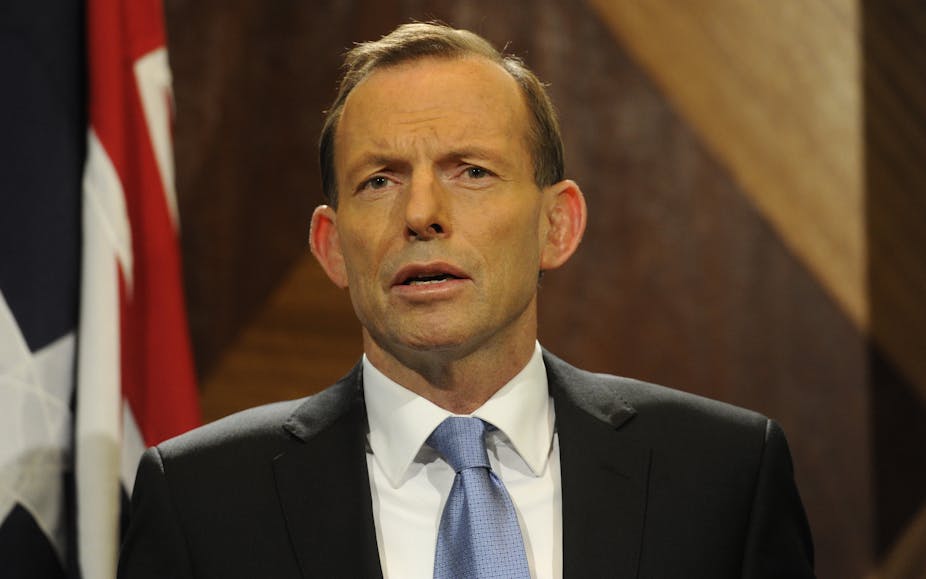
Tony Abbott is seeking credibility on foreign policy issues, but his recent rhetoric on China has done him few favours. AAP

Opposition Leader Tony Abbott’s recent overseas trip to help burnish his international credentials has revealed more of the potential direction of the Coalition’s foreign policy. Following his visit to the United States (as part of the regular Australian American Leadership Dialogue) was a visit to China, where he gave a speech to the China-Australia Chamber of Commerce and held meetings with Chinese Communist Party officials.

While he praised the growing economic strength of China, he also warned that government-owned Chinese investment in Australia may face greater restrictions under a future Coalition government. This has already been criticised as potentially threatening future foreign investment in Australia, with Foreign Minister Bob Carr claiming Abbott’s policy stance would result in a “retreat from Asia”.

Abbott’s 2009 book, Battlelines, didn’t reveal much depth of a foreign policy viewpoint beyond an emphasis on the “Anglosphere”, highlighting Australia’s traditional relations with the USA and UK, and also favouring Japan, as it shares similar values of a liberal democracy and market economy. Abbott has also stated his foreign policy would have more focus on Indonesia, although the Coalition’s relations with Jakarta over asylum seekers is already problematic.

Abbott appears to be adhering back to the Howard era of “pragmatic” relations with China, which emphasised trade, but sidelined controversies over human rights into a low-key bilateral dialogue forum. Abbott has at least declared that a Coalition government would forcefully advocate the promotion of human rights, although it remains to be seen how just how forcefully this would be applied to China, particularly if this results in any deterioration in trade relations.

Since China has shown is it increasingly willing to use its economic strength as a coercive diplomatic tool, any Australian government will continue to need to handle its relations with China extremely carefully.

Abbott pledged in Beijing to continue to pursue free trade agreement (FTA) negotiations with China, first undertaken by the Howard Government, and went on to claim that his second overseas trip as Prime Minister would be to Beijing, following his first promised trip to Indonesia, where he would somehow resolve the asylum seekers problem. Abbott hopes China will eventually embrace more reforms towards freedom in its political and legal system, to follow its economic modernisation. However, many analysts, not least former PM Kevin Rudd, argue China is unlikely to democratise any time soon, and so the world needs to somehow peacefully deal with an increasingly powerful China.

However, neither Abbott, nor shadow Foreign Affairs spokesperson Julie Bishop, have given much specific indication over how Australia should respond to the increasing tensions in the region. Military spending in Asia is estimated to overtake Europe’s this year, with fears of a conventional weapons arms race, particularly in naval and air power. Over 30% of this spending in the region is coming from China, which is increasingly assertive over territorial disputes in the South China Sea, where it is now establishing a garrison in the Paracel Islands, directly confronting Vietnam and the Philippines.The dispute with Japan over the Senkaku Islands is also intensifying.

The recent ASEAN Regional Forum (ARF) meeting in Cambodia ended without an official communique being issued for the first time, as China rejected a proposal by ASEAN, Japan and the US to establish a regional code of conduct to peacefully handle territorial disputes.

Despite the presence of regional multilateral organisations like the ARF, the East Asia Summit, and APEC, there is currently no effective institutional diplomatic mechanism to exclusively and directly deal with security problems and crises in the Asia–Pacific region. Abbott claimed in China that his government would attempt to ensure peaceful dispute resolution in the region, following international law. So far though, China is firmly resisting adherence to international law, particularly the United Nations Convention on the Law of the Sea (UNCLOS), regarding its maritime territorial claims.

On defence policy, Abbott has been critical of the $5.4 billion reduction in defence spending by the Gillard government in the last budget, indicating the Coalition will return military spending to 3% real growth, noting the criticism by the head of US Pacific Command of Australia’s defence cuts.

There seems little indication yet that an Abbott-led Coalition government would have any real appreciation of how Australia should productively respond to the diplomatic and security challenges being wrought by the increasing strategic competition in the Asia-Pacific region, beyond automatic support for the US military alliance.

Join the conversation

20 Comments sorted by

  1. Lincoln Fung

    Economist

    Abbott is unlikely to be as successful in dealing with China as he has so effectively opposed to the ALP government since he became the opposition leader.
    China is no Gillard or Rudd.
    If Abbott hopes his hardlining tactics may work, the US would have China measured long ago, given that the US has been and is still much much more powerful than Australia and there have been many harks there who are at least as good as Abbott in global leadership and skills.
    So yes, his stance on China has to evolve with time.
    Just see how American presidents changed their attitudes towards China from their campaigns once they came to the White House and began to deal with China.
    Rhetoric is one thing and reality is another totally different one all together.

    report
    1. Jack Arnold

      Director

      In reply to Lincoln Fung

      I am advised that China holds almost $1 TRILLION US government paper which may be a good reason for the change in attitude by US Presidents achieving office. This was possibly also a reason for US claims that some US banks "were too big to fail" in the GFC started by US banking practices.

      As for Abbott, I am reminded that Abbott is using the same "Nobody else is good enough" strategy followed by Hitler in the 1930s before the democratic election of the Nazi Party to government with the financial support of German heavy industry & monied classes.

      report
    2. Jack Arnold

      Director

      In reply to Jack Arnold

      Further to above ... then there was the 35 million pounds sterling injected into the German economy from five major US banks through Farben AG. One of the brokers of these types of deal at that time was Prescott Bush, progenitor to the Bush dynasty of US Presidential disasters.

      report
  2. Philip Dowling

    IT teacher

    I note that Kevin Rudd's advice on diplomacy and strategy is quoted in the article.
    If these were in his skill set may I suggest that he would still be or would have regained his position as PM.

    report
  3. Michael Gioiello

    High school music teacher/ freelance Opera singer

    I suspect, although we will have to wait and see, that Abbott's attitude to China will be the same as his attitude towards everything else. It is his way, or the highway. Tony Abbott, I feel will take the old fashioned, slightly racist, white supremisist attitude that he always does. The problem is that this approach may not sit too well with the Chinese communist elitists in Bejing, who are used to a little more respectful approach that Kevin Rudd showed them.
    I am sorry to sound so negative, however, if Tony Abbott gets in, than Australian voters ill get what they deserve. They don't deserve sympathy

    report
    1. Tony P Grant

      Neo-Mort

      In reply to Michael Gioiello

      Well may he seem to be "the new man of iron" he certainly doesn't have the family history of a Margaret Thatcher!

      Cowards and opportunists!

      report
  4. Garry Baker

    resarcher

    Abbott has done nothing to prove his managerial skills with these China pronouncements, other to take on board and reflect a fast growing public awareness in Australia of what China's aims really are.

    It is quite evident these do not include a transition to democracy, nor do they embrace a move to free trade as we know it. Indeed, wishful thinking at best. Rather, theirs' is more to do with a: "be reasonable - do as we say", approach, and woe betide anyone who opposes strategies of their central…

    Read more
    1. Tony Xiao

      retired teacher

      In reply to Garry Baker

      1. "their own internal security budget is a bigger spend than their armed forces just to 'harmonise' their own people"

      2011
      China Public security: $70.00 per capita
      Australia Internal security: $190.00 per capita
      USA Dept Homeland security: $203.00 per capita

      2. "nor do they embrace a move to free trade as we know it"

      China has 14 FTA with 31 economies and 8 have been signed
      Australia has 6

      3. " State Owned corporations acting as if they were driven
      by free enterprise motives, when…

      Read more
    2. Philip Dowling

      IT teacher

      In reply to Tony Xiao

      The extent of state ownership of commerce is a concern to all companies that are not.
      Thus Qantas finds itself in competition with Etihad and Emirates Airlines.
      If state owned enterprises operate within their own borders that may largely be a matter of internal political concern. if they operate overseas then it may be a concern for national security for other countries. Huawei, for example, may operate in a completely appropriate fashion ... until it is told to do otherwise by its political masters.

      report
    3. Jack Arnold

      Director

      In reply to Tony Xiao

      Those were the days ... when Australians owned their own natural resources. Then Howard as treasurer in the Fraser Liberal government took up offers of loan money from foreign banks despite warnings from thinking economists like Prof Wheelwright at Sydney University that it was a highway to dispossession & poverty.

      We had great state owned enterprises; the Commonwealth Bank (good value shares @ $2.50 FPO), QANTAS (no longer calls Australia home), state electricity generation (a bargain for the foreign buyers in NSW), Commonwealth Serum Laboratories (still a world leader), etc, etc, etc.

      report
    4. Tony Xiao

      retired teacher

      In reply to Jack Arnold

      Yes, what is interesting is that the Liberal PM Menzies a devout anti-communist continued on with the tenets of socialism in maintaining state control of key and strategic industries while at the same time enhancing the welfare benefits provided by the state including the 5 day working week and 3 weeks of paid annual leave etc.
      It could be argued and empirically supported that the Menzies era was the last era of socialism in Australia.

      report
    5. Tony P Grant

      Neo-Mort

      In reply to Tony Xiao

      Clive Palmer has an agreement with his "China First" mining operation in Qld, the conservatives seem to be all over the place on foreign investment and divided within the party?

      report
    6. Garry Baker

      resarcher

      In reply to Tony Xiao

      "" It was only a few decades ago that the Australian state
      either controlled or had a finger in most of the key industries
      including banking and insurance, transportation, communications,
      mining and energy. If Australia had continued down this path
      then maybe there would be less scuttlebuck about the
      current foreign ownership ""

      Hello Tony ... on these observations, one cannot help but agree. However it should be remembered funding for their genesis came out of the public purse because…

      Read more
  5. Wei Ling Chua

    Freelance Journalist (night passion) at Self-Employed: Picture Framing/Wholesales

    If we examine China economy by comparing the "list of countries by tax revenue as percentage of GDP" [ http://en.wikipedia.org/wiki/List_of_countries_by_tax_revenue_as_percentage_of_GDP ], you will find that China is a small government at 17%; whereas many so-called democracy and free markets are big government. For examples, Australia (30.8%); US (26.9%) and UK (39%).

    The fact that China economy is growing at high speed with plenty of cash is itself a form of human rights achievement.

    report
    1. Wei Ling Chua

      Freelance Journalist (night passion) at Self-Employed: Picture Framing/Wholesales

      In reply to Michael Gioiello

      Michael, I am telling the truth. I have backed up my claims with a link to Wikipedia. The fact that China managed to tax a lot less than the West and yet able to produce massive surplus and lifted 450 million people out of poverty in just 32 years, with a public approval rating of 82% (2012) on people satisfaction with the country direction as compared to around +/-30% for most western democracies (PEW survey: http://www.pewglobal.org/database/?indicator=3 ), such achievement itself proof that China has a team of good and caring leadership.

      Comparing to our (Australia) massive downsizing in the public sector across the country - state and federal, and yet our politicians including Tony Abbott are enjoying 2 major pay rise within 3 months: http://www.theage.com.au/opinion/political-news/anger-over-mps-pay-rise-20120704-21gfu.html , I believe that, if you think that China is red, than I think red is good.

      report
  6. George Naumovski

    Online Political Activist

    Abbott talks about Human rights, yeah I really see it as their core policy is the “slave & master” rule!

    China has the money and growth and no matter what regime they have, it is their business, not ours and so trade needs to be open with them because they will be the power house soon.

    Tony Abbott/LNP just spews out what the population wants to hear but can’t explain how they will achieve anything and that is in its self very dangerous for Australia.

    report
    1. Tony P Grant

      Neo-Mort

      In reply to George Naumovski

      Abbott finds he has to be the "hard man" with a population of 22 million people...he would make Stalin/Mao look like moderates with what was put before them *China/Russia"?

      report