
ABC TV’s Making Couples Happy tries to do it with science

Can a floundering relationship be saved in eight weeks using “science”? Premiering tonight, the new ABC series Making Couples Happy sets out to answer this very question. The show follows four “ordinary” couples at different stages in their lives but with one thing in common – unhappy marriages. Three…

Tvj5nbr3-1360712036
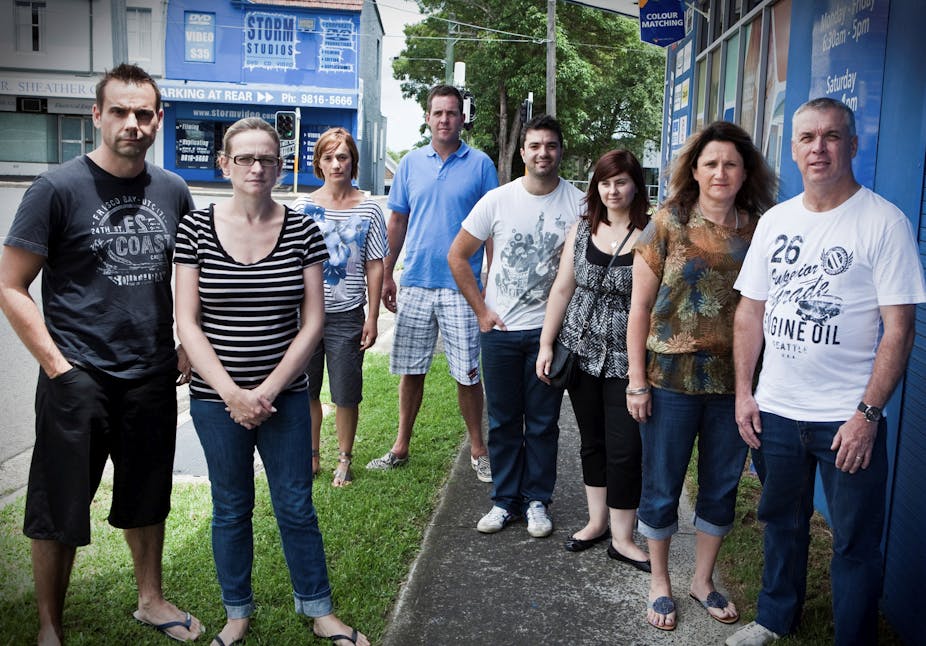
Can science save floundering relationships? Participants in ABC TV’s Making Couples, airing tonight, find out. ABC TV

Can a floundering relationship be saved in eight weeks using “science”? Premiering tonight, the new ABC series Making Couples Happy sets out to answer this very question.

The show follows four “ordinary” couples at different stages in their lives but with one thing in common – unhappy marriages. Three experts – a clinical psychologist, a counsellor and sex therapist, and a mind-body specialist – use “science” to provide them with strategies they can use to improve their happiness and thereby, it is assumed, save their relationships.

But, is happiness what’s important for the maintenance of a relationship? And will these relationships last if the couples become happier or would they have lasted anyway?

It’s interesting to note that one unhappy couple “managed” to stay married for 29 years. Indeed, research shows that happiness is not required for individuals to stay in relationships where they’re not happy. Some even stay in abusive relationships. There are many reasons why people stay and they span everything from being committed to the relationship to having no viable alternatives.

Despite this, the interest in this program is likely to be high because it presents a chance to see “warts and all” what problems many couples face, and how (and if) they can be “solved”.

We are reminded that a third of all Australian marriages end in divorce and that happiness (or at least satisfaction) is linked to physical health. So it’s important for our health and for society that we’re happy in our relationships.

The couples face a range of problems including poor communication, unrealistic relationship expectations, a lack of balance between work and family life, financial issues, the strain that young children can place on relationships, differences in parenting style, and a lack of intimacy.

So, what techniques do the experts suggest to help them “move forward” in their relationships and, perhaps, “save” them?

The couples are asked to engage in a number of tasks that highlight, among other things, what’s “wrong” with their relationship and where the couple are not a “team”. We’re shown the effects of positive and negative feedback on their emotions and performance, which highlights the way criticism makes us feel and act.

We see how non-verbal communication shows how we feel about people we’re interacting with – the couples are told that even if they don’t want to do something, they should try to do it because the feelings will come, so they have to “fake it until you make it”.

For the most part, a “one-size-fits-all” approach is used with all of the couples, but sometimes, the impact of what we personally “bring” to our relationships is also shown. People who are sensitive to rejection, for instance, interpret ambiguous situations as signalling that their partner is rejecting them whereas others who aren’t so sensitive do not. Such individual differences need to be taken account of when psychologists and counsellors work with couples.

Despite this, there are some useful messages we can all take away from the series and they include:

The series frames these messages in terms of research findings, but they’re quite simplistic and don’t reflect the complexity found in research.

In relationships of the kind the show is about, there are two people who “bring” a lot to the relationship. The way they view themselves, for instance, and others, as well as the world. Views of self can vary from extremely positive to extremely negative. Others can be viewed as, for example, trustworthy or not. The world can be seen as a benign or hostile place or somewhere in between. These views affect how people respond in their relationships.

And different factors like this interact with each other to make the relationship more than the sum of the two people in it. Some of these factors have a direct effect on relationship satisfaction, some have indirect effects, and some alter the relationship between two other factors.

These complexities (and others, like being unemployed or the gendered nature of housework) make every relationship unique. So whether a relationship will or will not be maintained is difficult to predict – even when people are happy.

The show’s the clear message is that relationships require work and this can be difficult. The four couples are brave, and especially so for baring their souls and lives for the camera. I think this series is worth watching.

Articles also by This Author

Sign in to Favourite

Want to follow The Conversation?

Sign up to our free newsletter to get the day's top stories in your inbox each morning, with a special wrap on Saturday.

Help us have better conversations — donate

Join the conversation

13 Comments sorted by

  1. Sue Ieraci

    Public hospital clinician

    I heard one of the couples interviewed on radio this morning. One interesting comment from a participant was that being on TV had "raised the stakes" - or created an additional motive to try hard for success.

    It would be reassuring to think that the programme did something for the participants, in addition to providing entertainment for viewers.

    report
    1. Jennifer Boldero

      Associate Professor in Psychological Sciences at University of Melbourne

      In reply to Sue Ieraci

      I agree. Unfortunately, it's not possible to separate out the impact of this additional motive on a successful outcome. That said, if participation does lead to a couple being "happier" whatever the reason for this change is, in some ways, irrelevant. Again, however, there is no guarantee that happiness will lead to the relationship continuing.

      report
  2. Dale Bloom

    Analyst

    “The couples are asked to engage in a number of tasks that highlight, among other things, what’s “wrong” with their relationship and where the couple are not a “team”.”

    This seems fraught with danger, as it can lead to a very pessimistic attitude.

    Perhaps it would have been better for them to concentrate on what is “right” with their relationship and where the couple are a “team”.

    report
    1. ernest malley

      farmer

      In reply to Dale Bloom

      Dale - if you have a mirror in your abode, please look into it and smile.
      In many, many months of reading your comments I have yet to see one which was an addition to the common weal, which made a smile arise upon the reader's face, which made the world a sunnier, happier place.
      No matter the subject, though we are all too painfully aware of your specific propensities -some might say pathologies - you always have to burst a balloon, unweave the rainbow, trammel the silk.
      Why?

      report
    2. Dale Bloom

      Analyst

      In reply to ernest malley

      I haven’t abused you, but I can if you like abuse.

      Australia has one of the highest divorce rates in the world, and the divorce industry is very profitable for a very few, and very expensive for the vast majority.

      I would think that the people who would profit from the divorce industry the most would be Family Law solicitors and some feminists.

      They would be most likely to encourage a pessimistic attitude towards marriage.

      report
    3. Judith Olney

      Ms

      In reply to Dale Bloom

      If you don't know what's wrong with a relationship, you can't begin to fix the issues, that is why this is an important step in rebuilding a relationship.

      report
    4. Dale Bloom

      Analyst

      In reply to Judith Olney

      I don’t watch much TV anymore, as I find it too Americanised, unreliable and commercialised.

      The programs seem gossipy and voyeuristic, or they seem like a version of a woman’s daytime TV program, where there is much drama about not much at all really.

      There is a concern that the programs will be feminist, and will attempt to portray heterosexual relationships as being ultimately doomed because a man is involved in the relationship.

      It is also a concern that the ABC has now lowered its standards so much to show such gossipy, voyeuristic, feminist type stuff.

      report
    5. Judith Olney

      Ms

      In reply to Dale Bloom

      Totally agree on the commercial TV programs, I find them mind numbing, so don't watch commercial TV much at all.

      I found the show, talked about in the article, to be interesting from a psychological point of view, with no gossip, and no portrayal of men or women as particularly bad, just as human beings. I found it refreshingly honest, and wish all the couples well.

      I enjoy the ABC, and SBS, and the program standards of both channels is very high.

      I realise that you have a big problem with feminists and feminism, (almost every thing you post contains a bitter tirade against women and feminism, so your views are well known), so its probably best that you keep away from any programs or people that upset you. Carrying so much hatred, anger and bitterness, is not healthy. I hope that you can find your own happiness one day Dale.

      report
    6. Dale Bloom

      Analyst

      In reply to Judith Olney

      Certainly something has to be done about the divorce rate that has grown to be one of the highest in the world, but interestingly Australia also have one of the highest rates of marriage in the world.

      And yet I have never heard of a single social scientist give one theory as to why this is so.

      My theory is that the high divorce rate results from the stresses of living in a cultureless society that is becoming more overcrowded and wiping out our environment, together with having to join the rat race to pay the mortgage, and a feminist type society forever negative about men and male-female relationships.

      But that is only my opinion of course.

      report
    7. Judith Olney

      Ms

      In reply to Dale Bloom

      Its an interesting trend, but one I think has less to do with feminism, (I don't see society as negative about men or male/female relationships at all), and more to do with an increasingly materialistic and consumerist society, the "rat race" as you put it.

      I also agree with your view that we are overcrowded, but again, the economy as it is viewed now requires more growth in population, more use of finite resources, and more destruction of the environment to sustain itself. This will only change when human beings wake up and realise that there cannot be continual and exponential growth, in a world of finite resources, it must end. I fear that humans will not willingly change, but change will eventually be forced upon us.

      I'm not quite sure what you mean by cultureless, there is definitely a culture, just not one that is good for humans or sustainable.

      report
  3. John Bryan

    logged in via Facebook

    Two things...replace balance with harmonise; acknowledge the TV approach is like MKR, reality TV, we love seeing 'contestants' break down.

    Balance is tricky, constant, stressful. Harmony recognizes that highs and lows work together for greater achievement and satisfaction.

    The 'judges' tend to be sanctimonious. They exude how clever they are; they know how life should be lived. Really?

    report
  4. Tralee Cable

    Self Employed

    I watched out of interest in the result, but also to determine if it were possible for a reality show to actually deliver on a promise, without resorting to theatrics and drama. There were, naturally, dramatic moments, but for the most of it all I was absorbed by what appeared to be very genuine emotions and desire to improve their lot. The growth in a couple of the contestants, who at the start appeared to be only involved as an 'appeasement', but by the end were entirely immersed in the project…

    Read more