ABC’s Mark Scott defends against “groupthink” attacks by The Oz

ABC Managing Director and Editor-in-Chief Mark Scott has hit back at The Australian over its attacks on the ABC’s alleged “groupthink”. In a speech delivered at Melbourne University’s Centre for Advanced Journalism tonight, Mr Scott has defended the editorial independence of the ABC, saying The Australian…

Fbszw6m6-1339574986
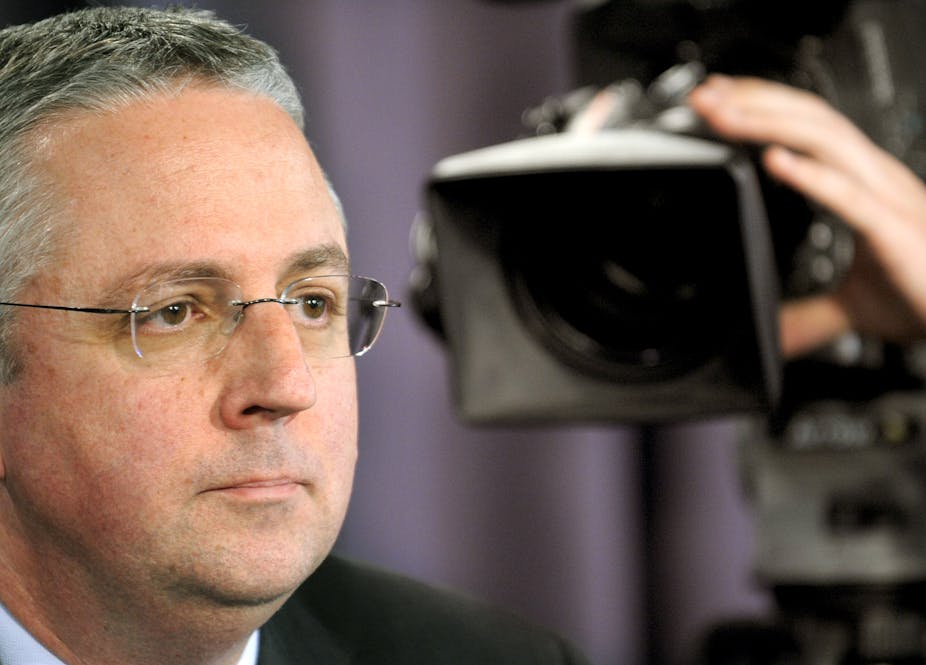
ABC Managing Director Mark Scott: “I think there are still marvellous journeys to be had down the road of journalism.”

ABC Managing Director and Editor-in-Chief Mark Scott has hit back at The Australian over its attacks on the ABC’s alleged “groupthink”.

In a speech delivered at Melbourne University’s Centre for Advanced Journalism tonight, Mr Scott has defended the editorial independence of the ABC, saying The Australian has “a fundamental misunderstanding … of the way an organisation like the ABC must operate”.

Mr Scott made the comments as he launched the book, Australian Journalism Today, by Canberra University Professor Matthew Ricketson.

Mr Scott also said he had been surprised “at the speed and intensity of the decline in the newspaper sector here in recent months”.

“People who work inside and have full insight into the performance of the mastheads speak with a genuine shock and fear about what the numbers are now telling them about the precarious print business model,” Mr Scott said.

We welcome comments.

Full text below:

“Since I accepted Matthew Ricketson’s kind invitation to launch this book on this date, three things have happened. That’s not to say I wouldn’t have accepted the invitation had I anticipated these things Matthew, but perhaps I would have asked for danger money.

“Firstly, it appears that virtually every author of a chapter in this book has been attacked in one way or another in recent weeks by The Australian.

“Secondly, the ABC itself has suffered a further tickle up from Rupert Murdoch’s broadsheet, accused of being an epicentre of groupthink.

“And finally, we are in the midst of unprecedented speculation about the nature of job cuts and restructuring set to descend on both News Limited and Fairfax, our largest and most significant newspaper organisations.

“Now, before making any comments on any of these matters, in the interests of full and open disclosure, I would like to make the following declarations:

  • I have spoken to Margaret Simons on occasion in the past.

  • I declare I have read her writings on the media.

  • I further declare I have not read nor followed her writings on gardening, as the state of my backyard attests.

  • Furthermore, I declare that Matthew Ricketson is taller than me.

“I want to talk about the current state of the industry, its impact on the nature and future of journalism craft in this country and the audience for this new book, Australian Journalism Today.

“But firstly, let me deal with at least one of many misunderstandings about the ABC that exist at The Australian. It recently gave me and other leaders at the ABC several thousand words of free advice on the subject of groupthink. Now, free advice is often worth what you pay for it, but nevertheless I paid attention to The Australian, if only because I have always been happy to listen to experts speaking authoritatively in their field.

“I must say it is a little difficult to know where to go with this, being lectured by The Australian about a certain narrowness in editorial perspective and a singularity in worldview. I was reminded of the wonderful American satirical singer and MIT maths professor, Tom Lehrer, who retired from recording in the early 70s. He remarked at the time that awarding the Nobel Peace Prize to Henry Kissinger made political satire obsolete.

“I think there is a fundamental misunderstanding at The Australian of the way an organisation like the ABC must operate. I am Editor-in-Chief of the ABC and am finally responsible for all the content that goes online, all that goes to air across five television networks and six radio networks, including 60 local radio stations across the country. And at times, I will talk with our leading content directors about the stories and issues of significance, how we are covering them, angles we might be missing. And we will discuss our performance and the quality of our work.

“At The Australian, they seem to think I should operate in the same way as their own Editor-in-Chief. I have no doubt that at The Australian, the senior editorial team run a tight news conference, with a clear editorial line emerging about the stories they will be pursuing, the people they are supporting, the agendas they are setting, the philosophy they are advancing. The paper executes accordingly, making Mitchell, without doubt and for a long period of time, the most personally dominant editorial executive working in the country.

“The ABC is not like that. We are not a single masthead like The Australian. In fact I think the ABC is more like a large chain of newspapers or separate editorial products, though not seeking to deliver for profit or shareholder return, but for the public good. We have clear policies and guidelines, clear expectations about standards and levels of performance, but finally we entrust our journalistic teams to execute. We do not have a point of view or take an editorial stance. More than ever, I think we can demonstrate a wide range of perspectives, forums for vigorous debate and a culture that can deliver for our audiences – from the fastest, most accurate tweet, to the finest and most vigorous investigative reporting.

“Not long after I started at the ABC in 2006, in a speech to the Sydney Institute, I set out the direction the ABC would be taking editorially. How, in all our content, we’d deliver balance, diversity and impartiality, the full range of voices and perspectives as set out in our new Editorial Policies.

“And I think it’s pretty clear to the public that those editorial standards, diversity of opinion and impartiality I set out six years ago, are part of the ABC’s editorial DNA today. It was good to see, as both the Finkelstein and Convergence Report noted, that Australians regard the ABC as Australia’s most trusted media organisation for news and information. By a long stretch.

“I think our team is doing very well. Not just our big news and current affairs programs, but our teams working in regional and rural Australia putting together countless programs daily, delivering the very best news and information from and to their local communities, the State, the nation and around the world.

“The model The Australian seems to want the ABC to adopt would be akin to Chris Mitchell being forced to attend a daily news conference, convened by News Limited CEO – and the man finally editorially responsible for all product – Kim Williams, where Kim Williams instructs Chris and all other editors on the News Ltd line to be run across all papers and mastheads the following morning. Where your local team on the ground was not trusted to make editorial judgments and deliver the best product possible to their audiences. I am not sure how Chris would react to this.

“The idea of such a News Limited conference run by Kim is, of course , intriguing – and were it to happen I would be very keen to acquire recording and broadcasting rights for the ABC.

“Let me move on to more serious matters for the industry as a whole.

“I can only imagine how daunting it is for a university student, studying communications, to read the headlines and the speculation about what is about to happen to our major newspaper companies. Announcements about sweeping changes at both Fairfax and News Ltd are imminent. Hundreds of jobs to go; major reorganisations and I suspect centralisation in the management of editorial resources.

“For years we looked at the United States newspaper industry and were thankful that here we had not seen the level of circulation decline, job losses, revenue collapse, and the sweep of closures. But it looks like it might now be our time.

“And I admit that the speed and intensity of the decline in the newspaper sector here in recent months has surprised me. People who work inside and have full insight into the performance of the mastheads speak with a genuine shock and fear about what the numbers are now telling them about the precarious print business model.

“As I remarked when delivering the A N Smith lecture at this university a couple of years ago, these forces unleashed by digital technology, globalised content, empowered consumers and the opening of closed markets were always going to overwhelm even the most powerful proprietor and long-established operator. It was not going to be possible to shape this world. Survival would be more about your capacity and capability to ride out wherever the wave would take you, to nimbly adapt and reform your organisation in the face of forces unleashed.

“I must tell you that the ABC is not immune from these forces. Of course our revenues have not been hit in the same way as those dependent on display or classified advertising in recent times. In a digital media world, we find the ABC audiences clamouring for more content on more platforms.

“This can’t be delivered simply through creative accounting. Real changes and tough decisions have had to be made.

“We’ve been fortunate to receive some additional funding for new projects such as ABC3 and a new slate of drama, but we have funded a lot of our new activity in recent years ourselves, by making those tough decisions and by redirecting existing resources. And while the audiences for ABC iview and ABC News24 have assured us those decisions were right, there’s more work still to be done, more tough decisions ahead of us.

“Over many years, the ABC has wrestled with the challenge of doing more with less. If you take a 20 year snapshot, the ABC had about $100m more in real terms for recurrent expenditure two decades ago and around 1500 extra full time staff – delivering a fraction of the content we are now delivering across more television outlets, more radio networks – and an online and mobile world unimagined in 1991.

“There are some who would have preferred us to remain snap-frozen: to just keep doing what we were always doing, in a very traditional sense, on radio and television. Who would have urged us not to move into a world of round-the-clock news, delivery online and through apps, not going near Twitter and Facebook.

“Instead we have looked to rigorously engage – not simply rely on what we have always done – but what we can uniquely do and how we can service our audiences most effectively in this digital age. We have limited funds and new demands. It would be easier not to cut programs, nor create new ones; easier not to reallocate priorities and re-examine the way we work. But we must to ensure we deliver the very best service we can to audiences today. We must focus on what we do best and what is best for the people who own us, fund us and use us.

“That is why we found the money for News 24; why we are streaming our services to online and mobile; have created industry leading apps; developed iview and new services on digital radio. There was no additional funding for any of these activities. Some, like News 24 and the streaming services, are a very major financial investment for us. The cost of delivering our streaming services continues to ramp up dramatically. It is a storm driven by increased audience demand: educated consumers, with smarter devices, cheaper broadband with much higher caps – and a desire to watch right now. But delivering services this way is exactly what we must do to be relevant and compelling to our audiences.

“In our news division now, there is lots of work underway about how we meet audience expectations. Staff from around the country have been engaging with the challenge of providing the full suite of news services: from the electric immediate to the intense, long form.

“This work cannot be undertaken unless there is a recognition of changing priorities in the face of new priorities. Your 7pm bulletin will still be vital – but for most of the audience, it is no longer their first exposure to the news that day. The mobile and online investment is vital to remain the authoritative news source – a role once met for us only through radio and television. Your audience wants your very best, up-to- the minute, at any given minute. And you need to have the funds on hand to deploy as the emerging story demands it.

“I have been travelling around the country speaking to ABC staff on this kind of thinking – and frankly my messages are not that different to those you are hearing from other media executives. We need to be content-driven and audience-centric, across all our platforms. We need to work together to deliver on our strategies across our divisions. We need to be willing to make tough decisions on programs and priorities to ensure we continue to be a compelling part of lives of our audience. We need to be respectful of our past but not captive to it. My message to the ABC staff has been clear – the forces being unleashed on media organisations are unprecedented and, in the words of former Intel boss Andy Grove, “only the paranoid will survive”.

“But for all that – despite all the gloom and the prospect of bleak news, I hope that those who will most use this book, the journalism students, can be excited about what still lies ahead for them if they get the opportunity to find and tell Australian stories. In our experience at the ABC, from the smallest town to the biggest city, there is an endless appetite for Australian stories, well told.

“In his marvellous poem on Odysseus, Cavafy writes of the long journey of the war hero back to his home in Ithaca – long delayed and interrupted, at times lost, detained and stalled.

“But the real experience comes not at finally reaching home – the career goal – the big job – the fulfilled ambition.

Instead, a long journey makes you:

“wealthy with all you have gained on the way, not expecting Ithaca to make you rich.

Ithaca gave you the marvellous journey.”

“I think there are still marvellous journeys to be had down the road of journalism.

“Firstly, there has never been a larger and more accessible audience for news and information. More than ever, people want to be informed and know what is going on. And as you look around the world and across our own country, the stories have never seemed to be bigger or of more significance to our lives.

“And as new forms emerge, new ways of connecting and communicating with audiences, like Twitter – which is a personalised wire service and news agency for everyone – the demand and importance of old forms continue. I think of Four Corners – it’s older than me and most people in this room – and still going strong – breaking news, uncovering hard truths, setting the agenda. Good old-fashioned journalism reaching audiences in old and new ways: on television, on catch-up, online, on Facebook.

“And whilst print is clearly challenged, text is not. People are reading more than ever, in vast numbers. And not just short tweets: detailed analysis, commentary, investigation and reporting. A Quarterly Essay can shake the Prime Ministership.

“Of course, we can ask where the jobs will be – but the reality is that journalism was never the easiest profession to get into. Throughout my career, the number of applicants to traineeships was always about 100 to 1 – much the same as today. Of course, until recently, it was such a closed industry to get into – a handful of papers, a couple of TV and radio licences. Miss the opportunities to work in those places, you had no-where else to go.

“But now of course, with the right energy and ideas, there are so many more platforms where you can tell your stories, reveal your ideas and showcase your talent: where you can try to connect with and grow an audience. No, it may not make you rich and it may not even be how you pay the bills. At times I fear there will be fewer paid jobs in journalism and that many who practice the craft may do it as so many other artists and craftsman operate – as part of a life, but not a singular vocation.

“I do think though that most of the time, the most energetic, the most creative, those who work the hardest will find a way and that journalism will be a marvellous journey.

“And I think this new book, Australian Journalism Today, gives a unique insight into preparing for the world of journalism. Not just the skills you need – I did enjoy Peter Clarke’s analysis of interview techniques – but also the nature of the industry and the values and principles that underpin it.

“I want to thank you Matthew for your leadership of the project and all the authors who contributed to it. I am sure it will find a strong and engaged audience, particularly with this generation of journalism students all around Australia.

“As to the business models that will support and sustain journalism, I am afraid will still don’t know. We still can’t see the sustainable, wide-ranging solutions to that wicked problem anywhere in the world.

“I don’t think we should be afraid to say we don’t know. It mightn’t warm the hearts of the analysts and the investors – but the sheer question gets you closer to the answer than pretending that you do.

“In the lecture she delivered when receiving the Nobel Prize for Literature, Wislawa Szymborska, said she greatly values the phrase “I don’t know.”

“It’s small, she says, but it flies on mighty wings. “It expands our lives to include the spaces within us as well as those outer expanses in which our tiny Earth hangs suspended. If Isaac Newton had never said to himself "I don’t know,” the apples in his little orchard might have dropped to the ground like hailstones and at best he would have stooped to pick them up and gobble them with gusto. Had my compatriot Marie Sklodowska-Curie never said to herself “I don’t know”, she probably would have wound up teaching chemistry at some private high school for young ladies from good families, and would have ended her days performing this otherwise perfectly respectable job. But she kept on saying “I don’t know,” and these words led her, not just once but twice, to Stockholm, where restless, questing spirits are occasionally rewarded with the Nobel Prize.”

“Perhaps some economist, or business leader, or journalist – someone with a restless, questioning spirit – will win a Nobel Prize by solving the riddle of the business model to fund quality journalism in this digital age. Until then, we just need to get on with practicing the craft as best we can for the audiences we serve today.

“This book will serve well those training for that task. I wish them and the book well.”

Sign in to Favourite

Want to follow The Conversation?

Sign up to our free newsletter to get the day's top stories in your inbox each morning, with a special wrap on Saturday.

Spinner
Help us have better conversations — donate

Join the conversation

67 Comments sorted by

Comments on this article are now closed.

  1. Daryl Deal

    retired

    Just another one of Murdoch corrupt cheque book journalism propaganda rag, failing to call a spade, a spade.

    Sadly, in 1964 The Australian, appeared to be a breath of fresh air, of journalism asking and answering the six basic questions, minus the usual propaganda found in it's rivals.

    However, appearances can be very deceptive, for after 1967, the paper entered into a rapid retreat, to become a virtual clone of the USSR's Pravda and started printing editorial propaganda with hidden agendas, in lieu of real news.

    Since it now hides behind a paywall, no one cares whether it lives or dies in the 21st century.

    Such is life.

    report
    1. Wendy Albert

      Gardener

      In reply to Daryl Deal

      that is so true about the Australian it used to be a joy to read now its only good for mulch. I am so grateful that we we have someone like Mark Scott running the ABC and so grateful that the ABC has survived all the vitriol flung at it. When compared to any other media outlet in this country the range of intelligent and entertaining programs delivered by journalists who actually research their stories and know what they are talking about is utterly magic. Mark Scott for Prime Minister!!

      report
  2. Marc Hendrickx

    Geologist

    Seems Mark Scott missed the point of The Australan's criticism, the narrow views of ABC staff on certain subjects is certainly skewing its reporting, and goes against its charter. There are many examples. A recent one: ABC ( and The Con) yet to correct their coverage of the flawed Gergis/Karoly paper...why? How is this not newsworthy?

    report
    1. Jane Critti

      student

      In reply to Marc Hendrickx

      It seems to me that the point of the ABC is not to deny the narrow views but to have multiple views. Unlike the Australian, the ABC does not have one perspective that is dictated to from on high

      report
    2. Marc Hendrickx

      Geologist

      In reply to Jane Critti

      That is precisely The Australian's point, but unfortunately ABC is not living up to the dream and unlike The Oz we all pay for it (as we all pay for The Con).

      report
  3. Don Aitkin

    writer, speaker and teacher

    I don't read the Australian on a day-to-day basis, so I don't know what Mark Scott was reacting to. But I do think that there is an ABC 'culture', and that it does affect what passes for news and 'reality'. In some ways this is unavoidable — all large organisations have a culture — but in the case of the ABC it is supposed to be impartial. I don't think it is, in matters like climate change, boat people and the Aboriginal people.

    Equally, I'm not sure what the remedy is!

    report
    1. Marc Hendrickx

      Geologist

      In reply to Don Aitkin

      "I'm not sure what the remedy is!"
      Simple ...cut it loose and let the market decide.

      report
    2. Gavin Moodie

      Principal Policy Adviser

      In reply to Don Aitkin

      How on earth is the ABC not impartial?

      On your minority and lay view on global warming, for example, the ABC has given considerable prominence to denialists. Not as much as the Australian, of course, but surely your're not suggesting that the ABC is impartial only when it reflects your own views?

      report
    3. Alvin Stone

      logged in via Facebook

      In reply to Marc Hendrickx

      Marc, the ABC was never designed as a commercial proposition as its charter shows.

      Interestingly if the worldwide decline in print continues it may very well be that public broadcasters funded by the taxpayer will become our leading source of text based news.

      As for the print media in this country, even with all their apps and funky online features, they are still trying to deliver the same product, which is why they will continue to fail. The wrong people are in charge of the online direction of print media. They just don't get how online works.

      It is remarkable with all their resources how these major news companies haven't worked out how to get the best from their archives, interviews, photos and market reach. Our print media is destroying itself through its unchanging approach.

      report
    4. Gavin Moodie

      Principal Policy Adviser

      In reply to Alvin Stone

      True, but to be fair the film and music industries have similar problems 'getting' digital: it took Apple, not an old media company, to work out how to make money from music.

      report
    5. David Arthur

      n/a

      In reply to Don Aitkin

      Gday Don, regarding climate change, Gavin Moodie is correct: the ABC gives more due to the rambling of ideologically bound fools than is warranted.

      report
    6. Don Aitkin

      writer, speaker and teacher

      In reply to Gavin Moodie

      Gavin,

      I need to write this out at much greater length. It seems to me that what happens on ABC's TV and radio news is constructed within a particular view of the world. I happen to agree with a lot of it, and it provides a different account of the world to that of Channel 9, which I also watch, since Ch 9 gives me local news, which the ABC no longer does at much length. SBDS provides another view again.

      What is thought to be 'news' is different in each outlet, but in my judgment that of the…

      Read more
    7. John Nicol

      logged in via Facebook

      In reply to Gavin Moodie

      Gavin,

      Could you please, for the benefit of other readers here, name one programme , just one, in which the ABC has allowed itself to promote any single idea held by so-called skeptics. It will also be necessary to let us know just what they said.

      If you like I could list hundreds where they have prommoted global warming including through their totally biased Science Show run by the biggest climate bigot of all in the ABC, Robin Williams.

      Thank yo for your help, in wide eyed anticipation!

      John Nicol jonicol18@bigpond.com

      report
    8. John Nicol

      logged in via Facebook

      In reply to David Arthur

      G'day Gavin,

      I repeat my challenge to you that I have offered to Gavin above. I can name three successive occasions when the ABC News, the 730 Report and Lateline repeated, albeit in different ways, the frightening nonsense that our children and grand children were headed inexorably to armageddon.

      I wrote in as did many others and objected and since then it has only repeated similar material twice in the one three hour session.

      Did you ever visit their totally unbiased Planet Slkayer? I did and along woith many others let them knbow what a vicious programme it was, designed for quite young children and to encourage them to act as thought police for their parents in promoting the ridiculous ideas behind dangerous and immenently threatening Global Warming.

      I could go on but await your response. Thank you. John Nicol jonicol18@bigpond.com

      report
    9. Gavin Moodie

      Principal Policy Adviser

      In reply to Don Aitkin

      I agree that the ABC valorises the west, democracy, capitalism, christianity, Australia, etc. So at that general level the ABC adopts a particular world view, which in my view is essentially conservative and right wing. That is, it is closer to Adam Smith than to Karl Marx.

      But most climate scientists state that anthropogenic global warming is settled science. In this case the ABC isn't reflecting a value system but a scientific consensus. Likewise it reports evolution as settled science and…

      Read more
    10. John Nicol

      logged in via Facebook

      In reply to Alvin Stone

      Alvin,

      My wife and I subscribe to newspapers on the web as we do not have a convenient delivery service here. Each morning, we do as we have done since we were married 55 years ago.

      We have a cup of tea and read the paper - once shared by splitting, now using two old computers. \No problem and no wonder news paper circulation has fallen and will continue to do so, but it will not mean that they are not providing the news to a wide population..

      Like Don, we also mostly watch ABC, SBS…

      Read more
    11. Alvin Stone

      logged in via Facebook

      In reply to Gavin Moodie

      The ABC reports boat people as asylum seekers because, until proven otherwise, that is exactly what they are. They are not at this stage illegal immigrants because under the refugee treaties we have signed they do not have the status of illegal immigrants.

      Interestingly, Chris Mitchell's views on Indigenous issues are generally sympathetic but with a different approach to the solution.

      Extinction stories are completely valid because we do have an enormous rate of extinctions in this country. In the past five years we lost the pippistrelle bat and the white lemuroid possum and have plenty of others species and habitats on a knife's edge. Sadly, Australia is a world leader when it comes to wiping out species and we have the capacity to do something about it, so it makes sense to give this a profile.

      report
    12. Ian Smith

      PhD candidate (ecology)

      In reply to John Nicol

      apx 97% of climate scientists agree humans are warming the planet
      100% of all major scientific organisations (nasa,csiro, etc) agree humans are warming the planet.

      At what point should the ABC stop reporting a 50/50 dissenting view? 99%, 100%? less agree with the theory of gravity.

      (also almost no scientist says we are heading to armageddon, just that it is going to cause issues and damage GDP)

      report
    13. Ian Smith

      PhD candidate (ecology)

      In reply to Alvin Stone

      spot on Alvin,

      Also an extinction is not left or right, it is fact.

      if it was said the extinction is due to sloppy policies by the liberal party, then yes it is bias.

      why has ANY environmental reporting is being deemed "left wing" ?!

      report
    14. Bernie Masters

      environmental consultant at FIA Technology Pty Ltd, B K Masters and Associates

      In reply to Alvin Stone

      Alvin, I hope you're not offended if I call you a 'glass half empty' person. In response to your comment: "Extinction stories are completely valid because we do have an enormous rate of extinctions in this country. In the past five years we lost the pippistrelle bat and the white lemuroid possum and have plenty of others species and habitats on a knife's edge. Sadly, Australia is a world leader when it comes to wiping out species and we have the capacity to do something about it, so it makes sense…

      Read more
    15. John Coochey

      Mr

      In reply to Alvin Stone

      Actually not true. It is an offence to enter Australian territory without the required documentation with eighty per cent of boat people destroying their passports after they leave Indonesia. There is also a requirement formalized in the Dublin Convention to apply for asylum in or from the first country of safe haven. There is o right to travel around the world to get the best deal on housing and social security benefits.

      report
    16. John Coochey

      Mr

      In reply to Don Aitkin

      I completely support Don on this. The recent ABC coverage of the so called death threats to climate scientists was a disgrace especially Media Watch. it was clearly shown that ten out of the eleven so called threatening emails were not threats and the eleventh incident was an over dinner conversation between a Commissioner for the Environment and a licensed culler about the kangaroo management which was and is topical at that time of year. Media Watch was informed of this but refused to run it claiming the eleventh case was ambiguous. That is deliberate concealment of information

      report
    17. Ian Smith

      PhD candidate (ecology)

      In reply to Bernie Masters

      "in spite of having the capacity to so something about it and actually trying to do something about it, we've lost the species."

      I wouldn't say that is quite true...

      "in January 2009 an expedition found only four individuals in a single roost. Bat expert, Lindy Lumsden, at the time warned the Australian government that the population could be as low as 20 bats and "if the current rate of decline continues, this species is likely to be extinct within the next 6 months."

      Lumsden added, "It…

      Read more
    18. John Coochey

      Mr

      In reply to Mike Hansen

      Bullshit! There is not one word which rebuts my statement, not a single word

      report
    19. Bernie Masters

      environmental consultant at FIA Technology Pty Ltd, B K Masters and Associates

      In reply to John Coochey

      Jonathon Holmes was being too clever by half in his Media Watch segment which I've just watched for the first time. The Australian newspaper may not have been completely correct - in fact, they exaggerated quite a lot - but the fact remains that the ABC refused to withdraw or modify its claim that climate scientists at ANU received death threats. There's clearly fault on both sides but, after climategate and non-melting glaciers and a number of false or unreasonable claims by climate change alarmists, I see the Australian's articles as merely bringing some balance back into the debate.

      And please watch your language, John, or you may end up standing for Parliament or becoming an official at the HSU! :-)

      report
    20. Mike Hansen

      Mr

      In reply to John Coochey

      John Coochey's claim.
      "Media Watch was informed of this but refused to run it claiming the eleventh case was ambiguous. That is deliberate concealment of information"

      From Media Watch
      http://www.abc.net.au/mediawatch/transcripts/s3507732.htm
      "And the meaning of the eleventh is now controversial - for more on that see our website. Suffice to say it may not describe a threat at all.

      Read the Australian article about this email
      Read the email from John Coochey to Media Watch"

      So Media Watch is so keen to conceal Coochey's claims, it has a link to The Australian's article and Coochey's email on its web site which they referred to in the program.

      Well you are right John. It is not a single word.

      report
    21. John Coochey

      Mr

      In reply to Mike Hansen

      Precisely! Read it! is hindered away so why not publish out front? Or simply put it out front in the firs place?

      report
    22. Philip Dowling

      IT teacher

      In reply to Ian Smith

      Ian, Even my teenage daughters know that quoting the same source three times in a row will get you marked down for assignments.

      report
    23. Mike Hansen

      Mr

      In reply to Bernie Masters

      Bernie is the answer to Gina and Clive's dreams - an "environmental consultant" who denies climate science.

      Credibility zero, integrity -1

      report
    24. Bernie Masters

      environmental consultant at FIA Technology Pty Ltd, B K Masters and Associates

      In reply to Mike Hansen

      Mike, sorry to disappoint you but I'm not a climate change denier. I'm a fence sitter, unconvinced by either side of the argument, although I'm strongly opposed to the federal government's political response - the carbon tax - which is a serious waste of time and money and which won't solve any problems, just create new ones.
      But it's disappointing that you've had to resort to what I consider personal abuse, as mild as it was. It pretty much typifies a range of people on both sides of the debate who, either through frustration or because of their personality, can't remain focused on the issue itself but have to get personal. Quite sad.

      report
  4. Chris Plant

    Engineer

    It is very scary to realise that Mark Scott actually believes the ABC is impartial and represents a broad range of views. He is even more blinded by ideology than I had thought. As are most of its audience - all of whom love to have their own views broadcast interminably at the expense of the hoi polloi. George Orwell would indeed be impressed.

    Can anybody seriously say that Q & A, The Insiders, The 7.30 Report, The Drum, ABC 24 etc etc are heavily biased towards the Left, and the Far Left…

    Read more
    1. Mike Hansen

      Mr

      In reply to Chris Plant

      Chris - you either do not watch the ABC or you are a fantasist.

      Last week's Insiders had the usual cringe inducing performance from Abbott cheerleader Piers Akerman who long ago discarded any pretence of objectivity.

      The 7.30 report is hosted by the former seminarian and anti-abortion campaigner Chris Uhlman whose infatuation with Tony Abbott is embarassing.
      http://en.wikipedia.org/wiki/Chris_Uhlmann

      report
    2. Philip Dowling

      IT teacher

      In reply to Mike Hansen

      Mike,
      So who hosts The Insiders, and which politicians has he worked for?

      "A former seminarian" !!! My how terrible a crime ... at least in the mind of some bigots. Some anti-Catholic bigots.
      Instead of throwing stones at Catholics as they used to , some people now just throw words.

      report
    3. David Arthur

      n/a

      In reply to Chris Plant

      ".. the more lunatic ideas of the Greens?"

      and what, pray tell, are these 'lunacies'?

      report
    4. Mike Hansen

      Mr

      In reply to Philip Dowling

      Chris Plant argues that "that Q & A, The Insiders, The 7.30 Report, The Drum, ABC 24 etc etc are heavily biased towards the Left, and the Far Left..."

      When I point out that is not true, you respond with "Look. Over there a wombat"

      Get an argument or give it a rest.

      report
    5. Bernie Masters

      environmental consultant at FIA Technology Pty Ltd, B K Masters and Associates

      In reply to Mike Hansen

      Mike, I also cringe at Piers Akerman but politeness (and libel laws) prevent me from saying what I really think about David Marr who has to be one of the most poisonous and biased reporters I've ever come across. So the ABC tries at times to bring some balance into its presentations.

      report
    6. John Nicol

      logged in via Facebook

      In reply to Chris Plant

      Chris,
      I think you meant to say "Can anybody seriously say that Q & A, The Insiders, The 7.30 Report, The Drum, ABC 24 etc etc are NOT heavily biased towards the Left, and the Far Left at that? Even Counterpoint - the self-proclaimed 'solitary voice in the wilderness' - has been taken over by the Left. (added NOT!)
      John Nicol

      report
    7. John Nicol

      logged in via Facebook

      In reply to Mike Hansen

      Bernie,

      How about the "unbiased" David Marr who appears much more often than Piers Akerman and is about ten times as strifdent in his views.

      report
    8. Philip Dowling

      IT teacher

      In reply to Mike Hansen

      Mike, I am still awaiting an answer to my question.
      I can understand why the image of a wombat came to mind.
      I suggest that you either shave more or smash your mirrors.

      report
    9. Philip Dowling

      IT teacher

      In reply to David Arthur

      The notion that eco-tourists can support the Tasmanian economy.
      The notion that renewable energy industries can provide sustasinable jobs.
      The notion that desalination plants can be built during a La Nina event.
      The notion that dams cannot provide cheap renewable energy.
      The notion that red river gums were common on the Murray before European settlement.
      The notion that China isn't building coal fired power stations.
      The notion that Bob Brown's children will inherit a warmer planet.

      report
  5. Carol Daly

    Director

    Thanks to Mark for a thoughtful speech about the state of journalism in Australia.
    The difference between one editorial line a la The Australian/all the Murdoch press and the ABC with many points of view (e.g. Counterpoint and Q&A) is telling.
    The fact that Australians trust the ABC more than Fairfax and Murdoch media is telling.
    I blame the Murdoch media in particular for the poor state of democracy in the Anglophile world and currently Australia.
    Here, they made a decision after the last…

    Read more
    1. Alvin Stone

      logged in via Facebook

      In reply to Marc Hendrickx

      I suspect the ratings article was missed Mark because it was placed deep in the website (not mentioned on the front but buried down two levels in the webpage) and probably similarly placed in the print edition.

      As a former editor I know how easy it is to bury and hide stories you don't want to give prominence to. The Australian does the repeatedly with its print placement and on its website.

      Carrying a six para story where no one can find it is essentially the same as not running it at all…

      Read more
    2. Marc Hendrickx

      Geologist

      In reply to Alvin Stone

      Alvin virtually all you have described above can be said of the ABC. A case could even be made to include your lines that "history will not judge it well", and that it is "a growing embarrassment for all journalists, including some who work there". The key difference is that the ABC is paid for by our taxes, the OZ is not.

      report
    3. John Nicol

      logged in via Facebook

      In reply to Marc Hendrickx

      Marc,

      I am very surprised by your comment as I thought you would know by now that whatever you say about the ABC will be defended to the hilt by Academia in general and in particular, dare I say it, those who often frequent these pages.

      Surely by now you have written at least one complaint to the ABC about its bias and found that the whole execise is a complete and utter waste of your valuable time. I have been silly enough to do it on several occasions and am at present still pursuing, as…

      Read more
    4. Gary Murphy

      Independent Thinker

      In reply to John Nicol

      Say - does anyone know how I can write a letter of complaint to News Ltd about it's bias?

      report
  6. Falu Eyre

    logged in via Facebook

    I cannot believe that The Australian could allege bias against any other form of media. I stopped reading it years ago because of the right and far right bias. What else would you espect from a Murdoch publication. As for a leftist bias in the ABC did you not watch Julia Gillard on Q nd A? Tony Jones was (perhaps quite properly) antagonistic towards the PM and I was impressed with how she did not loose her cool.

    report
    1. Philip Dowling

      IT teacher

      In reply to Falu Eyre

      I normally watch Q&A. However when I heard that Julia Gillard was on, I remembered my blood pressure problem. So I exercised instead. Air swinging my baseball bat that I last practised with when K Kenneally was premier of NSW.

      report
  7. Shauna Murray

    Research Fellow

    I am surprised that someone in Mark Scott's position pays attention to something printed in the Australian. As others have said, the partisan position of that newspaper has been clearly stated on a number of occasions.

    Personally, I see a general drift in the direction of poor quality journalism, opinion pieces and a repetition of whats been said elsewhere throughout the Australian media, and I think the ABC is no exception. As has been researched, this leads to a general conservative bias in the media.

    report
    1. Philip Dowling

      IT teacher

      In reply to Shauna Murray

      Shauna,
      I'll let you in for two secrets.
      Rupert Murdoch doesn't make money out of The Australian.
      Even the Green politicians read the Australian to find out the day's issues.

      report
  8. Ian Smith

    PhD candidate (ecology)

    Is it me or has media in general has rapidly declined since pressure was ramped up on climate science?

    it's as if climate change is being used as a wedge to force people to choose between slash and burn economic growth and conservative social policies, or red tape wrapped social liberalism.

    I for one like free market conservation so I don't fit anywhere...

    report
  9. ManO'Steel(town)

    ManO'Steel(town) is a Friend of The Conversation.

    logged in via Twitter

    Whatever The Australian was, today it is an unashamed influence peddler. Its priority is to flex political and economic muscle in a last gasp to maintain some form of relevance in a media market that left the station some time ago and is now hurtling down the track toward the 22nd century.
    As Mark Scott diplomatically observes The Australian's bias is there for anyone to see - well anyone who still bothers buying it. It's market mostly seems to be troubled or confused conservatives clutching for…

    Read more
  10. Bernie Masters

    environmental consultant at FIA Technology Pty Ltd, B K Masters and Associates

    The benefit of being old (62 isn't all that old really, but I've been interested in the media for 40 years or so) is that, provided your memory isn't fading or leaning in a particular political direction, you will recall how the bias of the media changes all the time. The West Australian used to be seriously pro-Liberal in the 1970s, then pro-ALP in the time of Brian Burke in the 1980s, then pretty neutral and now it's in the process of changing from pro-Liberal to pro-ALP again. The Australian was…

    Read more
    1. Mike Hansen

      Mr

      In reply to Bernie Masters

      The Australian and Murdoch's support for the ALP or Liberal Party may chop and change but it is consistently in favor of the well heeled over the working class, in favor of the developer over the environment, in favor of waging war over making peace, in favor of vested interest over community well being. In that it's bias is remarkably consistent.

      report
    2. Mike Hansen

      Mr

      In reply to Bernie Masters

      The Australian and Murdoch's support for the ALP or Liberal Party may chop and change but it is consistently in favor of the well heeled over the working class, in favor of the developer over the environment, in favor of waging war over making peace, in favor of vested interest over community well being. In that it's bias is remarkably consistent.

      report
    3. John Nicol

      logged in via Facebook

      In reply to Bernie Masters

      Bernie,

      I think the fact that the papers you qioted as changing their approach to politics is evidence that they are not totally swamped by group think, but will take a stand on what is happening politically, rightly or wrongly, to speak to their readership about particular issues while taking a view or opinion on them as well. The fact they do not appear to omit reporting an issue which is opposite to their view, even if they do put their own impression on it, is more refreshing than the many omissions by the ABC in such instances as Karoly's recent paper on Global Warming which is such an embarassment to him and to the "global warming" fraternity, to name just one very recent case. John Nicol.

      report
  11. Philip Dowling

    IT teacher

    Mark failed to answer the charge of "group thinK".
    To argue that an editorial laissez faire approach is a defence against group think is rather naive.
    Group think was a term used to describe the pressure on a group to develop a shared view of reality, generally because of peer pressure rather than a hierarchical pressure. A hierarchy is always more likely in fact to create dissidents.
    In a group, infected by group think only people with similar attitudes will be hired. One can often survive when ignored by superiors. It is much more difficult when one is considered "difficult" or "not a team player" and quietly sent to Coventry. The pressure to conform can be quite high especially when there is high competition from others who want to join the organization, and when there are a comparatively limited number of other similar organisations.

    Groupthink is most easily seen in some of those execrable panel shows on commercial TV which show three people sharing their ignorance.

    report
  12. David Arthur

    n/a

    The Australian? Groupthink?

    It's a long time since I purchased a copy of "The Australian" to learn anything factual. These days, its major value is to find out what some of the world's creepier people want us to think.

    report
  13. Sonny Flowenswell

    Undergraduate Student

    It is unfortunate that the scope of public opinion in Australia is limited by the positions taken by those who most volubly debate it in the media. The media is failing Australians at the moment by reflecting only the simple partisan contests that predominate in Parliament. Particularly in the apparently declining mainstream press genuinely critical voices have been drowned out by relentless left and right party lines.

    In regard to opinion there is very little to be gained if you already know…

    Read more
  14. Gil Hardwick

    Anthropologist

    I think about this more and more.

    First comes the advent of the Internet. OK, we can understand that, it's a technological shift.

    Next comes the increase in higher education and the sheer numbers of graduates annually, in Western Australia alone perhaps 8-10,000 a year, with highly developed critical and analytic skills to challenge the entrenched media culture. That's OK too, it's a generational shift if you like.

    But there is a third factor bearing on the equation which I think is being…

    Read more
    1. Philip Dowling

      IT teacher

      In reply to Gil Hardwick

      For those that read papers, etc. on the web the most popular articles are listed.
      There seems to be a competition between the kardashian and lara Bingle articles.

      report