


Life originated on Earth about four billion years ago. Death, sex and multicellularity came along about a billion years later. According to our new atavistic model, cancer came with multicellularity.
About ten years ago, Paul Davies and I, who had both trained as astrophysicists, became interested in astrobiology and the question “Are we alone?”.
Astrobiologists study the big picture of the evolution of life. We study macro-evolution on time scales of billions of years. The origin of multicellularity in terrestrial life is one of the important things we need to know about if we want to make guesstimates about multicellular life forms on other planets.
We studied the evolution of the cellular differentiation that led to the different organs in a multicellular body. As new students of cancer, we were taught that cancer is a genetic disease of multicellular life forms.
Cancer is predominantly a disease of old age in which the body’s cells de-differentiate and proliferate without regulation. It seemed natural to us that since cancer involves the reversal of the pathways of differentiation, it must depend on the suppression of the genes that evolved hundreds of millions years ago that led to cell differentiation.
Using these observations, we developed a new model for the origin and evolution of cancer. The central concept of our model is that the complex adaptive behaviours of cancer don’t come from Darwinian evolution during the several decades in which cancer progresses inside a human body.
Rather, these behaviours originate from the destruction of the relatively recently evolved genes that control cell propagation, and the reactivation of ancient genes that were in control a billion years ago – before the evolution of highly differentiated cell types in multicellular organisms.
Our model conceptualises cancer as a genetic and physiological atavism, not as mysteriously resilient and adaptive rogue cells.
Genomes have a complicated history, like a canvas that has been painted on over and over again with different scenes in each layer. When the top surface of this palimpsest gets old and cracks and peels off, you don’t get random mutations of colour – you get glimpses of the underlying scenes that were painted years earlier.
Those underlying scenes are the ancient genes that used to rule the roost. And those ancient scenes don’t contain the genes to regulate cell proliferation. So cells can proliferate without knowing where they are in the body, and cancer emerges.
Our model gives hope to cancer researchers because it predicts that the number of adaptive behaviours available to cancer is not open-ended. If cancer evolved like bacteria or viruses, by passing on genetic variations to an uninterrupted line of descendants, then its evolution would be open-ended like the evolution of bacteria becoming increasingly resistant to antibiotics.
But cancer dies with its victim. And subsequent cases of cancer know nothing about previous cases. As a result, the strategies and weapons cancer uses to stay alive are ancient and limited in variety.
As we do more genetic profiling of cancer progression, our model predicts that we will find a limited number of patterns of gene expression. Understanding the genetic patterns of cancer progression is the key to managing cancer most efficiently. We could potentially overcome cancer if its progression were predictable, just as a battle can be more easily won if an enemy is predictable.
There’s a strong body of evidence to support our theory, including cancer’s many abilities that can’t be explained by only a few decades of trial-and-error evolution inside an ageing body. These abilities have to have evolved. To accurately de-differentiate and still remain viable, as cancer cells do, requires a degree of navigation through an adaptive landscape that has to be regulated by genes that know their way around.
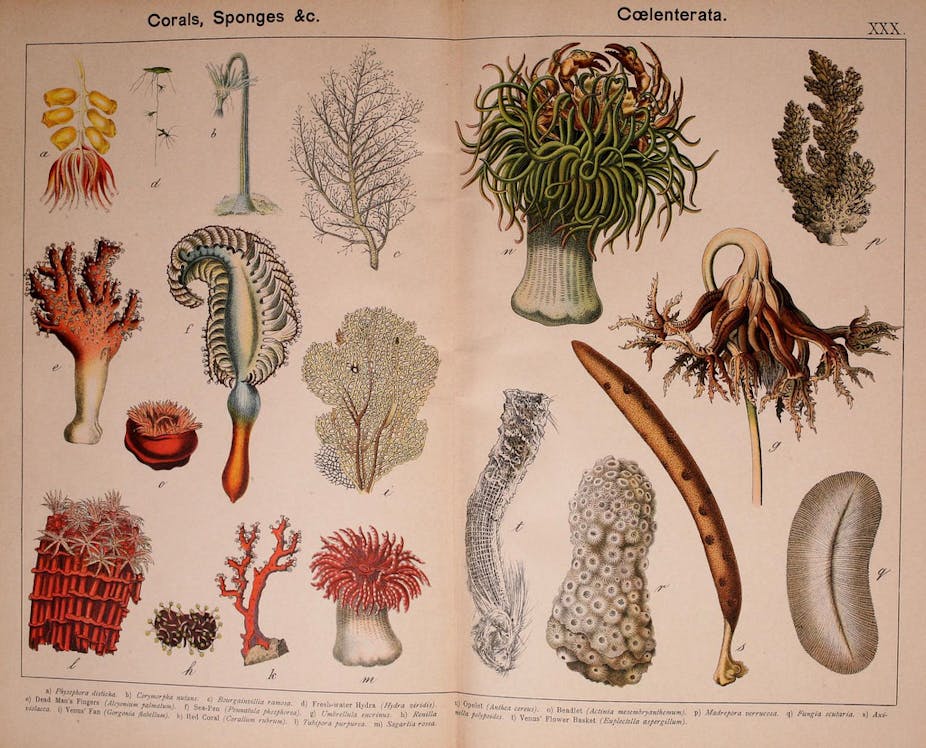
The first animals to evolve (think sponges and hydra) were made of colonies of cells with a small number of cell types. These have some similarities with cancer.
Cancer is a genetic disease of cells of our own body. As the differences between cancer genomes and normal genomes emerge from the mutational noise, our model predicts that the “driver” genes of cancer will be found to be old friends who helped us become multicellular creatures more than a billion years ago.
Our new cancer model shines evolutionary light on cancer’s origin and gives cancer researchers reasons for optimism.