
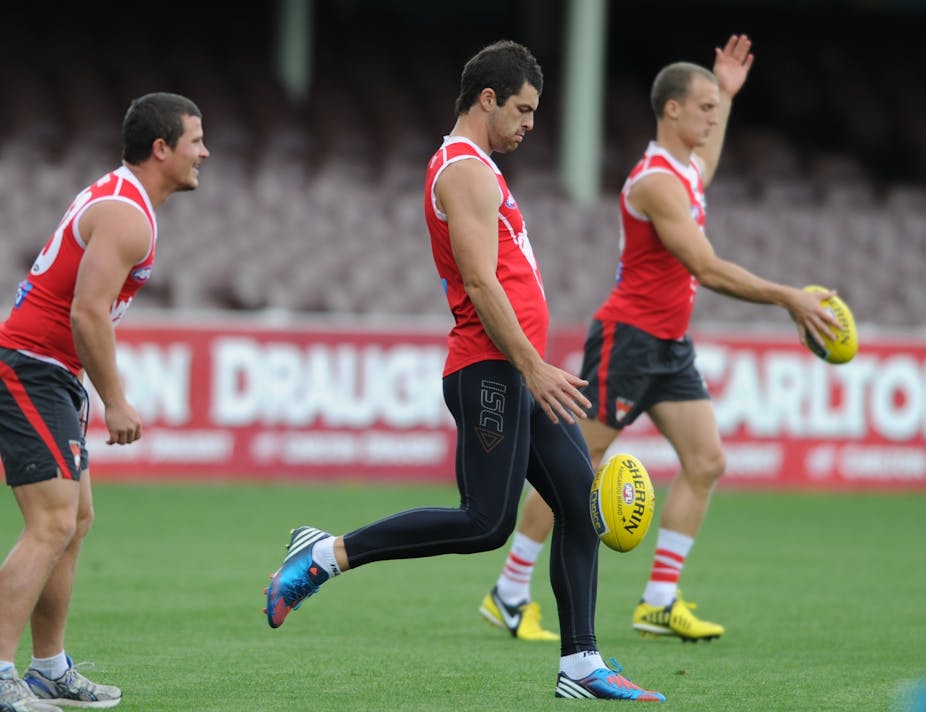
Sport is generally a healthy activity that transmits important societal values, such as fairness, perseverance, and teamwork. Unfortunately, it’s also the primary vehicle for marketing alcohol to the general population.
At its best, sport can provide participants and fans with a sense of identity, pride and self-esteem. But a visitor to Australian shores would be forgiven for thinking that sport is a subsidiary of the alcohol, fast food and gambling industries.
Indeed, the majority of alcohol advertising and sponsorship both in terms of frequency and time of advertising, and in alcohol marketing expenditure, occurs in and around sport. In 2009, two of the world’s largest alcohol producers, Anheuser-Busch InBev and SABMiller, spent approximately $350 million and $212 million, respectively, on television advertising during US sporting events alone. We are unable to obtain figures for Australia.
There are several reasons for the alcohol industry using sport for the promotion of alcohol consumption.
First, placement of alcohol sponsorship and advertising in large televised sporting events allows the alcohol industry to bypass regulations prohibiting alcohol advertising during times when large proportions of children may be watching television.
Victoria Bitter’s sponsorship of Australian cricket, for instance, means that children are exposed to alcohol advertising from ten in the morning to the end of play. And it’s difficult to miss the alcohol brands on signage and boarding around Australian sport stadiums. Or, the VB signs either side of the electronic score board each time a third umpire decision is needed.
Another feature that attracts the alcohol industry is sport’s ability to evoke strong emotion and social identification. Products presented within these sporting contexts are more likely to be remembered, liked and chosen.
Pairing a healthy activity, such as sport, with an otherwise unhealthy product, such as alcohol or fast food, makes that product seem less unhealthy and more acceptable and normal. Many of us will remember tobacco advertising in sport but I suspect that even smokers wouldn’t welcome that back.
Simply put, alcohol advertising and sponsorship in sport works in terms of increasing sales, and of course, alcohol consumption.

Reviews of research on the association between exposure to alcohol advertising and subsequent drinking intentions and behaviours shows that exposure to, and/or recall of, alcohol advertising and sponsorship by children and adolescents predicts their future drinking expectancies, norms, drinking intentions, and hazardous drinking behaviours.
A study from the United States also found that ownership of alcohol-branded merchandise by children and adolescents (such as football shirts and sport caps) was associated with their early initiation of drinking. Similarly, alcohol industry sponsorship of sportspeople has been found to be associated with more hazardous drinking levels among Australian, New Zealand and UK sportspeople.
Beyond these outcomes, alcohol industry advertising and sponsorship in sport and other settings, creates a culture where children perceive alcohol consumption as a normal everyday part of life. And they see it as something associated with sporting success or indeed, being Australian.
Given the known relationship between alcohol advertising and youth drinking, researchers who assess drinking norms, peer influence and parental influence as predictors of young people’s drinking, are in effect measuring people’s exposure to alcohol advertising and sponsorship.
Most of us didn’t grow up in a culture void of alcohol advertising and sponsorship, which makes it difficult for us to imagine sport without them. But given the high rates of hazardous drinking and associated problems in young people (violence, suicide, motor accidents), we probably don’t need to be giving them more encouragement to drink. The same was true for tobacco advertising and sponsorship in sport and few would now question the wisdom of banning such promotion.

The alcohol industry’s self-regulation of advertising has been shown to not work, and stronger regulation is clearly needed. Effective action is possible.
France has had a complete ban on alcohol advertising and sponsorship since 1991. Sport has not suffered and alcohol consumption has decreased in the past 20-odd years. Indeed, France even hosted the 1998 FIFA World Cup with this ban in place and enforced.
Similarly, Norway and Turkey have strong restrictions on alcohol advertising in sport, and South Africa is currently drafting a bill to ban all alcohol advertising and sponsorship in sport. It would be simple to do the same in Australia.
Naturally, “big sport” (AFL, NRL and cricket) and the alcohol industry will object to the removal of alcohol advertising and sponsorship, citing that grassroots sport will suffer. But the experience of nations where bans have been imposed suggests otherwise, such as Norway and France.
The Australian National Preventative Health Agency has successfully negotiated the removal of alcohol sponsorship from most of Australia’s major sporting codes (Football Federation of Australia, Netball Australia, Swimming Australia, Basketball Australia, Cycling Australia, Hockey Australia). But AFL, rugby league and union and cricket are resisting change.

Sport in Australia could still be funded by the alcohol, tobacco, and fast-food industries, but through the ring-fencing of a small portion of the tax gathered from their sales. This would allow sport to thrive without the downside of also promoting unhealthy products to our children.
This is the fifth part of our series looking at alcohol and the drinking culture in Australia. Click on the links below to read the other articles:
Part One: A brief history of alcohol consumption in Australia
Part Two: Social acceptance of alcohol allows us to ignore its harms
Part Three: My drinking, your problem: alcohol hurts non-drinkers too
Part Four: Alcohol-fuelled violence on the rise despite falling consumption
Part Six: Advertising’s role in how young people interact with alcohol
Part Seven: Big Alcohol and Big Tobacco – boozem buddies?
Part Eight: Explainer: foetal alcohol spectrum disorders
Part Nine: ‘Valuable label real estate’ and alcohol warning labels
Part Ten: Forbidden fruit: are children tricked into wanting alcohol?
Peter Ormonde
Peter Ormonde is a Friend of The Conversation.
Farmer
Another excellent instalment in an excellent series.
Geez drugs in sport! Who knew?
But I must take issue with this baselss assertion: "Sport is generally a healthy activity that transmits important societal values, such as fairness, perseverance, and teamwork."
Not this sponsored mass entertainment business... this transmits far more modern "societal values" ... like winning, cheating, doping and lying...whatever it takes.
This modern sporting ethos is on the field - with cricketers…
Read moreKerry O'Brien
Head of Behavioural Studies at Monash University
Hi Peter, you are absolutely right, with what has been going on in recent months, sport is increasingly associated with corruption, cheating, and everything else unhealthy and unsavory (excuse pun), I should have preempted the statement with, 'At its best sport can be.....'
Vested industries/interests (e.g., alcohol, gambling/betting, fast food) appear to have an alarming influence on policy makers/govt, and sports administrators appear to side with these industries rather than with the health (moral, physical, psychological, and social) of their sport, and young people in Australia.
Rajan Venkataraman
Citizen
Peter O
Please keep the updates from Woolibuddha coming!
Margo Saunders
Public Health Policy Researcher
And, curiously, the massive, prominent, and especially incongruous alcohol sponsorship of motor sport seems to remain untouched...?
Stephen Riden
Research and Information Manager, DSICA
Kerry O'Brian leaves a few facts out of his article.
Before supporters of banning alcohol advertising conclude that ANPHA made a break-through in its financial agreement with 12 sports, they should consider the fact that of those 12 sports, 10 did not have any exisiting alcohol sponsorships that I could detect, nor could the marketing industry detect any. If those sports want to correct the record, I'm happy to be proved wrong. So ANPHA is paying 10 sports bodies to not do something they were…
Read moreKerry O'Brien
Head of Behavioural Studies at Monash University
Hi Stephen, the systematic review conducted by Anderson included the international peer-reviewed scientific research on this area.
But you are correct in suggesting that its not JUST restrictions on alcohol advertising that lead to reductions in excessive and hazardous drinking, alcohol pricing and taxation, restrictions on outlet density and trading hours, are also likely needed in which to get a change in drinking culture and the associated harms. Please see this series of papers in the leading medical journal, The Lancet for the evidence. http://www.thelancet.com/series/alcohol-and-global-health
Stephen Riden
Research and Information Manager, DSICA
If it's in The Lancet, it must be true then.
Evert Rauwendaal
logged in via Facebook
If the French ban on advertising and sponsorship had absolutely no impact that means the liquor industry had been wasting their money on marketing for quite some time.
So why does the liquor industry spend money on advertising if it doesn't persuade people to drink?
Stephen Riden
Research and Information Manager, DSICA
A common but mistaken argument for regulating alcohol advertising is that if it didn’t work, then companies would not advertise. This begs the question as to what is meant by advertising has ‘worked’.
The purpose of alcohol advertising is to tell potential customers above the legal purchase age who are looking to make an alcohol purchase within a relatively short period of time (i.e the next week or so) about the products available to them They can then make informed choices among competing brands.
Advertisers’ objectives are to encourage consumers to switch to their brand and to create or maintain brand loyalty. Thus, advertisers gain market share at the expense of other producers, who lose market share. In that sense, advertising ‘works’.
Evert Rauwendaal
logged in via Facebook
Advertising doesn't attract new customers, it only persuades adults (because children are immune) already in the market to switch brands?
Ahahahahahahaha!
Simple question Stephen:
Does marketing persuade people to buy stuff? Yes/No?
Stephen Riden
Research and Information Manager, DSICA
No - not if they don't want the stuff advertised.
People see thousands of adverts each day and happily ignore almost all of them because they are not interested in what the advert is about.
What happens in your world - do you see a car advert and go buy a car?
No amount of advertising will pursuade you buy anything unless you have an existing need to fulfill.
Peter Ormonde
Peter Ormonde is a Friend of The Conversation.
Farmer
That's not actually how this sort of strategic marketing is designed to work Stephen... one doesn't watch a couple of overs and be overcome by a thirst than only a Fourex can fix.
It's about association... about becoming the wallpaper in daily life ... about being associated with blokes, and sport and winning and excellence and celebrations and the like.
In essence it is political. Not only does the sponsor buy dependent allies and potential defenders but it also is about good things - the Orstrayan culcha - and being a part of that. Putting something back into the community. Like our slot-addicted clubs.
That or there is just this deep visceral connection between brewing and balls. They sponsor the footy for the sheer love of sportsmanship and the game itself.
Stephen Riden
Research and Information Manager, DSICA
"Its...about being associated with blokes, and sport and winning and excellence and celebrations and the like."
Sound like a fine set of values for any product to be associated with. But that sponsorship doesn't mean that drinking alcohol has any greater attraction for fans of that sport. Attitudes to drinking and intoxication come from parents, the wider family and peer groups.
If the fans choose to drink, they hopefully will remember the brand.
Sponsorship certainly doesn't give out a message that being drunk is the best way to spend the weekend, or that disputes are best sorted out by glassing the other guy.
Margo Saunders
Public Health Policy Researcher
That's overly-simplistic. Advertising creates those 'needs' that its products and services then fulfil (notorious example used in marketing courses: who knew that we 'needed' hair mousse until it was invented?) and then serves to keep reminding us that we need it because of the various benefits that it bestows -- and not just this particular product, but that entire product category. But you know this.
Stephen Riden
Research and Information Manager, DSICA
Margo
Alcohol is a mature product, unlike hair mousse back whenever - alcohol's existence does not need to be introduced to anyone.
And taking the hair mousse example a bit deeper in thinking, it was then simply a new product that answered a pre-existing need - to hold hair in place - that had previously been provided by Brylecream (spelling?) and perms...I'm no hair product expert.
Take the iPad - a new way for people to access the internet. Was that a new need created just by slick…
Read moreMargo Saunders
Public Health Policy Researcher
On the matter of whether advertising creates or simply addresses needs, I think we will have to agree to disagree.
Evert Rauwendaal
logged in via Facebook
Oh my, you would only concede that car ads were persuasive if everyone exposed to them bought one.
How absurd.
Ben Renegar
logged in via Facebook
Alcohol sponsorship of sport filled the hole left by tobacco sponsorship. Nobody would even think twice today about the banning of tobacco sponsorship, it made complete sense, yet it's taken almost 20 years since that ban for us to finally start talking about alcohol sponsorship when exactly the same arguments apply.
Alcohol sponsorship normalises alcohol consumption and creates an association in the mind of consumers that inextricably links the two activities; watch cricket, drink beer. watch footy, drink beer.
For young boys in particular, looking to adult males as role models, they make a connection between drinking beer and being a man and alcohol sponsorship of major sporting events only serves to reinforce this. Is it any wonder that alcohol is so culturally engrained in our society?
margaret moir
old lady
I agree with Mr Ormonde what we see can hardly be called healthy sport.
It was a great day when Labor put through changes re Tobacco it will be great if the community can see that the Alcohol industry also needs a shake up.
Just another example of too much power with the vested interests.
Government representatives have a mandate to act in OUR national interest is effective blocked by media blitz and court actions and are forced to back away in some cases.
Multinationals, transnational business and powerful not so faceless persons have become too powerful add too much 24 x 7 media kangaroo court it appears even too powerful for elected governments.
Brian Byrnes
Retired
"...creates a culture where children perceive alcohol consumption as a normal everyday part of life"
When did alcohol consumption become an abnormal part of everyday life ?
Margo Saunders
Public Health Policy Researcher
It wasn't for me -- but then I grew up where the legal alcohol purchase age was 21, and I wonder if that actually has a strong social and cultural influence. It certainly meant that we had access to, and expected to be involved in, a range of social activities that didn't involve alcohol -- communities knew that there was always a large group of under-21s who needed places to go and things to do, as opposed to many Australian towns where it seems that every social venue involves alcohol. And my…
Read moreGary Max
logged in via email @gmail.com
The most disappointing aspect of the articles in this series is that, despite evidence that alcohol consumption in Australia is declining/flatlining while alcohol problems are growing, the same unimaginative availability controls are trotted out as urgent policy responses.
Read moreAvailability and marketing undoubtedly have some impact on drinking patterns. But why do some cultures drink more with less harm, others drink more and with greater harm despite more rigorous controls over availability?
Drinking…
margaret moir
old lady
Gary Max Did the alcopops tax work or where can I go to find the evidence that alcohol consumption is in Australia decining / flatlining? And can you tell me what cultures drink more with less harm I would assume if there is little violence the must be health issues produced by the excess alcohol consumption.
I hear what you are saying re move on Re: socially conscious vs big bad business but do you not think that there is a real problem in having issues (all sorts of issues) presented rationally and that some major media outlets are contributing to the decline of rational respectful debate on all the relevant facts and factors of important issues? I think that is such a major concern re big business as media is powerful to infuluence and with great power should come great responsbility or accountability.
Stephen Riden
Research and Information Manager, DSICA
Margaret,
The ABS has this webpage:
http://www.abs.gov.au/ausstats/abs@.nsf/Lookup/4307.0.55.001main+features72010-11
margaret moir
old lady
Stephen Thank you for the quick reply and the info just one question doesn't it also have figures on that site to say there is an increase in consumption of mixed drinks? I am still trying understand this type of data
Henry Franceschi
Director, NCD Treatment Centers
What patronizing nonsense, all based on myths:
1. MYTH 1: TV is free entertainment for the masses. Wrong. TV is neither entertainment nor is it consequence free. TV is (a) a sales device that gives advertisers a way to REACH you via your TV screen; (b) if advertisers can’t REACH you they sell you squat; (c) if you don’t allow it, SELLING can’t take place; (d) you control if advertisers REACH can REACH you and your kids or not.
2. MYTH 2: French and Australian motives for alcohol use are identical…
Read moreJason Thompson
logged in via Facebook
Kids are not static - they grow up, they get jobs, money, and then they purchase the stuff they couldn't but wished they could when they had none.
How many 16 year-olds do you reckon have 'no money, period'?
Dump the TV - Everyone?? Can't say that this is the most pragmatic or implementable solution. What next - dump the internet?
Henry Franceschi
Director, NCD Treatment Centers
The issue about kids in the article was that assertion that nasty advertisers are targeting kids through sports events. It's a silly argument because advertisers spend their money wisely and no experienced advertiser targets anyone whose demographics indicate that they are not actively spending in your category and with your specific brand. And most of those who have not yet become loyal to a specific brand are just sampling a whole range of tastes, flavors and brand images, so that too is not a…
Read moreLeigh Burrell
Living it up on a union slush fund - top hotels, fine dining, women, cash!
"Roll the two cultural habits and drivers in your head: quiet, polite and mature for the French, crude, rude and childlike for the Aussies, with binging, vomiting and street scenes pure Aussie."
As an Australian and a drinker I'm offended by your comments regarding Australians. Under Labor's proposed discrimination laws your comment would be unlawful. You loony lefties wanted laws against offending people, soon you may have them. Enjoy!