



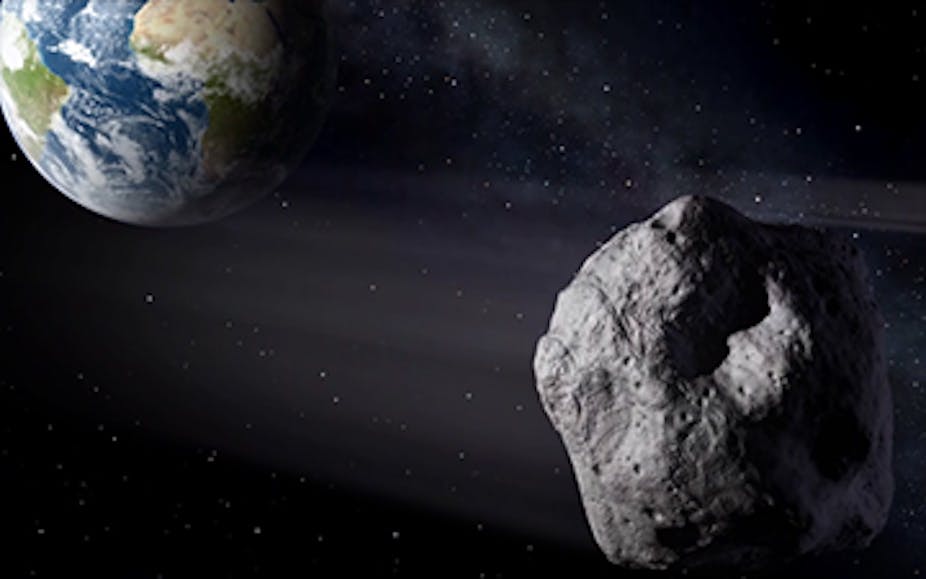
An asteroid expected to hurtle past Earth next week will fly within range of communication satellites but will not hit the planet, experts said today.
Known as 2012 DA14, the asteroid is around 45m in diameter and is on track to whiz within 27,700km above Earth’s surface next Friday at around 9.24am AEDT, a record close call for an asteroid of this size.
The US space agency NASA said “there is no chance that the asteroid might be on a collision course with Earth. Nevertheless, the flyby will provide a unique opportunity for researchers to study a near-Earth object up close.”
Professor Phil Bland, an asteroid expert and ARC Laureate Fellow at Curtin University said such a close visit would help scientists better prepare for an asteroid that was actually on track to hit Earth.
“One of the things we are interested in is if we saw something coming that we thought might be a problem, would we be able to track it accurately enough to know whether we should try to deflect it or do something about it?” he said, adding that even at 45m across, 2012 DA14 was still considered a smallish asteroid.
“In terms of its effect on Earth, if it hit us it would still make a reasonable mess. That’s a bit bigger than the one that blew up over part of Siberia in the beginning of the 20th century, called Tunguska,” he said.
“No one saw that one coming. It was a huge fireball that came in and blew up around 10km in altitude over part of Siberia and really devastated a huge area. It’s the same sort of energy as a big nuclear blast.”
That blast created shock waves powerful enough to flatten trees and houses, he said.
“If this one next week did hit us, it’d do something like that, it would be more likely to blow up in the atmosphere than on the ground. But we are safe and sound, they know where it’s going to be. This one is not going to hit us, we will not have any trouble at all.”
Professor Trevor Ireland from the Australian National University’s Research School of Earth Sciences said between two and 40 tonnes of extraterrestrial material entered Earth’s atmosphere a day.
“Most of the meteorites or shooting stars you see are the size of grains of sand or a match head but they come into the Earth’s atmosphere fast, at about 16km per second,” he said.
“The solar system is rather active. Even though we look up in the night sky and see not much happening, there’s certainly a lot of activity in the asteroid belt.”
Next week’s asteroid follows the release of a new scientific paper, published in the journal Science, that presented new evidence linking a giant asteroid impact in Mexico with the disappearance of the dinosaurs.
“These researchers have been able to find something dating the end of the dinosaurs as well as the impact and it’s getting close. It’s removing any doubt that dinosaurs were wiped out following that incident,” Professor Ireland said, adding that the impact, which caused the Chicxulub crater, may have coincided with a period of high volcanic activity.
“[The asteroid] was potentially ejecting sulfates and carbonates which put nasty chemicals into the air and block out the sunlight. You put that on top of the volcanoes at the time and you have something that could be quite toxic to the lungs of larger animals.”
Professor Ireland said the new evidence showed that “something really nasty happened there for the dinosaurs.”
“The good news is their departure allowed for the rise of mammals like us. So it’s swings and roundabouts.”