
AUSTRALIA BY NUMBERS: The Australian Bureau of Statistics released the first batch of its 2011 census data yesterday. We’ve asked some of the country’s top demographers and statisticians to crunch the numbers on Australia’s population: how we live, where we work, who our families are and how we spend our time.
Today, Michael Taylor looks at what the data show about ageing and people who care for the aged.
The first release of the 2011 census data gave the Australian public a detailed insight into ourselves — or, at least, as we were on August 9, 2011. Initial reports focused on the apparent absence of large numbers of people from Australia that evening: the nation’s population was 300,000 down on the previous estimate for 2011. Given current preoccupation with “Big Australia”, it’s unsurprising that this was the first part of the census to be discussed.
Another element of the data that attracted initial attention related to population ageing. The median age of Australia’s population in 2011 was 37.3 years, a substantial increase from 32.4 years in 1991. Approximately 14% of the Australian population was aged over 65 years in 2011, compared to 12% in 1996.
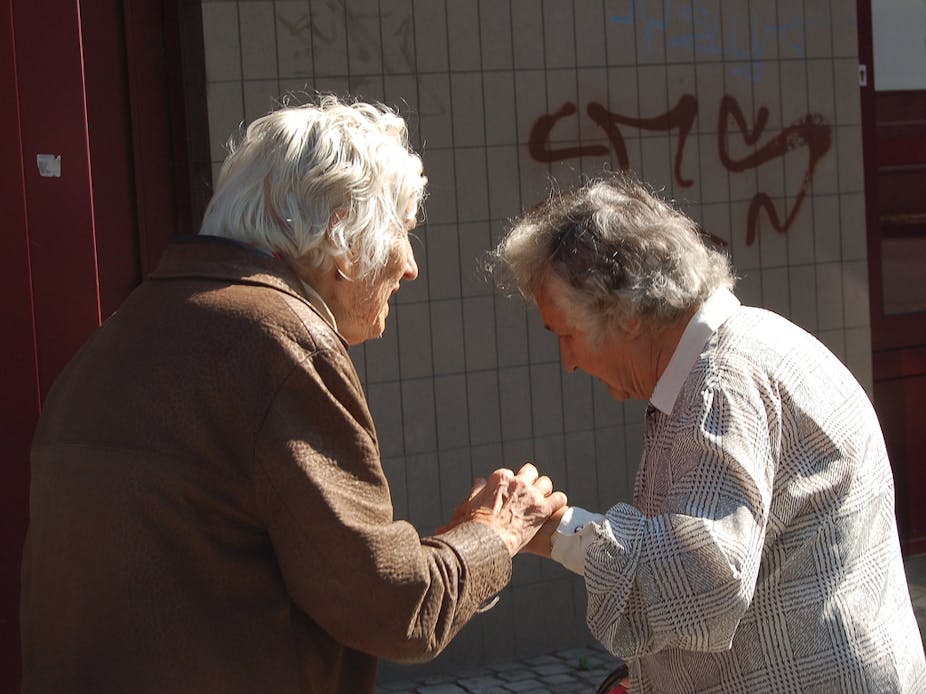
As well as these abstract indicators at the population level, the census also contains a far more personal picture of what this means for Australia’s population: the number of Australians who, for reasons of old age, disability or long-term illness, require assistance with everyday activities. In 2011, almost one million Australians stated they needed assistance with basic activities.
The census also provides us with information on the number of Australians providing unpaid assistance to family members. Approximately 1.9 million Australians stated that, in the two weeks prior to census night, they had provided assistance to a family member due to a disability, long-term illness or problems relating to old age.
These figures equate to 4.6% of the Australian population requiring assistance, and 8.8% of Australians providing assistance. This is a slight increase on the 4.1% requiring and 8% providing assistance in 2006.
These figures can be cast in even more abstract economic terms if we re-imagine “providing” and “requiring” assistance as simple supply and demand. When expressed in these terms (subject to many assumptions), the change over time gives cause for concern. In 2011, there were 1.9 providers for every recipient, an ever-so-slight decrease from the 1.95 providers per recipient in 2006.
While a number of explanations are possible, this may indicate the beginning of a slow drift away from an “average” two-to-one ratio (e.g. two adult children looking after an elderly parent) to a one-to-one ratio (e.g. two adult children looking after two elderly parents). Unfortunately, this decrease may also reflect that more people now require assistance and have no family members available to provide it.
It’s with such scenarios in mind that this census information is best understood. People caring (or those who have cared) for elderly parents will recognise the significance of the graph below showing the age distribution of assistance providers and recipients.
“Requiring assistance” is, naturally, skewed towards older age brackets. In 2011, almost half of all Australians aged 85 and above reported that they required assistance with their everyday activities. People who provided assistance were far more evenly distributed throughout the population, peaking in the 55- to 64-year-old age bracket, where almost one person in five provides assistance to a family member.

Subject to many assumptions about future population growth and change, the ABS predicts that by 2030, between 19.5% and 20.8% of the Australian population will be older than 65 years. While it’s not clear yet whether we will be a big or small Australia in 2030, we will certainly be an older Australia, and more changes in the provider-recipient balance are almost definite.
Another important aspect of this social change to keep in mind is that part of the pressure in the future will not just be the number of people requiring or providing assistance – it will also involve the amount of assistance they need or give.
The census information tells us only that someone spent time providing assistance to a family member in the past fortnight; someone who spent one hour a fortnight providing such assistance will answer yes to this question, just as a person who spent one hour a day would.
Similarly, the intensity of an individual’s requirement for assistance will also increase in the future, given current trends towards people having multiple long-term illnesses as they age, and increasing rates of dementia in our community.
The simple supply-and-demand balance discussed above is perhaps better understood as a rubber band stretched between individual providers and recipients. According to the Productivity Commission, the availability of formal assistance services for older people and people with disabilities are similarly stretched rubber bands, with Treasury this week warning of future difficulties in financing public programs.
Our ability to keep these rubber bands from breaking, and how we deal with what happens if they do, will be a substantial test for Australian society in the future.
Dale Bloom
Analyst
Australia’s population is definitely growing, and the major factor seems to be immigration.
“Net overseas migration accounted for 55% of the growth for the year ending December 2011, with the remaining 45% due to natural increase (births minus deaths).”
http://www.abs.gov.au/ausstats/abs@.nsf/mediareleasesbyCatalogue/CA1999BAEAA1A86ACA25765100098A47?Opendocument
The average age of an Australian is getting older, and one of the major factors could also be immigration. With 55% of population growth attributed to immigration, and if most or many of those immigrants are adults, we are importing an older population.
Any negative affects of an older overall population, are being accentuated by importing older people into the country, or bringing in so many people not born in Australia.
Regan Forrest
logged in via Twitter
So what solution do you propose?
Cutting immigration would bring many essential industries and services to a standstill. Just as one example is the medical profession. Our public hospitals are full of people who are trained overseas (my partner is one of them). This is partly due to the limited numbers of locally trained doctors as well as the fact that locally trained doctors tend to take more lucrative work in the private sector. There's no overnight solution to this as it takes a long time…
Read moreDale Bloom
Analyst
I see the current population as being about the right size, or perhaps it is already too large to be sustainable, and it does appear that importing in so many adults is simply increasing the aging population, and decreasing Australia’s ability to provide for that aging population in the future.
So we are systematically making the situation worse for ourselves in the future.
Regan Forrest
logged in via Twitter
I'd say yes and no to that.
In my partner's case, he's been a top-rate taxpayer since the day he arrived in Australia. The Australian taxpayer has benefited from his expertise and training without having to foot the bill for that training. Bottom line is that his taxes will more than pay for his presence here (by several orders of magnitide), even assuming an extended old age. I'm sure he's not the only migrant who is putting back much more than he is taking out.
Having said that, I think the popluation sustainability is a global issue, not a national one. We have surpassed the sustainable carrying capacity of the planet and we need to fundamentally rethink our economic models - continued "growth" is just not feasible.
Dale Bloom
Analyst
Some time ago, the Australian Academy of Science estimated Australia’s sustainable population at 23 million, which is approximately the current population.
http://www.science.org.au/events/sats/sats1994/Population2040-section1.pdf
Mostly due to immigration, we will now go well beyond that population figure, and the average immigrant seems to be middle aged, adding to the ageing population problem.
Regan Forrest
logged in via Twitter
But I ask once again, in light of the realities I've discussed, what solution do you propose?
Dale Bloom
Analyst
It would be useful for various people (mainly science researchers perhaps) to review the Academy of Science's report on sustainable population. From my review of the report, I would say we are well on track for an unsustainable population.
I would also like to see an immediate reduction in immigration, or a complete halt, with perhaps temporary work visas only for job vacancies will cannot fill in Australia.
Regan Forrest
logged in via Twitter
Hmm. OK. So in your ideal world I would be banned from returning to the country of my birth with my overseas-born partner?
Dale Bloom
Analyst
I would be cautious of going to some other country.
http://www.abc.net.au/news/2012-06-22/moodys-downgrades-big-banks/4085876?section=business
Australia is not immune also, and the situation only gets worse when countries have unsustainable populations they cannot afford.
Regan Forrest
logged in via Twitter
Sorry you've lost me. How does that answer my question?
Dale Bloom
Analyst
You seem to ask a lot of questions. We are currently building an unsustainable population that is also aging, and most of this is occurring through our immigration policies.
What would you do about it?
Regan Forrest
logged in via Twitter
I asked you one simple question actually. To spell it out: I was born in Australia. My partner was born overseas. In your immigration-free ideal, where would we be allowed to live?
In terms of my solution, I think that focusing on Australia is to fail to see the big picture. Population sustainability is a global issue and I would be looking at policies that encourage lower birth rates for a start.
To pull up the drawbridge, lock the rest of the world out, and try and insulate ourselves from what is a global problem is not feasible. Not to mention morally indefensible.
Dale Bloom
Analyst
You can go back to your country of birth if you want, if they will allow people in.
As for continuously increasing the population, there is a limit to what is sustainable. There is also a balance between the number of older people, and the number of younger people who can provide for, and look after the older population.
I have just read an article where young families can hardly afford accommodation anymore, much less provide for an older population, but large numbers of immigrants are still being brought in.
http://www.theaustralian.com.au/national-affairs/in-depth/housing-goal-fades-for-young-families-census-data-shows/story-fnegj121-1226405988640
Big thoughts are required about this absurd situation.
Regan Forrest
logged in via Twitter
Since I said "I was born in Australia", and you responded with "You can go back to your country of birth", it is indeed an absurd situation we find ourselves in.
This circular conversation has gone on long enough. Good day to you.
Dale Bloom
Analyst
There is no circular argument.
Australia has brought in too many immigrants, overpopulating the country, and too many immigrants were middle aged, increasing the aged population problem.
The future is likely to be one way, and all downhill now.
Richard Ure
logged in via Facebook
So having brought too many people in already, we now not only "stop the boats", but start deporting people like Regan (and me), also a multi-generation Australian married to an English person. Would you draw the line at descendants of the First Fleet who have dared to marry "foreigners"?
Dale Bloom
Analyst
Richard Ure,
I haven’t heard of anyone saying current immigrants should be returned back to their country of origin. Quite a few seem to be emigrating, or returning back of their own accord.
But at the same time it is not responsible to be bringing in so many people beyond the carrying capacity of this country, creating a massive ecological impact, and creating an aging population as well.
The concept that science will find an answer is a false concept. Science has not found an answer to overpopulation and high ecological impact to date.
Andrew Smith
Education Consultant at Australian & International Education Centre
"Carrying capacity" seems to be a very subjective notion and based upon a an unsustainable way of life in Australia which has high ecological impact e.g. automobiles, fossil fuels, low density suburban homes.
Further, most immigrants are young, i.e. maximum age is 50 but they would have a hard time making the points threshold due to their age, with preference for younger generation, whether they are full fee paying international student /graduates, and workers at peak of earning capacity and contribution they can make to Australia.
Try telling rural and regional communities with declining populations and unable to attract and/or retain skilled working Australians...... they of course need to rely upon foreign health/medical personnel, teachers, tradespeople, cooks and other workers.... while many Australians with same qualifications choose to work abroad or in state capital cities.
Andrew Smith
Education Consultant at Australian & International Education Centre
NOM includes temporary residents such as international students (since definition changed in 2006) who cause spikes in both NOM and population growth rates.
Irrespective of whether Australia has immigration or not, it is not population that is unsustainable, but the way Australians choose to live in (badly designed houses) and dependent upon increasing energy costs, both of which are unsustainable.
I guess the solution for caring of our ageing population and decreasing tax base will be through neglect and increased taxes for younger generations?
Not going to say here, but we all know what these proxy arguments about environmental care, unsustainable population growth and immigration are about; unless many on the hard right have suddenly become caring greenies :)
Taking the anti immigration argument further, quid pro quo, Australian citizens, partners and dependents will be forced to return to Australia?
Mark Carter
logged in via Facebook
I challenge anyone to buy a house in Australia today which isn't badly designed- Choice doesn't come into it!
Andrew Smith
Education Consultant at Australian & International Education Centre
We can go on and on about perceived problems but a first world country like Australia could surely develop solutions? Immigration and population are responsible for neither urban planning nor design, our three levels of government, housing/real estate industry and Australian society are.
Further, we can become defensive and not mention ageing of our population but the fact is there is a massive qualitative and quantitative issue arising (as is already occurring in Japan, large parts of Europe…
Read moreGil Hardwick
Anthropologist
Wonderful to see that it is not until after 75 years does requirement for assistance overtake provision. This sheds interesting light on the projected so-called 'burden' of aging in society. We look after one another pretty well, thanks, and with a lot of us returning to university rather than retiring a hell of a lot left in us yet.
With an average lifespan of 79 years for males and 84 for females, aside from those few 'selfish' enough to live past 75, and worse 85, my guess it's pretty well covered.
But then, I'd tend to argue that the over 75s and 85s contribute far more in the joy they bring us - well worth the investment - assuming we have more mixed and home-care facilities rather than locking them all away in institutions.
My neighbour here is in her early 90s, still living in her own house, an absolute delight. She makes us cakes, and we take her for walks . . . :-)
Regan Forrest
logged in via Twitter
Interesting point Gil.
The word "elderly" implies a loss capacities that does not necessarily go hand in hand with getting older. We need to mind our language.
Personally I'm of the opinion that "overnight" retirement (i.e. one day, you're aged age 64 and 364 days you're working full-time; the next day you're 65 and put out to pasture your gold watch) is neither good for the person or the economy. Our industries need people with experience, and our brains thrive on having things to do and…
Read moreMark Carter
logged in via Facebook
Its so depressing to see issues like caring for the elderly being used to sheepdog us into a bigger population.
But I guess many people will be eager on importing foreigners to care for their old folk- heaven forbid they'd ever have to do it themselves, or pay real wages to those doing the caring...
Alan Ditmore
mechanic
The strategy laid out below is geared towards conditions in the United States, and I don't know how close they are to conditions in Australia. What it requires is that different communities have dramatically different average social values, and those differences are diverging through domestic migration. It also helps if local councils spend a lot of local taxes on school and childcare, so that taxpayers in low fertility communities pay less school tax than those in high fertility communities…
Read more