AUSTRALIA BY NUMBERS: The Australian Bureau of Statistics has released the first batch of its census data. We’ve asked some of the country’s top demographers and statisticians to crunch the numbers on Australia’s population: how we live, where we work, who our families are and how we spend our time.
Here, Gary Bouma considers how the changes to our religious make-up will play out in schools.
The 2011 census results for religion have profound implications for Australia’s schools.
Yes, the number of Australians nominating “no religion” on their census form has increased substantially, to become the number two option nationally and the number one option in five of eight states and capital cities. But the results for those who did nominate a religion are indicative of substantial growth in certain sectors of the population. It is precisely this polarisation that will make for harder work in the government schools.
No religion, new religion
The most readily notable change from 2006 to 2011 is the increase in those claiming to have “no-religion” rising from 18.7% to 22.3% and supplanting Anglicans in the number two spot. Far from all of those who nominate “no religion” are atheists (there were only 31,000 or 0.16% in 2006), but it does represent a substantial shift away from organised religion; a trend that has been fairly consistent over the past few decades.
But before we rush to conclude that religion is a waning force in Australia some other results require examination.
Several “newer” religious communities have increased their numbers to become substantial players in the religious marketplace, at least as substantial as some Protestant groups that have long been understood to be a standard part of the religious landscape.
At 2.5%, Buddhists are within one or two censuses of becoming more numerous than Presbyterians. They are already more numerous than Baptists or Lutherans. So far Buddhists have not been particularly inclined to open special schools for their children, so there will be an increased presence Buddhists in government schools.
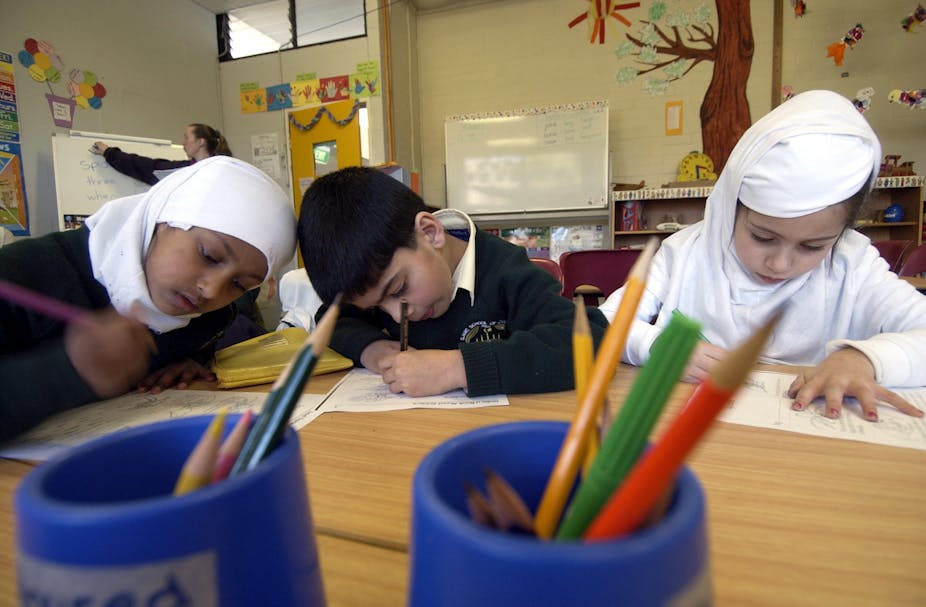
Muslims are also more numerous than Baptists or Lutherans at 2.2%, due to migration and a comparatively high birth-rate. This will certainly mean an increase in the number of Muslim children attending both government and Muslim Schools.
Hindus have risen by 86% since 2006 to represent 1.3% of the population, mostly through migration. Hindus are now more numerous than Pentecostals (1.1%) and Jews 0.5%).
Religious schools
The next decade will tell whether Hindus will follow Catholics, Muslims and Jews in establishing faith-based schools. They will certainly have the population numbers to do so.
Most other religious groups grew numerically if not as fast as the Australian population and thus slipped slightly in the proportion of the population. Catholics grew by nearly 300,000 suggesting that Catholic schools will be reasonably supplied over the coming years.
Among the other “top 20” religious groups only Anglicans, Uniting and Presbyterian/Reformed lost absolute numbers. Even in these cases, though, the rate of decline has slowed.
For example, Anglicans declined by 4.2% between 2001 and 2006 but only by 1% between 2006 and 2011. Most of the schools associated with these groups are “elite” and unlikely to be affected by these developments.
Polarising students
The full impact on schools of the changes revealed in the 2011 census will be clearer when the religion by age data are released, so we can see exactly the religious composition of school-aged children.
But we know that migrant groups are comparatively young, that Muslim birth-rates imply they will be populating schools in a greater proportion than, say, Uniting or Anglican who are comparatively aged. Those declaring “no religion” are younger than average, but school-aged children tend not to complete the census forms by themselves and are often “given” the religion of their parents until they do so.
Thus, government schools are likely to become even more polarised, between those who are not religious and those who now come from even more substantial and different religious backgrounds.
Yes, schools have been coping with this for a long time. The difference is the addition of substantial numbers of Hindu students alongside Buddhist, Muslim, Sikh and Baha’i students. Many of these students will be disinclined to leave their religion at the school gate. Parents from these groups will join those from other religious groups in seeking arrangements that recognise and affirm their children’s faith. At the same time larger numbers of parents who declare that they have “no religion” are likely to be seeking schooling that is free from religion.
Honouring diversity
As Buddhists, Muslims and Hindus form substantial communities, as they become numerically “normal” in the population and school communities, there will be increased pressure for education about religion in the curriculum. However, this curriculum will have to honour not only a diversity of religious backgrounds but also those who do not identify as religious at all.
School communities characterised by increased religious diversity including more of those who have “none” will challenge even further the current chaplaincy program, to say nothing of those programs that promote a particular form of Christianity.
School administrators who thought a “neutral” secular approach would cover these issues will continue to find this not to be the case.
Secularity is not neutral, and those who are serious about their religion will not abide this approach. There is no escaping it: recent changes to Australia’s religious composition will make education and school management more difficult.
Tim Scanlon
Author and Scientist
It disturbs me a little that faith based schools will continue to be strong. I recently heard that Catholic schools spend the peak hours of schooling (when kid's attention and learning faculties are at their peak) teaching religious education and stick science and maths at the tail end.
No wonder we have prominent religious figures in our community with a wanton ignorance of science. This does not bode well for our advancement as a society.
Michael Shand
Michael Shand is a Friend of The Conversation.
Software Tester
Point taken Tim that there are more important subjects to cover other than religion (ie. Math) however you may underestimate the role that religious belief plays in our society. When you teach children that it is alright to believe some* things on no evidence or in contradiction to evidence, and that no one can/should criticise them for it.....and then you end up with a bunch of adults who cannot tell if climate change is real or evolution is happening or whether stem cell research is killing an…
Read moreWarren Oliver
Code Cutter
I believe the religion by age data is available. 32% of the population aged between 0 and 4 were declared as "no religion". 25% of the population aged between 5 and 14 were declared as "no religion" and 28% of the population aged between 15 and 24 were declared as "no religion". This clearly shows that the younger people are less religious than the older ones. Not that surprising really.
Tristan Cooke
logged in via Twitter
You've interpreted the 'atheist' bit wrong. You say:
"Far from all of those who nominate “no religion” are atheists (there were only 31,000 or 0.16% in 2006)"
The question has an option of 'no religion'. You are allowed to type in 'athiest', 'agnostic' or 'humanist'... but most people would just mark the no religion box (and is in fact what the atheist foundation of Australia suggested.
We have extended comments on the design of this question here which we think undercounts 'no religion':
http://humansindesign.com/post/25563229570/did-the-2011-australian-census-get-religion-right
Michaela Patel
Primary & Secondary Teacher
I'm disappointed that with the new Australian Curriculum, they still haven't been able to come up with a decent approach to teaching comparative religion. Believe it or not, religious beliefs are important to more than half the world's population, and students should leave school with a basic understanding of different belief systems. The current approach in Victoria is terrible - my kids came home with colouring in books, photocopied worksheets with mazes ("Help Adam find Eve"), and no evidence at all of any discussion about the Christian religion. Certainly no comparison of what Christians believe versus what anyone else believes. No discussion of why some kids at school fast during third term (Ramadan) or don't eat certain foods. I'm currently ambivalent about organised religion, but I really wish I had learnt more about the dominant global religions when I was at school.
Tim Scanlon
Author and Scientist
Why do we need to teach religion in schools at all?
I'd argue that there are many far more important things that need to be covered adequately (science, math, language, nutrition, accounting, how to listen, how to turn your phone off in the cinema). Most people's understanding of religion is from Charlton Heston movies anyway, not like a school class will change that.
Michael Both
logged in via LinkedIn
A well-balanced comparative religion / history of religion course would be beneficial for a number of reasons:
Read more- a lot of human culture and development is intertwined with religion, so some basic understanding of religion is necessary to fully comprehend the 'how' and 'why' of human history (and also where the world is heading)
- it would demonstrate that at, at their basis, many religions have the same underpinnings / morality (don't kill, do the least harm, respect people and so on)
- non-pressured…
Tim Scanlon
Author and Scientist
I understand your points, but I would be more of the opinion that religion is just something that is tacked on, necessary for understanding, but not for anything else.
There is always a level of influence to anything, especially as you noted with history. Religion, politics and any other inherent biases are important to history, but they aren't history, they are the clarification. So rather than teach the comparisons, I'd prefer the history be taught. Otherwise you could end up teaching a lot of meaningless things, like Cernunnos, Esus and Airmed, for sake of comparative religious teaching.
So I don't disagree wholely, but more on the context of the teaching.
Although I don't agree with morality being the underpinning of religion. I think the two are mistakenly intertwined, as morality traces its origins to before religion as a modern concept.
Dee Lowe
Editor
The more I read the more pleased I am that I have chosen to be an antitheist ie opposed to belief in god(s), on so many levels.
Mike Williams
logged in via Facebook
"Yes, schools have been coping with this for a long time" - frequently by forcing children to be part of a religious group (usually CofE in my experience - which was like a dumping ground). This method of "coping" has been going on for decades.
Try formally resisting in a small community where the fact will be spread (by gossipy children, teachers and religious workers) and have social consequences for your parents and family.
There is very plainly a culture of "do not question" religious authority that still goes to the top of Australian society. It doesn't matter how much Voltaire you learn in History classes, applying such philosophy carries no weight when you have a very religious headmaster and deputy (in a government school).
"a “neutral” secular approach" would have all such religious instruction removed from the classroom and made an option for parents to guide their children to out of hours. What is not neutral about this secular approach?
Michaela Patel
Primary & Secondary Teacher
I think many people mix up the idea of religious indoctrination with the study of religion in society. You can't deny that religions play a role in the lives of billions of people around the world. Why not find out about these as part of a balanced SOSE curriculum? Ignoring religions, and refusing to let your children find out about them at school in a comparative way, is very irrational. Why the concern? What harm is there is finding out why some people wear different clothes, eat different foods…
Read moreGuy Taylor
IT Professional
If religion was simply about different clothes and food it wouldn't be a problem. But it isn't. It is dogmatic which is the opposite to learning and has no place in school. In a society that is becoming more anti-intellicual and scientifically illiterate by the day, promoting religion in schools will simply make this worse. The religious few who are pushing for faith based schools are in the minority and political correctness is preventing us from trying to keep education free from their agendas. Secular schooling is the only option for neutrality. Schools should teach knowledge ie science etc, lets the parents teach their belliefs, lets not double dose kids by doing that at school too...
Sandra Kwa
Grad Cert Ethics and Legal Studies, CSU
When I was a Christian teenager in a Presbyterian school, I was exposed to the concepts of Islam, taught through Social Science, and Hinduism, taught through Art History, finding their beliefs quaintly irrational, and culturally bemusing. I could not see my own faith as irrational, because I KNEW I was RIGHT, and had the one true God on my side! This was reinforced every Sunday when my family went to church. It dawned on me just after leaving school that my religion was just as irrational as the others. I wonder if proponents of SRE (Special Religious Ed) are often against GRE (General Religious Ed) because a neutral, secular, description of religious doctrine can tend to illuminate its irrationality?
Mike Williams
logged in via Facebook
I'm not mixing up religious doctrination with studies of comparative religion. There was simply none of the offer. I'm not sure why you're accusing me of this - you don't divide kids into sectarian groups to give neutral lessons on comparative religion.
Our school's religious classes and seminars were about learning to recite religious creeds, having threats of damnation and hellfire blasted at us, and having Fred Nile et al visit and use the school as a platform for his political and religious views.
Michaela Patel
Primary & Secondary Teacher
What good reasons are there for not teaching knowledge about religions? They are undoubtably very influential on many, many people. I don't think you can understand the conflicts in the Middle East without reference to religion and different forms of Islam.
I'm a teacher - it is my role to teach kids to learn to think for themselves, question information, and come to their own understanding of the world. I loathed physics when I was at school. It was my worst subject by far. Now as a science…
Read moreMichaela Patel
Primary & Secondary Teacher
I'm sorry, Mike. I didn't intend to accuse you of mixing them up. It seems that many people do however, and I read you post in that light. You obviously had a very traumatic experience with completely inappropriate religious education in school.
My original post, further up, expressed disappointment that the new Australian curriculum makes no real mention of religion, which I think should be included as part of the SOSE curriculum. I really feel it is a missed opportunity to teach a topic that…
Read moreSandra Kwa
Grad Cert Ethics and Legal Studies, CSU
Professor Bouma, please explain, in what sense is "secularity not neutral"? In my Australian Oxford, secular is defined as "concerned with worldly affairs rather than spiritual ones". It is for churches and other religious organisations to be concerned with spiritual affairs, not the state, and not state schools. Students MUST keep their personal spiritual beliefs personal once they pass through the gate. Any inclinations not to do so should be discouraged, or we WILL have a problem of sectarianism in the school yard. Comparative world religions, taught impartially, is essential education and would foster inter-faith tolerance, plus allow students to assess their own beliefs from a worldly perspective that they don't get at church on Sundays.
Michaela Patel
Primary & Secondary Teacher
You can't have it both ways - making people leave their religious beliefs at the gate on the one hand, and then have them somehow have them compare and contrast their own faiths within an education context. If they did that, they would have to acknowledge their beliefs in the classroom. Tricky.
It seems to me that religious sectarianism develops when people are NOT educated in the ways of other religions, and believe (there's that awkward B-word again) the stereotypes they get from movies, media…
Read moreDianna Arthur
Dianna Arthur is a Friend of The Conversation.
Environmentalist
I can only guess - as there is no comprehensive comparative religious studies at public schools sufficient or long term enough to make accurate statements, but an analytical study of all religions would reveal the strengths and the weaknesses of faith and dogma.
One would also need to include philosophy as a foundation from which to compare the spiritual with the rational approach to life and living with others.
I would posit that comparative teaching would reveal religion to have more in common with fairy tales and other myths. Formal religion, doubtless, have everything to lose from the teaching of comparative religion. It would be (quelle horreur) questioned, dissected, analysed and debated, such exercises revealing the shaky foundations of religious dogma.
No wonder the dominant Christian church is fighting against such programs. Will we have to struggle against the dogma of each, increasing in size, religion as Australia increases its diversity?
Luke Weston
Physicist / electronic engineer
And yet even as it becomes more and more clear from the actual census data that it's important to remove "scripture classes" and chaplains provided by evangelicals and fundamentalists who represent just one particular narrow flavour of Christianity from our state school classrooms, and possibly to replace them with secular comparative religion, or ethics, or maybe to actually return that classroom time to getting the basic numeracy and literacy and critical thinking and science literacy right first, and to replace Christian chaplains (provided by evangelical contractor organisations) with qualified and secular counsellors and psychologists, government funding to put these contractors from the evangelical Christian organisations into the state schools actually, bizarrely, continues to increase!
Gil Hardwick
Anthropologist
It remains a mystery to me, Luke, that these pentecostals, evangelicals, continue to get so much coverage, especially against some putative 'secularism' (maybe because they all make so much noise, create so much 'news' for the journos to peck at) when the real influence of faith-based education continues unabated in our established schools which quietly get on with the business of delivering what is in fact a very high standard of education.
A trivial side argument over some evangelical group…
Read moreGil Hardwick
Anthropologist
This generalised differentiation of religious from presumably secular education is unfortunate, especially in bandying this word 'faith' around so loosely.
Tim, there is barely a school in colonial Australia that wasn't founded by some faith community or other, in those days called churches, or in our Scottish tradition Kirk as the foundation of all community. You can argue faith in God, but I would then add faith in humanity as God's Creation, faith in the inherent goodness of people for that…
Read moreCatherine Byrne
Post-Doctoral Research Fellow at Macquarie University
Perhaps, at various times and in various places, a secular approach to education has been too strongly aligned with a strictly humanist or even atheist ideology. It is a disappointing ruse however, to declare that a neutral way for the secular principle is impossible.
Many who are serious about their religion (or spirituality) will certainly abide an approach in which no particular belief persuasion is encouraged or emphasised, and in which none are discriminated against.
The ‘secular principle…
Read moreSandra Kwa
Grad Cert Ethics and Legal Studies, CSU
Thanks Catherine!
I've just been chuckling over Wiley's 'Non-Sequitur' cartoon showing a guy arriving at the top of the stairway to heaven where there is a sign: "Welcome to HEAVEN - keep your religion to yourself." A haloed St Peter is saying "Ironically, it's what makes it so peaceful here."
George Higinbotham
logged in via Twitter
This passage is absurd:
Yes, schools have been coping with this for a long time. The difference is the addition of substantial numbers of Hindu students alongside Buddhist, Muslim, Sikh and Baha’i students. Many of these students will be disinclined to leave their religion at the school gate. Parents from these groups will join those from other religious groups in seeking arrangements that recognise and affirm their children’s faith. At the same time larger numbers of parents who declare that…
Read moreMichael Glass
Teacher
Why should religious diversity be a problem to schools, teachers and learning? People from a variety of backgrounds manage to get on in schools as they do in the rest of the community. Look at the changes that have happened in the religious landscape over the last 50 years. Anglicanism has gone from first to third place while Catholicism has gone from second to first place and no religion has gone from a small minority to second place. Religions that were hardly present in Australia fifty years ago are now almost part of the mainstream.
This is not to argue that we now live in a social and religious Nirvana. However, Australia of 50 years ago was not a social and religious Nirvana either. The point to remember is that despite the fears, social cohesion has not collapsed with the changes that have so far taken place in Australian society.