
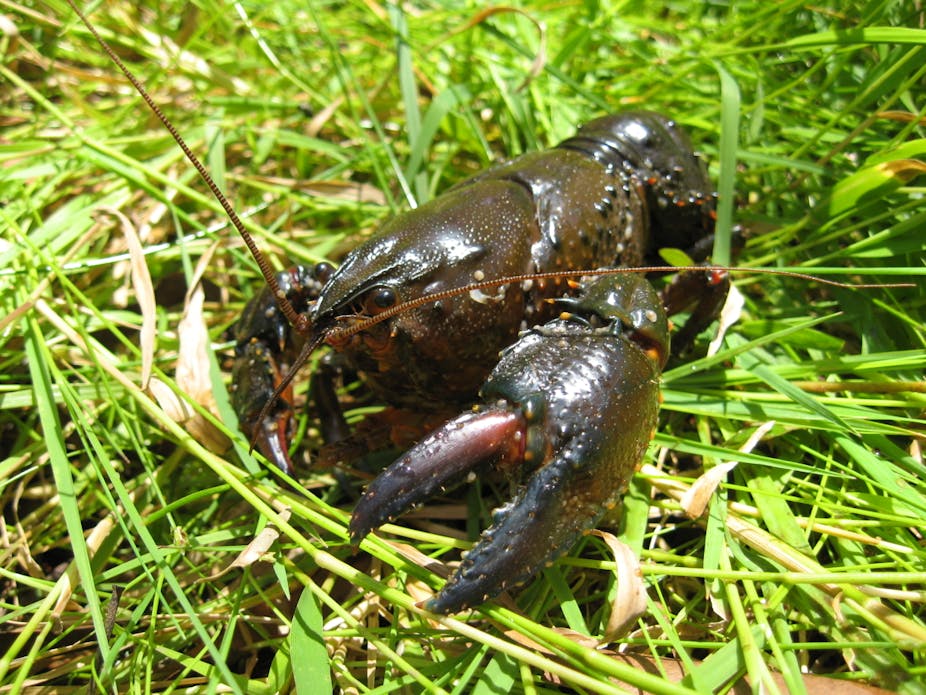
Australian endangered species: Spiny Crayfish

You may be familiar with some of Australia’s more iconic spiny crayfish, such as the giant Murray River crayfish, Euastacus armatus, but there is an untold diversity within this endemic Australian genus. In fact, there are over 50 described species of Euastacus, and they come in all shapes, sizes and…

J746g36w-1355886112
Euastacus dharawalus is the most critical of the spiny crayfish group. Jason Coughran

You may be familiar with some of Australia’s more iconic spiny crayfish, such as the giant Murray River crayfish, Euastacus armatus, but there is an untold diversity within this endemic Australian genus. In fact, there are over 50 described species of Euastacus, and they come in all shapes, sizes and colours – from large, thorny blue monsters that fearlessly roam the streams, to delicate, little orange numbers that almost never venture from their secluded burrows.

The genus Euastacus is rather widespread in distribution, with species peppered along the eastern Australian mainland from far north Queensland to South Australia. Although a handful of species are reasonably widespread (the larger and more riverine species), most have very restricted distributions, with several species isolated to a single mountain top.

Status

Euastacus jagara is one of the few species to have received targeted research. Jason Coughran

Regrettably, nearly 80% of these animals are recognised as threatened on the IUCN Red List. Seventeen species are listed as critically endangered, the highest threat category for a wild species. The biology and ecology of most of these species has only been briefly examined, and expanding on this is an urgent conservation priority. The information available shows that they are a slow-growing, long-lived species, with a relatively low reproductive rate.

Most species live exclusively in densely forested areas, and all are restricted to highland habitats. The 17 critically endangered species all have distributions of less than 100 square kilometres, and in most cases less than 10 square kilometres. Of course, within a species’ overall distribution the amount of actual habitat is fragmented and limited, so these species are extremely susceptible to even small-scale, localised impacts.

Threats

Many of the species occur in national parks or other reserves, and are thus afforded indirect habitat protection. However, for some species the remaining habitat could be compromised through agricultural encroachment, urban development, road construction or forestry. Because of their severely restricted distributions, they are also susceptible to localised pollution from surface runoff, accidental spills, insecticides and general litter.

Not all spiny crayfish are spiny and dramatic: Euastacus jagabar. Jason Coughran

Exploitation is another threat, and takes place in the form of recreational fishing, as well as an aquarium trade facilitated through online forums. All of these species are technically “no-take” species, yet evidence of illegal collection is not uncommon, even in the depths of national parks.

There are also threats associated with introduced species. Aquatic pests such as trout, yabbies (Cherax destructor) and cane toads are of most concern. Other common and widespread pests such as feral pigs also have adverse impacts on crayfish and their habitat.

One of the most difficult threats to tackle is climate change. With continued warming and drying, these species are simply going to run out of habitat. Crayfish are poikilothermic (unable to regulate their own temperature), so are completely at the mercy of their environment. In addition, these Euastacus species are highly adapted to cool temperatures, hence, their restriction to high, cool streams. With only a very narrow altitudinal window to start with, there is literally no room to move – nowhere to run, no way to hide.

Strategy

Measures that need to be implemented for these crayfish include: targeted research (on biology, ecology and taxonomy); increased public education; habitat restoration; pest control; and emergency response planning for localised impacts. The potential direct impacts associated with climate change are a more difficult challenge.

Detailed population estimates have not yet been undertaken, and will be very difficult given the extreme rarity and reclusive nature of these animals. Population studies are currently focused on E. dharawalus, which appears to be in rapid decline due to a suite of threats, the primary one considered to be the yabby, Cherax destructor. This translocated yabby completely dominates the small area of highland streams inhabited by E. dharawalus.

Conclusion

As pointed out by Garnett and Woinarski, there is an inconsistency between the IUCN Red List status of these crayfish and their formal recognition under state and Federal legislation. The criteria used to assess their conservation status is essentially the same between the different systems – so it is not that there is a discrepancy, just that there is a process involved that may take time. Formal recognition is an important first step in driving conservation actions.

This article covers Euastacus bindal, E. clarkae, E. dalagarbe, E. dharawalus, E. eungella, E. gamilaroi, E. girurmulayn, E. guruhgi, E. guwinus, E. jagabar, E. jagara, E. maidae, E. mirangudjin, E. monteithorum, E. robertsi, E. setosus, and E. yigara.

The Conversation is running a series on Australian endangered species. See it here

Sign in to Favourite

Want to follow The Conversation?

Sign up to our free newsletter to get the day's top stories in your inbox each morning, with a special wrap on Saturday.

Spinner
Donate and become a friend of The Conversation

Join the conversation

10 Comments sorted by

  1. Mark Harrigan

    Dr

    When I was a lad in the 60's I used to catch such fresh water crays (yabbies) by hand in the estuaries of the lane cove river in the forest surrounding North Epping (it was tricky - you had to sneak up on them from behind and use the water reflection to hide your image from them and then swoop quickly to catch them being the claws - many missed but enough sucess to give a whoop of success!). These estuaries or creeks were teeming with life then - tadpoles, frogs, yabbies and even small fish…

    Read more
    1. Jason Coughran

      Adjunct Research Fellow at Griffith University

      In reply to Mark Harrigan

      There’s certainly something to be said for that sense of wonderment, Mark.

      There’s a few species of Euastacus that are very large and obvious, and to stand beside a creek and watch one of these giant, spiky beasts slowly working their way in and around rocks is something else. There’s also some that like to leave the water and wander around on land from time to time, and getting bailed up by one of these on a walking path through the national park is truly unforgettable!

      I sure hope these kind of experiences are still there for future generations.

      report
    1. Jason Coughran

      Adjunct Research Fellow at Griffith University

      In reply to Bernie Masters

      Yes that's right Bernie, there are a few threatened species of Engaewa in the south-west, two Endangered and one Critically Endangered. After a global revision of freshwater crayfish in 2010, there's now quite an alarming picture for the world's crayfish fauna generally, with a large number listed as Vulnerable, Endangered or Critically Endangered on the IUCN Red List, http://www.iucnredlist.org.

      report
  2. Paula Peeters

    Principal Conservation Officer, Queensland Department of Environment and Heritage Protection

    Hi James

    Thanks for raising the profile of threatened species, especially invertebrates which are often overlooked.

    The Queensland government convened an expert panel in 2009 to assess the conservation requirements of crustaceans, including 14 Euastacus species. These Euastacus species were determined to be a low priority for conservation action, based mainly on the high proportion of their habitat / populations in protected areas. This assessment can change if new information on the status of a species and its threats becomes available.

    As you may be aware, anyone can nominate a species for listing under the Queensland Nature Conservation Act 1992. The nomination form and guidelines for listing can be downloaded at http://www.ehp.qld.gov.au/wildlife/threatened-species/index.html

    Cheers
    Paula

    report
    1. Paula Peeters

      Principal Conservation Officer, Queensland Department of Environment and Heritage Protection

      In reply to Paula Peeters

      Sorry Jason for getting you name wrong (Time for a holiday I think!)

      report
    2. Jason Coughran

      Adjunct Research Fellow at Griffith University

      In reply to Paula Peeters

      Thanks Paula,

      It is certainly a good thing that many of these species occur within National Parks, although this alone won't ensure the survival of these animals. For example, threats such as translocated yabbies require immediate specific intervention, without which species such as E. dharawalus in NSW could be lost in a relatively short time frame.

      The plight of these and other Australian crayfish was brought out more clearly in a recent global conservation revision in 2010... it is great to see the state listings start to follow, with E. dharawalus in NSW - a colleague of mine has also started the ball rolling for the Qld situation... other nominations should follow in the near future, and of course much research is still ongoing on these and other species - but these things take time.

      Thanks for highlighting the opportunity for anyone to nominate species for listing - something important that not everyone might be aware of.

      Cheers,

      Jason

      report
    3. Jason Coughran

      Adjunct Research Fellow at Griffith University

      In reply to Paula Peeters

      Thanks Paula,

      It is certainly a good thing that many of these species occur within National Parks, although this alone won't ensure the survival of these animals. For example, threats such as translocated yabbies require immediate specific intervention, without which species such as E. dharawalus in NSW could be lost in a relatively short time frame.

      The plight of these and other Australian crayfish was brought out more clearly in a recent global conservation revision in 2010... it is great to see the state listings start to follow, with E. dharawalus in NSW - a colleague of mine has also started the ball rolling for the Qld situation... other nominations should follow in the near future, and of course much research is still ongoing on these and other species - but these things take time.

      Thanks for highlighting the opportunity for anyone to nominate species for listing - something important that not everyone might be aware of.

      Cheers,

      Jason

      report
  3. Andy Sheppard

    Theme Leader, Biodiversity at CSIRO

    Really timely and neat awareness raiser. Thanks Jason. The impacts from the deliberate movement of yabbies is certainly a real worry and I suspect done quite innocently by some who move them around but don't understand the high local endemism in these species and all they want is yabbies in their creek for both cultural and culinary purposes. Certainly if there is a growing pet trade in yabbies species this could be more malicious too. Public awareness around this would be critically important for…

    Read more
    1. Jason Coughran

      Adjunct Research Fellow at Griffith University

      In reply to Andy Sheppard

      Thanks Andy,

      Yes I'm sure a lot of the translocations have been without any ill will, simply due to a lack of awareness about the native endemics. Two species (yabby, redclaw) have had rather a lot of publicity in the past, and most people would know of these - but in fact Australia has nearly 150 species of freshwater crayfish, and it's important to keep raising awareness of that diversity and the conservation concern for many of these species - as well as the impacts that translocation are having…

      Read more