Australia’s place in the global food chain: time to wise up

In recent weeks Australia’s PM, a shadow minister, and a state premier have heralded the opportunities for Australian farmers to capitalise on a global food-shortage and, in particular, rising demand for high quality food amongst the middle classes in Asia. It seems Australia is in the perfect position…

Bn34tjd5-1341996788
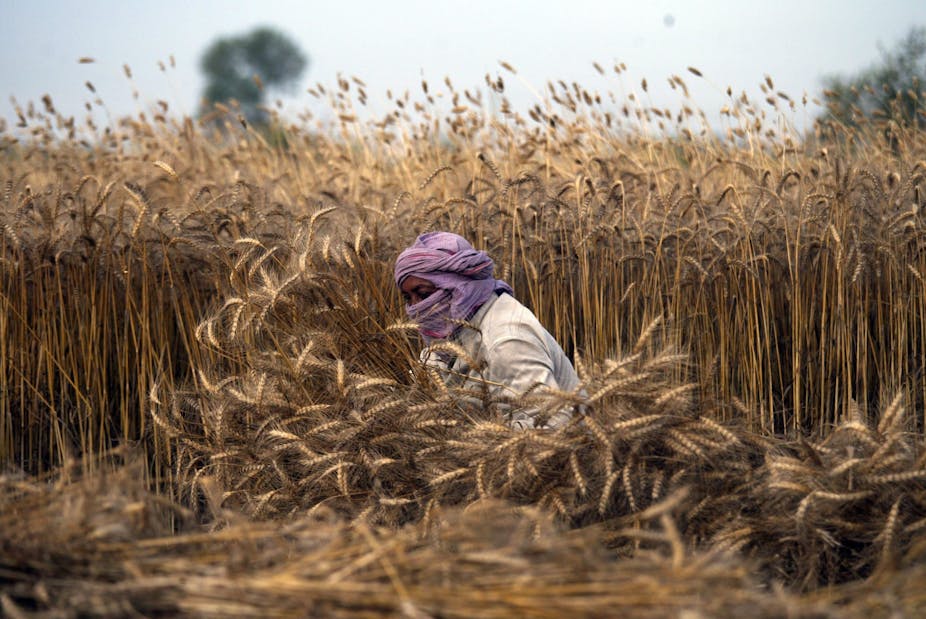
Harvest time: Asia’s rising incomes and demand for food are no guarantee of a mining-style payday for Australian farmers. AAP/EPA/Raminder Pal Singh

In recent weeks Australia’s PM, a shadow minister, and a state premier have heralded the opportunities for Australian farmers to capitalise on a global food-shortage and, in particular, rising demand for high quality food amongst the middle classes in Asia. It seems Australia is in the perfect position to do well and to do good. Closer examination suggests that many of the assumptions underlying these pervasive beliefs are problematic. I don’t think Australians can simply wait for the rising tide of Asian demand to improve the incomes and livelihoods of Australia’s farmers. If there are opportunities, they will have to be identified and pursued in a highly competitive environment.

Food production rises with good governance

Let’s examine some of the underlying assumptions. Is there really a global food crisis? There are hungry people and this is a tragedy that should not be trivialised. At the same time, most of the world’s population does get sufficient food each day. As the UN Special Rapporteur on Food recently acknowledged, hunger in the 21st Century is largely the outcome of poor governance and the influence of developed economies on food production in developing nations. Think fish and cat food. Just as arguments can be advanced suggesting there will be a future food crisis, counter arguments can be put forward suggesting that we will continue to muddle through. New farmland is being developed in South America, rising global temperatures should increase the area of arable land in north America and northern Europe and improved governance in Africa is leading to increased food production there.

Australia not suited to capture rising world demand

A key point is that Australia is unlikely to make a substantial contribution to solving world hunger. We simply don’t produce that much food, and poor people cannot afford our farm products. We have plenty of food and export about half of what we produce, but that is a tiny fraction of the global food supply – of which we supply about 1%. Australian farmers are efficient in terms of the food and fibre produced per unit of labour input, but most of our farming systems are based on high inputs of expensive fuel, fertiliser, chemicals, and machinery. With very high wage costs and a high Aussie dollar, it is increasingly difficult for Australia to hold existing markets.

What about the opportunities for Australia to export into Asia? Firstly, we need to recognize that there is capacity to increase food production in Asia. Farm incomes in Asia are typically too low to keep most farmers producing food. As farmers move to cities in search of higher paid work, and that typically is only around $2-$3 per day, large areas of land have become less productive. Indeed, in parts of India, minimum prices are set at local markets to encourage farmers to grow food.

To the extent that markets emerge or are developed, Australian exporters can expect intense competition from lower cost, larger scale producers in South America, Africa and even, North America. Chile and South Africa, for example, are also southern hemisphere producers able to meet out-of-season food demand in Asia.

Time for a realistic reappraisal

Most middle class Indians I’ve met almost exclusively eat Indian foods, often purchased directly from local suppliers, which they or hired help prepare. Even middle class Asians are not as wealthy as we might believe. Indian professionals receive about 10% of the income of comparable Australians. And as economists explain, as incomes rise, people typically spend a smaller proportion of their income on food. In India, increased incomes are more likely to be spent on motorbikes, phones, computers, education, and housing than on food. There is already a substantial cohort of wealthy consumers in Asia, but no real evidence of increased demand and prices for Australian farm products. The one exception is possibly lamb, and the story there is of marketing to cultures that prefer lamb.

So, both price and cultural preferences will be crucial factors influencing demand for food in Asia and for Australian products. The mining analogy is flawed: Australia is typically a low-cost producer of coal and iron ore; it is much easier to increase the supply of farm products as demand rises; and there is increasing demand for the consumer products and urban lifestyles that rely on mining outputs. There will be opportunities for Australians to export to Asian markets, but success cannot be assumed. Farmers will need to keep their costs down, but government and industry need to act rather than simply telling farmers that the future is rosy and they have the same opportunities as the miners.

Comments welcome below.

Sign in to Favourite

Want to follow The Conversation?

Sign up to our free newsletter to get the day's top stories in your inbox each morning, with a special wrap on Saturday.

Help us have better conversations — donate

Join the conversation

34 Comments sorted by

  1. Dale Bloom

    Analyst

    I would think wage costs in many agricultural industries have been reduced so much it is becoming difficult to employ people, because the wages are subsistence wages only.

    Only about 6% of Australia is arable enough to grow crops on a long term basis, and if less arable land is farmed, costs increase, such as increased costs for irrigation and fertilizer.

    It would be interesting to know how much of the arable land in Australia is already being farmed.

    report
  2. Ross James

    Engineer

    The government needs to look at how much of our agricultural land is going to foreign ownership. Also, why are our oranges left to rot on threes, while we import from Brazil?

    report
    1. Dale Bloom

      Analyst

      In reply to Ross James

      "why are our oranges left to rot on threes, while we import from Brazil?"

      Because supermarket chains procure from the cheapest source available, to maximise their profits.

      It can readily destroy local industries, but then the supermarket companies will often try to move to another country.

      report
  3. Lynne De Weaver

    logged in via Facebook

    The other major factor in food production is the availablity of arable land and water It seems both our State & Federal Governments are hell bent on turning prime agricultral land into mining sites.Witness the cancer-like spread of Coal & Coal Seam Gas mining activities in the Liverpool Plains, Hunter Valley and the Northern Rivers region of NSW.The Darling Downs, a major food producing region along with other regions in QLD, has already been savagely exploited by largely foreign owned corporations in complicity with our Governments for the short term exploitation of our prime agricultural land. Food security discussions also need to include the issue of intergenerational equity as we can't eat coal or drink gas.

    report
  4. Keith Bradby, Director, Gondwana Link

    Director

    Thanks Allan - great to hear some common sense on this issue. Much of the upbeat rehetoric we are hearing, that you mention, seems based on phsychological drivers rather than market analysis or review of what is happening in Australian agriculture. I'm no expert, and agriculture is not even my focus, but I sat through an ABARES Outlook Conference in WA last week and from the morning session could have been forgiven for thinking that the food boom to India, China and Asia was already upon us, and…

    Read more
    1. Gil Hardwick

      Anthropologist

      In reply to Keith Bradby, Director, Gondwana Link

      It's not all being ignored, Keith, no doubt as you are yourself well aware, merely lost among all the noise and media hype.

      A good case in point, you might have sat with us 10 years ago as we arranged to building of the new Margaret River Centre for Wine Excellence which saw the closing of four separate viticulture programs run by four universities up in Perth, allowing students only five weeks practicum over summer, in favour of the one regional Centre of Excellence in Margaret River positioned…

      Read more
  5. Joseph Bernard

    Director

    World population continuing to boom and guess what they need to eat.

    Australian farmers are one of the most efficent growers in the world and guess what food production leads to a truly sustanable future for all of us.

    So why are we going to pollute our ground water with fraking chemicals?
    why are we risking our future for some dirty industry that will disappear in the next fifty years? especially if we can not feed ourselves!

    report
    1. Michael Croft

      logged in via LinkedIn

      In reply to Joseph Bernard

      I agree with your comments but something to ponder about Australia's efficient farmers (and I am one of them). Australian efficiency is measured by food produced per person, and we are indeed very efficient by this simplistic measure. The Chinese farmer however, produces up to 9 times more food per hectare than I do - so which measure should we use - food produced per person or food produced per hectare? And then we start looking at energy efficiency - or lack thereof.
      .
      In 1940 it took 1 calorie of oil to produce 2.3 calories of food, today it takes between 8 and 10 calories of oil to produce 1 calorie of food (US figures, as there are none for Australia, but should be comparable). So are we really that efficient? Today we are putting in some 20 units of energy to get a yield of one unit of energy - a lousy return on investment by any measure, yet we call ourselves "the most efficient farmers in the world".

      report
    2. Michael Croft

      logged in via LinkedIn

      In reply to Ross James

      The answer is systemic, but in essence the shift to industrial farming and external inputs has been the problem. Industrial systems suit mechanistic inanimate processes and were poorly applied to biological farming systems, compounded by a lack of understanding and hubris - the implications of perpetual growth in a finite system and bigger is always better.

      Until 1940 most farms were much smaller, mixed farming enterprises and more labour intensive. Farms were mostly closed loop systems that…

      Read more
  6. lavinia kay moore

    child and family counsellor

    Why indeed do we import foods that we can grow here. Greedy supermarket corportions are only part of the problem. "Free" trade agreements are another, because generally they are not multilaterally driven.All USA such agreements have caused immense damage to local producers, growers and manufacturers.
    I do not believe that the cost of production here is the problem. Even in Africa imported American goods undersell locally grown products.
    Without intending to promote parochial or nationalistic thinking…

    Read more
    1. Joseph Bernard

      Director

      In reply to lavinia kay moore

      may i suggest

      1/ apply carbon tax to imported goods because the carbon footprint that is envolved in bring foods refrigerated from all arround the world must be factored into the price to reflect it true cost to the environment. there needs to be a parity pricing so that those that are doing the right thing (ie Australian economy) by pricing in carbon should help in this transistion to carbon trading economy.

      2/ Educate Australians as to the real cost of shopping at super markets who are screwing our farmers..

      3/ investigate what our farmers need. although Australian farmer are very resourceful, it would be great if they are helped as much as the mining industry for example.

      report
    2. Ross James

      Engineer

      In reply to lavinia kay moore

      I can't believe what I'm reading. I thought I was the only one who didn't accept population growth as inevitable. I'm greatly encouraged. I was amazed yesterday when I read somewhere that there are more people, therefore we need more food. The alternative wasn't even considered - no more people. We should allow immigration, only if our population is dropping. If other countries choose to overpopulate, we can't keep taking the overflow - they need to take some responsibility, but that's another story.

      It's unrealistic the expect consumers to pay more to by Australian goods - they'll always look for the best price for equal quality. Unfortunately, it's going to take government regulation to protect our local industries.

      report
    3. Michael Hay

      retired

      In reply to lavinia kay moore

      Lavinia, I heartily agree. I would go further and try to find the political correlation between offering farmers unspecified markets for their produce and then reducing their water entitlements so that grow less food. Oh, for some rational thoughts !

      report
    4. mark feltrin

      Renewable Energy and Resources

      In reply to Ross James

      "I can't believe what I'm reading. I thought I was the only one who didn't accept population growth as inevitable"

      No you are not not alone but many, many, many people feel the same way.
      When population growth is based on business interests and treating immigrating people like commodities then you have basis to questioning why.
      Examples in Victoria because of migration population growth include more urban sprawl (+ marginalisation of immigrant communities which a large part of these areas are…

      Read more
    5. Ross James

      Engineer

      In reply to mark feltrin

      I guess this is getting off the main topic, but let me just say that continued population growth isn't sustainable, any more than coal fired energy is. If we don't control population growth, mother nature will, and she can be cruel. We might as well start doing it now.

      It seems to me that this is the most urgent global problem, yet few people, let alone politicians (not normally regarded as people), want to acknowledge this.

      I object to huge population growth in other countries, who expect us to take their overflow. Personally, I'd stop all immigration unless the population was dropping, or number in equals the number out. I'd apply this to all countries.

      report
    6. mark feltrin

      Renewable Energy and Resources

      In reply to Ross James

      Off topic - yes and no.
      Population topics grow in importance as time goes forward.

      But its not all bad news. The Family Planning Summit held in England this week has shown that family planning, women rights and population matters are firmly and finally on the development agenda - so great work is being carried out around the globe particularly now in Africa. It is quite clear - even on economic terms that slowing population fertility rates for developing nations is fundamental to bypassing the poverty trap.
      Billions are now allocated and a major driver is the Gates Foundation.

      As for a solution in Australia - for me its like Tim Flannery says and have a independent body dealing with a sustainable population which food production (domestic and international use) would clearly have part to play

      report
  7. George Naumovski

    Online Political Activist

    Australia should become a food super power; food always grows and will continue to do so “basic fact” and so Australia should be the major exporter and grower of food. Government involvement and investments has to be made on this to continue the revenue it will generate for the life of it, as the minerals/resources will not last forever but food will!

    report
    1. Gil Hardwick

      Anthropologist

      In reply to George Naumovski

      But so can most places on the planet, George. Australia is marginal, not only in soils but access to markets in competition with all those other places.

      Here in Western Australia, even in 100 years time there will still only be 5 million people here, against a projected 12 billion globally by then, and will never feed more than about 12-15 million at most. Even then we will only supply part of their diet.

      The rest of Australia is even more remote from the main population zones than WA. I cannot…

      Read more
    2. Michael Hay

      retired

      In reply to Gil Hardwick

      Gil, the Federal Govt has a department of Trade which should be seeking out these markets for our goods - actively and urgently. We cannot wait for an overseas buyer to come knocking on our door, after all, why would they want to?
      I am happy to admit that I am not a free-trader. Responsible control with carefully applied tariffs in order to utilize ALL the farm produce we can which is home grown. The exported half of what we presently grow can be at a lower nett price as the main living is derived from our home markets. Although I admit that the antics of the AWB and the currency fiasco does not inspire confidence in the trustworthiness of export agencies.

      report
    3. Andrew Campbell

      Director, Research Institute for Environment and Livelihoods at Charles Darwin University

      In reply to George Naumovski

      Excellent article Allan. It is particularly apt for northern Australia, where we see occasional proposals to divert the water resources of the north to 'feed the starfving hordes of Asia' and beyond. Yet 40 years after the establishment of the Ord scheme with massive public subsidies( and water far from fully priced) the scheme is yet to break even and the most profitable crop is not food, but an essential oil (sandalwood). This makes sense economically because it does not require a cool chain…

      Read more
  8. Bruce Waddell

    logged in via LinkedIn

    This is an important conversation and the comments to date have been insightful. Today Australian agriculture is less important in national importance and the shortsigtness of this attitude is staggering. Our primary producers partly have themselves to blame for this attitudinal change. Other industries have changed and not cried poor when times were tough by seeking government assistance. Reference the footwear and clothing industries. (I immediately concede that the motor trade, coal, and…

    Read more
    1. trevor prowse

      retired farmer

      In reply to Bruce Waddell

      Can farmers produce more---yes. What are the impediments?---We have european subsidies that enable pork to be imported----we have low wage countries exporting into Australia. If we had a carbon tax on food being imported into Australia , free trade rules could put more restrictions on our exports. We have a government minister saying farmers can increase prices to cover their carbon tax costs, which is very hard when all farmers are price takers. Mining industry wages reduce the availability of…

      Read more
    2. Michael Hay

      retired

      In reply to trevor prowse

      Trevor, we have a clutch of politicians who are unable to think cohesively, much less plan a future for Australia's exports. Minimal tariffs, monetary control over our own currency, value-adding industries are all possible, but only if we are permitted to elect people who think in a broad, wholistic manner.

      report
  9. lavinia kay moore

    child and family counsellor

    response to Bruce Waddell and others
    It is appalling that our governments seem to place food security/food production/healthy environments at the bottom of their priority lists when it comes to putting in the investments needed to sustain them.
    What i see is local, state and federal governments/agencies spruiking about "development" which seems more often to be involved in developing aspects of our lives which bring big profits for a few at the cost of the wellbeing of the many.
    Have we really…

    Read more
    1. Julia DesBrosses

      logged in via Facebook

      In reply to lavinia kay moore

      Food/Seed Security is an issue that Australia only pays lip-service to when required at International Forums. We say we will give billions (food and seed aid) to reduce hunger and poverty worldwide, etc... and we actually do little to assist Aussie farmers, neither by investing in healthy production and management systems, nor supporting small farmers with serious incentives. Agribusiness and toxic systems and products only make it onto the national 'agriculture' agenda, as small farmers (like small…

      Read more
  10. Michael Croft

    logged in via Facebook

    Yes, it is "time to wise up"!

    In 2008 the world produced enough food for 12 billion people (UN/FAO figure). This was way too much food for the 6.7 billion global population at the time. So why were their food riots that gave rise to the Arab Spring? Why did 45 million children die of starvation that year? Why were 923 million people chronically malnourished as well? Why were there over 2 million food insecure people in Australia, arguably the richest nation on earth at this point in time…

    Read more
    1. Michael Hay

      retired

      In reply to Michael Croft

      Michael Croft - is it time to talk rationally and with wisdom about quotas? Growing surplus produce which is unmarketable is not based on either practicality or logic.
      There is also the unmentioned possibility that our country, instead of sending money to overseas disaster areas, could purchase food stocks from our own farmers, set up canneries and dehydration plants to process this food and fly it to the disasters. Edible food is then immediately available to distressed people: they can't eat money and the temptation for corruption to flourish is only enhanced. The base stock for such a system would probably come largely from good seasons, where farmers harvest more than their quotas. Payment could be something like cost+10%.

      report
    2. Michael Croft

      logged in via Facebook

      In reply to Michael Hay

      Quotas may well be an interim solution, however the dominant neoclassical economic paradigm won't hear of it. Free and unfettered trade is the order of the day. The issue is a fixation on single bottom line profit maximisation with social and environmental costs being "off balance sheet" or externalised. The circular biological, ecological and social process of agriculture has been turned into agribuisness which focuses exclusively on linear industrial scale systems and profitability. This will…

      Read more
  11. Keith Hammond

    Retired technician FAO of the UN

    Australian Agriculture generally is amongst the lowest cost structure, highest risk of Developed Countries, with risk levels commonly being further increased by Climate Change! This then will continue to serve as a primary limitation on F&A production.

    report
    1. Julia DesBrosses

      logged in via Facebook

      In reply to Keith Hammond

      Australian Agriculture has been 'developed' inefficiently, scientifically, by laboratory-based scientists rather than intelligent farmers... we are not a nation of 'natural' or traditional farmers with the inherent, appropriate skills and our applied European models have failed to sustain themselves and depleted our precious resources almost irreparably. Investing in hybrid seeds, expensive biotechnologies, endless research... and our own not-green revolution, has been costly and non-sensical. Investment…

      Read more
  12. Jane O'Sullivan

    Agricultural Scientist at University of Queensland

    Thank you Alan for a great article and for stimulating a great discussion. I agree with many of the points made. But the issue that has only been skirted around, and needs to be appreciated in full light, is that our agricultural sector is, like our manufacturing sector, a victim of the global oversupply of labour (overpopulation). Sure, we have the technical capacity to deliver more high-value food to growing middle-class niche markets, but the higher the value, the more labour input is implied…

    Read more
  13. Allan Kessing

    retired

    <I>We have plenty of food and export about half of what we produce,</I>?!? try 70% overall, more in some commodities (eg rice). As for our yields of one of our major exports, wheat, according to ABARE the average is 1.822 tpHa which is less than an Iraqi peasant trudging behind a bullock plough.
    <I>Australian farmers are efficient in terms of the food and fibre produced <B>per unit of labour input</B>...With very high wage costs... it is increasingly difficult for Australia to hold existing markets…

    Read more
  14. Robert Pekin

    logged in via Facebook

    An intelligent contribution to a debate that will not go away until adressed seriously. Thanks Allan. Thanks also to the sensible contributing comments, particularly Michael Crofts points.

    Another good reason to keep reading 'the conversation'.

    report