Babblers show why birds of a feather stick together

Blood is thicker than water when it comes to being a team player – at least if you’re a bird in outback Australia. So shows a new study I was involved in, published this week in the journal Proceedings of the Royal Society B. Our work sheds light on the evolutionary puzzle of why some individuals cooperate…

6b4nbcg6-1342067451
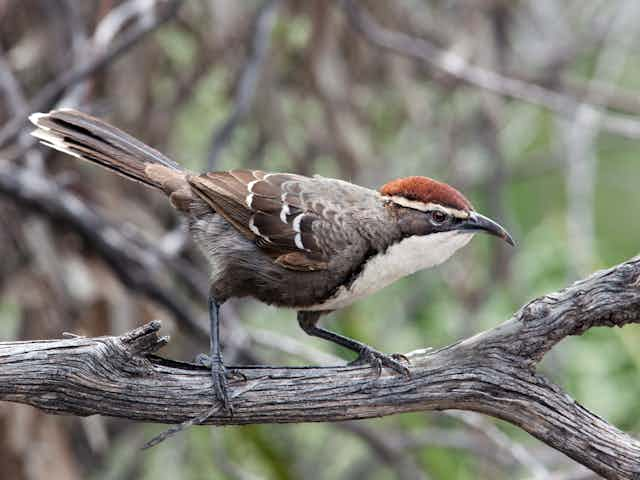
Chestnut-crowned babblers provide a perfect opportunity to test theories of cooperative breeding. Enchylaena

Blood is thicker than water when it comes to being a team player – at least if you’re a bird in outback Australia. So shows a new study I was involved in, published this week in the journal Proceedings of the Royal Society B.

Our work sheds light on the evolutionary puzzle of why some individuals cooperate with each other for a common good rather than pursuing their own selfish agenda.

Why do we ever play nicely with others? The world around us abounds with weird and wonderful examples of cooperation, from the sharing of blood meals by vampire bats to self-sacrificing sperm in wood mice. In fact, some of the most successful animals on the planet, ourselves included, are highly cooperative.

Jodie Crane

One of the most extreme forms of cooperation is when individuals sacrifice their own procreation in order to care for someone else’s kids (cooperative breeding).

Being so altruistic seems to contradict Darwin’s theory of natural selection – wouldn’t they be better off being selfish? Clearly, the evolution of cooperative breeding requires some special explanation.

One theory (group augmentation) suggests such behaviour is actually self-interested: in group-living species, individuals can increase their own success by helping to make their group larger. For instance, there is safety in numbers and by raising extra group members they could – selfishly – reduce their own chances of getting nabbed by a hungry predator.

An alternative theory (kin selection) proposes that, because we share DNA with our relatives, helping family members to succeed might help to pass these “unselfish genes” on to the next generation.

In other words, promoting the welfare of your brothers and sisters, who share approximately half of your genes, helps to propagate a line of future helpers.
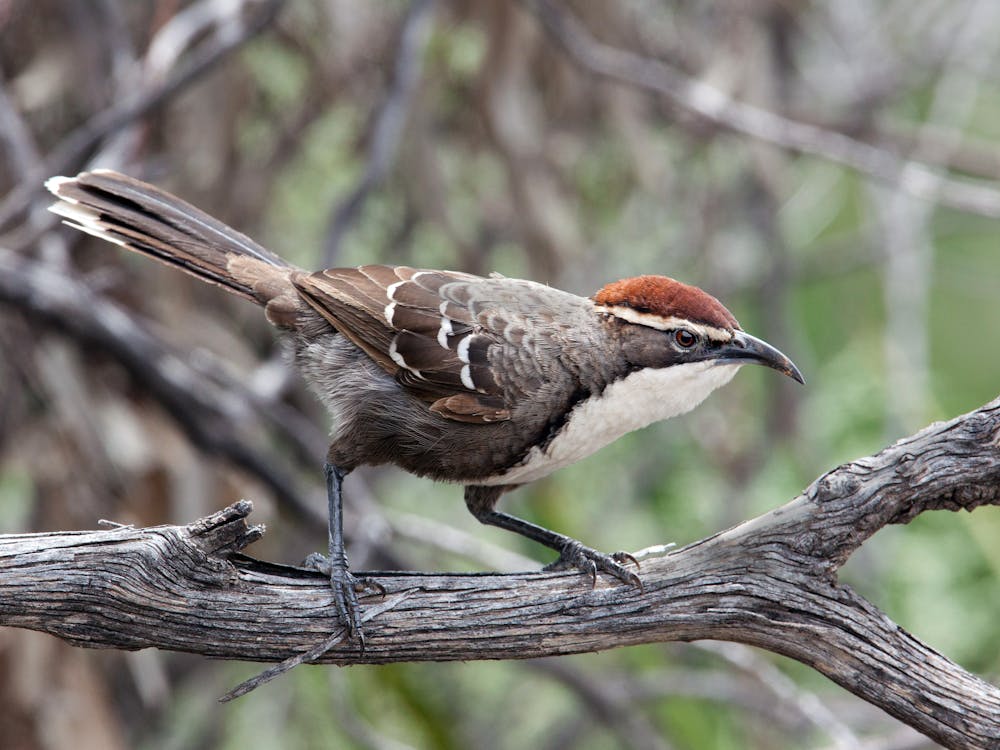
Enchylaena

Chestnut-crowned babblers – the subjects of our study – provide a perfect opportunity to test these two theories because babblers have a choice of who to help in their group.

The desert environment in outback Australia where they live is harsh and the extra help can mean the difference between life and death for the chicks. Most group members help to look after the chicks, despite not being the parents themselves.

But like any team activity, some individuals do the lion’s share of all the work, while others do nothing at all.

As it turns out, babblers are not swayed by group size when deciding whom to help. Instead, they seem primarily driven by an altruistic urge to help their family.

Even though they might be better off living in a larger group, they invariably choose to help their relatives instead. They also work much harder when they are looking after their brothers and sisters rather than more distant kin.

Our study took place on a wild population of babblers in red desert country at the University of New South Wales Arid Zone Research Station, near Broken Hill, NSW. The video above, from about the three-minute mark, shows both the research station and our project there.

By fitting the birds with tiny transponders it was possible to see which nests they visited and how many times they fed the chicks in order to figure out who cooperated with who.

These findings are relevant for understanding how our own societies evolved too because much of human society is underpinned by cooperation. Kinship is clearly important for babblers and we can speculate that it may have been important for the evolution of cooperation in people too.

In modern human societies, Good Samaritans can extend a helping hand to complete strangers. But our research suggests that cooperation may have started within the family.

It seems charity truly does begin at home.

Sign in to Favourite

Want to follow The Conversation?

Sign up to our free newsletter to get the day's top stories in your inbox each morning, with a special wrap on Saturday.

Spinner
Help evidence based journalism become the norm and donate

Join the conversation

5 Comments sorted by

  1. Gavin Moodie

    Principal Policy Adviser

    Thanx for this, which I found informative. But the article doesn't convince me that these most interesting findings about 1 species of bird in a very specific environment apply to other species of birds, and certainly not to other animals.

    And it is a silly fallacy to try to apply these findings to humans. Humans cooperate and probably cooperate more with kin, but this is concluded from separate observations of human behaviour, not by analogy from the chestnut crowned babbler.

    report
  2. Angus Martin

    Retired zoologist

    There are at least three good reasons for heartily applauding this study. In these times when biological fieldwork is often regarded as being too difficult and not giving value for money, it demonstrates the inestimable value of careful, patient, long-term field observations. Second, it eschews the all-too-common sloppiness which uses the terms “altruism” and “cooperation” as though they were synonymous and interchangeable. A cooperative individual is one who is coordinating or directing its behaviour…

    Read more
    1. Gil Hardwick

      Anthropologist

      In reply to Angus Martin

      Yes, I heartily agree Angus. There is nowhere near enough Anthropology these days doing this work, much less examining human-wildlife and ecosystem interactions.

      And thanks for the video, Lucy, watching it made me feel terribly homesick . . . .

      report
  3. David Paxton

    Veterinarian

    Thanks for the conversation, Lucy. I like the idea that "cooperative" animals can be selected naturally, and have argued that human beings could not have evolved the anatomy for enunciating words unless they were in an ecosystem which included the evolving dog, and thus together formed a complex that out-competed the Nerandertal. I think this fits with Richard Dawkins' proposition of an extended phenotype and the more fashionable idea of mutualistic symbionts. That is, cerebral hemispheres in one and olfactory lobes in the other, or rounded impacted bite in one, and a muzzle in the other.

    report
  4. Angus Martin

    Retired zoologist

    In reply to Gavin Moodie
    Not surprising that you weren’t convinced, Gavin, because that isn’t the point of the article. But cooperative breeding is widespread in birds, including such familiar locals as Superb Fairy-wrens and Kookaburras, in mammals such as wolves, jackals and meerkats, and, most spectacularly of all, in honeybees and other social insects. What Lucy is saying is that the Babbler study provides substantial evidence for kin selection being a basis for this pattern of reproductive behaviour, wherever it occurs. And I don’t understand where your “silly fallacy” comes into the picture. Of course humans are subject to the operation of kin selection – how could they not be? – but the article does not try to explain human social behaviour by analogy with the Babbler; nor does it suggest that kin selection is its sole basis.

    report