


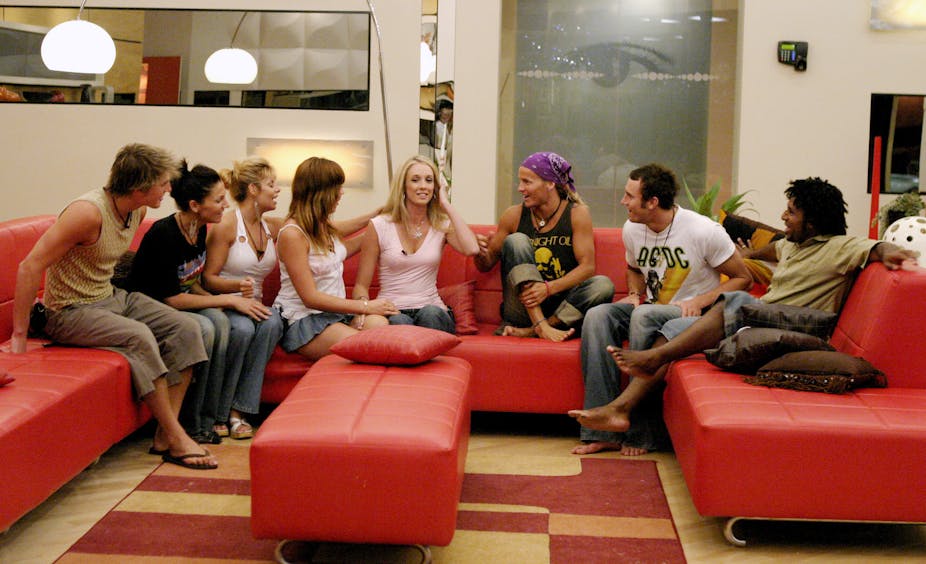
It’s tempting to wonder whether Channel Nine’s “Be Surprised” slogan, heralding the return of Big Brother, is intentionally ironic. After all, its producers are proudly offering nothing new.
Speaking to the Sydney Morning Herald, host Sonia Kruger was keen to stress the “new” Big Brother will be nothing of the sort. No matter who ends up walking through the doors, she promised audiences the familiar blend of “conflict, bromance and love triangles”. Nine has also eschewed the bells and whistles of convergent digital media. Instead, the channel is betting on the bread-and-butter appeal of live nomination and eviction shows.
It’s certainly a risk. After all, Channel Ten surrendered the BB franchise on the back of dwindling public interest, and the return to a globally jaded format seems a curious move in the face of an already crowded reality television market. Perhaps the biggest surprise will be if the gambit pays off.
Yet there’s a delicious ambiguity to the “Be Surprised” line that captures why Big Brother worked in the first place, and why it’s worth another shot. Predictably unpredictable, Big Brother is perfect television, because it reminds us of what the medium can be as a live experience.
It’s form, not content.
Television: the way we were.
Channel Nine is seeking digital television’s Holy Grail; a mass audience. When it comes to entertainment, others have managed this trick by returning to shows that seemed well past sell-by.
In 2005, Wayne Garvie, then Head of Light Entertainment at the BBC, charmed the audience at an academic conference on media with a speech that argued Strictly Come Dancing, progenitor to Dancing with the Stars, was the best thing British television had seen in decades; an apparently strange thesis coming from a man who holds a PhD in philosophy.
Yet Garvie had no time for culture snobs with their predilection for high quality drama and the news. Anyone who understood television also knew light entertainment is the medium’s toughest test. Garvie passed it with a marriage of two 1970s stalwarts; classic show Come Dancing and host Bruce Forsyth – the last man, bar Dr Who, to command a British mass national audience for the BBC on a Saturday evening. Strictly Come Dancing was going to get whole families sitting together, talking about what would happen next and making television the focus of weekend cultural life once more.
The lure of live TV
According to media scholar Jerome Bourdon, this is what live television is about. It doesn’t actually matter if shows are really live or recorded. “Live” is a sensibility, a feeling we are watching national life unfolding before us, and are participating in it too; this is as much about the way we watch as it is about what we watch. Good television gets us talking.
Love it or loathe it, Big Brother has been enormously successful as a “live” experience in Bourdon’s sense; an event that includes us in a public conversation, even if we don’t actually watch.
The format doesn’t fool anyone. Everybody knows the conflicts are contrived by Machiavellian casting choices and cramped spaces. Nevertheless, research on reality television audiences shows that much as viewers can see the trick being played before them, they still have faith that the combination of constant surveillance and live events will create something unexpected, something true, and something worth watching; or at least something to talk about at work or in the pub. You can count on it.
The power of the cringe
And these truths can be important. In 2006, controversial Scottish MP George Galloway decided to enter the UK’s Celebrity Big Brother. Galloway thought the house provided an ideal platform for his strong anti-Iraq War message; much more so than some ignored speech in the House of Commons. His detractors and supporters approved of his decision, because they believed for good or ill, Big Brother had the power to reveal him for what he was – crusader or popinjay.
Cynical as they were about the show and reality television in general, viewers kept watching to see if the fearsome orator’s skills would win through, or instead unravel for all to see; which they did when he tried to seduce another contestant by pretending to be a cat. Cringeworthy as the scene was, it also got people talking about what politics is for.
The Galloway incident captured the enduring appeal of Big Brother. We don’t know what the conflicts will be, or where they’ll end up - with the police or in Parliament - but we know they will happen, and when they do, they might remind us why television still matters. At least, Channel Nine hopes so.