


In June, the International Olympic Committee (IOC) stated that some athletes at the London Olympics, though legally female, may be subject to testing to see if their bodies produce an above-average quantity of “male” sex hormones, such as testosterone.
Competitors already undergo tests to rule out drugs that mimic these hormones, which affect things such as muscle mass. But this concern is over participants whose bodies naturally generate possible performance-enhancing features. If suspicion is raised, refusal to undergo testing will likely result in suspension even though the benefits of these elevated hormone levels is contentious.
Questions of who was allowed to compete in women’s events at the Olympics were first raised in 1968, out of the fear that there were men masquerading as women to gain advantage. Since then, athletes have been subjected to a range of tests, some humiliating and many invasive.
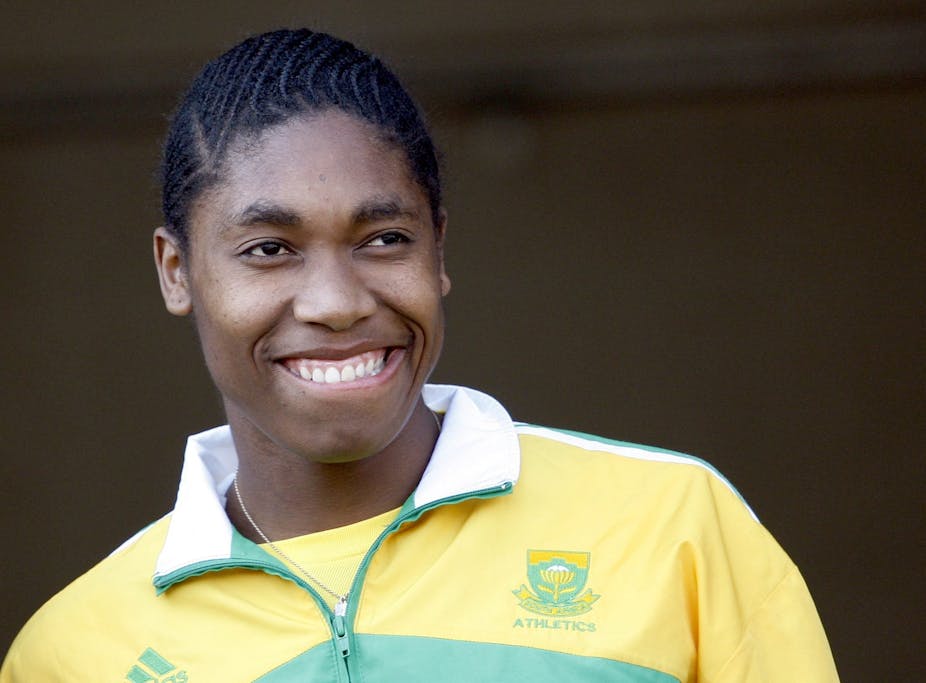
In 2009, South African athlete Caster Semenya was famously subjected to gender testing following victory in the 800m at the athletics World Championships, a move that attracted considerable media attention.
While the test results weren’t publicly released, Semenya was allowed to keep her world championships medal and, in 2010, was cleared by the International Association of Athletics Federations (IAAF) to compete in women’s events at an international level. Semenya carried the flag for South Africa during the 2012 Olympic opening ceremony.

For the London Games, any necessary gender tests are to be performed by an “expert panel” made up of an endocrinologist, gynaecologist and a genetic specialist. Ultimately, the panel decides whether an athlete is eligible to compete in women’s events.
As yet, there have been no publicised cases of gender testing at the 2012 Games.
Interestingly, it’s unclear whether a woman found to have elevated “male” hormone levels might enter into the men’s division. In fact, it would seem that suspended athletes are effectively in limbo, banned from contest because their body is classified as abnormal.
The IOC states their rules are not “intended to make any determination of sex”. So if not sex, then what is being decided?
Sex
Sex is often classified in terms of biological factors. Generally, sex is first assigned based on external appearances – we proclaim, “It’s a boy” when a baby is born with a penis. What this translates to in real terms is far from clear.
A person might have XY chromosomes typically associated with male sex organ development but be unable to process certain hormones, leading to outer “female” features. On the flip side, someone might be XX female but produce certain hormones so they look more “male”.
Given that we generally think of sex as falling into only two distinct categories – male and female – people who have variations in sex factors are often labelled intersex. However, variation from “typical” male and female characteristics in the population has been estimated as high as one in 100 births.

Gender
Gender has commonly been used to refer to social roles and identity. Feminists have often argued that there’s a distinction between sex and gender to point out that human potential is not determined by sex at birth.
Despite this distinction, we generally assume (sex variation aside) that babies dubbed girls at birth grow up to be women. In this way, a gender label and identity is also assigned. But for some, this doesn’t fit.
Some people seek to change recognition of their assigned identity. Such people often identify with the umbrella term “transgender” and may express their gender identity in many different ways. Some undergo surgery or hormonal therapy, though others do not.
The main point here is that there’s a lot of variation in how people identify both physically and socially. The problem is that in sport, we use the categories “men” and “women”, but this isn’t determined by how people self-identify. And given how fuzzy sex is biologically, when you try and introduce a test to assign people, you inevitably run into trouble.
Eliminating body difference
The idea there are distinct male and female hormones is misleading. In fact, even [ovaries produce testosterone](http://med.monash.edu.au/sphpm/womenshealth/docs/androgens-in-women.pdf](http://med.monash.edu.au/sphpm/womenshealth/docs/androgens-in-women.pdf). Because the IOC has chosen a specific “unacceptable” level of testosterone production, it seems that who classifies as a woman is a matter of hormonal degree rather than clear-cut biological difference.

There are many studies showing other naturally occurring traits that lead to competitive advantage in sport and yet these are not policed. Banning someone who has predisposed greater lung capacity, or larger feet and hands would sound obscene - so why do we so readily focus on sex factors?
The IOC position follows a similar decision made by the IAAF in 2011. The IAAF also suggests that females disqualified on this basis may elect to undergo treatment to normalise their hormone levels and be re-tested at a later date in the hope of then qualifying to compete.
Aside from possible minor side-effects experienced as a result of treatment, this kind of solution digs a trench where there was once a line in the sand. In essence, the difference between what we consider to be a “normal” woman versus man becomes more divided than ever.
Alternatives
A reaction to this testing might be to say that it’s fair enough. After all, how else do we distinguish between who can compete in which group?
One suggestion is that instead of separating sport into men and women’s categories, groups could be created that reflected varying levels of ability relative to physical characteristics. This would reflect the way you can compete in either lightweight or standard divisions in rowing, or weight categories in boxing.
After all, when it comes to sex and gender, two boxes just don’t seem to cover it.