
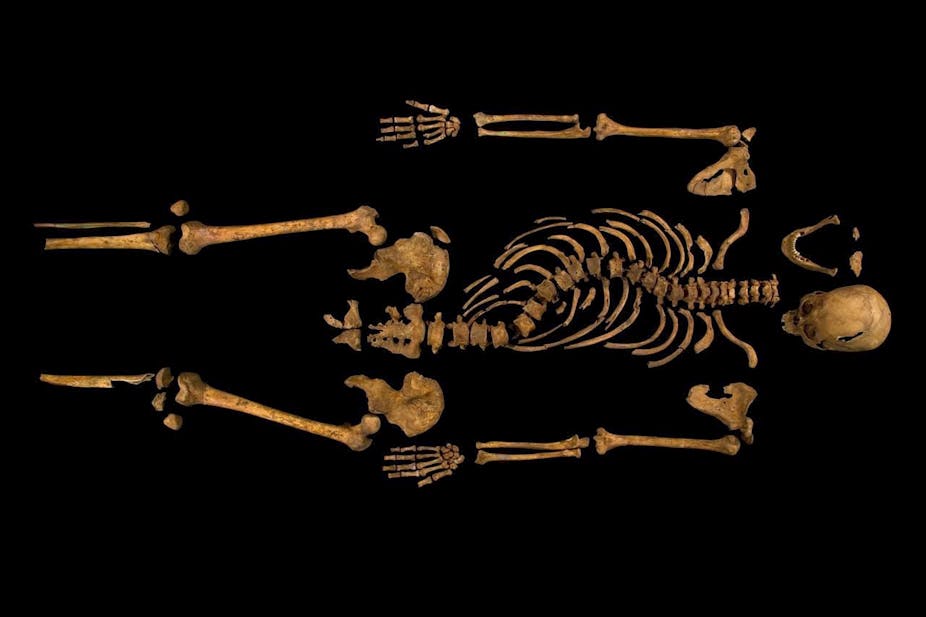
“It will be a whole new era for Richard III,” Lynda Pidgeon, spokeswoman for the Richard III Society, said of the discovery that the skeleton found under a car-park in Leicester is almost certainly that of King Richard III. “Hopefully people will have a more open mind toward Richard”, she added.
But why? How will it make people sympathise more with this highly contentious ruler? What does it add to our understanding of his life, death and character? The answer, arguably, is “very little”.
We now know that Richard died of one or more slashes to the skull with a heavy blade, and was also wounded by an arrow. But contemporary writings already confirmed that he died in the battle of Bosworth, and no one familiar with medieval warfare could suppose it was from a light tap on the shoulder. The skeleton shows pronounced scoliosis; this may help to quell exaggerated claims of Tudor writers that Richard was hopelessly deformed, but is perfectly consistent with John Rous’s account (written within seven years of Richard’s death) that he was “small of stature with … unequal shoulders, the right higher and the left lower”.

Evidence of post-mortem wounds to the body suggests that the body was humiliated after death. That’s hardly news. One contemporary London chronicler, generally reasonably reliable, says that Richard’s corpse was displayed stripped naked and trussed on horseback “like a hog, or any other foul beast”. However horrifying to modern sensibilities, this hardly surprises medievalists.
Corpses of deceased kings were not infrequently displayed in public, in part to convince would-be supporters of the certainty of their death. The body of a defeated king like Richard, accused in his lifetime of wife-murder, nephew-assassination and attempted incest, could easily be seen to deserve further ritual humiliation, signalling to onlookers the moral turpitude that “justified” his overthrow.
What these bones cannot tell us is anything decisive about the issues that radically divide Richard’s modern public between those who see him as a martyr to Tudor black-washing, and those who place him on the shady side even of the robust politics of his day.
There’s no DNA test to prove either these bones belong to a man who unjustly disinherited, and then assassinated, his nephews – or the reverse. The scholarly consensus nowadays is that Richard III almost certainly did order the killing of his brother’s sons Edward and Richard, aged twelve and ten, sometime between late June and November 1483. No texts record their appearance after October 1483 at latest; their household servants were apparently dispersed; the fact of their murder was taken for granted, in January 1484, by the French Chancellor, who had no particular axe to grind.
Most tellingly, as Michael Hicks argues, the boys were “politically dead” by November 1483. From then on Richard’s opponents, apparently convinced that the princes had been killed, stopped planning to reinstate the young Edward V, turning instead to candidates with exponentially weaker claims, like the eventually-victorious Henry Tudor.
So who had the power and motive to order the murders, and the reason to conceal them? Richard III.

The problem, therefore, is not lack of archaeological or written evidence; it’s that proponents and detractors of Richard will doubtless continue — even after this discovery — to interpret the evidence differently.
Supporters highlight Richard’s (arguably) exemplary role as military leader on behalf of his brother Edward IV, particularly in the Scottish wars of 1480-83, and to his popularity with his northern English subjects.
Detractors point out that a man may be simultaneously an efficient general and administrator and a completely unscrupulous politician. Some modern Ricardians even defend child-murder.
Mathew Morris, first finder of Richard’s skeleton, argues:
Even if Richard did kill the princes in the tower, you have to judge him by the standards of his day – no other medieval king would have taken the risk of leaving them alive.
Possibly. But this shirks the crucial question: why was Richard king in the first place? Edward V clearly should have succeeded his father. Only after Uncle Richard had usurped his crown did he become a danger to be eliminated. And not all medieval uncles of child-princes were usurpers.
In 1422 Henry V died leaving his infant heir Henry VI well supplied with uncles, one of whom became his regent. Henry nevertheless succeeded to the throne, and survived until 1471 (when he was probably killed by order of Edward IV).
Tourists and historians alike will undoubtedly find the discovery of Richard III’s burial exciting. To some it may be easier to identify with the real, material skeleton than with a figure known only through historical texts.
But will it change our entire view of Richard III and his reign? I doubt it.
Mat Hardy
Lecturer in Middle East Studies at Deakin University
I know it's a moot point when your head has been clipped open like a boiled egg, but at the press conference they said they were wrong about the arrow wound. The piece of metal found inside the skeleton was a Roman-era nail that was nothing to do with the body.
Philippa Maddern
Professor of Medieval History at University of Western Australia
Thanks Mat! I hadn't caught up with that. Though as you say, the sword and (probably) halberd blows were no doubt the crucial factr
Mat Hardy
Lecturer in Middle East Studies at Deakin University
I'm surprised they nominated halberd as the likely weapon. I would have thought the good English bill a more likely candidate.
Philippa Maddern
Professor of Medieval History at University of Western Australia
Well, a bill and a halberd are not always clearly distinguishable; in fact the OED points out that a 'bill' can mean a variety of long-handled edged weapons, including a halberd. There's also a thing referred to in 15th C English texts called a 'wifle', which is even vaguer--any kind of edged attached to any kind of longish handle, it appears. So I'm not sure with what precision the archaeologists are actually identifying the weapon...
Mat Hardy
Lecturer in Middle East Studies at Deakin University
I think the halberd evolved from the bill, but they are a similar weapon in the sense of one bit for hacking and one bit for spiking someone. I would just favour the bill in this case because it was a more common weapon for dismounted men at arms in England at the time. The proper halberd was more a continental thing, especially Swiss/German.
But strike another aristocratic kill up to the slashy/pointy thing on a stick. Charles the Bold went the same way.
#polearm-nerdiness
Mat Hardy
Lecturer in Middle East Studies at Deakin University
And a 'wifle' is a long type of firearm described by someone with a Johnathan Ross style speech impediment.
Sean Lamb
Science Denier
"but is perfectly consistent with John Rous’s account (written within seven years of Richard’s death) that he was “small of stature with … unequal shoulders, the right higher and the left lower”."
Does the analysis to date confirm the rest of Rous's account? Namely being retained two years in his mother's womb and having hair and teeth on his shoulders?
Sean Lamb
Science Denier
How does Thomas More's account emerge
". Then said the protectour: ye shal al se in what wise that sorceres and that other witch of her counsel shoris wife with their affynite, haue by their sorcery & witchcraft wasted my body. And therwith he plucked vp hys doublet sleue to his elbow vpon hist left arme, where he shewed a werish withered arme and small, as it was neuer other."
I believe William S. picked up on this point also. The arms look alright to me.
Philippa Maddern
Professor of Medieval History at University of Western Australia
Certainly not! Rous was an extremely chatty (and hence certainly not always accurate) antiquarian writer, based in Warwickshire. I think it's pretty clear from the whole text that while his comment about the uneven shoulders comes either from direct observation, or from reported observation, his account of Richard's birth is just gossip and fantasy (how would Rous have known what was going on in Fotheringhay in 1452 anyway?) It's actually a kind of topos—medieval writers quite commonly created stories about the births of either allegedly saintly and heroic, or allegedly villainous individuals, in order to create a certain identity for them.
In the original draft of this piece, I had a short paragraph pointing out that the present discovery doesn't validate the whole of Rous's account, which still has to be read extremely critically; but unfortunately the word-limit dictated cutting it out...
Geoffrey Edwards
logged in via email @gmail.com
"But will it change our entire view of Richard III and his reign? I doubt it."
I think that, perhaps, you are writing from the perspective of a Medieval Scholar, and not that of the "man in the street."
Having a brief look at the Richard III Society website I kept coming across a certain theme. i.e., the conception of history at the popular level, not the Academic. What might 'hardly surprise medievalists' might be very surprising to people whithout a background in History at the tertiary level…
Read moreKris McCracken
logged in via Facebook
Just wanted to say, "Fine Point Geoffrey Edwards". Couldn't agree more.
Geoffrey Edwards
logged in via email @gmail.com
That is very kind of you, Kris. Cheers.
Philippa Maddern
Professor of Medieval History at University of Western Australia
That's a very fair point Geoffrey; the find certainly has raised a lot of popular attention, and I;m very pleased about that. (it will also no doubt make a difference to the levels of tourism in Leicester--let's not forget the economic benefits.)
I just wish, however, that I could believe that it would lead the people who have been engaged by this find actually to go away and read some of the history! (After all, let's face it, Shakespeare was writing fiction, not history.) I wish it because I think there's a lot more, and a lot more interesting material, in the history than in the bones, however fascinating they are in themselves…
Geoffrey Edwards
logged in via email @gmail.com
Philippa,
Thanks for the response.
I agree that the number of people who follow up on this will probably be small and that is indeed a shame. But given the competition for peoples attention these days I have to accept that this probably better than no attention at all.
And I agree with you on the books over bones. My historical journey started with an annotated translation of Dante. The footnotes really opened my eyes. Personally, I can't imagine trying to understand Europe without a good view of the those 800 or so years between Odoacer and Dante.
Russell Walton
Russell Walton is a Friend of The Conversation.
Retired
Although the historical implications of the find might be zero, it's a remarkable archaeological achievement.
Fiona Chatteur
Educator
Phillipa you are wrong. Finding Richard III's bones will indeed change history. It will confirm the use of the scientific method and use of mitochondrial DNA in the identification of individuals (even those 500 years old). It proves the methodology of history scruitiny into existing documentation (even if it some of it was done by the Richard III society who have vested interests) to confirm archaeology. It proves that the techniques of careful and considered archaology provide exciting results…
Read moreGeoffrey Edwards
logged in via email @gmail.com
Fiona,
"It will confirm the use of the scientific method and use of mitochondrial DNA in the identification of individuals (even those 500 years old)."
- No. That would be entirely circular.
How do we know that that the DNA identification works? It allowed us to identify Richard the III. How do we know it was Richard the III? DNA identification.
Anyway, the science wasn't really in need of 'proving'.
"It proves that the techniques of careful and considered archaology provide exciting…
Read morePhilippa Maddern
Professor of Medieval History at University of Western Australia
Well, Fiona, I'm still not convinced. Even before this discovery (which is exciting—I don't quarrel with you on that score!), we knew that archaeological investigation of DNA—and also the examination of the chemical composition of tooth layers—can bring to light very precise and exciting information on the identity of individuals, and on their past history. See, for example, the investigations in 1996 on the 9000-year-old Cheddar Man skeleton, from Somerset, which showed that while his mitochondrial…
Read moreRachel van Someren
logged in via Facebook
With scoliosis, especially a pronounced case as this appears to be (judging from how they have laid out the bones) we often see an accompanying rotation, resulting in a rib hump. This is where a section of the spine & ribs rotate out of alignment. The hump can be far more pronounced than caused by a kyphotic spine (widow's hump). We see this fairly regularly in our spina-bifida and muscular dystrophy population. Not being a forensic pathologist or similar (I'm a rehab engineer) I don't know if this can be seen from the skeleton - but I would expect so. Has there been any mention of this in the academic analysis of the skeleton?
Geoffrey Edwards
logged in via email @gmail.com
Hi Rachel,
Not sure if this is directed at me or Philippa, but thanks for bringing this up. I have just been looking at rib humps and I see what you mean.
I must admit that haven't really delved beyond the basic outlines (read: oo-aah look at them pictures), but it certainly seems something worth exploring.
Rachel van Someren
logged in via Facebook
Hi Geoff,
The comment was meant for both of you. And for me - would love to know if they can see any evidence in the skeleton. And what caused the scoliosis? Spina Bifida? Scoliosis in the general population is much more common in teenage girls than boys. I believe they used to check for it at school by getting the girls to bend over & touch their toes, when it becomes more obvious to the naked eye, then they would refer to the GP for follow-up if necessary. This was in the days of school nurses in State Schools.
Mat Hardy
Lecturer in Middle East Studies at Deakin University
I think the whole project is a great example of cross-disciplinary co-operation. Even the DNA match wouldn't be possible without some good work from genealogists.
I've been loving the History Cold Case series on SBS, which presents similar projects.
Philippa Maddern
Professor of Medieval History at University of Western Australia
I'm at the limits of my knowledge of scoliosis here (since I'm a medievalist, not a medico of any sort); but I don't think they can necessarily tell from the skeleton what caused it. I gather that scoliosis from birth is now rare, so it may be that he had the kind that can develop in teenage; but I'm not sure that even modern medicine is certain about what causes it, so I doubt that anyone can say for certainty what caused it in Richard. But if a medical specialist tells you otherwise, believe them!
Philippa Maddern
Professor of Medieval History at University of Western Australia
Hear Hear!
Venise Alstergren
Venise Alstergren is a Friend of The Conversation.
photographer, blogger.
It would appear, from a previous commentator, that I merely represent 'the man in in the street'; a hoon berefet of knowledge. But, here goes....Yes, it's very interesting to notice how certain sorts of romantic historians writing in the nineteen fifties, had Richard III, not with a crooked back, but with an over developed sword arm and right shoulder. (A trait that was true of a famous Argentinian tennis player). Also to see where and how those fatal blows hewed into him. However, spare the king…
Read morePhilippa Maddern
Professor of Medieval History at University of Western Australia
You're right on the question of the extent and scale of physical discomfort and suffering often visited on medieval people. Examinations of the fourteenth century skeleton of Sir Hugh Hastings, a famous Norfolk knight, for instance, showed serious (and inevitably painful) stress arthritis in his right shoulder and arm, almost certainly from the constant swordplay and weapons training he had undertaken, probably since he was in his teens. An even more gruesome story comes from a skeleton exhumed…
Read moreVenise Alstergren
Venise Alstergren is a Friend of The Conversation.
photographer, blogger.
The story of the man with the abscessed tooth has ruined my lunch.
You are half-right about arthritic pain-I speak from personal experience. Arthritis is very much tied to weather, especially humidity. (Having just got back from Borneo and Brunei and ninety degree humidity, I was living on pain-killers. Back in Melbourne I've seldom felt better and am quite capable of leaping onto a horse).
Something puzzles me. If Richard was such an evil man, why was he made Protector of the young Edward…
Read morePeta Lee
Graphic Designer
As a lifelong sufferer of scholiosis (discovered by the school nurse aged 10) I can assure you it has no affect on one's sex life. But you DO learn to sleep with your neck pointing in the same direction as your spinal curve (otherwise agony).
Re. the identification - wow. Exciting. Great news. Fascinating. What a wonderful thing science is, and even more wonderful is Man's capacity to wonder, to investigate, to hypothesise and to discover.
And culturally, I know that the next time I see Richard III, it will be even more exciting. Because new knowledge is the ultimate excitement. (Though please let it be John Bell - sublime, not Kevin Spacey - oh dear.)
Venise Alstergren
Venise Alstergren is a Friend of The Conversation.
photographer, blogger.
PETA LEE: It was kind of you to tell me about scoliosis, and its effect, if any, on one's sex life.
It is very exciting and, as I mentioned earlier, it puts paid to those historians in the fifties who denied Richard III his back problems, saying that as a first-class swordsman his right shoulder had assumed a size twice that of other people.
Is Spacey with the Royal Shakespeare, or is it the National Theatre? I have to say Kevin Spacey as Richard III is an experience I could live without
Peta Lee
Graphic Designer
Um, a little off topic but...
John Bell as Richard III was one of my defining theatre moments. I didn't want to go, I thought it would be too "old school."
Well, whatever it was, it was astonishingly moving and amazing. FYI, he acted with the uneven shoulders and withered arm.
Then just last year I saw Kevin Spacey as Richard III in Sydney. I was not dispappointed - it was great fun, and so was Kev. It all moved along swimmingly and worked. But I remembered John Bell the whole time. I remembered the pathos and the self-deprecation. I remembered the malice twinned with love for Anne (how did he do that?!). Spacey gave a good performance - but Bell's was Great.
And now I hope to see Bell again after this discovery. With JB knowing what Richard looked like. Having his face in his mind. That will be awesome.
Philippa Maddern
Professor of Medieval History at University of Western Australia
Why was he made Protector? Well, there you have it--he wasn't. On Edward IV's death, the royal council met to consider what should be done--should a regency or protectorate be set up? If so who would act? They decided NOT to appoint Richard Protector (though he was the obvious candidate), but instead to have the young king crowned as soon as possible, which in effect meant that they would treat him as if he were adult, and capable of ruling; though the council would continue to advise him.
Read moreRichard…
Philippa Maddern
Professor of Medieval History at University of Western Australia
Indeed, science is a wonderful thing; but let's not forget, as Mat has said above, the also wonderful contributions of historians and genealogists, without whom these scientists would have been unable to prove anything but that these were the bones of a fifteenth-century battle victim.
Peta Lee
Graphic Designer
OK, Phillippa, your comment gives me pause (um but I love everything else you wrote :-)
Historians and Genealogists are operating scientifically.
I include of all those people/professions when I think of "science".
Do we all remember when Science meant ANY inquiry into the unknown that sought guesses, experiments, hypotheses and, finally, theories. In the ultimate example, we had Answers.
Philippa, historians and genealogists are "scientists" to me. They follow the same path.
BTW, I SO love Time Team. Especially the daggy jumpers.
Philippa Maddern
Professor of Medieval History at University of Western Australia
Very fair point, Peta! That would indeed be my preferred usage of the word science--and I apologise for misunderstanding you. It's just that many people seem to use 'science' to mean 'only the really hard sciences', relegating everything else to the dubious status of a sort of private fiction...
But I should not have assumed that you were falling into that trap!
Venise Alstergren
Venise Alstergren is a Friend of The Conversation.
photographer, blogger.
It looks as if I will have to bow to your superior knowledge on the Protector issue-at least until I've had a chance to re-research the period.
You wonder how a Medieval king could be ambitious. Ambition strikes at birth, irrespective of class, or illustrious relations. Look at Alexander the Great. His father, Phillip, was a king. Ambition takes many forms. It could be to be a better king than one's predecessor, or it could manifest itself as revenge for a hated mother/father/uncle. Equally, the…
Read moreVenise Alstergren
Venise Alstergren is a Friend of The Conversation.
photographer, blogger.
So be off topic! I haven't seen the production you mention, but two of the memorable performances of Richard III stand out for me. The first was Laurence Olivier, and I disliked it. To me Olivier was playing the part of Richard. He wasn't being Richard III. I've never thought much of Olivier because of this trait. There was one of his efforts where I thought he 'was' the character. Think it was called the Entertainer.
One performance which was excellent was the Ian McKellen production which he set in Nazi Germany, and I take your point about actors will now have the benefit of actually knowing how Richard looked.
Yolanda Newman
Learning support coordinator
What I have enjoyed about the discovery of the skeleton is just that - the discovery. It is fascinating to find skeletons or bones and to be able in this case to link them to a person in books is just wondeful and exciting. I have enjpyed all the contributions to the article by Phillippa and her article as well. I am sorry though that it did finish on a a bit of a low note. In my local media a journalist wrote in a similar - but definitely not scholarly vein - and her words were that the discovery of the skeleton was 'meaningless'. How disappointing! Those of us ordinary types who loved the television program 'Meet the ancestors' and who enjoy 'Time Team' and who relish the finding of tiny coins and scraps of pottery would rate the finding of the skeleton of a king up there in the stars!
Philippa Maddern
Professor of Medieval History at University of Western Australia
I certainly wouldn't say that it's a meaningless discovery! Every contribution, archaeological and historical, is valuable in its way--and the value of this one, as Geoffrey rightly said above, is in its power to appeal to 'ordinary types' (I must be one of them, by the way--I like Time Team too!)
Incidentally, I'm interested to see that images of the reconstructed face from the skeleton have now been released. They too show a reasonable degree of congruence with the contemporary portrait of Richard III in the National Portrait Gallery. On the one hand, this is to be expected--the reconstructionists have had to base the hairstyle and hair colour on the portrait. On the other, it does suggest that late-medieval portrait painters may have been more focused on actually achieving a likeness than is sometimes supposed--and that is an observation useful to historians!
Lynne Bagwell
Retired
I have been so interested in the finding of Richards bones, as I have long believed that he has been the victim of a medieval media beat up. I read Paul Murray Kendal's 'Richard the Third" some time ago, taken from purely contemporary records and recommend this as vital reading for anyone interested in the subject. Someone in 'Conversation' asked "Who made
Richard Protector"? It was Edward on his death bed who named Richard Protector because he knew the problem of a minority king controlled by the Woodvilles. And the Princes? I ask who was to gain the most? and answer myself - Henry!. The children of Edward had been declared illegitimate (See Bishop Stillington), and Henry wanted to marry Elizabeth, daughter of Edward, but she had to be legitimate; but then, so would the boys and there goes his claim to the throne. It is endlessly fascinating, isnt it? Richard will be redeemed, you just watch !!!! Lynne
Philippa Maddern
Professor of Medieval History at University of Western Australia
Well actually, Lynn, I I don't think it was as simple as that. You're right that Richard was the subject of a lot of bad press from the succeeding Tudor dynasty. No serious scholar disputes this, and nor do serious scholars take the Tudor sources uncritically. Instead, modern scholars base their assessments, as far as possible, on sources as nearly as possible contemporary to Richard III--and hence not written with the aim of justifying Tudor succession.
But these sources tell many stories…
Read moreGavin Moodie
logged in via LinkedIn
It is great that medieval history has attracted so much interest and hopefully support after the shadow minister for finance Andrew Robb's cheap attack on an Australian Research Council grant for medieval history.
Incidentally, if you haven't seen it the City of Leicester erected this sign in the car park: 'This is a pay and display car park. Please pay at the ticket machine. No burying of dead monarchs.'
http://www.alisonjackson.com/richard-iii-click-here-to-see-our-favourite-twitter-picture-courtesy-of-prince-charles/richard-iii-twitter-pic-close-up/