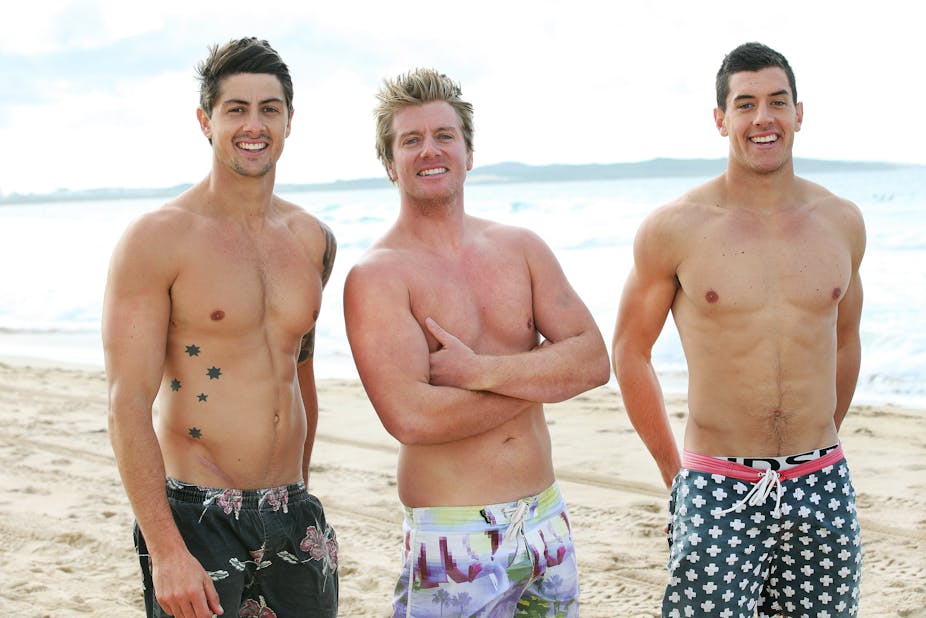
The first episode of The Shire ran last night on Channel 10. Described as “dramality” – a combination of drama and reality television – the show purports to show the lives of young people living in Sutherland Shire, known colloquially as “The Shire”.
But why is this place, south of Sydney, the chosen setting for this kind of program? And what can this setting, and the show overall, tell us about the kind of Australia that is projected?
A little piece of paradise?
Sutherland Shire sees itself, in its own marketing, as a “natural oasis” protected from the urban life of Sydney. This is what the show trades on – the idea of the shire as a utopian space, a place where young people live special lives cut off from normality. The Shire expresses this claim to utopian exceptionality.
Shot using the kinds of production values typical of American shows such as CSI: Miami, The Shire offers us a glossy, hyper-real, hyper-colourful Australia.
It is no coincidence that it is the same setting for the first big Australian reality show, Sylvania Waters. The fly-on-the-wall series about the blended families of Noelene Baker and Laurie Donaher was broadcast on Australian television in 1992 (and in Britain in 1993).
Then, as now with this new reality show, it was trying to show a particular image of Australia – something that may have been embarrassing but only to those that lived outside its borders.
In Sylvania Waters, many viewers saw the Baker-Donaher clan as the appalling nouveau riche. But what was shocking in 1992 has become, it seems, enviable in 2012. The difference is eleven years of John Howard’s neoliberal agenda. Between the two series only the attitude has changed. The McMansions of the Shire could well have been the waterside home of the Baker-Donahers.
The projected image of this life in this setting is a particular view of Australia that we have come to accept as normal – the beach, the sand and conservative values. A kind of Eden that many might aspire to.
Faking it
This version of Australia hasn’t changed since Sylvania Waters, and neither has the narrative framework in which our semi-fictional, semi-real characters operate. How race and youth are treated in the show are particularly telling.
Sophie and her best friend Vernesa are two characters in The Shire. Sophie works as a beautician and they see nothing wrong in focusing on and enhancing their natural attributes, fake lips and forehead go with fake tan and fake breasts. As Howard’s neoliberal social philosophy demanded, they are self-made. The obsession here is with youth – all that is needed is a stray grey hair and the characters go running to get botox.
Bekaa too, another character, returns from Dubai where she has had a nose job. For these women cosmetic surgery is a key aspect of the kind of individualised self-help they identify with. Their remade bodies blend with the remaking of life-styles that are exemplified in those in The Shire.
The more things change…
Sophie and Vernesa are non-anglo characters and their given roles mark them as distinct from the main group. They are not present at Rif Raf’s party. The new “dramality” format does not mean viewers will be getting a new kind of narrative with non-anglo characters on an equal footing.
In fact, the “Aussie” characters i, Mitch, Gabby, Andy, Bekaa, and the rest, could be straight out of Home and Away. Like Home and Away, and Australian soap operas generally, ethnic characters are kept to a minimum and when they do appear are still often given secondary roles.
While this is problematic enough in soap operas, in a “dramality” like The Shire, which claims some degree of realistic representation, it is even more pernicious.
After all, this is where the 2005 Cronulla riots took place. Then, Lebanese people who were coming in by train to use the beach were seen as a threat to the locals’ way of life. They weren’t Aussie enough. From this perspective, the Cronulla riots took place where they did for the same reason that both Sylvania Waters and The Shire were shot there: the shire gets thought of as a utopian repository of Aussie values.
The character of rapper Rif Raf and his family, most likely of Lebanese descent, seem to have learnt the lesson. If you want to be accepted you have to assimilate, and the best way to do that is through upward social mobility into a nouveau riche life of spectacular consumption.
The same might be said for Sophie and Vernesa. For whom are they going through all the trouble of remaking their bodies? Perhaps for themselves, but also to be of more value in the dating market.
In this shire, this utopia of Aussie values, what is acceptable is founded in the hyper-real glossiness and then expressed through the late capitalist remaking of everyday life as consumerist spectacle.
What is missing of course, is any true portrait of Australia. But perhaps, in the end, a real Australia would be too confronting, at least to those with traditional Aussie values.
Warwick Brown
Retired
Wow, so what they say about ‘Cultural Studies’ is true? Or is this a satire on it? If the Professor is serious, this is the worst piece of nonsense I have ever read on The Conversation. Talk about sucked in! This is a TV show for crying out loud. ‘Howard’ ‘Cronulla riots’ and ‘McMansions’ were enough it to set you off, it seems. I didn’t watch the show, will probably never watch the show (and Laura Bingle isn’t for me either) but, seriously, do you know anything of Sutherland Shire?
Read moreSome Sydneysiders…
Anthony Ervin
Mathematics Teacher at New South Wales DEC
Warwick,
What is laughable is your take on this. It seems the producers of the shire walked around Cronulla and chose a few kids to represent the "Shire". Seriously though, representative, you have to be kidding. The most down to earth people live there and most I think are horrified that other people see them this way.
I hate the idea that other countries think we are all like this as well. You cant just laugh this crap off and think nothing will come of it. To the contrary, it only makes life hell when you say you are Australian and people think you want Botox injections. But what is really worrying is that young people watch this tripe and generate ideas about their own identity as Australians.
Warwick Brown
Retired
Now don’t you go overboard too Red. This is a work of fiction. I KNOW there are plenty of good people living there and none of whom fit this stereotype (either of this show OR the Cronulla Riots). And I will admit that the ‘keep others out’ attitude there isn’t as bad as the northern beaches and Bondi people who have openly and publicly stated many times over the years that they don’t want ‘outsiders’ (particularly those from the western suburbs) going there. While this show might not be a good look for those who live there, it is a long bow to think that everyone will be stereotyped like this, just as the Puberty Blues stuff wasn’t general either. My main point remains though. This take on the show is way, WAY over the top and doesn’t follow the facts at all.
Anthony Ervin
Mathematics Teacher at New South Wales DEC
Well I dont know about Bondi but I am a volunteer lifesaver at Bronte, I am born and bread westy yet have been welcomed warmly by very friendly locals. How does that fit into your argument? BTW many Bondi-ites come to Bronte and are just as friendly.
Ken Swanson
Geologist
Red
Do not over think it too much. It is all fiction nothing more. It does not claim to be a statement about us, it is no more than Neighbours, Home & Away and the Chaser. Low brow entertainment.
I do not form a view about the UK when I watch a mix of Emmerdale, Midsummer Murders, Coronation Street, Graham Norton, the EPL and Little Briton. I am not looking for a social thread or some insidious message the producer is trying to subliminally send me. I allow myself to be entertained. Relax.
Steve Hindle
logged in via email @bigpond.com
What are the odds that this will end up on British TV in order to confirm the ugly Australian stereotypes?
It is time for another Sylvania Waters.
Mariana Podesta-Diverio
Undergraduate Arts Student at University of Sydney
Maybe its time for a television show about how television program pitches get chosen by network executives. It could be called "How stupid do they think we are?"
Diana Brown
Parent; language student
Mariana, that made me laugh! But seriously, folks..... obviously 'they' think we are profoundly stupid - look at the rest of the rubbish that's served up on most channels. And as these shows are watched by millions, well, maybe we ARE that stupid? I've discovered that most of the people I know who saw it, or as much of it as they could stomach, watched out of curiosity (after all the hype) and then in a kind of appalled fascination at the unremitting awfulness of the characters' stupid pointless lives. I won't watch it again because ten minutes was enough, but wouldn't condemn those who do because it's also pretty damn funny.
Christopher White
PhD candidate
Good idea; except I think the title should be "Just how stupid are they?"
Regan Forrest
logged in via Twitter
"But what was shocking in 1992 has become, it seems, enviable in 2012."
Enviable - really? If the twitter feed associated with the show is anything to go by, the characters and their lifestyle were seen as anything but 'enviable' by viewers. 'Disdain' would more accurately sum up the reaction.
In that sense, I see little difference between this and how Sylvania Waters was regarded 20 years ago. Framing it as a consequence of Howard neoliberalism seems a long bow to draw.
Anthony Ervin
Mathematics Teacher at New South Wales DEC
I think enviable to those perhaps a little bit malleable not so much nittwits.
Mat Hardy
Lecturer in Middle East Studies at Deakin University
I just want to know why they didn't show Frodo or Bilbo?
Mariana Podesta-Diverio
Undergraduate Arts Student at University of Sydney
What "glossy neoliberalism"? Mentioning the "nouveau riche" concept in passing doesn't add a political economic backbone to an otherwise superficial "analysis"of The Shire that essentially states the obvious.
"the shire gets thought of as a utopian repository of Aussie values". Really?
When I read the title of this article, I was looking forward to a more thorough/intelligent critique of the show...
James Jenkin
EFL Teacher Trainer
Hi Jon, you say 'most of us cringe' - what do you mean by 'us'?
Most Australians - or most nice middle-class inner-city Conversation readers? This couldn't be pure snobbery, could it?
Diana Brown
Parent; language student
It's always unwise to make assumptions about the socio-economic status of contributors to online forums such as this one. Unwise and, perhaps, even a little snobbish?
Dale Bloom
Analyst
The so-called Cronulla riots started when locals began patrolling the car parks after women were being harassed in the car parks. They were being harassed by members of an ethnic group who came to the beach, not to go for a swim, but to harass women who came up from the beach to the car park
The lads in the photo in this article are obviously not surfies. Too many muscles, and obviously they gained those muscles in the gym and not from surfing.
The series is likely to be fake, but so is TV.
Grant Wyeth
Digital recruiter/writer
It seems that "neoliberalism" is an argument in itself these days. The only attempt that was made to engage in any kind of philosophy was the idea that by getting nose jobs etc these girls were "self made". What is the logical extension of this? That humans don't have the right to their own appearance? I doubt you'd suggest that we should have a Department of Appearance, where the state can prevent us from looking ridiculous. But it points to the weakness of this article, not to mention the ignorance that is prevalent around liberal philosophy. Even in academia.
Jon Stratton
Professor of Cultural Studies at Curtin University
Hi Grant,
Yes, you're right. I didn't engage properly with neoliberalism in this piece. Unfortunately, 1000 words isn't enough to do justice to many of the points that I was making. Should you want a more detailed and nuanced discussion of the impact of neoliberalism on Australian culture can I please recommend my most recent book: Uncertain Lives: Culture, Race and Neoliberalism in Australia. The Introduction lays out the argument about neoliberalism in a much expanded form. Much of the Introduction can be found online.
Anthony Nolan
Ruminant
I shall read your introduction with interest. Before doing so, however, my own two bob's worth is that neoliberalism creates a culture in which specific subjectivities flourish and others don't. Those whose subjectivity appears somewhere, anywhere in fact, on the personality disorder scale tend to flourish especially those up the NPD end but borderlines and sociopaths also do very well. Admittedly, this truncated argument does all sorts of crude violence to theoretical nicety. However, as a rough rule of thumb it is useful to realise that the more people appear to conform to the dominant narrative of what constitutes success then the madder and sicker they are.
Grant Wyeth
Digital recruiter/writer
Having read the introduction to your book there are a few issues I have with it, but not the time (or space) to discuss them here. I will say though, that Howard's amping up of the nationalism in Australia would have had Hayek spinning in his grave. If, as in Hayekian philosophy, the state is an impediment to exchange (of any variety, monetary or not), then surely the nation is a psychological impediment as well? The irony here of social conservative parties adopting (some of) Hayek's ideas is that they were advocating both individualism and conformity at the same time. From what I take on a surface level of your introduction is that without the State to foster multiculturalism, the market (and traditional powers) will homogenise everything. I disagree. But then again, I don't really have much of an eye on mainstream Australian culture to judge properly.
Diana Brown
Parent; language student
That is so bewitchingly thought-provoking. I've never had the slightest interest in neoliberalism before but am now determined to explore the topic with some energy. What you said makes such dazzlingly good sense. Thank you so much for putting it so clearly.
Tim Adams
logged in via LinkedIn
"The difference is eleven years of John Howard’s neoliberal agenda.."
Seemingly this agenda only exerted its influence selectively.
The Federal Division of Melbourne has had a Labour incumbant across the same period since Sylvania Waters, the so-called "late capitalist remaking of everyday life" has produced the first Green in Melbourne (Adam Bandt).
Where was the John Howard influence there?
Cheery picking examples of Australian life - worse, an intentionally exaggerated slice of Australian life - to support a political comment is something that would be marked FAIL when I was at University.
Sean Lamb
Science Denier
"fake breasts. As Howard’s neoliberal social philosophy demanded, they are self-made."
Now I understand what John Howard was on about when he said "The Australian people have never had it so good"
Martin Hirst
Associate Professor Journalism & Media at Deakin University
One thing I don't quite get about The Shire - I have watched some of ep 1 online having missed it 'live'. It will be in the FoxBox from now on for me - this genre of 'dramality'.
I googled it and see it was coined by Mark Burnett - yep the very rich guy behind Survivor and The Voice and nearly every reality format in between.
I get that it is a portmanteau word for a blend of drama and reality, what I don't get is which bits am I supposed to believe and which bits can I disregard (or enjoy) as fiction and creation?
There are no supers or flashing lights, or even on-screen warnings so it's impossible to know.
Will the 'actors' break frame and tell us "Sorry, just kidding," when they do or say something awful?
Who are the 'real' characters and who in The Shire is just a character?
I think this is a bit dishonest, I make no judgment on the quality till I see a real car crash.
Diana Brown
Parent; language student
Hi Martin. I think that calling the woeful thing "a bit dishonest" is a remarkable exercise in understatement and restraint. Masterful! Quite agree, too.
Catherine Kraina
Retired
If this an example of the quality of media and social analysis that a modern professor produces, taxpayers are not getting value for their education dollar.