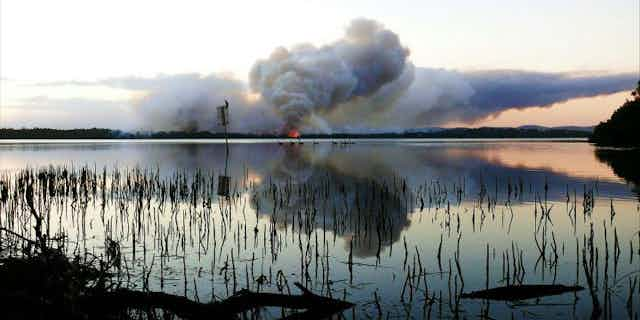

At this time of year, each year – the bushfire season – the complex nature of human behaviour hits home. Bushfires are a terrible event. The environmental destruction, the loss of property and sometimes lives, the damage to infrastructure, the fear and uncertainty, all take their toll in terms of financial and psychological costs. Extensive time and resources are rushed into emergency responses and the immediate aftermath of the fire – the fire needs to be put out, people need to be safe and have their basic needs met.
It is suggested that, of the approximately 60,000 bushfires which occur in Australia each year, one-third to a half are deliberately lit. Some believe that this proportion is much higher.
The occurrence of bushfire is only going to get worse. The Intergovernmental Panel on Climate Change’s Fourth Assessment Report predicts that in south-east Australia the frequency of very high and extreme fire danger days is likely to rise by between 4% and 25% by 2020 and between 15% and 70% by 2050. This increase in fire danger is likely to be associated with a reduced interval between fires, increased fire intensity, a decrease in fire extinguishments and faster fire spread. The implication of this is that many more fires which have been deliberately lit will become more dangerous.
The irony is that so much more could be done, both during and outside the fire season, to prevent the occurrence of fires and prevent the terrible losses and trauma. Yet few resources are allocated to either better understanding the drivers of bushfire or taking action to prevent the fire.
The cost of arson in Australia, according to recent Monash University work, was found to be $1.1 billion in 2009-2010, and this doesn’t include human or environmental costs. If only some of this cost was spent in prevention rather than repair.
The present response largely revolves around environmental modification, particularly around extensive cool burning. There are now serious questions as to whether this policy can be achieved and if it is the best way to go. A more comprehensive policy platform is needed to better target the situational conditions (where fires are lit, such as behind schools), and behavioural causes (for example, fires are often lit outside after school).
One example of excellent prevention work to raise community awareness, act as a deterrent and facilitate reporting of suspicion of arson is being undertaken by the Gippsland Arson Prevention Program (GAPP), in Victoria. Work is being undertaken on a voluntary basis in a collaboration between all sectors – business, the police, CFA, emergency services, the local council, the Department of Environment and Sustainability, Crime Stoppers and Monash Sustainability Institute.
Very little is known about people who intentionally light fires in Australia. However, we do know that they are largely male. About 40% are 15 to 20 years of age, 30% over 30 and about 10% children aged 10 to 15 years. About half of those over 15 years are unemployed. About two-thirds have, or will have, a conviction for violence – they are troubled people.
Even the little bit of knowledge we have suggests directions for prevention of arson. The disengagement of youth from employment and studying is a disgrace in Victoria, with youth unemployment – 15 to 19 years, the very age group which has the highest propensity to light fires – at 29.5% as of July 2012. This official figure is likely to be an under-estimation of the actual number.
Recent research at Monash Sustainability Institute has shown that some people are reluctant to report a suspicion of arson. Strong pathways from reporting to prevention need to be built, with resources for both arson investigation and an appropriate legal response, and treatment opportunities.
In 2005-06, 2,926 arson charges were laid in Victoria, while 39 people were sentenced in Victoria’s higher courts. Over the five years, 31% – 12 people, just over two people a year – received a term of imprisonment. One year was the most common sentence.
Significant new thinking is needed around bushfire arson prevention, aimed at structural, service design and operational levels and supported by research and evaluation of effects. A reduction in bushfire arson needs transformational, rather than incremental, change across all points of prevention. Not least of these prevention measures is a far more effective response to reducing greenhouse gas emissions.
Firozali A.Mulla
PhD
Bushfire arson: prevention is the cure How will you manage to watch the hugs land? If you can manage then you may cure but I doubt this I thank you Firozali A.Mulla DBA
Peter Ormonde
Peter Ormonde is a Friend of The Conversation.
Farmer
I recall - vaguely, like most of my recollections of late - coming across some very disturbing data on the role of US park rangers, foresters and fire fighters in lighting fires. It was essentially a profiling exercise - identifying the common characteristics of in-house arsonists who were blamed with starting between 40 and 60% of park and forest fires in the US.
Lone, middle aged males with a history of family collapse and isolation - lonely and depressed... troubles with alcohol. Particular seasons seem to trigger it - Christmans, Thanksgiving - family festivals where there is no family.
The US research led to substantial changes in the recruitment processes for the RFS and other agencies here.
Complex sad psychology at work here.
David Glover
Communicator
Hi,
Something seems to have gone awry with the figures quoted in the second last paragraph.
According to the linked paper, you're correct in quoting 2,926 charges with 39 convictions in 2005-06. Of these, 16 received a custodial sentence that year, compared with 110 over the five years 2001/02–2005-06 (22 per year on average). Still a disappointingly low conviction and penalty rate, but considerably higher than the 2 per year you've quoted.
Murray Webster
Forestry-Ecology Consultant/Contractor
No doubt Arson is a big problem and the authors are correct to bring it to attention to readers.
Read moreIt would be useful to see statistics on the area burned by arson compared to other ignition sources to provide a more complete picture of damage caused by arson. Some fires are less than a hectare but others can be 100 000 hectares or more.
However background and context are important.
I disagree with this statement ” The present response largely revolves around environmental modification, particularly…
Peter Ormonde
Peter Ormonde is a Friend of The Conversation.
Farmer
Really good comment Murray.
Fact is NPWS doesn't have a fraction of the resources required to actually manage the assets it controls on our behalf. Never will.
And in the Australian ecosystem - fire comes with the turf. It's how everything works. For the most part anyway.
I'm surrounded by National Parks - magnificent rainforest mountain country through to alpine plateaux. And it is declining, under constant threat and encroachment - from pigs through to lantana and feral grasses, to…
Read moreMurray Webster
Forestry-Ecology Consultant/Contractor
"magnificent rainforest mountain country through to alpine plateaux"
Barrington Tops?
Peter Ormonde
Peter Ormonde is a Friend of The Conversation.
Farmer
Now there's a man who knows his paddocks, folks.
Not too much of that sort of variation about though. But well spotted, Murray.
I grew up fishing the rivers and walking all over the place. Returning 40 years later it is heartbreaking to see the deterioration of what was once tree fern and epiphyte crowded forest into dessicated scrubland. Vast slabs of it.
Despite our best efforts. Perhaps because of them.
Still magnificent, but a pale shadow in parts.
bill parker
editor
After I joined a bush fire brigade many years ago, my first wild fire was arson. The pattern was deliberate that day. Light fires so as to stretch resources and make incident management difficult. Get a maximum response from the agencies responsible.
As time passed it became obvious that most bush fires were not natural. The perpetrators in the area were male and at least one was a trained firefighter. He knew where to light up and when.
The Bush Fires Act 1954 in WA was at the time deficient in that penalties were insufficient. Section 32 has been amended a few times and now "property" includes flora and fauna. The penalty is now 20years imprisonment.
I have no sympathy whatsoever for those who deliberately light bush fires. I liken the act to attempted murder.
Peter Boyd Lane
geologist
While this article focuses on clearly defined arson, I believe there is an associated and equally worrying aspect. In November 2011 we (in SW WA) had hot, windy and predicted to remain very hot and very windy days. Just NOT the time to light a fire. Yet a number of "prescribed" burns were undertaken, with predictable distastrous results. A huge amount of wilderness forest burnt, some 50 homes destroyed, infrastructure and many business losses. Arson? No, but a mindset worryingly close to it.
Carol Chenco
Carol Chenco is a Friend of The Conversation.
Research Officer
Good discussion but not a mention of the loss of non human life - all the animals who get destroyed in bushfires don't seem to matter as long as there is no loss of human life or property. Does destruction of the 'environment' encompass the death of animals? if so, say so. Obviously human life and property are priorities for humans, but I also feel for all the poor animals who die because of bushfires - human or natural causes. Also I don't discriminate between feral pests and native animals - they all suffer.
bill parker
editor
Perhaps you should get to know something about the way bush fire brigades operate Carol. Clearly we protect human life first and foremost, but whilst we do our best to protect fauna, whatever it is, our own safety and that of the public comes first. Environment does mean flora and fauna.
Carol Chenco
Carol Chenco is a Friend of The Conversation.
Research Officer
Thanks Bill, as I said 'obviously human life and property are priorities for humans', it was more that there is often not mention of the significant animal losses and the effect on biodiversity. This eventually comes out once the scientists do their research but Joe Public is not often made aware of this. That's all.
Blair Donaldson
logged in via Twitter
I can't help but wonder how much arson is inspired by the constant media references to fuel reduction burning and dire warnings of impending disaster before the summer even arrives.
Yes people need to be aware of prevention and the need to move out should a serious fire occur in their area but constantly advertising these facts along breathless descriptions of the likely dire consequences of not heeding warnings appears to be a trigger for some minds.
I'd like to see the statistics for arson in bushland and abandoned properties over the winter period when media messages regarding fire prevention is almost non-existent.
Certainly fires in bushland might be harder to set in winter but it's not impossible in dry years, yet, we hardly ever hear about deliberately lit fires. Something is triggering the arsonists.
Ron Chinchen
Retired (ex Probation and Parole Officer)
Having met a number of arsonists through my employment, while they've been serving time, I agree with the profile given except one factor that I noticed that may or may not be statistically justified. Most of the arsonists I met tended to be loners or as indicated disenfranchised, and they tended to be intellectually at the lower end of those considered below average intelligence. Their behaviour often gave them a sense of power they dont feel in general social interactions.