
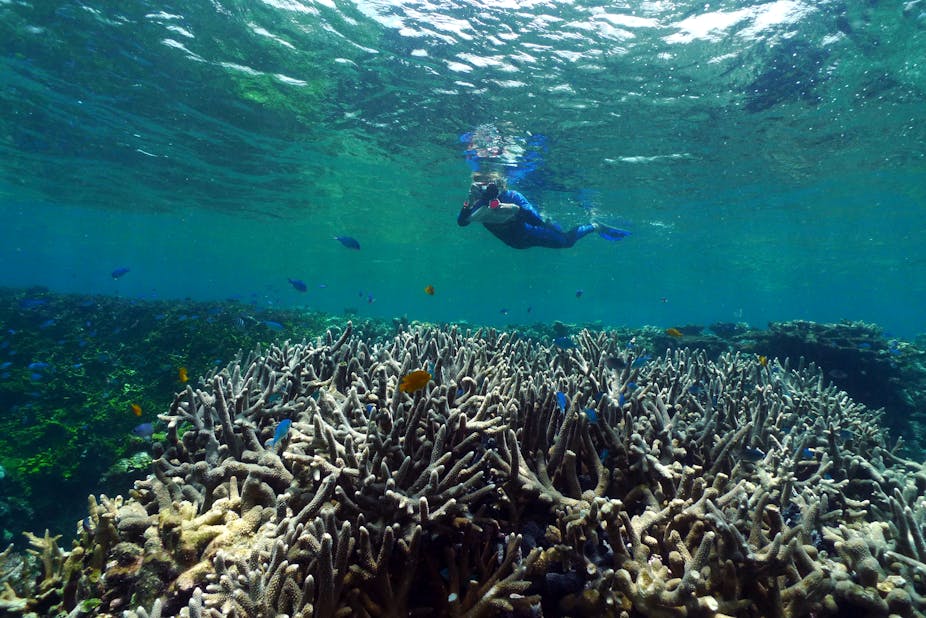
Calls for climate action as Great Barrier Reef suffers major coral loss

The Great Barrier Reef has lost half its coral cover in the last 27 years, and it could halve again by 2022 say researchers from the Australian Institute of Marine Science. A study published today in the Proceedings of the National Academy of Sciences, found storm damage drove 48% of the loss, the crown…

Wymmzc5h-1349074978
Extreme weather events, such as Cyclone Yasi, are damaging the Great Barrier Reef. AAP

The Great Barrier Reef has lost half its coral cover in the last 27 years, and it could halve again by 2022 say researchers from the Australian Institute of Marine Science.

A study published today in the Proceedings of the National Academy of Sciences, found storm damage drove 48% of the loss, the crown of thorns starfish 42%, and bleaching 10%.

“This finding is based on the most comprehensive reef monitoring program in the world,” said Peter Doherty, research fellow at AIMS.

Dr Doherty said the monitoring included surveillance of more than 100 reefs since 1985 and from 1993 had incorporated more detailed annual surveys of 47 reefs.

The data show that reefs can regain their coral cover after severe events such as tropical cyclones, coral bleaching or crown of thorns starfish population explosions, but recovery takes 10-20 years.

“At present, the intervals between the disturbances are generally too short for full recovery and that’s causing the long-term losses,” said study author Hugh Sweatman.

Ove Hoegh-Guldberg, director of the Global Change Institute at the University of Queensland, agreed that the frequency of events was the key issue, and said action to address CO2 emissions was the only sensible remedy.

“What these results tell us is that the small change in the frequency of extreme events has a big impact on complex systems like the Great Barrier Reef, “ Dr Hoegh-Guldberg said.

He added that there was a climate component to all of the events, with warmer seas driving more intense storms, flood inundation events triggering crown of thorns starfish outbreaks, and mass coral bleaching driven by extreme heat events.

“The problem we are currently facing on the Great Barrier Reef is that today none of these stressors occur in isolation,” said coral biodiversity researcher Zoe Richards.

“This research clearly shows that over the last decade the rate at which coral cover has declined has accelerated and this reflects the cumulative impact of multiple stressors and the inability for communities to recover.”

“We can’t stop the storms, and ocean warming (the primary cause of coral bleaching) is one of the critical impacts of the global climate change,” said John Gunn, AIMS CEO.

“However, we can act to reduce the impact of crown of thorns,” he said. “The study shows that in the absence of crown of thorns, coral cover would increase at 0.89% per year, so even with losses due to cyclones and bleaching there should be slow recovery.”

Dr Hoegh-Guldberg said the only sensible and economic remedy was to reduce global CO2 emissions to zero within the next 10-20 years.

He said the connection between flood inundation and coastal run-off and the crown of thorns problem was very compelling.

“This makes an extremely large smoking gun: Warming of the planet increasing episodic flood volume which then impacts the food supply of larval crown of thorns starfish, which then leads to an increased frequency of outbreaks.”

Sign in to Favourite

Want to follow The Conversation?

Sign up to our free newsletter to get the day's top stories in your inbox each morning, with a special wrap on Saturday.

Spinner
Donate and become a friend of The Conversation

Join the conversation

28 Comments sorted by

  1. Marc Hendrickx

    Geologist

    In past discussions here Ove I raised questions regarding evidence of past bleaching events that might better support the contention that current events are extremely out of the ordinary. I was particularly interested in evidence of past bleaching events that may show up in xrays of coral core. Do you know if there has been any progress on this?

    report
  2. Nick Heath

    Great Barrier Reef Coordinator, WWF

    The main takeaway from this article is that we must cut the pollution which cause outbreaks of the Crown of Thorns Starfish

    A certain amount of storm damage is natural and expected, and the study shows reef recovery rates still exceed the rate of damage from storms and cyclones

    The CoTs are another story. They are increasing their reef damage at a far greater rate than natural, increasing in frequency from once every 50-80 years (and perhaps longer) to once every 15 years

    And we shouldnt overstate the climate-flood story. Its not the quantity of flood waters, its what is in it. Nutrient pollution has accelerated 500-900% since Eurpoean settlement

    Only cuting carbon pollution will not save the Reef south of Cooktown

    Massive new efforts are needed to cut fertiliser pollution of the Reef. We have Murray Darliong Basin scale damage now occuring and while billions are being spent there, far less than that is spent on the Reef.

    Nick

    n

    report
  3. Marc Hendrickx

    Geologist

    "Dr Hoegh-Guldberg said the only sensible and economic remedy was to reduce global CO2 emissions to zero within the next 10-20 years."
    The reef unlikely to survive for long under such a proposal as the subsequent economic collapse will mean there will be no funding for environmental programs. Hardly a sensible choice, hardly economically or environmentally responsible, just as we'll he's not in charge of making policy decisions.

    report
    1. Joel Piotrovsky

      semi-productive

      In reply to Marc Hendrickx

      "...the subsequent economic collapse..." And the deniers like to call believers in AGW alarmists!

      report
  4. Comment removed by moderator.

  5. Comment removed by moderator.

  6. David Arthur

    n/a

    It is reported that coral loss is attributable
    10% to coral bleaching events
    42% to crown of thorns starfish
    48% to storm damage.

    Now, increased frequency and severity of storms is certainly due to climate change, as is increased frequency and severity of bleaching events. However, storms would not cause so much damage if the reef was otherwise in good health.

    Would there be so much storm damage if starfish weren't ever-present in plague proportions? No.

    This story is as much about agricultural, mining and coastal development practices in the entire Coral Sea catchment part of Queensland, as much as it is about too much CO2.

    PS The sudden introduction of so many no-take zones about 10 years ago suggests that the then Government was already aware of deleterious changes underway.

    report
    1. Nick Heath

      Great Barrier Reef Coordinator, WWF

      In reply to David Arthur

      Hi there

      Storm damage is a natural part of the reef's conditions. Sure it has been influenced by climate change and will be increasingly so. But no one is saying all 48% storm damage is climate change. The fact the far nortthern reefs which are dealing with with climate but little farm pollution are doing fine. And recovery rate of reefs after storm damage is significant - if their had been no CoTs outbreak we would have seen greater coral cover than we saw at the start of the study.

      So at…

      Read more
    2. David Arthur

      n/a

      In reply to David Arthur

      Thanks Nic. I agree with you about caring for the Reef.

      Here's a comment I posted over at Fairfax's Brisbane Times site (http://www.brisbanetimes.com.au/environment/conservation/great-reef-catastrophe-20121002-26vzq.html).

      "It's not just pesticide runoff that's causing crown of thorns numbers to boom, it's nutrients from fertiliser and soil runoff, from runoff from coal mines and urban waste water.

      "No mention of any of that in this newspaper report, so they should have given Nicky Philips…

      Read more
    3. David Arthur

      n/a

      In reply to Nick Heath

      Thanks Nick.

      Perhaps WWF could have a word with Tony Burke about augmenting Reef Rescue along the following, job-creating lines?

      Problems are better addressed at their source. For coastal fisheries, that can mean hundreds of kilometres inland with riparian revegetation (river bank restoration) and elimination of point nutrient/contaminant sources such as urban sewage effluent and runoff from mines.

      Perhaps a scheme along the following lines could be implemented:

      1. Resume the banks of rivers draining to the Coral Sea, all the way inland to the Dividing Range.

      2. Replace the dole with work schemes to replant these river banks with native riparian vegetation.

      3. Replace all river access for grazing stock with in-paddock watering troughs (solar/wind-powered water pumping from the river).

      4. Implement draconian restrictions on mine drainage to rivers, even if the mine is flooded out, unless the water leaving the minesite contains negligible contaminants.

      report
    4. David Arthur

      n/a

      In reply to David Arthur

      So what's the problem with the proposals I make? Someone has given them an "unconstructive" tick, without having the decency or wit to explain their issue with what I see as perfectly sensible proposals to augment the Federal Government's Reef Rescue deal. Thanks a lot, whoever you are, for your "constructive" contribution to the Conversation.

      report
  7. Comment removed by moderator.

  8. Alex Cannara

    logged in via LinkedIn

    The combustion industry has long exceeded the ability of Earth;s Carbon Cycle to return to geologic storage what's released into the air each year, for decades. We now emit >30Gt Co2 (>10Gt C) into the atmosphere, while the natural rock weathering and calcification by sea organisms handle at best a % or so of that to subduction zones as limestone. And, subduction has a schedule that cares not about the combustion industry's need for $ -- right Marc?
    ;]
    Hey, let's not make the industry pay a Carbon Tax, let's just require they pay for the Oxygen that gives their product any value at all. After all, NASA had to pay for the Space Shuttles O2!

    http://eps.berkeley.edu/development/view_person.php?uid=6449&page=72

    report
    1. Marc Hendrickx

      Geologist

      In reply to Alex Cannara

      What's this combustion industry you speak of? I see no such thing. There's the avgas that powers the planes used to get to international conferences, the petrol that drives the 4WDs and boats used to transport equipment to and from the reef, the coal fired power stations that provide electricity to the labs, and the methane burping cows that provide the steaks for the departmental BBQ. Is this the "combustion industry" you speak of?
      As usual, you've got things ass about Alex.

      report
    2. Alex Cannara

      logged in via LinkedIn

      In reply to Marc Hendrickx

      Good try Marc, if a desperate one.

      So, the things you speak of are what % of the combustion used to drive industry & business around the world? Do you not realize, for example, that Canadian tar sands companies are even worried about their own costly carbon footprints for producing their steam for extraction, etc?

      By the way, how much fuel does the industry you work for burn just to provide its products? Oh, that's right, you claim to be a "geologist", but you won't tell us who pays you.
      ;]

      report
  9. Wade Macdonald

    Technician

    In 2011 a 15 year study concluded that there was no noticeable hard coral decline across a plethora of sites on the GBR. Some areas increased, some decreased but overall, no net loss?

    In 2012 we have a 50% decline on the GBR over the last 25 years?

    Wow....what a detrimental gap 12 months can make?

    This must be the climate change 'consensus' our political leaders speak of when promoting carbon taxes?

    report
    1. trevor prowse

      retired farmer

      In reply to Wade Macdonald

      Has the GBR been surveyed during the drought to see the different effect to the last few years during the heavy rain periods. From the BOM data, the storms and cyclones in Queensland are reducing and the air temperatures at the 12 tidal stations have not had an average mean trend increase in Australian for the last 20 years.
      Does the nutriment load only occur in flood conditions ?

      What practical measures can be taken to reduce COTS influence , and were they of a lesser problem during droughts?
      What is the variation in temperatures of the sea in north compared to the south, and has the reef deteriated more in the north where the sea is warmer?
      This article could imply that direct action may make a quicker response to the GBR than waiting 1000 years for the full effect of climate change mitigation to begin.
      Australian legislation passed this year has projections that show an increase in total co2 in 2020 , especially if we continue to increase our population.

      report
    2. John Bruno

      Professor of Marine Ecology and Conservation at University of North Carolina

      In reply to Wade Macdonald

      Hi Wade, I understand your confusion. I coauthored a response to the 2011 article and blogged about it's many flaws here: http://www.skepticalscience.com/coralreefbaselines.html

      But the big difference is the new paper had data through 2012 - an addition 6 years during which we saw a lot of coral loss.

      That said, it is frustrating for AIMS to be publishing somewhat contradictory papers based on the exact same database.

      report
    3. Marc Hendrickx

      Geologist

      In reply to John Bruno

      Perhaps next time you could post your comments to a more reputable location! or perhaps send a comment to the journal.

      report
  10. John Harland

    bicycle technician

    i expected some mention of proposed coal export terminals in the area.

    report
  11. Ken Swanson

    Geologist

    Don't worry.
    Just wait 3 months or so and there will be another report published by equally qualified academics contradicting Ove with proof the reef has recovered. This always happens with his predictions, no one takes him seriously any more.
    Watch this space.

    report
    1. Alex Cannara

      logged in via LinkedIn

      In reply to Ken Swanson

      Really, Ken? Since we've already had our scientists studying the reef fr years and reports published that show it being decimated faster that expanding, you're so sure this fellow's a twit?

      Really?

      Maybe if you studied the many research results on reefs around the world, you might come to a more realistic conclusion.

      Anyone who's a scientist or engineer can, for example, join the major scientific societies and get their publications. Start with the AAAS, Nature, etc.

      report
    2. Ken Swanson

      Geologist

      In reply to Alex Cannara

      Yes really Alex

      Watch this space.

      In the past Ove has been forced to correct his own dud predictions.

      Get the blinkers off mate. That's an Australian term.

      report
    3. Alex Cannara

      logged in via LinkedIn

      In reply to Ken Swanson

      Thanks Ken, yes, we have the same expression, and we have "straw man" as well, to describe your odd reliance this one guy Ove to use what may be his errors to cover for your own lack of research before spouting (Amuricun).

      So, same advice, read beyond the echo chamber of deniers & fact avoiders,
      mate. You could even go to the library, if you can't join a professional publication group.
      ;]

      report
    4. Ken Swanson

      Geologist

      In reply to Alex Cannara

      Sorry I thought we were commenting on this guy because he was the one being quoted here.
      Spare us the personal abuse Alex we have seen enough of that from you on this blog
      Next you will be claiming that I have a "handler", one of you usual abusive tags
      I am talking about Ove, you are deflecting

      report
    5. Alex Cannara

      logged in via LinkedIn

      In reply to Ken Swanson

      Yes, and I was never talking about Ove, until you generalized from him as an odd way of denying the reef (your country's reef) problem. Remember?

      "Just wait 3 months or so and there will be another report published by equally qualified academics contradicting Ove with proof the reef has recovered."

      Remember the point, Ken?

      report