



In the lead-up to release of the carbon tax package, the government signaled a desire to end renewable energy support measures and rely solely on a carbon price to transform the Australian energy sector. But the political reality of a minority government has resulted in a raft of additional measures that majority government alone would not have achieved. The final agreement effected largely by the Greens and Independents includes the creation of several independent bodies to help drive Australia’s shift from climate changing fossil fuels to renewable energy sources, and for giving Australia a real chance at profiting from the coming clean energy technology boom. But they may not be sufficient.
ARENA: all programs in one body, but not enough money
The Australian Renewable Energy Agency (ARENA) has been created to consolidate the existing government programs for renewable energy into a single body. This is a welcome move. An independent governance board adds an extra step of separation between the day-to-day vagaries of politics and decisions about renewables funding.
This should in theory lead to better outcomes, but it depends on who ends up running the board and how far they really are from government.
ARENA’s budget is $3.2 billion. $1.5 billion of that was previously committed through existing programs. Exactly where the remaining $1.7 billion has come from is unclear – is it actually new money, or money that has already been allocated through existing programs but not yet spent?
If the $1.7 billion is new money it is another welcome but small addition. If not, then the main benefit of ARENA is to cut some red tape from the Solar Flagships program — the grant scheme for large-scale solar projects.
If the government is seeking to increase the amount of renewables built under this model in the immediate future it would need to allocate many times more money for grants.
CEFC: an independent green investment bank
The Clean Energy Finance Corporation (CEFC) is the other main renewables initiative in the climate change package. The CEFC is modelled on the UK’s recent “Green Investment Bank”. It will use publicly provided money to drive renewable energy and energy efficiency projects, investing where private investors are unwilling to for various reasons.
By setting up an agency at arm’s length from the government, that is still free to take on higher risks than the private sector, an important gap has been bridged.
The $10 billion budget over five years sounds exciting. The budget provided indicates that most of this money won’t be available until the latter half of the decade, with only $944 million provided to 2015.
If the CEFC can provide financing at low interest rates it has the potential to lower the cost of renewable electricity. As renewable projects are capital intensive and have no fuel costs, the interest rate repayments on the capital investment have a large effect on the final price of electricity.
Low-interest financing may not be enough in itself to get first-stage renewables off the ground. In the US, large solar thermal plants are being built due to the combination of renewable portfolio standards (like our LRET), low-interest financing via loan guarantees, and additional grant funding from the Investment Tax Credit.
Half of the of the CEFC’s $10 billion budget is quarantined for investment in “the commercialisation and deployment of renewable energy and enabling technologies.” This mandate should mean it will make investments that are currently too risky for private investors, and leave the safer ones for the market.
Business-as-usual in the power sector will be gas and wind power, so it’s hard to see a justification for the CEFC investing there.
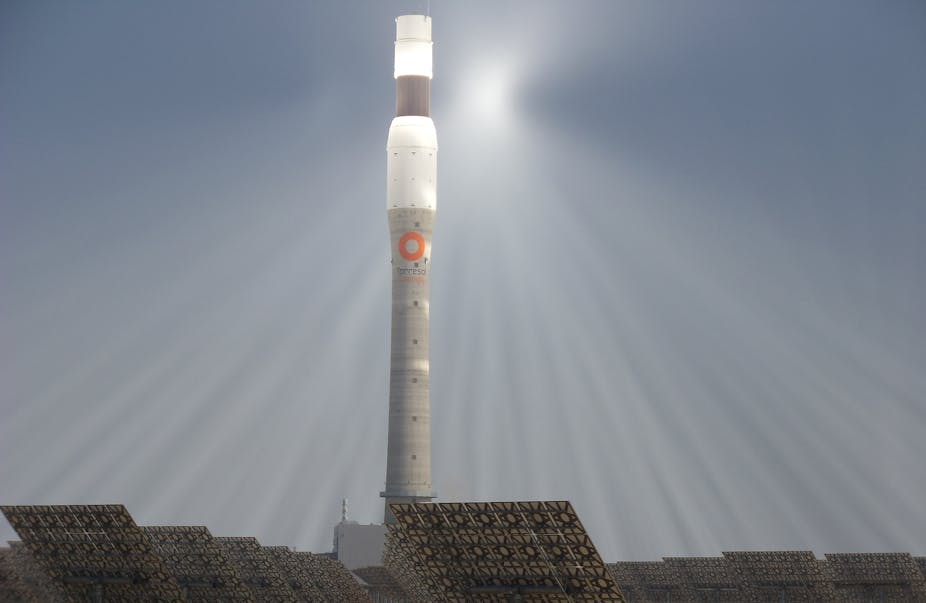
For the CEFC to be effective, it should focus on newer renewable technologies and bridging the “valley of death” between commercialisation and mass-scale deployment – likely candidates are solar thermal with storage and possibly wave power.
How do we get private investment flowing?
Ultimately though, if Australia is to get serious about accelerating decarbonisation then the goal must be to create market conditions that stimulate private investment in renewables without further government intervention.
Investment in the mining sector is measured in the dozens to hundreds of billions of dollars per year. Why? The price being paid for their commodities makes for an incredibly attractive return-on-capital.
The most successful policies for renewable energy around the world do the same thing – provide an attractive enough price for the product so that private capital flows.
When managed properly, feed-in tariffs (FiTs) have done exactly that and worked. They allow renewable energies to reach a stage where the premium tariffs can be reduced year-on-year to the point where they will eventually be no longer necessary.
Policymakers should remember the success of feed-in tariffs in Germany and Spain for achieving large rollouts of renewable energy. Fortunately, nothing in the government’s carbon price package would prevent well-designed national FiTs being implemented this decade.
The package announced yesterday represents a step forward,and the role of the multi-party climate committee in navigating through the mire of vested interests is to be commended. It has elements of a useful framework that can be scaled up in response to public acceptance and climate science.
However there is much work to be done, and the future of renewable energy beyond the LRET is still uncertain. We may see a few extra renewable projects go ahead, but we have still not created the full scale of market conditions necessary for transformation to a renewable energy economy.