

It now appears that the scientist who seemed to be advocating that we clone Neanderthals was suggesting only that “we need to start talking about it.” Ethics is an essential part of such a conversation: assuming we can overcome the enormous technical challenges that currently bedevil any such cloning initiative, should we do it?
Big science is expensive, and any money spent on it is money not spent elsewhere. The (perhaps many) millions of dollars required by this kind of research could be used for hospital beds, poverty alleviation or medical research. Of course, the money may come from private sources, rather than government, and private individuals may have the right to use their money in this way.
But it’s one thing to say that they have the right to spend their money in this way and quite another to say that it’s ethical to do so (there are many things we have the right to do that are nevertheless morally wrong: we can lie to one another, we can buy artworks and burn them, we can express racist or misogynist views, and so on). The very fact that research involves the expenditure of scarce resources, and therefore opportunity costs (the alternative uses we might have made of the money), means that it must have some positive value to be ethical.
What kind of positive value might justify it? Obviously, research is often justified by the benefits it promises to bring us: medical research has played an important role in extending the length and the quality of lives of human beings (and animals, too). And while it’s much harder to put a value on basic research – curiosity-driven research, it’s very plausible to think that basic research is valuable.
First, it plays an indirect role in bringing about benefits to humans and other animals: everything in science is connected, however distantly, to everything else, and deepening our knowledge about anything might enable us to develop better therapies in the long run. Second, knowledge seems to be valuable in itself: knowing more about the universe and our place in it is sufficiently important to justify expending some resources on science (and on the humanities, too).
Will this research bring us practical benefits or deepen our knowledge? Cloning is now used in agriculture to that extent it has practical benefits (assuming – perhaps bravely – that this kind of agriculture is itself justified). It may be that solving the enormous technical challenges involved in cloning Neanderthals would contribute, in some way, to these practical applications.
More certainly, the research would produce knowledge that we currently lack. Right now, we know how to clone only in one way: by somatic cell nuclear transfer. Essentially, the process involves transferring the nucleus of a cell from one organism into the egg cell of a host organism. This gives us a cell with DNA the great majority of which comes from the animal to be cloned (only the mitochondrial DNA of the egg comes from the host). When the technique is successful, we get an animal that is genetically very similar to the original animal. Because we lack a preserved Neanderthal somatic cell, however, we can’t use this method. Instead, the research proposes synthesising a DNA cell using the near-complete Neanderthal genome. No doubt, the attempt to do so would add considerably to our knowledge of genetics.
Suppose we succeeded in cloning a Neanderthal. Then, it seems, we would gain knowledge in another way: we could observe the growing child and his or her behaviour. However, though we would certainly learn something in this way, it would be rash to think that we were learning much about Neanderthals through observing the clone. We don’t know how much of Neanderthal behaviour is dependent on environmental input, of the right kind and at the right time.
Human beings are innately disposed to learn language, but an alien who cloned a human being might not learn that fact unless they provided the right kind of environmental input (language develops given the right kind of exposure in childhood). Language use is, of course, central to the kind of social animals we are; so an alien who cloned a human being might learn relatively little about us (in fact, they may get a highly misleading picture of what human beings are like).
We run an analogous risk with the Neanderthal: we might get an extremely misleading picture of Neanderthal behaviour from a child brought up in a modern environment (even were we to try to replicate the environment in which his or her ancestors might have lived: we simply don’t know enough to get close).
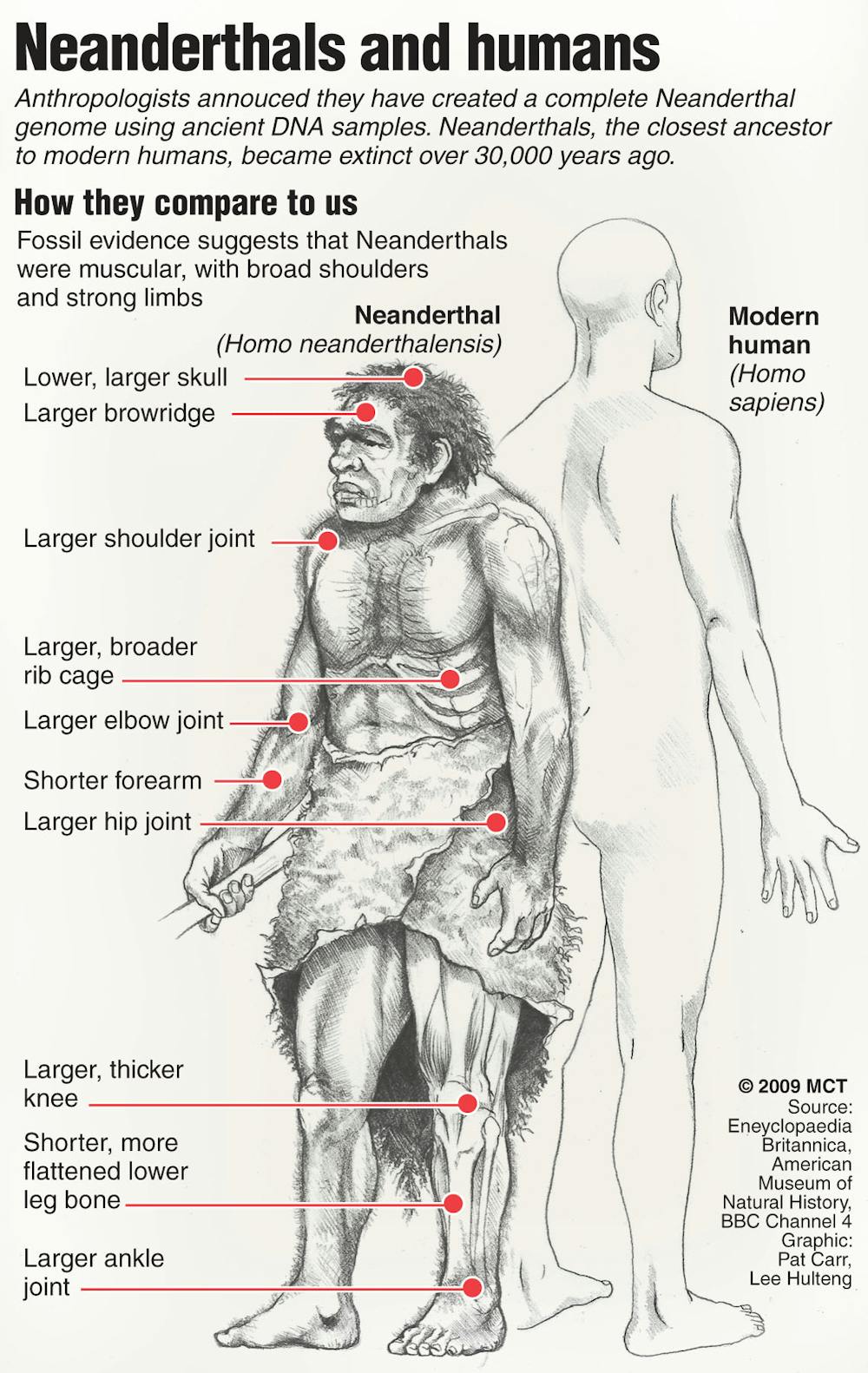
The idea that we might try to replicate the environment in which Neanderthals lived brings us to the central issue concerning the ethics of this research: the welfare of the cloned individual. Neanderthals were intelligent: they made tools and may have had language; they certainly had a complex culture.

Unlike most other animals, the cloned Neanderthal would have a grasp on how it is being treated. It would either have to be brought up in ignorance of its place in the world, or its unique position – the last representative of an extinct species, alone on the Earth – would have to be made clear to it.
Either option seems likely to cause it suffering; in the first place though the kind of isolation from others that ignorance would require; in the second case through a kind of existential loneliness. To have a flourishing life, it – like us – probably requires some kind of community in which it can take its place. We are unlikely to be able to offer the clone such a community.
Further, being a constant object of scientific curiosity is not likely to lead to a life of flourishing. At worst, it might feel like it’s the main attraction in a freak show.
Like other attempts at cloning, moreover, it’s highly unlikely we would not succeed at first try. Rather, it is likely to require many attempts. Embryos that are not viable would die early; some people would be troubled by that fact (though I am not). Even if we succeed in bringing an embryo to term, there’s a high likelihood that the infant would die soon afterwards or have significant health problems: it might well take many births to produce a relatively healthy individual. Sickness and death are major costs, borne by the cloned individual.
Finally, spare a thought for the woman who bears a cloned Neanderthal to term. She will undergo an invasive procedure, endure a pregnancy which may involve significant complications, and be herself the main attraction in a freak show. She may develop an attachment to the child, but is unlikely to ever have a normal relationship with it. Of course, any woman who participated in such research would be a volunteer, and women have the right to do what they like with their own bodies. Nevertheless, I suspect that she would herself bear significant costs.
I doubt that cloning a Neanderthal is possible anytime soon. The technical hurdles are too great. The knowledge we might gain through overcoming these hurdles, were we to succeed, would be of great intrinsic interest. But I doubt that they can justify the research, in the light of the costs that would have to be borne, especially by the cloned individual.