
Child abuse inquiries as catalyst for deep change in the Catholic Church

The awful record of the institutional Catholic church’s leadership in dealing with the scandal of clerical sex abuse of minors has clearly, and rightly, been a trigger for the federal government’s Royal Commission into sexual abuse of children in Australia. This is a record that has already prompted…

2qgqr7nq-1360023023
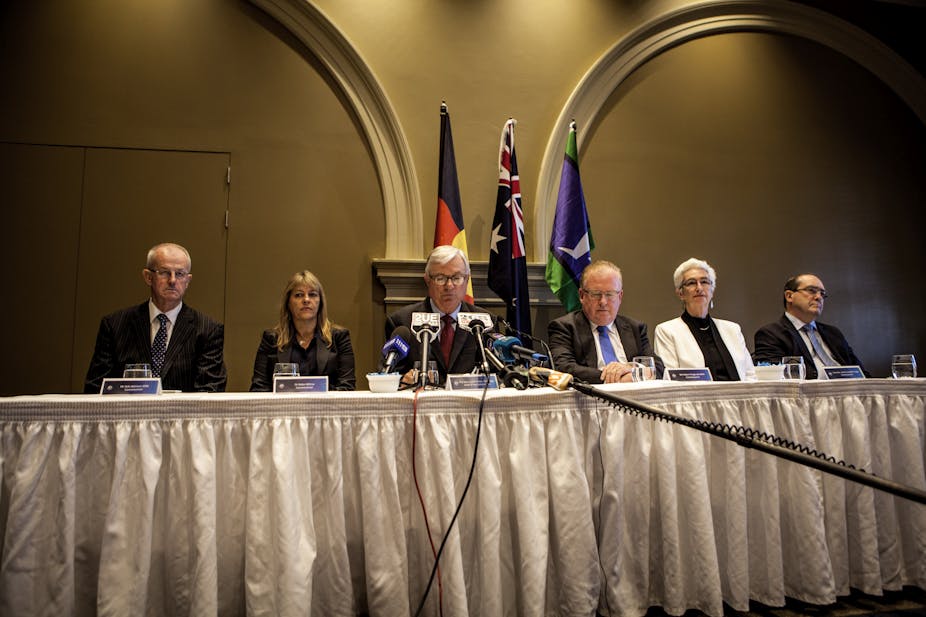
Justice Peter McClellan (centre), Chair of the Royal Commission into child sex abuse, delivers a media statement with his fellow commissioners in Sydney. AAP/Damian Shaw

The awful record of the institutional Catholic church’s leadership in dealing with the scandal of clerical sex abuse of minors has clearly, and rightly, been a trigger for the federal government’s Royal Commission into sexual abuse of children in Australia.

This is a record that has already prompted other inquiries here and overseas.

It would indeed be wrong to ignore the failings of other churches and secular institutions as recent events in Britain have revealed, most notably, the lax performance of the BBC in the scandalous behaviour of their pin-up star, Jimmy Savile over decades of impunity in abusing children.

British DJ and television presenter Jimmy Savile OBE, who is alleged to have committed several hundred counts of sexual abuse offences between 1955 and 2009. (Photo by R. Poplowski/Fox Photos/Getty Images) Fox Photos/Getty Images/R. Poplowski

The tentacles of this scandal have reached to a variety of other secular institutions, including children’s homes and hospitals. The terms of the Australian inquiry , as announced by the federal government, have reasonably addressed such concerns by including institutions other than the Catholic Church in the Commission’s remit. Closed institutional power over the vulnerable, wherever it exists, is a key factor in the perpetuation of abusive conditions.

Even so, the Catholic Church has and continues to have major problems dealing with this issue of clerical sexual abuse, and virtually every day produces new evidence in a variety of countries, not only of abuse by clergy, but of negligence, cover-up, concealment, and deceit that have contributed to dreadful injustice to victims.

Significantly, these problems have combined with other tensions and stresses within the church to expose an even deeper crisis in the church’s structures and doctrines, and have contributed to a broad disaffection of laity and significant sections of the clergy with the church’s leadership and its exercise of authority. In Ireland, for example, the previous widespread attitudes of respect and deference towards church authorities and institutions have almost entirely disappeared, conspicuously amongst the young, but even dramatically amongst the older generations.

The sex abuse crisis has crystallised for many Catholics an alienation from church structures and authority that began with the papal encyclical Humanae Vitae of 1968 reasserting the standard ban on artificial contraception.

It has been confirmed by the passing of the years as a crucial turning point in the Church’s grip upon the obedience of Catholics, since it is clear that a vast majority of Catholic laypeople disregard the ban with no compunction and that hardly any clergy in the industrially advanced world advert to it in their preaching. It is true that some American bishops made contraception a sort of issue, along with the more central one of abortion, in their ill-judged intervention in the recent American election, but the total failure of that intervention to have a significant impact on the outcome merely makes my point.

Sadly, loss of authority on this matter has reinforced the determination of church leaders to hold the fort on a range of disciplinary and doctrinal issues that the reforms of Vatican Council II opened the way to review. This has produced numerous exercises of arbitrary, unconscionable and clumsy disciplinary measures against clergy, such as the forced resignation of

Former Bishop of Toowoomba William Morris, who was removed from the position by Pope Benedict XVI in 2011. AAP/Catholic Media Office

Bishop Morris of Townsville, the disciplining of the Irish priests, Fr. Tony Flannery and Fr. Brian Darcy, for writing about issues that the Vatican regards as closed, the clamping down on the organisation representing American nuns, the United States Leadership Conference of Women Religious (USLCWR) which has had the indignity of being placed under the guidance and oversight of, guess what, a man, the Archbishop of Seattle. The Vatican apparently found fault with the Conference’s fidelity in promoting church teaching particularly on life issues.

Since the liberalising winds of Vatican II, the various orders of nuns have been in the forefront of new thinking and fresh policies in religious life.

Much of this campaign of repression, as indeed, the child sexual abuse and the cover-ups, are connected with the Church leadership’s obsession with all matters to do with sex and the regulation of it. This is not indeed new, because since the early years of Christianity, there has been a concern with the control of sexual conduct.

Such concern was understandable in certain contexts and cultural backgrounds, involving dubious sexual practises in societies surrounding the early church, but this was augmented by a later obsession with the supposedly supreme virtues of virginity, and a grudging concession that married sex was only legitimate when geared (somehow) towards reproduction.

Add St. Augustine’s view that Original Sin was transmitted through the generations by the “lust” accompanying sexual reproduction and you have a heady mix. One might have expected that this history would have produced more vigilance in detecting and confronting sexual crimes by the clergy, but by a weird irony this deep suspicion of sex seems to have been an element in the collusive attitudes of church authorities to the sexual abuses of children by its ministers. It is as if the belief that all sexual activity is somehow tainted makes the egregious destruction of childhood innocence just another failing to be expected. Or perhaps the concentration on policing sexual misdemeanours of the laity helped blind authorities to the offences of the supposedly chaste and celibate clergy.

Pope Benedict XVI at the Saint Peter Basilica in Vatican City. AAP/Claudio Peri

Of course, another potent factor in the secretive and dictatorial reactions of too many Catholic leaders to the current crisis is the fear of a loss of authority. This is not merely the outcome of a selfish attitude to the loss of personal and institutional power and status (though one can never underestimate the effects of that in human affairs) but a genuine alarm at the splintering of what the authorities see as orthodox belief.

This reflects a rigid conception of what it is to be a Catholic Christian, a conception that has long historic roots in thundering denunciations of heresy, promulgation of excommunications, division of Christian communities, and persecutions. Other communions, of course, have a similar record, but the tendency to centralise authority in the papal office and its administrative support team in Rome has created a uniquely authoritarian, indeed dictatorial, style of leadership.

The style is not new, of course: it dates back to the consolidation of Roman clerical power in the reforms of the 10th century which also introduced the regime of priestly celibacy. Yet it has proved extraordinarily resistant to the widespread demise in the modern world of the secular models of imperial and monarchical sovereignty from which it was largely derived.

This picture of the role of authority has been buttressed by a distorted image of the history of Catholic doctrine as a constant preservation, with some elaboration, of an initially given “deposit of faith”, inerrantly propounded and defended by papal authority. I have no space to expose the defects in this image, but it is built so deeply into the present structure of the Catholic Church that it would require a drastic change in the church’s system of governance and its self-understanding to root it out.

Defence of the image and fear of its reshaping is behind so much of the Vatican’s reactionary efforts to overturn what its officials see as deviant developments from Vatican II.

Justice Peter McClellan, who will head the Royal Commission into Institutional Responses to Child Sexual Abuse. AAP/Damian Shaw

When priests question the ban on even discussing the ordination of women, or “colonial” bishops dare to point out that the drastic decline in vocations to the priesthood could have something to do with clerical celibacy or with denial of women clergy, the fury from above and from those below who share the Vatican picture of authority is immense.

Also reinforcing the anxieties of Roman authorities is the increasing evidence that large numbers of ordinary Catholics have already made up their minds about the irrelevance of the Vatican and Episcopal fulminations against artificial contraception, homosexual practice and gay marriage, pre-marital sex, assisted reproduction, and even certain aspects of euthanasia and abortion. International surveys have consistently shown this cleavage between official teaching and the sincere beliefs and practice of the flock. For instance, surveys in the United States regularly show that the official Vatican line on contraception and abortion has very little influence upon what Catholics think. One recent poll of American Catholics in 2009 found that only 14 percent agree with the Vatican’s position that abortion should be illegal.

A 2008 poll showed that 86 percent of Catholics approve of abortion when a woman’s health is seriously endangered, 78 percent think it should be possible for a woman to obtain an abortion when a pregnancy is the result of rape, and 66 percent supported health insurance coverage for abortion when test results show that a fetus has a severe abnormal condition.

On contraception, a 2008 United States poll showed that “sexually active Catholic women older than 18 are just as likely (98%) to have used some form of contraception banned by the Vatican as women in the general population (99%). Even among those who attend church once a week or more, 83 percent of sexually active Catholic women use a form of contraception that is banned by the Vatican.” Recent Gallup Poll figures have shown that 40 percent of Catholics (compared to 41% of non- Catholics) found abortion “morally acceptable”. In another poll, 44% of regular Catholic churchgoers found homosexual relations morally acceptable and 53% of them agreed that heterosexual relations outside of marriage were morally acceptable. The percentages in both cases were higher amongst the non-regular church-going Catholics (61% and 77% respectively).

These figures tell a remarkable story. Outside the United States the situation is often similar, if not more dramatic, certainly in predominantly Catholic European countries. The Vatican either ignores this disjunction between official teaching and general belief and practice or treats it as a sign of widespread apostasy.

But the time for such lofty disregard is over, and the crisis about the institution’s profound failure to deal with the sexual predations of its clergy should be an opportunity to abandon the defensive and arrogant attitudes to the modern world and to so many of the church’s own adherents that has been for too long the church’s leaderships’s stock in trade.

It is an irony that this opportunity will come courtesy of the righteous fury and just judgement of elements in that very “outside” modern world so scorned by the Vatican.

UPDATE:

Pope Benedict XVI has announced his retirement. Given his commitment to negating the impetus of Vatican II and his weak leadership in the child abuse crisis, his retirement signals an opportunity for the Church to provide new, consultative, non-dictatorial stewardship and to re-examine its self-image.

I am not confident that the cardinals, especially those appointed by Benedict and his predecessor John Paul II, will have the character and nerve to do so. But if they do, then the words of Malcolm in Shakespeare’s Macbeth about the executed Thane of Cawdor will have a special relevance. To paraphrase the Bard: “Nothing in his papacy became him like the leaving it.”

Articles also by This Author

Sign in to Favourite

Want to follow The Conversation?

Sign up to our free newsletter to get the day's top stories in your inbox each morning, with a special wrap on Saturday.

Spinner
Help us have better conversations — donate

Join the conversation

28 Comments sorted by

  1. Stephen John Ralph

    carer

    My point of view is from a committed athiest .

    In regards Christianity (partic the Catholic variety) my thoughts are that you are a christian because you in the first place espouse the values of Jesus Christ, and secondly you follow the doctrines set out by the various sects.

    Now if the bible is the bible if christians, you either swallow it whole and live it's credos, OR don't accept any of it.

    I don't believe you get the options of deciding this bit is good and this bit is bad. You can…

    Read more
    1. Geoffrey Edwards

      logged in via email @gmail.com

      In reply to Stephen John Ralph

      My point of view is also athiest, though I am not sure what it is I would commit to so I will leave that bit out.

      "Now if the bible is the bible if christians, you either swallow it whole and live it's credos, OR don't accept any of it."

      - No. You don't actually get to tell people what their relationship with their text ought to be. Religious people of all faiths engage in an act of interpretation and are at liberty to do so.

      "I don't believe you get the options of deciding this bit is good…

      Read more
  2. Stephen John Ralph

    carer

    Hi Geofffrey

    is you say religion is fluid and there would be reason for thinking so, but dont tell the pope. I think he as the arbiter of rules and religion still reads the bible as a god-written text for eternity. (sort of like the American constitution).((cheap i know))

    I think you may have ever so liberal christians as friends who give you the impression religion is changing.
    In fact it is only the friends who are changing NOT the religion.
    I will grant the anglican church has made headway…

    Read more
    1. Geoffrey Edwards

      logged in via email @gmail.com

      In reply to Stephen John Ralph

      Stephen,

      "I think you may have ever so liberal christians as friends who give you the impression religion is changing. In fact it is only the friends who are changing NOT the religion."

      - No. I have no "liberal Christian" friends. I have a double major in History and Studies in Religion. It is not an impression, just the realities of history.

      "I will grant the anglican church has made headway where women are concerned..."

      - Important note. I am not talking about "change" as a notion of…

      Read more
    2. Stephen McCormick

      Ph.D. Candidate in Mathematics

      In reply to Geoffrey Edwards

      "The only biblical literalists I know are Atheists."

      I like that comment. There are far too many atheists who feel the need to tell religious people how wrong they are; it's almost like we need a new word for being without religion, but not actively opposed to it.

      report
  3. Stephen John Ralph

    carer

    and goeffrey

    YOU

    - "No. You don't actually get to tell people what their relationship with their text ought to be. Religious people of all faiths engage in an act of interpretation and are at liberty to do so."
    ME
    Come on - why go to church and listen to all those boring sermons.......if religion doesnt tell people how to live their lives I'll...I'll ...I'll explode. papal bulls, excommunications, bible bible bible bible.
    YOU
    "- Well, obviously you can: people DO. In fact, many believers…

    Read more
  4. Stephen John Ralph

    carer

    Hi Geoffrey

    perhaps your admirable qualifications means you have trouble seeing the forest from the trees.

    From what I can ascertain (dont you love Wikkipedia) the current authorised version of the KJB went backwards in terms of translation to older olden times, instead of adopting a more modern (for the time) approach.

    Now that I know your background you will certaibnly be able to tell me - is that true?

    Also given your insistence that "the word of god" has been updated in people minds…

    Read more
    1. Geoffrey Edwards

      logged in via email @gmail.com

      In reply to Stephen John Ralph

      "Also given your insistence that "the word of god" has been updated in people minds, why has no significant modern as today text come forward to be used in services/ masses etc? OR HAS IT?"

      Because you don't need one.

      It is a big text. Really Big. You go through it and find passages that speak to your problem. It is very easy to do, especially fro those in the clergy who are familiar with it.

      They even have indexes with cross references. The internet makes it easier again.

      Here is a link to the OT Proverbs 17:20 with versions from 17 or so different English Translations of the bible in print:

      http://bible.cc/proverbs/17-20.htm

      On the right are cross references to passages dealing with similar themes. Below is a selection of commentary.

      report
  5. Pat Moore

    gardener

    Sexually predatory patriarchal dogmatic reactionary misogynst institution. An anachronism with much blood on its hands. End of story.

    report
    1. Alice Kelly

      sole parent

      In reply to Pat Moore

      A very lucid interesting article. I agree Pat.
      Power. Sex. Authority. Control. The "church story" has it all.
      However, I don't think the story has been completely told. There is reference to "dubious sexual conduct in societies surrounding the early church". Says who. The church spin at the time. The church had complete control of writing at that time. I know of no pagan texts which can explain the rituals of those times. We know women and men had respect within these earlier societies. We know…

      Read more
  6. Stephen John Ralph

    carer

    HI Geoffrey

    if I didn't know better I'd say you shot yourself in the foot with >>>>>

    """"Because you don't need one.

    It is a big text. Really Big. You go through it and find passages that speak to your problem. It is very easy to do, especially fro those in the clergy who are familiar with it.""""

    so there you go...an old old old text with answers to modern dilemmas - its a miracle I tells ya.

    it doesn't speak to my problem(?) that is - i don't take a word of it as gospel (no doubt you'll tell me it does)

    to tell you the truth, I'm a bit over it, I don't believe in the stuff, so why argue against it. I think I was arguing for the sake of arguing, which I apologise to you for.

    report
    1. Geoffrey Edwards

      logged in via email @gmail.com

      In reply to Stephen John Ralph

      "if I didn't know better I'd say you shot yourself in the foot"

      - Well, you can probably guess my answer here.

      "an old old old text with answers to modern dilemmas"

      - Yes. By the act of interpretation. Not a literal reading.

      "it doesn't speak to my problem(?)"

      - If I understand you meaning correctly, I would say: You haven't learnt how to make it talk. It is an act of creativity, not of seeking direct knowledge.

      "I think I was arguing for the sake of arguing, which I apologise…

      Read more
  7. Anthony Nolan

    Ruminant

    The Catholic Church is an institution whose time is up. Given the scale and depth of the child sexual abuse issue it is difficult to deny that the institution is one run by and for the benefit of paedophiles.

    report
  8. Stephen John Ralph

    carer

    now see what you've done geoffrey - I'm replying and I just didnt want to......really i didnt.

    okey dokey - those BIG questions...see i dont think it answers them, just gives a version of events

    why are we here - god knows........only to me god is an invention of man...i'm sure you've read that dostoyevsky piece where the bishop gives a monologue about christianity.

    basically i think because we are so terribly frightened of death as the final solution we turn to religion to con ourselves into believing that there's "something out there for us."

    We cant comprehend the vastness of the universe in our terms, so we have invented an omnipotent being who created it.

    I often wonder that IF god created the universe, then IF there are other inhabitable planets they must have an equivalent of jesus or mohamed or whomever.............................well i mean i only wonder how religious peeps might view this .... i dont wonder about it at all personally.

    report
    1. Geoffrey Edwards

      logged in via email @gmail.com

      In reply to Stephen John Ralph

      "now see what you've done geoffrey"

      Don't blame me!

      "..see i dont think it answers them, just gives a version of events"

      - I agree. But for many people it does answer those questions.

      "why are we here - god knows........only to me god is an invention of man.."

      - Indeed, if one is an atheist, the notion that the concept "God" is of human origin goes pretty much without saying

      "basically i think because we are so terribly frightened of death..."

      Certainly, our mortality is an…

      Read more
  9. Stephen John Ralph

    carer

    Geoffrey

    I read that twaddle and it's like Scientology meets Elmer Fudd.

    Its smacks of Christianity by numbers so rote and juvenile that you should find it embarrassing.

    Let's agree to disagree.................you find religion compelling because it explains why we are here and where we are going.

    I find religion distasteful because it serves up myth-based ideas that seem absurd and irrational.

    I will concede that if religion offers solace and comfort to its followers, then go for it.

    Reminds me of that old joke.....I hate homosexuality and I dont want it shoved down my throat.

    report
    1. Geoffrey Edwards

      logged in via email @gmail.com

      In reply to Stephen John Ralph

      Stephen

      "...you find religion compelling because it explains why we are here and where we are going."

      I refer you to my first comment. I am an atheist.

      My statements are about religion, not in support of them.

      My statements describe why other people might find it compelling.

      Many very smart people are believers. Much, much smarter than you or I. If you have no wish to understand why that might be the case, that is entirely your decision and neither more nor less valid than any other.

      "I find religion distasteful because it serves up myth-based ideas that seem absurd and irrational."

      I find religion no more or less distasteful than majority of the other myths that guide civilisations.

      "Let's agree to disagree..."

      No :)

      report
  10. Stephen John Ralph

    carer

    And Stephen Mc

    just as many Christians, Muslims, Jews etc who choose to not only criticise , but to consign them to a hell they (the athiests) dont believe in anyway. And also those C,M, J etc who sometimes legislate to harass, imprison or murder non-believers.

    I dont like the term athiest because it implies by saying "I dont believe in God" that there might actually be one (or two or three).

    report
  11. Stephen John Ralph

    carer

    Hi geoffrey

    >>>>>>"Many very smart people are believers. Much, much smarter than you or I."

    speak for yourself....I am the centre of my own universe.

    And from my point of view I could argue that those very same smart people are dumb to believe in a load of old codswallop.

    >>>>>"I find religion no more or less distasteful than majority of the other myths that guide civilisations."

    I think that as an academic you might want to explode those myths rather than perpetrate them.

    report
    1. Geoffrey Edwards

      logged in via email @gmail.com

      In reply to Stephen John Ralph

      "I think that as an academic you might want to explode those myths rather than perpetrate them."

      I am not an academic

      The "exploding," from the perspective of empirical science, has been done many times over by people much more expert than me.

      But I think that "exploding" these myths sort of misses the point about myth and I don't see it as an interesting use of my time.

      As atheists we often say that life has no inherent meaning or telos - we say that people have to make their own way and find their own purpose. It seems a bit weird to then suggest that people are not permitted to make use of their cultural inheritance as a way of doing this.

      If life has no purpose, the atheist visions possess no more moral weight than the religious.

      report
  12. Stephen John Ralph

    carer

    geoffrey (hi)

    you imply that if a person is an atheist and has no religious principles to guide them thru life - they have no purpose. thats a bit sad.

    And I as an atheist (lets call it that) cannot agree that life has no inherent meaning to me.....in fact considering the alternative, I'm very much attached to this world for all its imperfections.

    And do you not with your double degrees fit this following description of academia

    >>>>>>> Academia is the community of students and scholars…

    Read more
    1. Geoffrey Edwards

      logged in via email @gmail.com

      In reply to Stephen John Ralph

      "you imply that if a person is an atheist and has no religious principles to guide them thru life - they have no purpose."

      - I imply no such thing. I say that atheists tend to argue that life has no inherent purposes, the purposes we pursue are culturally conditioned or of our own choosing. We learn them or discover them and follow them. This is not saying people have no purpose, only that it is not given to us by the world.

      "Academia is the community of students and scholars engaged in higher…

      Read more
  13. Stephen John Ralph

    carer

    Hi geoffrey

    ''i'm a bit bored now........how's the weather where you are?

    report
  14. Kenneth Mazzarol

    Kenneth Mazzarol is a Friend of The Conversation.

    Retired

    I understand that the Pope was involved in a paedophile cover up in his early career and is resigning because he does not want to soil the papal position. Do these clerical blokes know the meaning of the word ethics??
    In case you are interested, I do not bow and scrap but I observe the Golden Rule to the letter.

    report
  15. wilma western

    logged in via email @bigpond.com

    Very comprehensive look at the conflict between the behaviour of the congregations and nominal adherents of the catholic church and the conservative , myopic reactions from the vatican and other hierarchy .

    There will be a huge upsurge in debate on these issues now that the Pope has announced his retirement on Feb 28

    report
  16. Michael Leonard Furtado

    Doctor at University of Queensland

    Bravo, Tony! What a shame that your estimable article has so far been mainly sidetracked by a debate between an atheist and a fundamentalist! That may well be a measure of how low the academic status of moral philosophy and religion studies, especially in relation to to the Catholic Church, has sunk within Australia!

    The greatest sadness is that Catholicism now rates at best as a curious historical anachronism in the modern world and at worst so totally at odds with the modern world that there…

    Read more
  17. Stephen John Ralph

    carer

    Hi Michael

    as maybe the "atheist" in your comment about subverting the topic, fair enough, but it leads to where it leads as far as i'm concerned.

    YOU can always keep your comment on track cant you, and just delete those that annoy you.

    A bit like other issues in the media over past time, I think the catholic church has taken most of the heat for a wider sexual abuse regime.

    Perhaps given the religious/pastoral dynamic, the emphasis should be on religion (not only catholic tho), but there is a considerable amount of sexual abuse against children cases outside of religious parameters.

    Within immediate and extended families, schools, groups such as scouts, doctors, etc etc.

    Whilst this article refers in partic to the catholic church, that institution is not the sole perpetrator.

    report