
Clever regional unis can form the backbone of a clever country

Most urban Australians don’t tend to think about regional Australia, and when they do it’s often hazy notions of a place blighted by natural disasters, economic gloom and declining population. But for one-third of the population who live in rural and regional Australia – a proportion that is actually…

Pbp4y7hv-1354076687
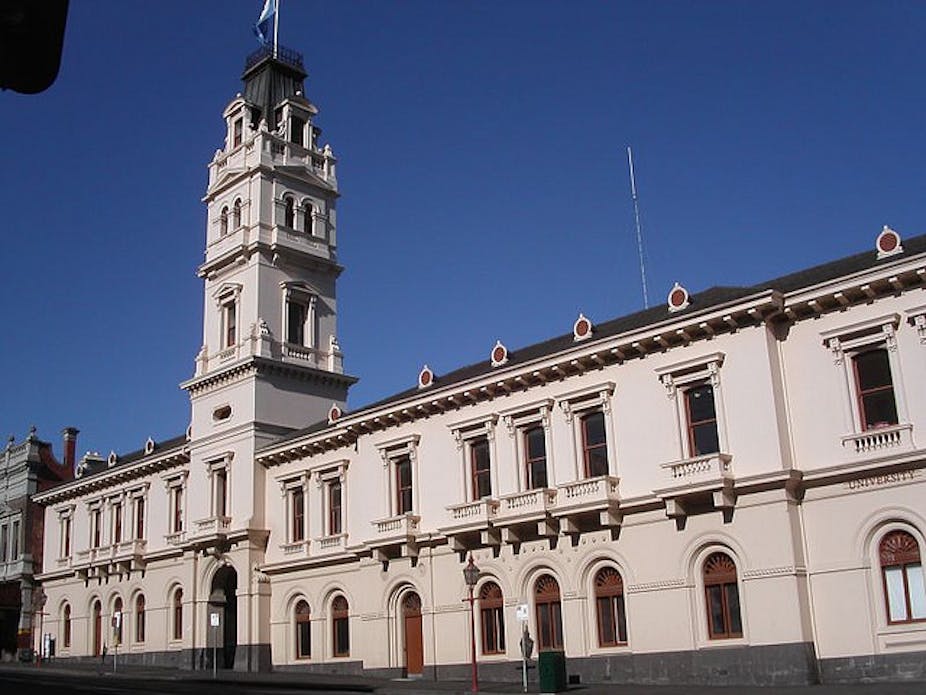
There are plenty of misunderstandings about what regional universities do, but they can play a big part in shaping Australia’s future in the knowledge economy. Flickr/WilLiao

Most urban Australians don’t tend to think about regional Australia, and when they do it’s often hazy notions of a place blighted by natural disasters, economic gloom and declining population.

But for one-third of the population who live in rural and regional Australia – a proportion that is actually increasing – this is far from the whole picture. The common portrayal may be one of despair and destruction, but the people actually affected are far more likely to be positive and resilient.

The general misconceptions about regional areas also affect the way some people view regional universities. In some circles, it’s often thought that the best and brightest potential students should naturally aspire to attend a large, long-established university in a capital city.

But this is just one of many misperceptions about regional universities and the role they play. We need to better recognise the contribution regional universities make to the economy, their communities as well as learning and research.

A matter of perception

It’s clear that regional universities build up educational opportunities and human capital for regional Australia. But they also build much the same for the nation as a whole and this is only increasing.

At its heart, the effort to strengthen Australia’s regional universities is all about giving a “fair go” for the areas they serve. After all, these areas generate two-thirds of Australia’s wealth while lagging behind on many measures of social progress.

There are gaps in educational outcomes in rural and regional areas with Year 12 completion rates about 20% lower than in the capitals, and 12% of adults in regional Australia having a degree compared to 27% in the capitals.

This shows there is more to be done, but more support for regional universities is not an act of pork barrelling or charity and the institutions need to continue to earn their place by undertaking quality teaching and research. They are doing this, with innovative pedagogy and a real focus on targeted, strategic research that provides tangible benefits for the regions, nationally and internationally.

One of the misconceptions sometimes held about regional universities is that they are somehow a lesser option for under-performing regional school leavers unable or unwilling to study at a capital city institution, but the actual statistics paint a different picture.

For example, at the University of Ballarat the average age of students is 26 and 20% studying with us are from capital cities. This cohort of older, wiser students is actually looking for a different type of university experience and lifestyle and its members are prepared to study at regional universities to find what they want.

A fair go for the regions

Luckily for regional universities, it seems that the long-held belief that Australians support a fair go holds true. The Australian Bureau of Statistics last month launched its latest Measures of Australian Progress report which tracks our aspirations as a nation.

During the launch the Australian Statistician, Brian Pink, summarised some of its findings, saying, “we found that Australians feel that having equal opportunity or a fair go, is an essential element for progress. They also want an economy that meets Australia’s needs today, tomorrow and into the future. People feel that the non-material aspects of life such as recreation, sport, popular culture and the arts are also important for progress."

They also found that Australians think having a say in the decision making that affects their lives, and having institutions that are accountable for their decisions, is crucial.

As responsive, nimble institutions deeply embedded in their communities, regional universities currently play leading roles in advancing every single one of these key measures of progress and aspiration.

Regional cooperation

The Bradley Review of Higher Education in 2008 highlighted inadequacies in provision of higher education across regional and remote Australia. The institutions belonging to the Regional Universities Network (RUN) are now actively engaged in an agenda to address many of these inadequacies.

This is why RUN members signed a formal Accord last month allowing wide scope for collaboration between our universities in a range of areas.

The Accord – which is the first of its kind between regional universities – will benefit our students, staff and communities. It allows us to address the relevant issues – thin markets, the need for comprehensive offerings in teaching and learning, the need to collaborate in research, and the opportunity to boost the sustainability and capacity of our institutions in regional Australia.

It also covers such areas as joint appointments, multi-badged degrees, credit transfer arrangements for students, internal staff vacancies and professional development activities, and the consolidation of appropriate support functions.

We all want to be part of building a clever country, but this ambition also requires clever regions. And the basic Australia-wide aspiration for a fair go demands that regions have high-quality educational opportunities in universities that offer agility, provide responsiveness and are deeply engaged with their communities.

Sign in to Favourite

Want to follow The Conversation?

Sign up to our free newsletter to get the day's top stories in your inbox each morning, with a special wrap on Saturday.

Spinner
Donate and become a friend of The Conversation

Join the conversation

13 Comments sorted by

  1. David Godden

    retired

    David Battersby notes "After all, these [regional] areas generate two-thirds of Australia’s wealth while lagging behind on many measures of social progress." Could David please clarify what he means by the first half of this assertion - that regional areas generate two-thirds of Australia’s wealth. Firstly, carefully distinguish between wealth (a stock) and income (a flow); secondly, between gross and net measures; and thirdly, carefully define the actual measure.

    report
  2. Gavin Moodie

    logged in via LinkedIn

    Regional universities are also crucial in linking their region to global research and stimulating innovation in their region.

    Hopefully the Regional Universities Network will soon include all regional universities.

    report
  3. Keith Bradby, Director, Gondwana Link

    Director

    Thanks David for this solid defence of an important aspect of regional/rural life. It touches on what I see as a sad element of the Australian psyche - much of the city really does look down on the country, considering those of us who live closer to the real world as somehow less important and less able. First bit of good advice I got (from a senior CSIRO scientist) thirty years ago when i started being environmentally active was 'never underestimate the arrogence of a group of men in a meeting…

    Read more
  4. Giles Pickford

    Giles Pickford is a Friend of The Conversation.

    Retired, Wollongong

    I was brought on a farm near Albany, took a degree at UWA, got a Traineeship in Canberra, and then got my first job in the Registrar's Office at UWA. My next jobs were UNE, AVCC, James Cook, University of Wollongong and ANU.

    In other words I came from the bush and I stayed in the country.

    David Battersby is right. Regional universities punch way above their weight in creating a better Australia. The Regions know this, so every time someone suggests that "we can't afford 38 Universities and…

    Read more
  5. Comment removed by moderator.

  6. J T....

    professional

    Rural universities can provide benefits to the town they reside in. It is important that the courses offered at these universities have good career and income prospects.

    Some Aboriginal education initiatives have been blamed for giving people more degrees than a Harvard professor with little employment prospects. It is similar with some of the veterinary degrees now on offer. The number of universities has exploded and now many students after finishing the 5-6 years at university are becoming unemployed as there aren't enough jobs.

    report
    1. Gavin Moodie

      logged in via LinkedIn

      In reply to J T....

      'Many' graduates may be unemployed, but the unemployment rate of graduates remains low, and far lower than people without a degree.

      report
    2. J T....

      professional

      In reply to J T....

      Gavin,
      You are using statistics on the average graduate. For some courses it may be that the cost of obtaining the degree outweighs the benefits of employment opportunities.

      For example more than 50% of students achieving a veterinary degree are paying international or domestic full fees at around $250,000 for the whole course. Two regional universities have started offering the veterinary degree in the last decade which has led to an oversupply of graduates. Unemployment has doubled in the last 5 years for veterinary graduates to just over 11%. Prospective students need to consider outcomes before taking time out of the workforce to invest in a degree.

      report
  7. Gavin Moodie

    logged in via LinkedIn

    88.4% of the veterinary science graduates in 2011 available for full time employment were employed full time, which is well above the 76.6% for graduates of all disciplines in 2011.

    report
    1. J T....

      professional

      In reply to Gavin Moodie

      Gavin,

      Did those 76.6% of graduates spend 5-6 years at university, many with expenses of $250,000 as happens with a veterinary degree?

      The trend is also important. Unemployment for vet graduates has doubled in the last 5 years as the number of graduates has increased significantly. If this continues, veterinary unemployment will be higher than the average. And the average includes many degrees that are much shorter in duration. Costs vs benefits are important for any prospective student.

      report
  8. Gavin Moodie

    logged in via LinkedIn

    If costs and benefits of tertiary study are important to prospective students presumably student demand will fall if the relative cost-benefit analysis deteriorates. The important calculation is not absolute cost-benefit but one option's cost-benefit in comparison with all other feasible options.

    report
    1. J T....

      professional

      In reply to Gavin Moodie

      And the Australian Veterinary Deans have suggested declining student quality and demand due to the opening of a few regional universities leading to surplus graduates. Similar has recently happened in the United Kingdom with veterinary degrees. It is rated as one of the lowest return on investment degrees and conditions seem to be deteriorating due to oversupply and increased graduates.

      I agree students need to be very careful to consider all feasible options and the outcomes possible from undertaking a degree.

      report