Climate change and the acidifying, freshening, warming Southern Ocean

The distinctive, planet-encircling flows of the Southern Ocean have played a role in moderating global warming, but change is at hand with the water heating up, getting less salty, storing more carbon, and growing more acidic. These changes could lead to rises in sea levels, changing weather patterns…

4398538253-6de7fe5ed4-o-jpg-1322513203
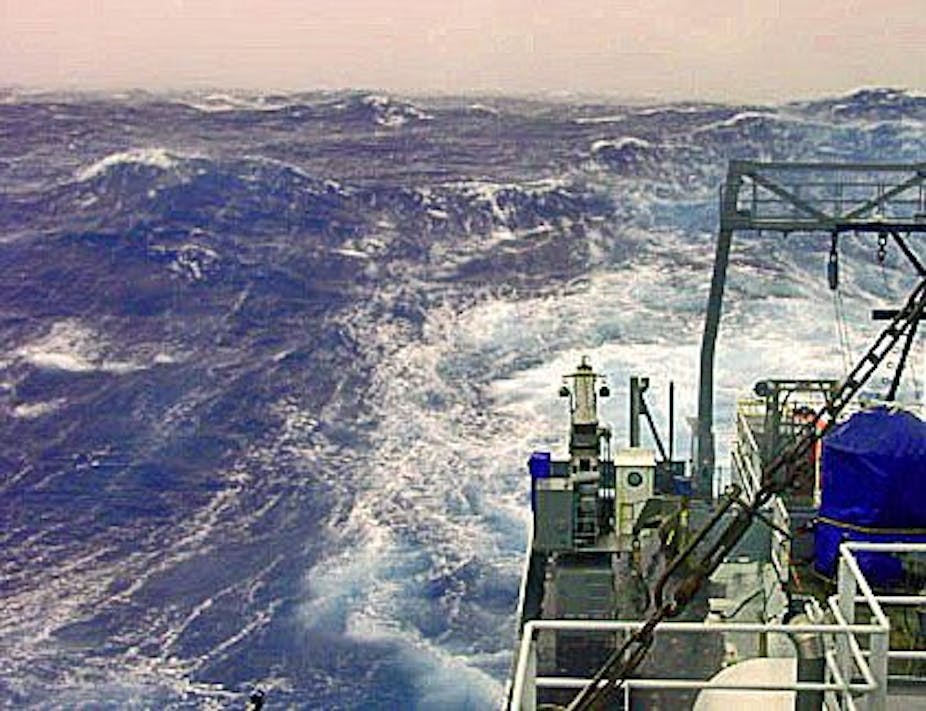
The Southern Ocean, as photographed during the Thomas G Thompson Southern Ocean Expedition. Flickr/Barbara L. Slavin.

The distinctive, planet-encircling flows of the Southern Ocean have played a role in moderating global warming, but change is at hand with the water heating up, getting less salty, storing more carbon, and growing more acidic. These changes could lead to rises in sea levels, changing weather patterns, and the inability of marine life to form shells, skeletons, and reefs.

These are some of the findings of Position Analysis: Climate Change and the Southern Ocean, a report released today by the Antarctic Climate and Ecosystems Cooperative Research Centre (ACE CRC).

Below is an interview with report co-author Dr Steve Rintoul, Oceans Program Leader at the ACE CRC, followed by analysis of the report from Professor Carlos Duarte, Director of the Oceans Institute at the University of Western Australia.


Report author Dr Steve Rintoul, Oceans Program Leader, Antarctic Climate and Ecosystems Cooperative Research Centre

The oceans as a whole are really important for climate because they can absorb huge amounts of heat and carbon dioxide. In a sense, when we talk about global warming that’s happening today, we’re really talking about ocean warming.

More than 90 per cent of the extra heat energy that’s absorbed by the Earth has gone into warming up the oceans, so if we want to track climate change we need to track the oceans. Similarly for carbon dioxide the oceans have absorbed about 30 per cent of the carbon dioxide we have emitted into the atmosphere, so that’s acted to slow the rate at which climate would have otherwise changed – it’s helped to mitigate the effects of climate change.

The Southern Ocean has a particulary important role in storage of both heat and carbon. About half of the extra heat energy that’s been stored by the Earth has entered the oceans through the Southern Ocean and about 40 per cent of the carbon dioxide that’s stored in the oceans enters though the Southern Ocean. Yet, the Southern Ocean represents only about 20 per cent of the surface area of the oceans. So it’s a factor of two for carbon and two-and-half for heat more effective than you might have expected for the area of the Southern Ocean in terms of storing heat and carbon.

The reason it can do that is because of a unique pattern of ocean currents. You can think of the Southern ocean as a window to the deep oceans [. It’s the only place where deep waters rise up and reach the sea surface, and it’s one of the few places where large amounts of water sink from the surface down into the interior of the ocean. It’s because of those rising and sinking motions that the Southern Ocean can store lots of heat and carbon.

There are two sets of ocean currents. The largest current in the world-ocean circles around Antarctica from west to east, and that extends from the sea surface right down to the sea floor and into the ocean basin. At the same time this water is whipping around Antarctica, there’s a slower but important set of flows that is moving towards Antarctica and rising towards the surface, or flowing away from Antarctica and sinking down away from the surface into the deeper ocean; we call that the overturning circulation. A lot of the critical climate aspects of the Southern Ocean have to do with the overturning circulation – how it works now and how it might change in the future. Given that the ocean plays an important role in today’s climate, if the Southern Ocean were to change that might have widespread consequences for climate and not just in the Southern ocean region.

Recent data shows that the Southern Ocean is changing now: it’s warming and it’s becoming less salty, and the amount of carbon dioxide that’s stored in the Southern Ocean is increasing – there’s more carbon accumulating in the Southern Ocean. Each of those three changes tell us something about how the system works and also acts as an indicator of what we might expect to happen in the future.

One of the effects of warming on the Southern Ocean is that it tends to increase the rate at which the ice that flows off Antarctica enters the sea and melts. The warmer the ocean the faster the ice around the edge of Antarctica melts. If the ice that’s already floating around Antartica melts it doesn’t make any difference to sea-level-rises directly, just like melting ice cubes in a drink don’t cause the drink to overflow the cup. But what happens when you thin or break up the ice that’s floating around the edge of Antarctica is that more ice flows off the continent and into the ocean, and that does increase sea-level rise. So the largest single uncertainty in estimating the future range of sea level rise is the question of what’s going to happen to the ice sheets of Antarctica and Greenland. And what happens to the Antarctic ice sheets is intimately tied up with the rate of warming of the Southern Ocean.

We’ve also observed the freshening of the Southern Ocean; it’s becoming less salty. This tells us two things. The fact that the surface waters are getting fresher tells us that there’s more rainfall than there used to be. At these latitudes we expect there to be more rainfall as the Earth warms up, and there to be less rainfall in the drier zones further north in the subtropics. That’s because warm air holds more moisture in, so as the Earth warms up we expect the whole water cycle on Earth to become more vigorous – more evaporation in the evaporative zones and more rainfall in wetter areas. So the Southern Ocean provides one of the clues but that’s already happening now.

We also see the very deepest layers around Antarctica becoming fresher. It’s an indication that some of the extra melting of ice around the edge of Antarctica is flowing into the sea and getting carried down to the deep ocean by the ocean currents.

The third change is the carbon concentration. What’s important about this is that the ocean’s picking up of carbon dioxide is in a sense a good thing for us – it soaks up CO2, and that makes the climate change less rapidly than it would otherwise. But it has another consequence and that is in changing the chemistry of the ocean. It makes the ocean more acidic and makes it harder for organisms to form shells or skeletons or reefs out of calcium carbonate.

As we put more carbon dioxide into the Southern Ocean eventually we’ll cross a threshold where the water will actually become corrosive to reefs and shells made out of calcium carbonate. The point at which you cross that threshold depends on the temperature of the water, and it will be crossed first in the cold waters of the polar regions, both north and south.

We’ve realised that that threshold will be crossed earlier than we thought, at least at some times of the year, and those corrosive conditions will exist in winter as soon as 2030 – only two decades from now. And this will happen at much lower levels of carbon dioxide: at levels of only about 450 parts per million. We used to think that threshold wouldn’t be crossed until we got to about 550 parts per million.
ACE CRC

Professor Carlos Duarte, Director of the Oceans Institute, University of Western Australia

The report, “Climate change and the Southern Ocean”, provides an updated assessment of the patterns of change in ocean circulation, heat, and CO2 inventories in the Southern Ocean in an attempt to assess impacts of climate change on this region of the oceans.

The data presented and summarized shows that the Southern Ocean is the region of the world’s oceans that less clearly displays a signal of climate change with surface waters actually cooling in some areas, and is also the area of the oceans that has trapped less anthropogenic carbon in the world’s oceans. Hence, out of all regions of the ocean, the Southern Ocean is that where evidence for climate change impacts is, as yet smaller.

The report contains elements of ambiguity, because it first refers to the Oceans of the Southern Hemisphere, to then focus to Southern Ocean, which the authors extend to encompass the waters south of 30 degrees South, whereas the Southern Ocean is typically defined as the waters south of [latitude] 40 degrees South or even south of 50 degrees South. Hence, the report really mixes up impacts in the Southern Ocean with those of the temperate waters of the South Atlantic, Indian and Pacific Oceans, which interact with, but are not part of, the Southern Ocean.

While the report provides a thorough account of changes in circulation and, to a lesses extent, chemistry, it is largely lacking of information on documented and future changes in the biology of the Southern Ocean, where impacts of climate change compound with those derived by intense hunting of whales along the 20th Century and fisheries of krill.

When focusing on the Southern Ocean per se, it is clear that the impacts of climate change on the Southern Ocean have been thus far minor, with those derived from the decline in ozone possibly being far greater than those derived from increased green-house gases.

However, as the report outlines the Southern Ocean plays a key role in connecting the circulation in all oceans so that resolving the future behavior and changes of the Southern Ocean is fundamental to predict planetary-scale changes in the oceans. Detecting and predicting possible changes in the physics, chemistry and biology of the Southern Ocean is, therefore, a task of global significance. The fate of the extensive ice sheets of the Southern Ocean is also of global significance in determining the rates of sea level rise.

Australia is poised to play a key role in the investigation of the Southern Ocean, but cannot do this alone, and should form an alliance with strong oceanographic institutions in New Zealand, South African and Chile (prominently Concepción University), as well as other countries, such as Germany, US, France and, recently, China, with a strong research effort in the Southern ocean.

I also believe that the authors are making an understatement when they consider Australian infrastructure for blue-water oceanography, particularly research vessels, to be modest. Provided the large ocean areas within Australia’s Exclusive Economic Zone and its important interests in the Southern Ocean, Indian Ocean, and Pacific Ocean or when comparing Australia to any other country it will like to compare with, the capacities for blue water oceanography of Australia are simply dwarf, and at the level of those of Belgium, with its less than 100 kilometres of coastline.

If Australia is to rise to a leading role in the oceanography of the Southern Ocean it needs to address the very severe deficiency in research infrastructure to operate offshore in the ocean. Here is an opportunity to enhance the role of Australia in the region.

Comments welcome below.

Join the conversation

26 Comments sorted by

  1. Gideon Polya

    Sessional Lecturer in Biochemistry for Agricultural Science at La Trobe University

    From a biological perspective, warming and ocean acidification around Antarctica is negatively impacting Antarctic krill, Euphausia superba, through loss of sea pack ice (habitat for krill and its primary phytoplankton food) and acidification due to increasing carbon dioxide (CO2) (with consequent damage to organisms with calcareous exoskeletons) (see: http://en.wikipedia.org/wiki/Antarctic_krill#Decline_with_shrinking_pack_ice ).

    In 2011 US scientists Trivelpiece et al. published a paper in the…

    Read more
  2. Mark Harrigan

    Dr

    Thanks to the authors of this interesting article - especially about the unique features of the Southern Ocean playing such an important role as a heat sink/mover of water & heat and cycling of aborbed atmospheric CO2 and heat energy due to the circulation from the deep ocean.

    I was also fascinated by the change in saltiness due to shifts in rainfall patterns - an aspect I understand to be of great significance when contemplating the future impacts of climate change since shifts in rainfall can have significant impacts on how humans manage their food sources.

    What was worrying was the lower threshold for CO2 impacting reef and calcium/shell formation - 450ppm of CO2 is worryingly close.

    The Ocean CO2 absorption is often referred to (if it is referred to al all) as the "other" climate change problem - this article is a salutory reminder of that. I hopw we see another update soon.

    report
  3. Tim Scanlon

    Author and Scientist

    Very interesting work, thanks to the authors.

    I've been wondering about how scientists hope to measure the seas with any level of accuracy, considering the size, depth and flows involved. Accounting for all that variability, I do not envy the researchers involved.

    I'm wondering how the Southern Ocean changes, especially relative to the Indian Ocean, will change our frontal systems and tropical storm in Western Australia. We've already seen some changes to the southern stream flow, changing our frontal systems. Is this going to intensify or change to a different pattern all together?

    report
  4. Doug Cotton

    IT Manager

    Before we all get too concerned we should note this week's new peer-reviewed paper which shows temperatures are not increasing in line with IPCC estimates which projected to another 3 or more degrees by 2100.

    http://iopscience.iop.org/1748-9326/6/4/044022/pdf/1748-9326_6_4_044022.pdf

    The published range of increase in this paper was 0.014 to 0.018 deg.C per year. I constructed my own trend on the plot in Fig.8 and deduced my own rates from such, because I feel the upper end of the range they quote is a little high.

    My reading of the graph (Fig 8) led to an estimate of an extra 1.3 deg.C of additional warming (on top of current temperatures) for the 89 years until 2100. This would be at the rate of 1.3 / 89 = 0.0146 deg.C per year which is within the published range.

    report
    1. Mark Harrigan

      Dr

      In reply to Doug Cotton

      Again Mr Cotton shows he understand nothing of the science he reads.

      Such a propjection is meaning less - as it would assume zero additional CO2 added to the atmosphere - alas that is't going to happen.

      Even a cursorary examination of the paper to which re refers in figure 8 shows an increase of close to 0.6 degrees in the relevant 32 year period. He also clearly fails to understand the authors stated conclusions

      "The resultant adjusted data show clearly, both visually and when subjected to statistical…

      Read more
    2. Doug Cotton

      IT Manager

      In reply to Mark Harrigan

      It does not assume zero CO2 added to the atmosphere. It looks at what actually happened in the years from 1979 to 2010 during which, as we all know, CO2 levels increased along a roughly linear trend. So, if anything, it assumes that the amount of CO2 the world is pumping into the atmosphere would be at the same average rate that applied to these last 32 years or so. If the world actually reduces annual emissions, then the temperatures rise would be less - if the theory holds water anyway.

      report
    3. Doug Cotton

      IT Manager

      In reply to Mark Harrigan

      If the temperature were to rise by 2.2 degrees (Dr Harrigan's upper limit) then that would be 2.2 / 89 = 0.0247 deg.C which is well outside the published range of 0.014 to 0.018.

      If, as a compromise, Dr Harrigan, we take the middle of the published range, we get 89 x 0.016 = 1.42 additional degrees of warming above current temperatures (at the end of 2010) by the start of the year 2100. The IPCC said it was highly unlikely that the increase would be less than 1.5 deg.C by 2100 and the mean of their projections was more than double that..

      Yet 1.42 < 1.5

      report
    4. Mark Harrigan

      Dr

      In reply to Doug Cotton

      Are you really that dim? I siad that a projection based on a linear projection of the paper would assume zero additional CO2.

      The paper is based on the CO2 we have added to date - not additional mounts

      report
    5. Mark Harrigan

      Dr

      In reply to Doug Cotton

      Yet again Mr Corron demonstrates utter nonsense. The baseline for temperature anonalies is around 1980 levels. If we apply the midpoint of the abserved warming since 1980 in the relevant paper of 0.016 degrees per year that produces 120*0.016 or a little over 1.9 degrees temperature rise by 2100

      That can be expected to accelerate as CO2 levels rise. This is what the IPCC takes into account hence stating that 2 degrees it at the low end of their estimated warming

      Mr Cotton has made a chidlike error in calculating projected increases in temperatures from NOW and to 2100 and compaaring with the IPCC estimate from the baseline (roughly in 1980). This is not the first time he has made such blunders. he has no idea

      report
    6. Doug Cotton

      IT Manager

      In reply to Mark Harrigan

      They clearly said that there was no rate of increase in the gradient. This means the graph is linear, not quadratic or exponential etc (ie, not curving upwards.) Hence there is no basis for assuming that would change - ie it will continue linearly. You only have to look at it to see it's linear, which I admit surprised me because I would have expected a slight curve ending in a lower gradient.

      You yourself have previously said temperature increases as carbon dioxide levels increase. You explained…

      Read more
    7. Mark Harrigan

      Dr

      In reply to Doug Cotton

      Again Mr Cotton shows he fails to understand the basics of climate science and what he reads in the paper.

      Apparently he also can't do maths. 1.8x10^-2 per year of warming extrapolated from 1979 to 2100 gives 2.2 degrees.

      I have never made a statement that "temperature increases as carbon dioxide levels increase. You explained that they levelled out when temperatures levelled for 20 years after 1945 for example". It's just that Mr Cotton doesn't understand the physics. I explained that there was no NET warming over that period due to other effects (see here http://www.skepticalscience.com/images/IPCC_Radiative_Forcing.gif)

      What Mr Cotton fails to appreciate is that the increase in CO2 levels is accelerating http://co2now.org/ - when you add this to the also weel documented amplifcation effects of increased water vapour, release of Methane from the permafrost ect, the projects of this people are ENITRELY consistent with the IPCC projects of 2-4.5 degrres by 2100

      report
    8. Doug Cotton

      IT Manager

      In reply to Mark Harrigan

      The steepest I can make the gradient is shown here with calculations:

      http://theconversation.homestead.com/1979-2010.jpg

      This yields 0.0163 deg pa which is slightly above the median in the published range 0.014 to 0.018. I will also use 90 years rather than 89.

      Multiplying 0.0163 x 90 = 1.47 degrees above 2010 temperature, which is still less than the "highly unlikely" IPCC figure of 1.5 and less than half their mean which was over of 3 degrees.

      report
    9. Mark Harrigan

      Dr

      In reply to Doug Cotton

      Mr Cotton continues to show adamantine density.

      The IPCC figure os 2-4.5 dgrees refers to the temperature anomaly - or to paraphrase "temperature above the levels seen in the late 70's" when the anomaly was zero. Taking 1979 as a baseline a steady gradient of 0.0163 years gives

      0.0163 x 122 = 2 degrees.

      Coupling in the impact of accelerated CO2 levels is the bais for the various IPCC estimates.

      Boy - how can anyone pay credence to someone who is so consistently silly?

      report
    10. Doug Cotton

      IT Manager

      In reply to Mark Harrigan

      I made it quite clear that I was talking of rises above current temperatures. If you think the IPCC is still talking about 3 degrees above what it was in 1980, then I suggest they are deliberately alarming the public even more, because the public thinks in terms of future warming from now, or perhaps the date of their last report.

      I keep pointing out that the study states that there is no evidence of any increasing gradient. It is linear as a look at the plot indicates. And it has been linear…

      Read more
    11. Mark Harrigan

      Dr

      In reply to Doug Cotton

      Look it up Mr Cotton, instead of your usual ignorant sounding off

      "anomalies are calculated relative to the 1961-1990 mean of the 20th century"

      http://www.ipcc-data.org/ar4/var-air_temperature-change.html

      It is YOU who are attempting to mislead (either that or your comment was just plain dumb) and again you fail to understand the IPCC (as usual).

      I have also never said that CO2 accounts for the 33 degrees. I said that GHGs do. That is an established pice of science. More rubbish and spurious science from Mr Cotton

      report
    12. Doug Cotton

      IT Manager

      In reply to Mark Harrigan

      Well you can add 0.5 degrees as shown on the plot from 1979 to 2010 and that will make 1.97 degrees - still under their 3.2 degrees or whatever it was. I will blame my lack of knowledge of this detail on what the media promulgate.

      I did ask you at the time what percentage of the 33 degrees you attribute to CO2 in order to derive the sensitivity - and got no answer.

      If water vapour makes up on average 1% of the atmosphere, then, on a pro-rata basis CO2 would have contributed (390/10000) * 33…

      Read more
    13. Doug Cotton

      IT Manager

      In reply to Mark Harrigan

      Anyway, the whole thing is overstated because they are using about two-thirds of the upswing of the 60 year cycle. When you look at the last 60 years you get 0.010 degrees instead of 0.016 degrees per year. http://theconversation.homestead.com/60years.jpg and when you look at such a period there is no need to adjust for ENSO etc. So this gives 1.2 degrees for 120 years from 1980.

      report
    14. Mark Harrigan

      Dr

      In reply to Doug Cotton

      Mr Cotton says" I will blame my lack of knowledge of this detail on what the media promulgate."

      This is both laughable and unethical from someone who presumes to be so arrogant to claim he knows better than the vast majority of the world's science bodies of credibility and the vast majority of the world's climate scientists. So he now admits re relies on the medi for his information about climate science? No wonder he constantly spouts such utter rubbish on the topic and consistently makes such a fool of himself.

      This Information, along with how the IPCC defines net radiative forcing (about which he has also shown abysmal igornance on other threads) is PUBLICLY AVAILABLE. It took me all of 30 seconds to find it on google.

      Mr Cotton should be ashamed of his persistently unethical practice of pseduo science.

      report
    15. Mark Harrigan

      Dr

      In reply to Doug Cotton

      There is no UPSWING over the last 60 years. More rubbish from Mr Cotton.

      look at the data - temps were stable between 1940 and the late 70;s

      http://climate.nasa.gov/keyIndicators/

      Prior increases correlate with solar radiation http://www.skepticalscience.com/pics/Solar_vs_Temp_basic.gif

      Increases since then are largely due to CO2

      http://www.skepticalscience.com/images/co2_temp_1900_2008.gif

      Your CO2 references are rubboish - just like eevrything else you say

      report
    16. Mark Harrigan

      Dr

      In reply to Douglas Cotton

      Joseph Postma published an article criticizing a very simple model that nonetheless produces useful results. He made several very simple errors along the way, none of which are very technical in nature. In no way does Postma undermine the existence or necessity of the greenhouse effect.

      Mr Cotton has been suckered

      report
    17. Mark Harrigan

      Dr

      In reply to Douglas Cotton

      The only valid statement in the post above is Mr Cotton admitting "I was wrong"

      Indeed he is wrong - about everything he posts on climate science, Even his her0 - Dr Roy Spencer - acknowledges the existence of the Greenhouse Effect - as do all credible scientists - By this post Mr Cotton has truly donned the official uniform of the tin foil hat brigade

      report