
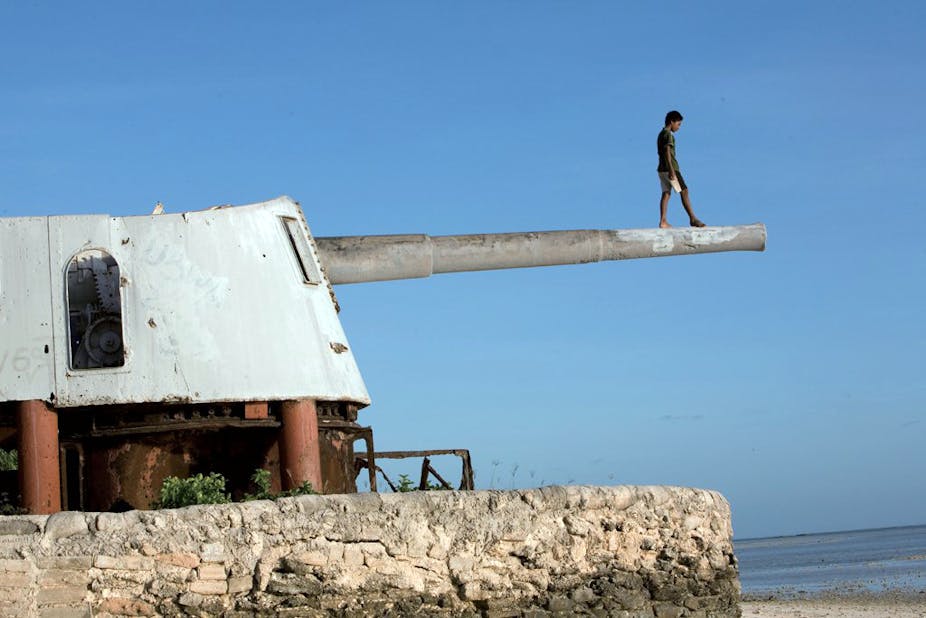
The vulnerability of Pacific Island countries to climate change has been the subject of significant media coverage, including Kiribati’s recent request that its people be moved to Fiji to avoid rising seas.
However, despite this widespread awareness, until recently there has been limited reliable detailed scientific information available to these countries. A major new report recently released by the Bureau of Meteorology and CSIRO is helping to fill this gap. It provides the most comprehensive scientific analysis to date of climate change in the Pacific region.
The 530 page, two-volume scientific report called “Climate Change in the Pacific: Scientific Assessment and New Research” shows clear evidence of how the climate in the Pacific has changed and may change in the future.
How is the Pacific climate changing?
The history of climate change in the Pacific includes a rise in air temperatures that is consistent with the global pattern of warming. All of the island stations analysed exhibit warming trends since 1960, with increases of 0.4˚-1.0˚C. The past decade was the warmest on record.
Sea-surface temperatures over the Pacific also generally increased over this period by a similar amount. This warming of the Pacific Ocean’s surface waters was accompanied by a cooling of equatorial waters 200m below the surface. This distinctive pattern of change – surface warming and sub-surface cooling – is reproduced in climate model simulations of the 20th century that include increased atmospheric greenhouse gases.
Rainfall has shown dramatic variations over the same period – linked to the El Niño-Southern Oscillation and the Interdecadal Pacific Oscillation – but few consistent trends. Sea level rise, of great concern to many of the low lying atolls in the Pacific, has continued across the region. Extreme sea levels are also increasing, primarily as a result of increases in average sea level.

The research also shows potential serious impacts for coral reefs of the region. As carbon dioxide increases in the atmosphere the ocean absorbs some of this carbon dioxide and becomes more acidic. This is a major problem for many Pacific island nations because ocean acidification can obstruct coral growth.
The report also indicates that there are no significant trends in the overall number of tropical cyclones, or in the number of intense tropical cyclones over the South Pacific Ocean over the 1981–2007 period of satellite measurement. Further west, however, there has been a decline since the late 19th century in the number of severe tropical cyclones making landfall over north-eastern Australia.
These and other results described in the report indicate that both natural variability and human-forced climate change are needed to account for the changes observed in the Pacific.
What will happen in the future?
Over coming decades the importance of human-forced climate change is projected to increase substantially. By 2090 the warming in the climate models best able to simulate Pacific climate relative to 1990 projected an increase of approximately 1.5 to 2.0˚C for a low business as usual greenhouse gas scenario. Under a high business as usual scenario, it would be approximately 2.5 to 3.0˚C. Possible scenarios with higher concentrations would cause greater warming.
The region can also expect widespread increases in extreme rainfall events, large increases in the incidence of hot days and warm nights, decreases in droughts in most parts of the Pacific and further sea-level rise.
Projected growth in atmospheric carbon dioxide concentrations is expected to cause further ocean acidification throughout the 21st century, reaching critical thresholds for coral reef growth by 2050.
While uncertainties remain for tropical cyclone projections, they are projected to occur less frequently in the Pacific Ocean over the 21st century. Projections also suggest an increase in the proportion of storms in the more intense categories.
With over 100 contributing authors, “Climate Change in the Pacific” is the result of three years of collaboration between Australian scientists and agencies in the Pacific. Volume one of the report presents a regional overview and the second volume comprises individual reports tailored for the 15 participating countries.
This report was produced as part of the Pacific Climate Change Science Program (PCCSP), which was part of the Australian Government’s International Climate Change Adaptation Initiative to assist the 14 Pacific Island countries and East Timor better understand how their climate has changed and how it may change in the future. A new program, Pacific Australia Climate Change Science and Adaptation Planning Program, is part of Australia’s five year, International Climate Change Adaptation Initiative. You can download the full report.
This article was prepared by Dr Scott Power on behalf of more than 100 colleagues in the CSIRO, Bureau of Meteorology, 15 national meteorological services, Geoscience Australia, and universities.
Alex Cannara
logged in via Facebook
Wow, we have it easy, so far...
www.washingtonpost.com/national/health-science/as-climate-changes-louisiana-seeks-to-lift-a-highway/2012/
Of course, water does run downhill & down under.
;]
Mike Hansen
Mr
Interesting article Alex but your link is broken.
http://www.washingtonpost.com/national/health-science/as-climate-changes-louisiana-seeks-to-lift-a-highway/2012/03/12/gIQAJoEQLS_story.html
Nick Kermode
logged in via email @hotmail.com
Thanks very much Scott. Q.E.D
Bernie Masters
environmental consultant at FIA Technology Pty Ltd, B K Masters and Associates
while some Pacific islands are in danger from sea level rise, the 2009 report - http://www.abc.net.au/news/2010-06-03/pacific-islands-growing-not-sinking/851738 - that 80% of islands are stable or growing suggests that the warmer seawater temperatures are increasing biological productivity in the waters surrounding the islands, allowing more sediment derived from the broken down skeletons of marine organisms to accumulate onshore and increase their land mass.
Are there any scientific reports to refute this 2009 study or to show that circumstances have changed and that more islands are shrinking due to sea level rise?
As an aside, it's possible that the islands that are growing in area are benefiting from an increase in biogenic sediment caused by the death of marine organisms as a result of warmer water temperatures. Has this been researched by anyone?
Tim Scanlon
Author and Scientist
Bernie, you seem to have missed the most important part of that article (ignoring the fact that it is a news item on a study and not a study):
But Dr Kench says this does not mean climate change does not pose dangers.
"The land may still be there but will they still be able to support human habitation?"
The article pretty much states that the sea level rise is a huge problem:
"Sea levels are obviously rising - I think in the short term [the study] suggests that there's maybe more time to do something about the problem than we'd first anticipated," he said.
"But the key problem is that sea level rise is likely to accelerate much beyond what we've seen in the 20th century."
Bernie Masters
environmental consultant at FIA Technology Pty Ltd, B K Masters and Associates
Tim, my comment wasn't trying to suggest that there aren't other problems affecting a number (possibly a large number) of Pacific island nations. But, if most islands are stable or growing, this reduces the likelihood that major decisions might be made prematurely or before the full range of options can be assessed by the inhabitants of at-risk islands. For example, if rainfall is reducing causing fresh groundwater supplies to diminish, solar- or wind-powered desalination plants may buy more time. Similarly, the technology exists to precipitate CaCO3 from seawater and produce more sand that could be added to an eroding shoreline.
My experience is that decisions made in haste are often the worst ones and, while Kiribati may not have much time to decide, many other island states may have decades or longer to decide their ultimate fate.
Tim Scanlon
Author and Scientist
Oh, I get what you mean now.
I agree we don't need decisions made poorly. But I'd also argue that time is not on our side as decision makers have successfully ignored climate change issues for a few decades. These island nations may have options, but they do need action. We have options, yet we seem intent on being half-arsed about acting.
I think the main reason that decisions made in haste suck is because the people making those decisions try to do the quick and easy options to look like they are taking decisive action. My managers refer to it as "quick runs on the board", which is manager speak for "any old crap that we can do a media release for now". I'm definitely with you on the idea that actions have to actually be concrete and worthwhile.
Pip Archer
Student
Thanks for this article! It's important for Australia (and New Zealand) to think about the effects of climate change specifically in our region given we're already a large source of aid for stricken Pacific nations and a likely destination for their climate refugees. Last year we saw hushed calls for the possible relocation of Tuvalu inside Australia itself! Although not a lot followed publicly from that event, it demonstrates the alarm felt in Pacific nations and we should take seriously that these concerns will only grow stronger in the future.
Philip Dowling
IT teacher
The "issue" of climate change refugees is minimal. Tuvalu has a population 12 000. Kiribati a population of 105, 000. If these populations were to relocate over a period of 10 years to Australia, then this would mean an additional 6 000 people per year.
According to the Immigration website, in 2008–2009, Australia accepted 158 021 migrants.
This assumes that Charles Darwin was incorrect, and that coral atolls do not grow additional coral.
Extrapolation of oceanic pH can only be described as speculative.
Michael James
Research scientist
The issue of Tuvalu is not simple. I wrote about this in Crikey some years ago: (Note my primary source is Nature.)
Read more.............................
http://www.crikey.com.au/2009/08/06/comments-corrections-clarifications-and-cckups-54/
6 August 2009, Crikey Daily Mail.
Climate change and the Pacific:
Michael James writes: Re. "Special report: In the Pacific, they're not waving, they're drowning" (yesterday, item 6). While Katherine McGrow is correct that some of these Pacific atolls are drowning…