Close 100 man-made lakes to stop cane toad spread: study

Shutting down around 100 man-made water storage structures in Australia’s north west could stop the spread of cane toads into Western Australia’s Pilbara region, a new study has found. Cane toads, which breed astonishingly fast and can kill native animals such as quolls, snakes and goannas, need water…

Yby2sjmg-1355460191
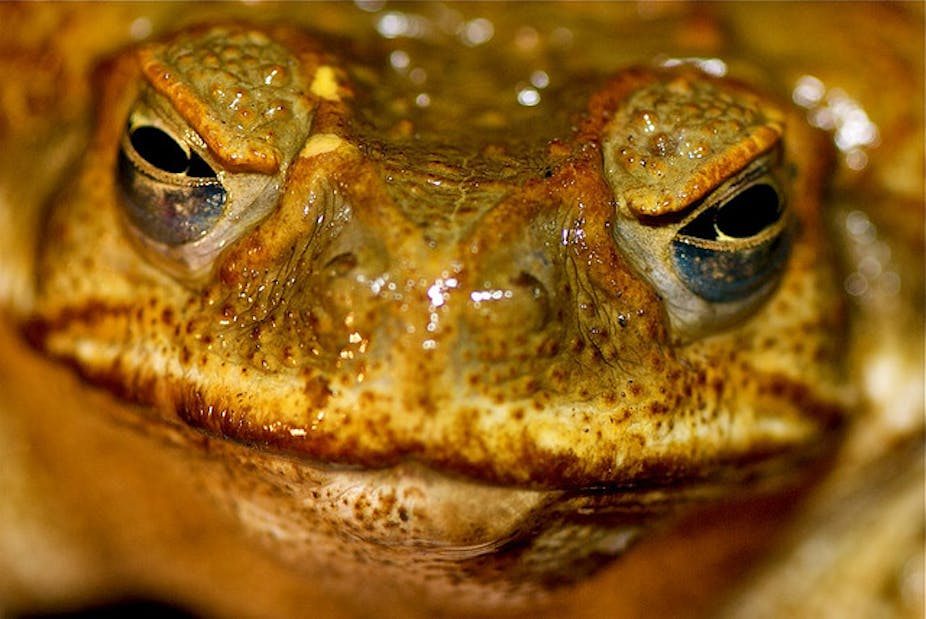
Closing about 100 man-made bodies of water could stop cane toads from spreading further into Australia’s north west, the study found. http://www.flickr.com/photos/blundershot

Shutting down around 100 man-made water storage structures in Australia’s north west could stop the spread of cane toads into Western Australia’s Pilbara region, a new study has found.

Cane toads, which breed astonishingly fast and can kill native animals such as quolls, snakes and goannas, need water in which to lay eggs and hatch tadpoles. They are expected to completely colonise the Kimberley region within a decade.

Turkey nest dams — water storage structures built by graziers — shore up drinking water for livestock but also inadvertently serve as breeding grounds for cane toads.
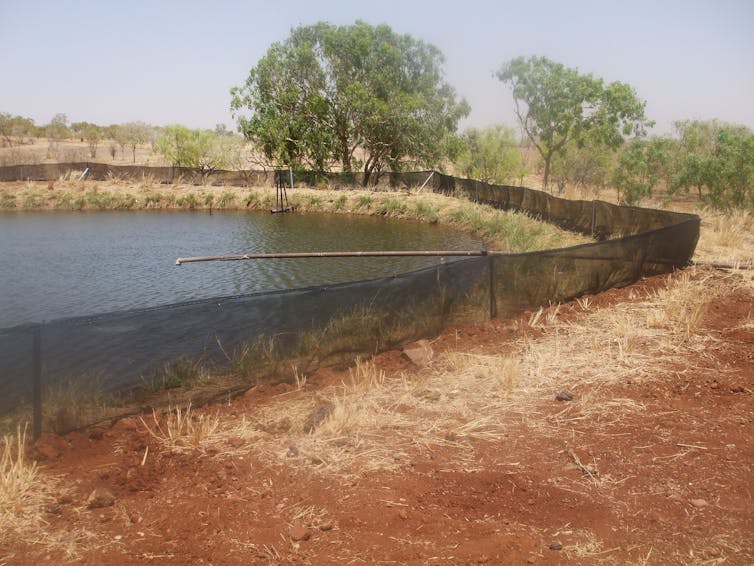
An example of a turkey nest dam. Dr Mike Letnic, University of NSW

New modelling published in the Journal of Applied Ecology showed that removing 100 of the man-made water bodies would prevent the toad’s advance.

“If we remove a subset of those water bodies, we will keep 270,000 square kilometres of Australia toad-free,” said one of the researchers, Dr Ben Phillips, an evolutionary ecologist from James Cook University.

“What the modelling exercise has told us is that local control options exercised in the right spots can have massive landscape benefits.”

Dr Phillips said such a plan would only work with the support of pastoralists who currently use those water bodies for farming and livestock.

“There would be major costs to any pastoralists affected so those costs shouldn’t be borne by the pastoralists,” he said.

Removing the man-made lakes was not equivalent to shutting down the bore entirely, said Dr Phillips.

“The bore water can simply be diverted to a toad-proof closed tank and drinking trough system for stock watering purposes.”

The poisonous frogs were first introduced to north-eastern Queensland in 1935 to control sugar cane beetles and have now spread into NSW, the Northern Territory and parts of Western Australia.

Professor Ian Musgrave, senior lecturer in Pharmacology at University of Adelaide and a researcher of cane toad toxins, said that the research “shows that it may be possible to halt the invasion on at least one front using very simple, environmentally friendly methods.”

“None of the control measures we have in place are able to deal with the relentless advance of thousands of toads in remote, and often impassable regions. Biological control measures (such as using lungworms) have been disappointing, although trapping based on chemical signalling may hold more promise,” said Dr Musgrave, who was not involved in the research.

“Toads, it goes without saying, need water, although the leading populations of cane toads have evolved to be more resistant to lack of water than the garden variety, they still need reasonable access to water to spread. The Kimberley Pilbara corridor is a natural choke point in any wave of toads coming down the WA coast. Only a narrow strip of coastal land that fronts great swathes of desert has sufficient water to host these toxic terrors on their journey south,” he said.

“What is very encouraging is that their modelling work shows that we don’t even need to concentrate on all these waterholes, which would be a daunting task, even given the narrow region involved. They find that there are three critical choke points where closing a relatively small number of waterholes would stop the toads movement south.”

Dr Hugh Possingham, Director of the ARC Centre of Excellence for Environmental Decisions at the University of Queensland said the research was interesting and important.

“An economic analysis on top of the ecological analysis would be useful – although we may not have sufficient time,” said Dr Possingham, who was not involved in the modelling.

“If it is true that the invasion could be halted or significantly delayed, then the benefits would be much more than financial – the ecology of a huge ecosystem is under threat,” he said.

“Long distance dispersal via human transport such as vehicles still poses a serious risk that would negate the benefit of this clever strategy, so rigorous quarantine is an essential additional strategy.”

Additional reporting by Sally Zou.

Sign in to Favourite

Want to follow The Conversation?

Sign up to our free newsletter to get the day's top stories in your inbox each morning, with a special wrap on Saturday.

Spinner
Become a friend of The Conversation and donate

Join the conversation

13 Comments sorted by

  1. Comment removed by moderator.

  2. Comment removed by moderator.

  3. David Arthur

    n/a

    So, replace turkey nest dams with above-ground tanks into which toads can't hop, and watering troughs?

    Now that you point it out, it seems blindingly obvious, especially as our yard has become popular with skinks and frogs since I started putting toads in the wheelie bin.

    Crikey, it's almost as advanced a concept as saving water by replacing irrigation channels with pipelines. Whod'a ever thought of that? Apart from the Persians, who watered the irrigated fields around Persepolis via underground canals, qanats, from the Zagros Mountains.

    PS note to moderator: the other comment on this page is even less on-topic than mine.

    report
    1. Michael Hay

      retired

      In reply to David Arthur

      While it is good to note that someone is actually thinking about the problem of the Cane Toad Advance, it does seem that more research is required to find a way to eliminate the toads without there being some trade-off with someone else's income.
      Ideally, an aerial spray which wipes out toads but has no effect on any other form of native or imported life. But as this is still an impossible dream we need some other ideas.
      Research, that is the answer - immediate, funded and knowledgible.

      report
  4. Comment removed by moderator.

  5. Pat OBrien

    Activist

    Yes, but what about the wildlife...the birds, bats, wallabies etc etc. How do they get a drink?

    report
    1. Sunanda Creagh

      Editor at The Conversation

      In reply to Pat OBrien

      Hi Pat, good question but given these water bodies are man made and relatively recent inventions, wouldn't the native wildlife have evolved to do OK without them?

      report
    2. Dingo Simon

      Owner, Durong Dingo Sanctuary Qld

      In reply to Pat OBrien

      Totally agree with Pat. Why sacrifice the lives of the rest off the environment by cutting off water.
      I have 4 dams on my property. Only one has million of cane toad tadpoles in it. Why not the others, I simply don't know. I am using Dettol, but that only affects the ones on the edge of the bank, the rest are underwater 1m out from the bank and I cant get to them. I have pulled out 60 year old fence posts and found large cane toads at the bottom, how they got there puzzles me as there was no…

      Read more
    3. Pat OBrien

      Activist

      In reply to Pat OBrien

      I don't think so Sunanda, some of those dams have been there for a few generations, and it's like feeding wildlife, if you provide water the wildlife will come....often the very next day. Some of the species that depend on that water would have only known those sources.

      Also, much of the natural billabongs have been altered or drained to provide more grazing areas. I cant see farmers making their tanks and troughs wildlife friendly either. Also there are fresh water creatures, including some that we may be unaware of, that live in the dams.

      Other than the negative impact on wildlife, the idea of closing tanks that cane toads can use makes sense.

      report
  6. Bernie Masters

    environmental consultant at FIA Technology Pty Ltd, B K Masters and Associates

    Having just returned from a month in the Pilbara, the suggestion of closing off access by cane toads to 100 artificial water storages makes sense and would be a relatively cheap and worthwhile experiment. However, there are occasional summer wet seasons in the area between Broome and Port Hedland where rainfall is so heavy and so prolonged that there may well be sufficient water resources for cane toads to make it across to the Pilbara regardless. Even so, if application of this suggestion buys us a few years in which people like Ric Shine can come up with ecological control measures against the cane toad, then it will be a justifiable investment.

    report
  7. Comment removed by moderator.