
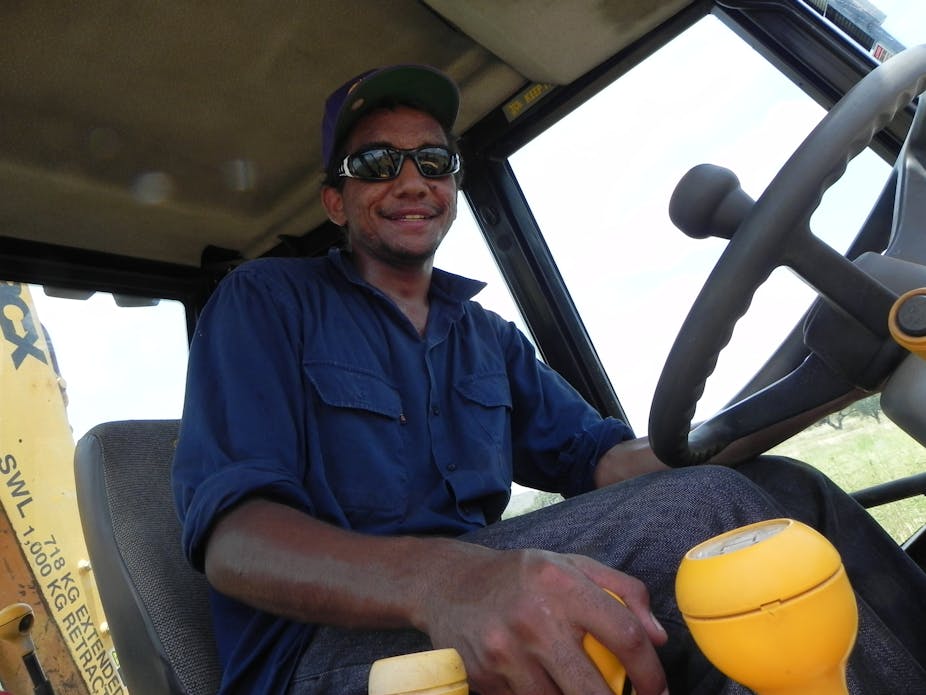
Closing the gap, or making it wider? Putting a value on Indigenous jobs

Among all the school payments and defence cuts, last week’s federal budget also quietly committed an additional $5.2 billion to the government’s Closing the Gap program. It’s a vote of faith from the government that the initiative is working. And there’s no doubt Closing the Gap is making inroads into…

Rzphtjyv-1337057861
Indigenous community jobs aren’t part of the mainstream economy, but they fit the needs of the community well. Kayt Davies

Among all the school payments and defence cuts, last week’s federal budget also quietly committed an additional $5.2 billion to the government’s Closing the Gap program. It’s a vote of faith from the government that the initiative is working.

And there’s no doubt Closing the Gap is making inroads into Indigenous disadvantage on a number of fronts. But it’s also becoming clear to people working in remote communities that the fundamental assumptions at its core may be limiting its potential.

“Closing the Gap” is the catch-all name for a set of five COAG Agreements first funded in the 2008-2009 Budget. These agreements committed a total of $9 billion federal and state dollars to a raft of initiatives involving remote housing, health, early childhood development and economic participation (which is code for employment rates).

While annual Closing the Gap reports set out dates by which various targets should be met, the funding time scales are different for different targets. Some run out this year, others extending as far forward as 2031. The upshot of this being that it’s hard to say what the government plans to do next and how flexible it is in its indigenous affairs thinking.

This is never more apparent than in the federal approach to Community Development Employment Projects (CDEP).

CDEP

For those new to the argy bargy around CDEP: Indigenous people love it because it offers part-time work and can be flexible, allowing for time off for funerals and so on. It also enables people to live and work in community.

CDEP was introduced in the 1970s when new wage laws moved Indigenous people off stations, where they had largely been paid in-kind, creating significant Indigenous unemployment.

The concept underpinning CDEP is that Indigenous people are paid by the Commonwealth for doing work that contributes to the well-being of their communities.

CDEP construction workers in Warmun community. Kayt Davies

But CDEP has been abused, in cases where the tyranny of distance made it hard to keep serious tabs on who was actually working and who was leaning on a shovel watching. This lead to the 2009 “revision”, which saw projects killed off everywhere except in remote Australia.

In many communities – especially in places with limited job markets – Indigenous people see CDEP as a respectable occupation distinctively different from being on benefits. Working on CDEP is something to be proud of.

CDEP can offer wages for training and linkages with seasonal work followed by more training that can gradually overcome serious “barriers to employment”.

But the program is on the government’s hit list, because payments are actual wages and not benefits. This means they can’t be quarantined for “income management” and governments seem quite keen on income management, despite its resemblance to the old days of paying Indigenous workers in tea, sugar and blankets.

Notes from the field

Ross Johnston works for East Kimberley CDEP. He is the organisation’s Enterprise Development Manager, which means he works at the coalface of the Closing the Gap effort.

East Kimberley CDEP Pty Ltd is one of the last remaining CDEP operators and Johnston is heading up its community development efforts. For the past few months his focus has been on the Warmun community.

Warmun (below) is 200km south of Kununurra and some of the 400 or so Gija people who live there are the traditional owners of Purnululu National Park, otherwise known as the Bungle Bungles.


View East Kimberley in a larger map

East Kimberley CDEP has three staff living in Warmun, Johnston visiting two or three times a week and a crew of 12 local lads technically on staff but working as a trained up building/construction manual labour crew for hire. It’s also running horticulture, first aid and station work training programs in town.

While these initiatives are clearly working to some extent for the individuals involved, Johnston is worried about the long term well-being of the community. In his words, the problem with Closing the Gap is that it is fundamentally deficits-based, meaning it’s focused on dysfunction and bringing in filler for the gaps, rather than on finding what’s working well.

Johnston claims, “governments largely misunderstand the context of Indigenous development in the East Kimberley – and probably throughout Australia.”

East Kimberley CDEP has impressive “employment outcome” stats. According to Johnston, this is because the organisation understands that cultural relevance is the key to overcoming the inertia that sees so many well-intentioned programs poorly attended.

Mainstream or fringe?

While Closing the Gap has seen an increased focus on “overcoming barriers to employment” and helping/requiring Indigenous people to achieve mainstream employment norms, these strategies are meeting resistance.

Ross Johnston shares Professor Jon Altman’s view that the Indigenous economy is not a mainstream economy. Altman is from the Centre for Aboriginal Economic Policy Research at ANU and has spent the last decade researching Indigenous communities. He uses the term “hybrid economy” to describe three partially overlapping sectors involving public funding, private funding and non-monetised customary activities.

In other words, despite all government efforts for Indigenous people, scholarly research and in-the-field experience is saying that community-based Indigenous Australians do not exist in a mainstream economy.

Warmun’s Art Centre is a shining example of just how well cultural economic ventures can work, as enterprises and as nourishing focal points in a community. Warmun art production can best be described as custom-based productive activity. It’s different from mainstream activity in that it is based on traditional and cultural knowledge.

Art in Warmun has great meaning for its practitioners (with permission from Gija elder Ethel McLelland). Kayt Davies

There has also been a clear enthusiasm for the building/construction labour crew in Warmun, both from the participants and their families. Johnston says this enthusiasm is because of the cultural importance of being involved in rebuilding of Warmun after a devastating flood that swept the community March 2011.

His concern is that despite the significant gains for the crew participants in skills and work experience over the past 12 months, “as the rebuilding comes to a close in 2012 the question is; will the participants be prepared to go elsewhere for construction work away from the community?”

He explains that “for many cultural reasons it is not easy for Gija people to undertake employment in someone else’s country – even in Kununurra or Halls Creek. Of course there are exceptions, however, these are very much in the minority."

Whose jobs are they anyway?

The ironic twist is that while Gija unemployment in Warmun is high, thanks to Closing the Gap and other initiatives there is currently a significant and increasing number of non-Aboriginal people working in Warmun in the education, health, retail, administration, arts and social services sectors.

Johnston says, “Many of these jobs could be done by Gija people if relevant training is developed and provided."

All this means that there is an important ongoing role in supporting this kind of mentoring, and CDEP organisations are well placed to do it.

CDEP workers Dylan Yalunga, Dennis Jessell, Billy Joshua and Aiden Peters. Kayt Davies

But he warns that two major problems potentially stand against this succeeding in a place like Warmun.

One is the mistaken belief that Indigenous residents can quickly make the transition into the mainstream economy. The other is the looming question of whether there will there be enough government funding after June 2013 to ensure the delivery of these services.

While the 2012-13 Budget included $240 million over five years to “underpin community development activities and community capacity building” through the new Remote Jobs and Communities Program, Johnson is waiting to hear whether the benefits will trickle down to people in places like Warmun.

Articles also by This Author

Sign in to Favourite

Want to follow The Conversation?

Sign up to our free newsletter to get the day's top stories in your inbox each morning, with a special wrap on Saturday.

Spinner
Become a friend of The Conversation and donate

Join the conversation

29 Comments sorted by

  1. Lincoln Fung

    Economist

    Laving whether the closing the gap works or not, it seems clear the government alone is unlikely to produce long lasting changes in the most efficient and effective way and it will only work best the disadvantaged people must also have motivations to change themselves.
    Further it is clear that changes for the better may involve sacrifices too and some life style changes.
    It is and will continue to be self deluding if one thinks jobs can be created for many of very isolated very remote areas where is is only a very small number of people. That will serve no other purpose than being political correctness.
    Governments and policy makers must realise they will need to be truthful.

    report
    1. Kayt Davies

      Senior Lecturer, Journalism at Edith Cowan University

      In reply to Lincoln Fung

      There are many productive things that can be in remote locations, from manufacturing to craft to agriculture and telephone work - just think about how many jobs can be outsourced offshore. But in some places there is also a lot of learned helplessness, illiteracy, alcoholism, FASD and confusion over work ethics in the face of royalty payments, humbugging and 'sit down money' that require community development work to done, to empower the optimistic and nurturing voices in communities to find and implement solutions.The people I spoke to in Warmun don't plan to leave and are willing to work.

      report
    2. Lincoln Fung

      Economist

      In reply to Lincoln Fung

      Yes I agree with you. It is true there are places in remote areas that may have opportunities. I don't mean there are few opportunities in all very remote and very isolated areas.

      report
  2. Black Knight

    writer

    From my time as a community development worker in the town camps of Tennant Creek I know how important these jobs can be. It is crucial, however, to remove the ethnocidal control trip aka "the intervention ".

    And will those fearless critics who narrowly focus on these not being real jobs widen their analysis to the rest of Australian society.

    At one time the economy of the newly self-governing Northern Territory made more sense if viewed in terms of the Australian defence budget, not as part of the fetish we know as 'the economy'. But all those non-indigenous people in the NT who gained employment at the time were regarded as having 'real' jobs.

    The 'economy' may make better sense when viewed, in part, as a system of patronage. Yes, university positions included, Professor.

    report
    1. Black Knight

      writer

      In reply to Black Knight

      We should be paying senior indigenous lawmen for performing their duties in looking after country, and for mentoring the younger men. This would go a long way to correct some of the imbalances resulting from colonisation.

      report
    2. Black Knight

      writer

      In reply to Matt Stevens

      I reckon the senior indigenous lawmen, who understand there is more to life in this country than those who operate with entirely Western worldviews, would agree with what I said, even if you don't understand Matt. But 200 plus years of having things entirely one way has encouraged some lazy thinking about such matters. May I recommend you go and sit in that red earth and take up The Conversation with them. I did this in the 1980s, and know what I am talking about (even if it sounds strange at first).

      report
    3. Matt Stevens

      Senior Research Fellow/Statistician/PhD

      In reply to Black Knight

      Sadly, things are very different to the 1980's...Mentoring the young people in the old ways of the hunter gatherer Indigenous age or the new ways of the 21st technological age? The elders from pre-self-determination wanted the children to be teachers, mechanics, office workers, doctors, but many of these old men's words have been lost in the course of the last 3-5 decades. I agree that where ceremonies exist and are still known for coming of age and other important matters (though who is to decide how relevant they are now?) then these should continue, but realistically, many of these ceremonies cannot continue as they once did. For example, now, the custom of shutting down communities for weeks because of a death is just not realistic with the way people live now...things need to change and it is all about managing that change and working out what stays and in what new form, if required, the old ways stay.

      report
    4. Matt Stevens

      Senior Research Fellow/Statistician/PhD

      In reply to Black Knight

      Sadly, things are very different to the 1980's...Mentoring the young people in the old ways of the hunter gatherer Indigenous age or the new ways of the 21st technological age? The elders from pre-self-determination wanted the children to be teachers, mechanics, office workers, doctors, but many of these old men's words have been lost in the course of the last 3-5 decades. I agree that where ceremonies exist and are still known for coming of age and other important matters (though who is to decide how relevant they are now?) then these should continue, but realistically, many of these ceremonies cannot continue as they once did. For example, now, the custom of shutting down communities for weeks because of a death is just not realistic with the way people live now...things need to change and it is all about managing that change and working out what stays and in what new form, if required, the old ways stay.

      report
    5. Emma Anderson

      Artist and Science Junkie

      In reply to Black Knight

      I hear you Bruce. From where I'm sitting there seems to be this us and them approach which is part of the problem, not the solution.

      I liked your suggestion about the lawmen being part of the paid mainstream legal fraternity. This is not only a form of employment, it may also be enable cultural transmission and mutual understanding between traditional and western law. That is a smart move.

      Also, what do you think about the idea of more language taught in schools, and not less? I would…

      Read more
    6. Black Knight

      writer

      In reply to Emma Anderson

      Hi Emma

      Thanks for your positive reply.

      One of the crazy things about modern Australia is that learning one of the original languages of this country is about the LAST things which is possible.

      And those languages contain so much of great values about Life (with a captial 'L') and this country, including the true poetry of this land we only know by its Latinsed name of south of somewhere else.

      What is the age-old name and position of the plant we all know as "banksia" thanks to a wealthy…

      Read more
    7. Emma Anderson

      Artist and Science Junkie

      In reply to Black Knight

      Matt

      As far as spending time to reflect and deal with sorry business is concerned, I think a hybrid culture would benefit from including such an activity.

      It is a universal feature of the human condition that we experiencing grief and loss. But I'm not seeing much respect for that in how things are done these days, despite what the evidence says about people needing to process emotions, the negative consequences on health when this does not occur, and the side-effects on the broader community…

      Read more
  3. Martin Sammon

    logged in via Facebook

    It has been some time since I was involved in CDEPs, but in some of those NSW CDEPS, the level of community involvement was high, and particiants enjoyed having a role.

    In isolated communities, where maybe exclusion from mainstream communities in not a limiting factor, creating people value in whatever form this may take is very important.

    I found women were the movers and shakers in forming new ideas and structure. But I also found it very difficult to advise on new ideas or new economic…

    Read more
  4. Samantha Alexander

    Health Promotion Officer

    There will always be a continual policy failure if governments and mainstream society continues to focus on the products and symptoms and not actually engage and focus on the causality and reason behind these products.

    Mainstream society focuses on individual aspects because they are valued as important and relevant. This concepts were delivered in Kevin's Rudd’s apology in which he engaged on the topics of employment, health, education, housing and living standards (still current ideas that…

    Read more
  5. Matt Stevens

    Senior Research Fellow/Statistician/PhD

    What is the point of this article? Before even starting such an article, one has to first start with an argument. What is it we, as a country are actually managing (or not) in terms of Aboriginal policy? Is our goal to set policy that allows and provides incentive to Indigenous Australians to exist across all levels of the socioeconomic continuum (aka capitalism)? Yes, no, ummm. Clearly the most important part of a transition from hunter gatherer to sedentary technological capitalistic living is…

    Read more
    1. Kayt Davies

      Senior Lecturer, Journalism at Edith Cowan University

      In reply to Matt Stevens

      The problem with starting out with an argument, or a barrow to push is that commitment to the barrow can restrict listening -- and what is really needed now in the Kimberley is some quality listening. There are clear thinking competent people living in communities who, if listened to well, can articulate the sticking points that have led to the current situation being described as a "wicked problem". I think it is also important to be clear that while there are bonds and commonalities, that Indigenous…

      Read more
    2. Matt Stevens

      Senior Research Fellow/Statistician/PhD

      In reply to Kayt Davies

      I do applaud your optimism Kayt - not sure how long you have been working in the area. Good luck to the community development approach and what happens when the community developers leave? The evidence is not very robust around community development approaches. Like certain teaching methods being ideologically driven, they sound wonderful in theory, but don't stack up when you want results. There has to a focal point for Indigenous people wherever they live, to where they want to get to. Otherwise…

      Read more
    3. Emma Anderson

      Artist and Science Junkie

      In reply to Matt Stevens

      I'm not discounting the value of education here Matt but it goes in all directions and you seem to have missed that point.

      Your tone seems to be about how the white fellas can edumacate those old fashioned black fellas like they don't live in the 21st Century or know what's good for them. Are you kidding me mate?

      What we need is more respect and self determination for everyone. That means that a good balance of being able to live traditional ways and more contemporary ways. It also means…

      Read more
  6. evan mcdonald

    contractor

    I dare anyone in this country to try and find out the TOTAL GOVERMENT SPEND, in Australia, on the Aboriginal population compared to the rest of Australia's other social sub categories combined.
    It doesn't matter if it has a cute name to cover it, but communities that do CDEP work are really just being paid out of the tax dollar to keep their own community clean. And if one should choose to visit you'll see that this is not money well spent. I think it might be time to move on from the current parent /child relationship between Aboriginals and the Government and encourage a bit of true indepence from welfare. Other nations that have less of a safety net actually seem to have far more community involvement, which in turn translates to communty pride.

    report
    1. Black Knight

      writer

      In reply to evan mcdonald

      Evan, it is not a "parent - child" relationship, patronaging though the present arrangement is.

      Australia's First Peoples are captive within a modern-nation state which has expropriated their resource base (living countries) without consent, treaty or any other formal exchange relationship. Their Ways (cultures, languages, laws, worldviews, cosmologies) have been treated as unreal.

      There is an ongoing struggle in this country as surviving First Peoples attempt to deal with the impacts of a…

      Read more
  7. Jon Altman

    Research Professor in Anthropology at Australian National University

    Sorry to enter this discussion late. I would like to make three brief comments.

    First, I commend Kayt Davies for undertaking field based research, we urgently need such case studies based on primary data collection and observation and interview.

    Second, it is interesting how one rarely sees a case study documenting the imagined horror CDEP project where everyone is doing nothing. In fact, most case studies seem to just reflect the positive story that we pick up from official data collection…

    Read more
    1. Dale Campbell

      CEO

      In reply to Jon Altman

      The first thing to say here is that I'm pleased to see such a robust discussion on CDEP - and to wonder at its apparent absence from the policy discussion.

      Jon's notion of the hybrid economy is spot on. It's not a pipe dream either, it is working for many remote communities. I've lived in 2 over the last few years and there is a different notion of "work" that incorporates time for sorry business, ceremony, etc. In general indigenous people are often happy enough to trade off wages and other…

      Read more
  8. Jon Altman

    Research Professor in Anthropology at Australian National University

    Dale it is good to keep this conversation going. Let me clarify that I have never suggested that in some situations CDEP was/is paid with no work requirement: some organisations lack capacity to properly monitor participants, others believe in providing minimum income support, others again actually trust participants to undertake productive work.

    Two additional comments. First, the 'reform' of CDEP has not just impacted on individuals, it has also seen the bankruptcy of what were once robust…

    Read more
    1. Dale Campbell

      CEO

      In reply to Jon Altman

      Jon, again I find myself agreeing with much of what you have to say. Not least is that solutions must have a high degree of community participation.

      Amongst practitioners there's consensus that programs are often too rigid; what works in one community won't necessarily work in another. CDEP had the flexibility so that one community that needed a land reclamation project for example could run it under CDEP, while the next could run a child care program.

      That flexibility has now gone as CDEP has been "replaced" by a swag of "real job" programs. There isn't the space in this forum but there are many practical reasons why this hasn't worked.

      CDEP needs to be revisited. I take your point about the Canberra consensus but at the end of the day Parliament is the place where governments should be held accountable.

      report
  9. Black Knight

    writer

    I am wondering how this conversation fits in with what Marcia Langton has being saying in her Boyer lectures, if at all.

    report
  10. Dale Campbell

    CEO

    And one final point .... this string highlights the fact that Indigenous issues can excite emotions. While passion can be useful in the right context, it can also cloud rational discussion. It's not about having a polite dinner party, it's about getting policy prescriptions that deliver solutions. All too often Indigenous issues are used to defend a particular idealogical position. Ultimately, this does nothing for the people that ideology purports to represent.

    report